Page 200 of 380
Downloaded from www.Manualslib.com manuals search engine When towing at high altitude on steep uphill grades, consider the following:
Engine coolant will boil at a lower temperature than at normal\
altitudes.
If
you turn your engine off immediately after towing at high altitude on steep
uphill grades, your vehicle may show signs similar
to engine overheating.
To avoid this,
let the engine run while parked (preferably on level ground)
with the automatic transmission in PARK
(P) (or the manual transmission
out of gear and the parking brake applied) for a few minutes before turni\
ng
the engine off. If
you do get the overheat warning, see “Engine
Overheating” in the Index.
Parking on Hills
You really should not park your vehicle, with a trailer attached, \
on a hill. If
something goes wrong, your rig could start
to move. People can be injured,
and both your vehicle and the trailer can be damaged.
But if you ever have
to park your rig on a hill, here’s how to do it:
1. Apply your regular brakes, but don’t shift into PARK (P)
yet, or into
gear for a manual transmission. Then turn your wheels into the curb if \
facing downhill or into traffic if facing uphill.
2. Have someone place chocks under the trailer wheels.
3. When the wheel chocks are in place, release the regular brakes\
until the
chocks absorb the load.
4. Reapply the regular brakes. Then apply your parking brake, and \
then
shift into PARK (P), or REVERSE
(R) for a manual transmission.
5. If you have a four-wheel-drive vehicle with a manual transfer case
shift lever, be sure
the transfer case is in a drive gear - not in
NEUTRAL
(N).
6. Release the parking brake.
4-46
Page 203 of 380
Downloaded from www.Manualslib.com manuals search engine Problems on the Road
Section
Here you’ll find what to do about some problems that can occur on the road.
Hazard Warning Flashers
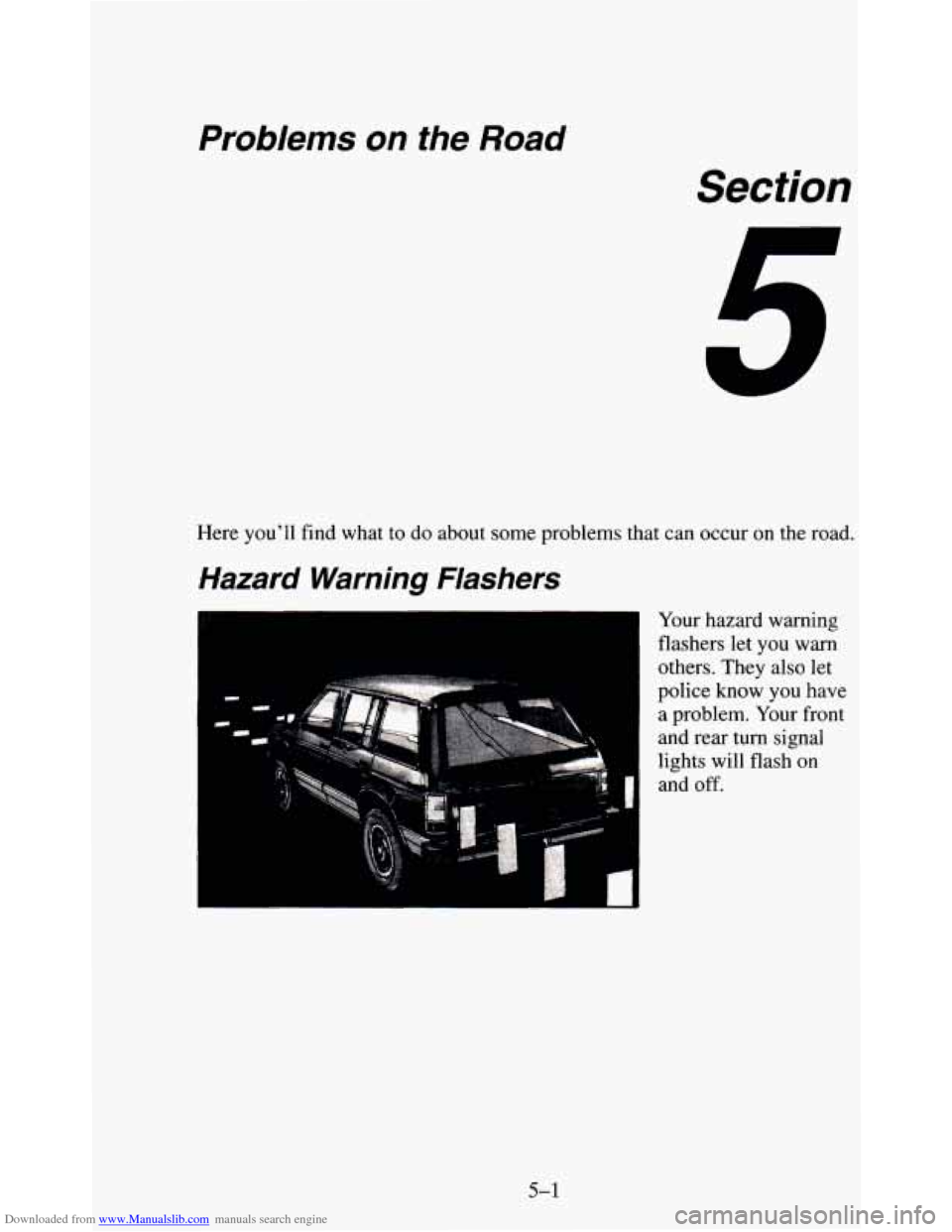
Your hazard warning
flashers let you warn
others. They also let
police know you have
a problem. Your front
and rear turn signal
lights will flash on
and
off.
5-1
Page 204 of 380
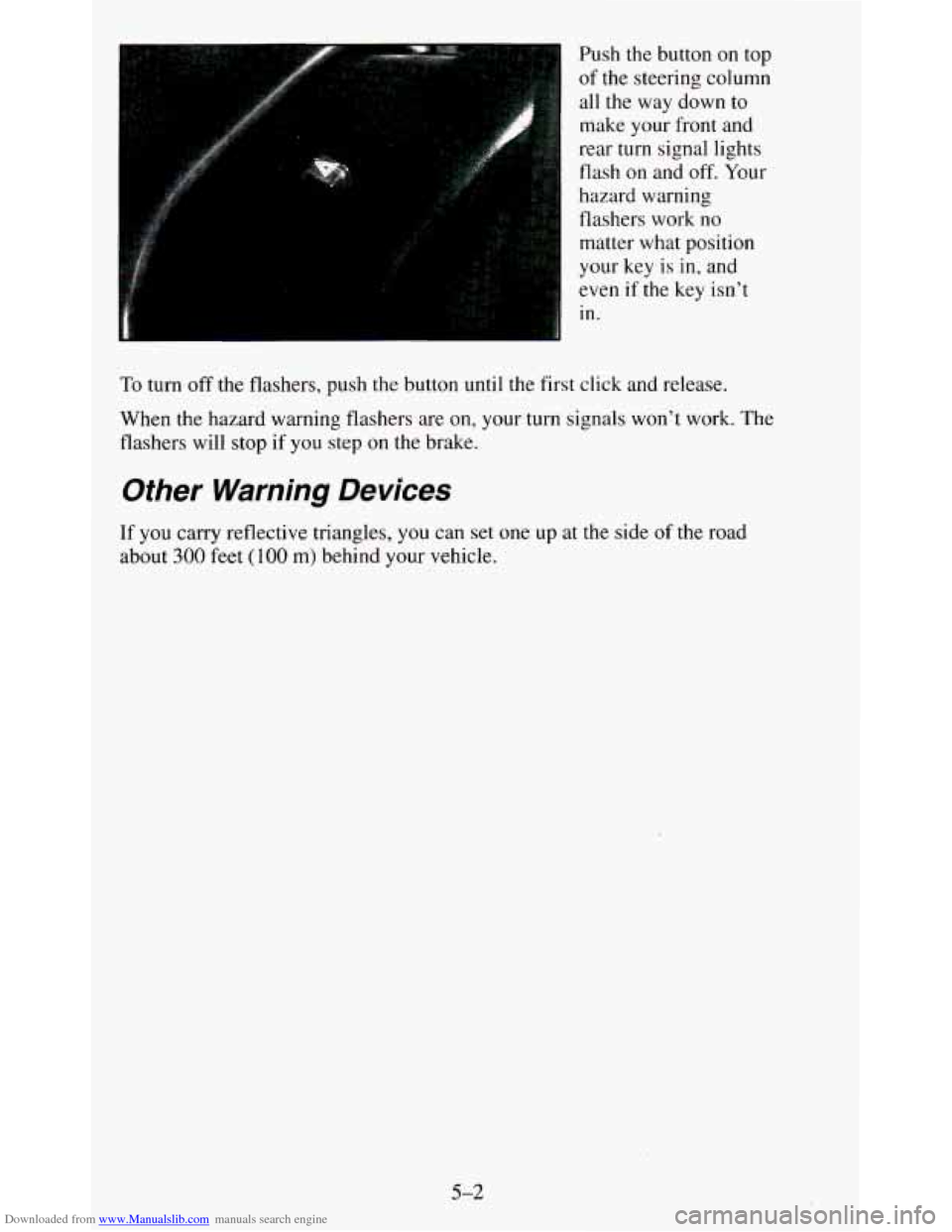
Downloaded from www.Manualslib.com manuals search engine , Push the button on top
i of the steering column
all
the way down to
make your front and
’ rear turn signal lights
flash on and off. Your
hazard warning
flashers work no matter what position
your key
is in, and
even if the key isn’t
in.
To turn off the flashers, push the button until the first click \
and release.
When the hazard warning flashers are on, your turn signals won\
’t work. The
flashers will stop if you step on the brake.
Other Warning Devices
If you carry reflective triangles, you can set one up at the side of the road
about
300 feet (100 m) behind your vehicle.
5-2
Page 209 of 380
Downloaded from www.Manualslib.com manuals search engine Towing Your Vehicle
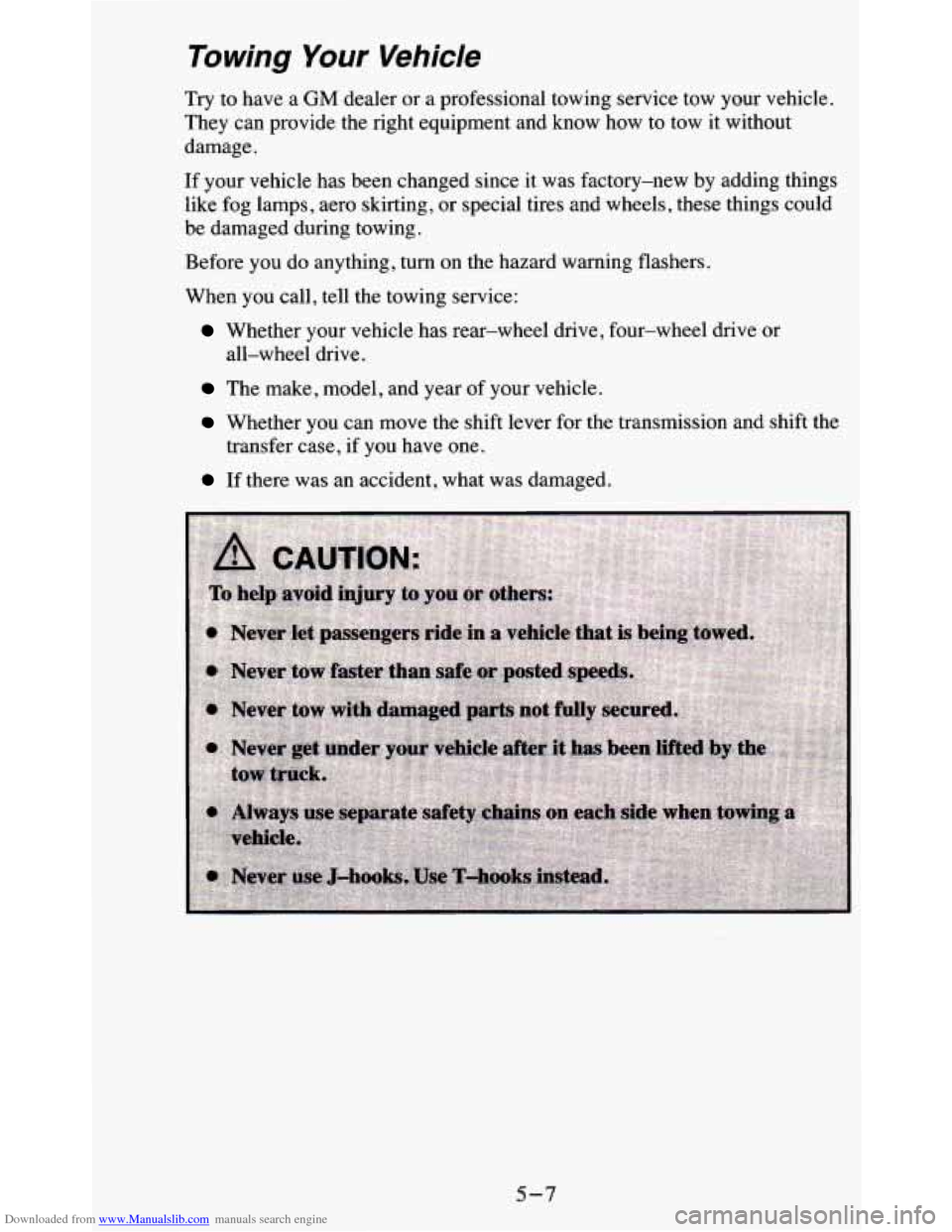
Try to have a GM dealer or a professional towing service tow your vehicle.
They can provide the right equipment and know how
to tow it without
damage.
If your vehicle has been changed since it was factory-new by adding things
like fog lamps, aero skirting, or special tires and wheels, these things could
be damaged during towing.
Before you do anything, turn on the hazard warning flashers.
When you call, tell the towing service:
Whether your vehicle has rear-wheel drive, four-wheel drive or
all-wheel drive.
The make, model, and year of your vehicle.
Whether you can move the shift lever for the transmission and shift the
transfer case,
if you have one.
If there was an accident, what was damaged.
5-7
Page 216 of 380
Downloaded from www.Manualslib.com manuals search engine If No Steam IS Coming From Your Engine
If you get the overheat warning but see or hear no steam, the problem may
not be too serious. Sometimes the engine can get a little too hot when you:
0 Climb a long hill on a hot day.
0 Stop after high speed driving.
0 Idle for long periods in traffic.
e Tow a trailer. See "Driving on Grades" in the Index.
If
YOU get the overheat warning with no sign of steam, try this for a minute
or
so:
1. Turn off your air conditioner.
2. Turn on your heater to full hot at the highest fan speed and open the
window as necessary.
3. If you're in a traffic jam, shift to NEUTRAL (N); otherwise, shift to the
highest gear while driving
- AUTOMATIC OVERDRIVE (@) or
DRIVE (D) for automatic transmissions.
If you no longer have the overheat warning, you can drive. Just \
to be safe,
drive slower for about ten minutes.
If the warning doesn't come back on,
you
can drive normally.
If the warning continues, pull over, stop, and park your vehicle \
right away.
If there's still no sign of steam, push the accelerator until the engine speed is
about twice as fast
as normal idle speed. Bring the engine speed back to
normal idle speed after two or three minutes. Now
see if the warning stops.
But then, if you still have the warning,
turn oflthe engine and get everyone
out
of the vehicle until it cools down.
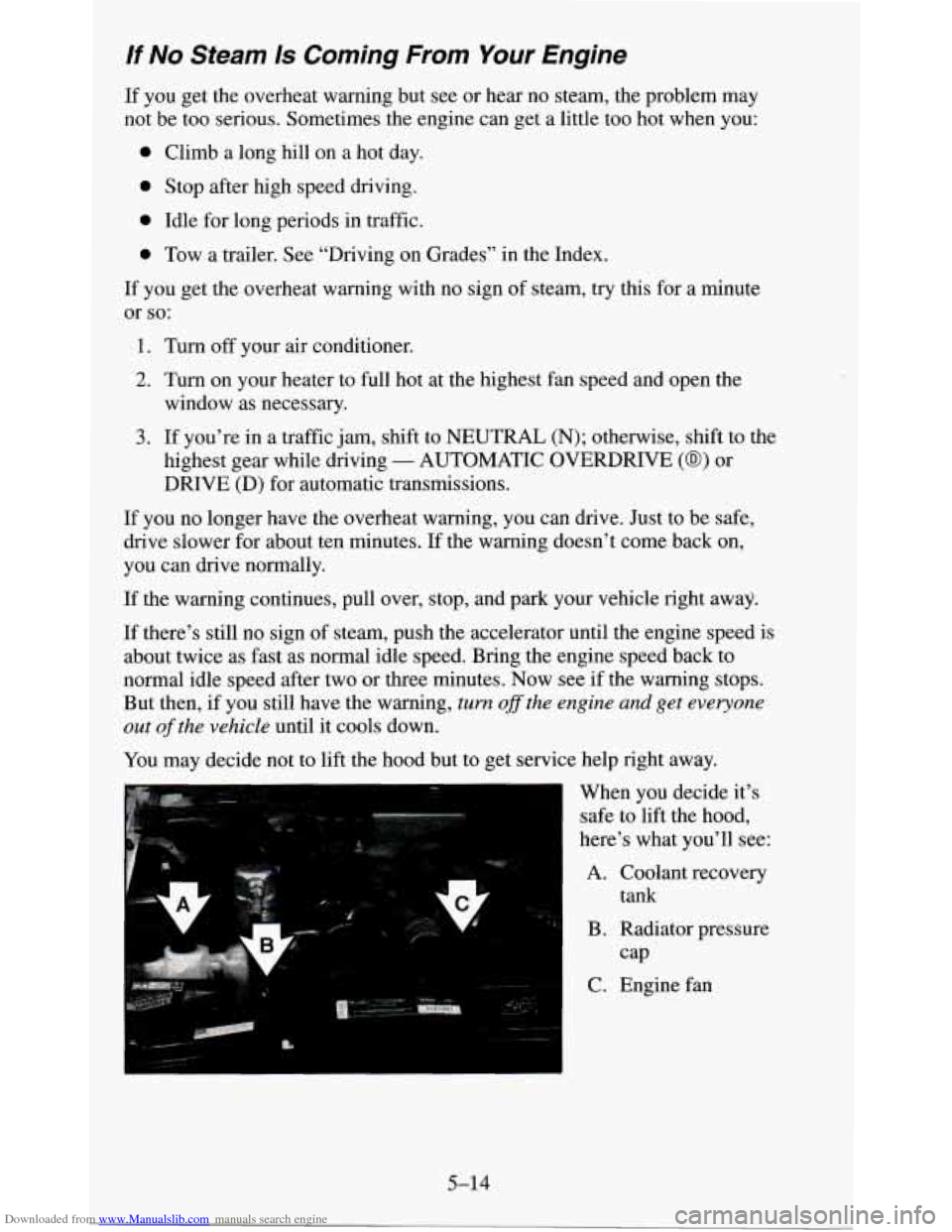
You may decide not to lift the hood but to get service help right away.
ici
5-14
When you decide it's
safe to lift the hood,
here's what you'll
see:
A. Coolant recovery
B. Radiator pressure C. Engine fan tank
cap
Page 219 of 380
Downloaded from www.Manualslib.com manuals search engine When the coolant in the coolant recovery tank is at ADD, start your vehicle.
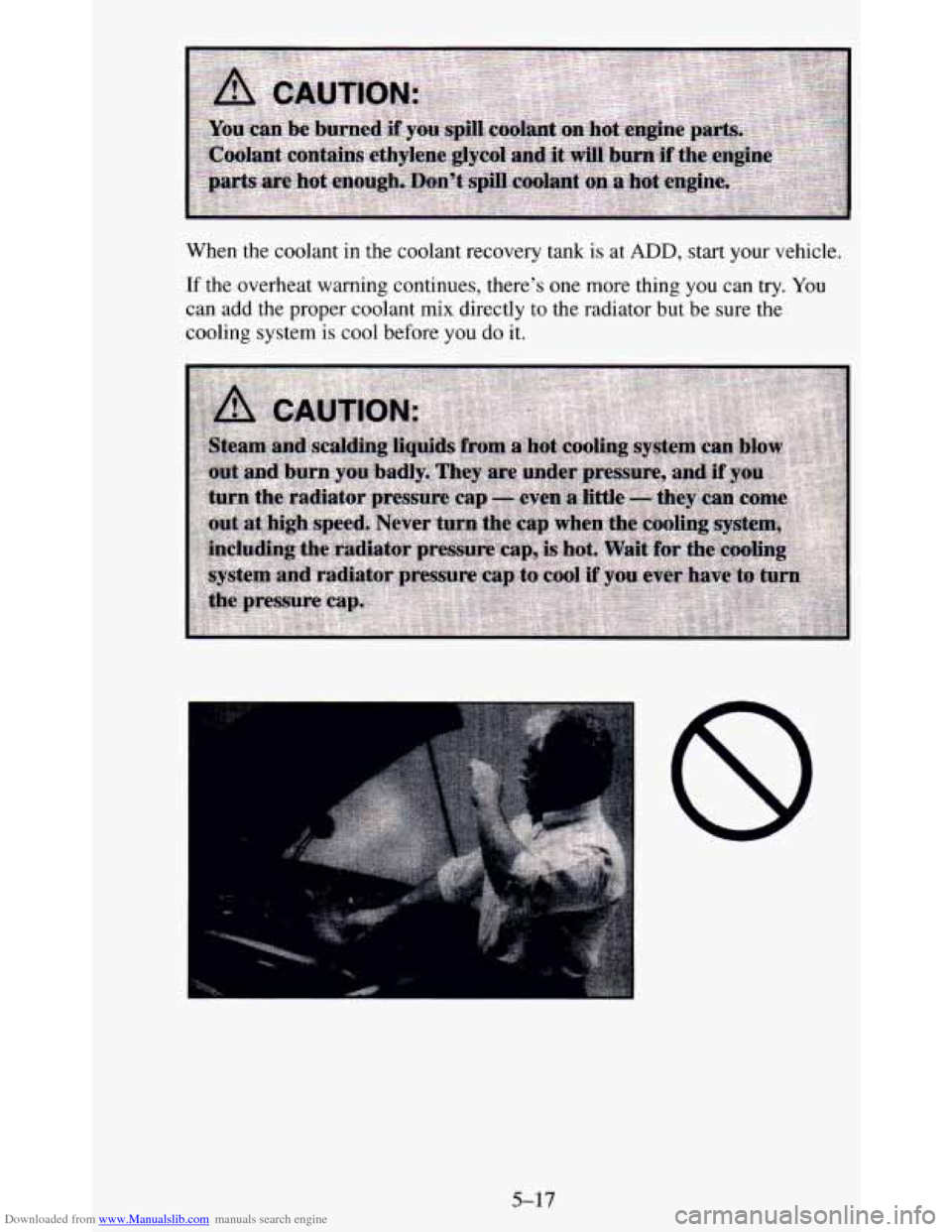
If the overheat warning continues, there’s one more thing you can try. You
can add the proper coolant mix directly to the radiator but be sure the
cooling system
is cool before you do it.
5-17
Page 223 of 380
Downloaded from www.Manualslib.com manuals search engine If a Tire Goes Flat
It’s unusual for a tire to “blow out” while you’re driving, especially if you
maintain your tires properly. If air goes out
of a tire, it’s much more likely to
leak out slowly. But
if you should ever have a “blowout,” here are a few tips
about what to expect and what
to do:
If a front tire fails, the flat tire will create a drag that pulls the vehicle
toward that side. Take your foot
off the accelerator pedal and grip the
steering wheel firmly. Steer to maintain lane position, then ge\
ntly brake to a
stop well out of the traffic lane.
A rear blowout, particularly on a curve, acts much like a skid and may
require the same correction you’d use in a skid. In any rear blowout, remove
your foot from
the accelerator pedal. Get the vehicle under control by
steering the way you want the vehicle to go. It may be very bumpy and
noisy, but you can still steer. Gently brake to a stop, well
off the road if
possible.
If a tire goes flat,
the next part shows how to use your jacking equipment to
change
a flat tire safely.
Changing a Flat Tire
If a tire goes flat, avoid further tire and wheel damage by driving slowly to a
level place.
Turn on your hazard warning flashers.
5-21
Page 253 of 380
Downloaded from www.Manualslib.com manuals search engine Four-wheel Drive Remote Oil Filter
If your vehicle has four-wheel drive, you will have a remote oil filter. There
is a special access door in the steering linkage shield assembly located under
the radiator support. Twist the screw to lock or unlock the door.
Engine Coolant Heater
An engine coolant heater can be a big help if you have to park outside in
very cold weather,
0°F (-18 “C) or colder. If your vehicle has this option,
see “Engine Coolant Heater” in
the Index.
What to Do with Used Oil
Did you know that used engine oil contains certain elements that may be
unhealthy for your skin and could even cause cancer? Don’t let used oil stay
on your skin for very long. Clean your skin and nails with soap and water,
or a good hand cleaner. Wash or properly throw away clothing or rags
containing used engine oil. (See the manufacturer’s warnings about the use
and disposal of oil products.)
Used oil can be a real threat to the environment. If you change your own oil,
be sure to drain all free-flowing oil from the filter before disposal. Don’t
ever dispose of oil by putting it in the trash, pouring
it on the ground, into
sewers, or into streams or bodies of water. Instead, recycle it by taking
it to
a place that collects used oil. If you have a problem properly disposing of
your used oil, ask your dealer, a service station or a local recycling center
for help.
Air Cleaner
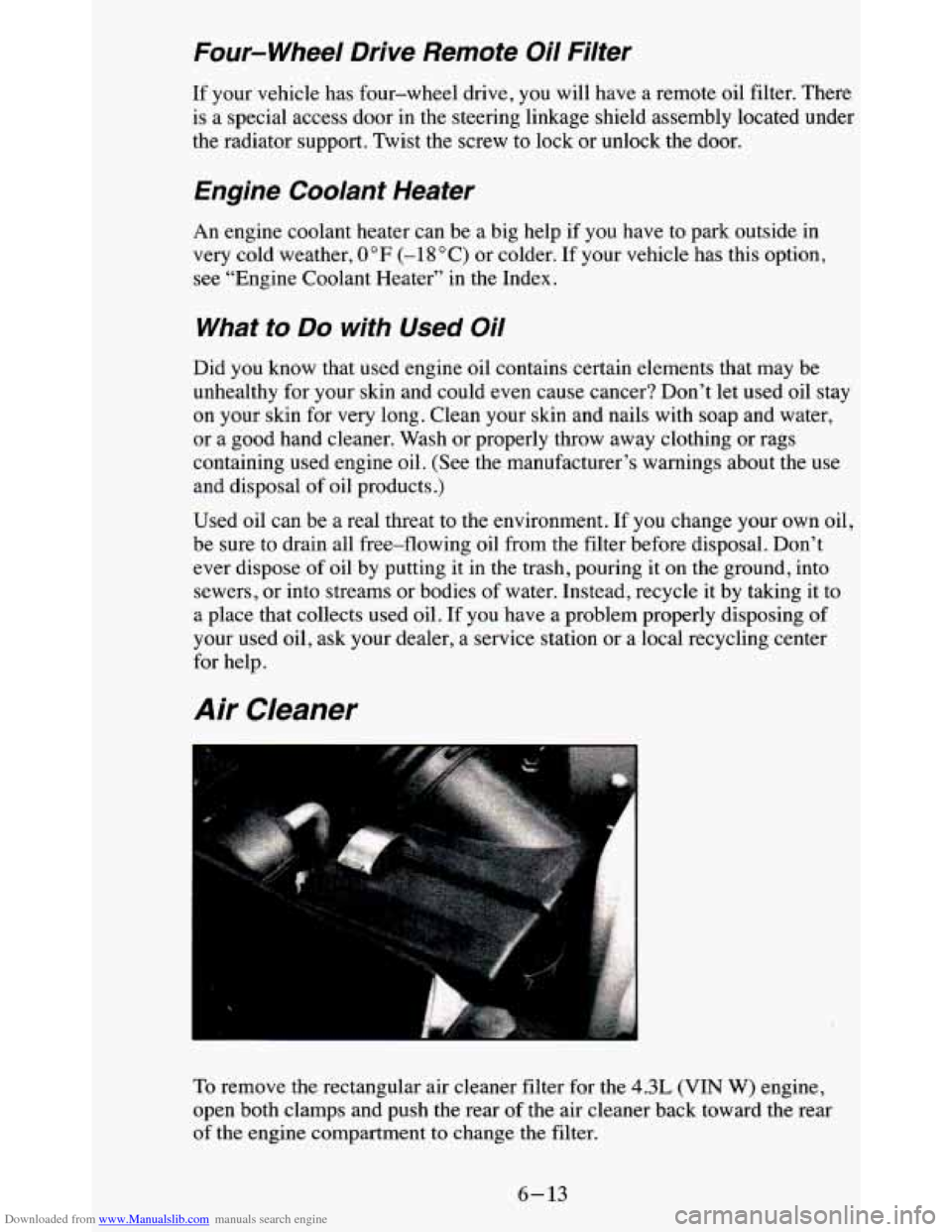
To remove the rectangular air cleaner filter for the 4.3L (VIN W) engine,
open both clamps and push the rear
of the air cleaner back toward the rear
of the engine compartment to change the filter.
6-13