1995 CHEVROLET BLAZER battery
[x] Cancel search: batteryPage 206 of 380
Downloaded from www.Manualslib.com manuals search engine You could be injured if the vehicles roll. Set the parking brake firmly
on each vehicle. Put an automatic transmission in PARK (P) or a
manual transmission in NEUTRAL
(N). If you have a
four-wheel-drive vehicle with a manual transfer case shift lever, be
sure the transfer case
is not in NEUTRAL (N).
3. Turn off the ignition on both vehicles. Turn off all lights that aren’t
needed, and radios. This will avoid sparks and help save both batteries
And it could save your radio!
NOTICE:
If you leave your radio on, it could be badly damaged. The
repair wouldn’t be covered by your warranty.
~~
4. Open both hoods and locate the batteries. Find the positive (+) and
negative
(-) terminals on each battery.
5. Check that the jumper cables don’t have loose or missing insulation. If
they do, you could get a shock. The vehicles could be damaged too.
Before you connect the cables, here are some basic things you should
know. Positive (+) will go to positive (+) and negative (-) will go to
negative
(-) or a metal engine part. Don’t connect (+) to (-) or you’ll
get a
short that would damage the battery and maybe other parts too.
5-4
Page 207 of 380
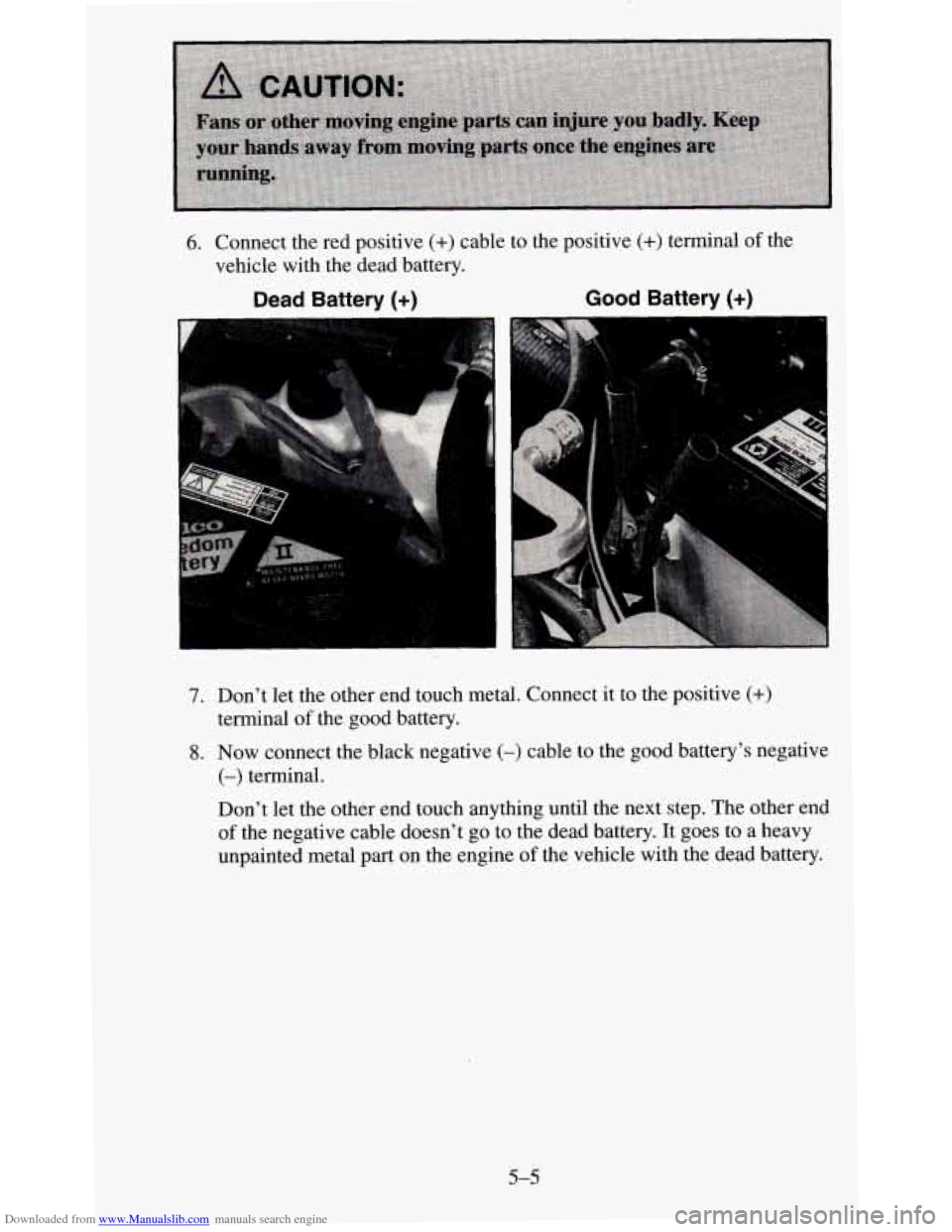
Downloaded from www.Manualslib.com manuals search engine 6. Connect the red positive (+) cable to the positive (+) terminal of the
vehicle with the dead battery.
Dead Battery (+) Good Battery (+)
7. Don’t let the other end touch metal. Connect it to the \
positive (+)
8. Now connect the black negative (-) cable to the good battery’s negative
terminal
of the
good battery.
(-) terminal.
Don’t let the other end touch anything until the next step. The other end
of the negative cable doesn’t go to the dead battery. It goes to a heavy
unpainted metal
art on the engine of the vehicle with the dead battery.
5-5
Page 208 of 380
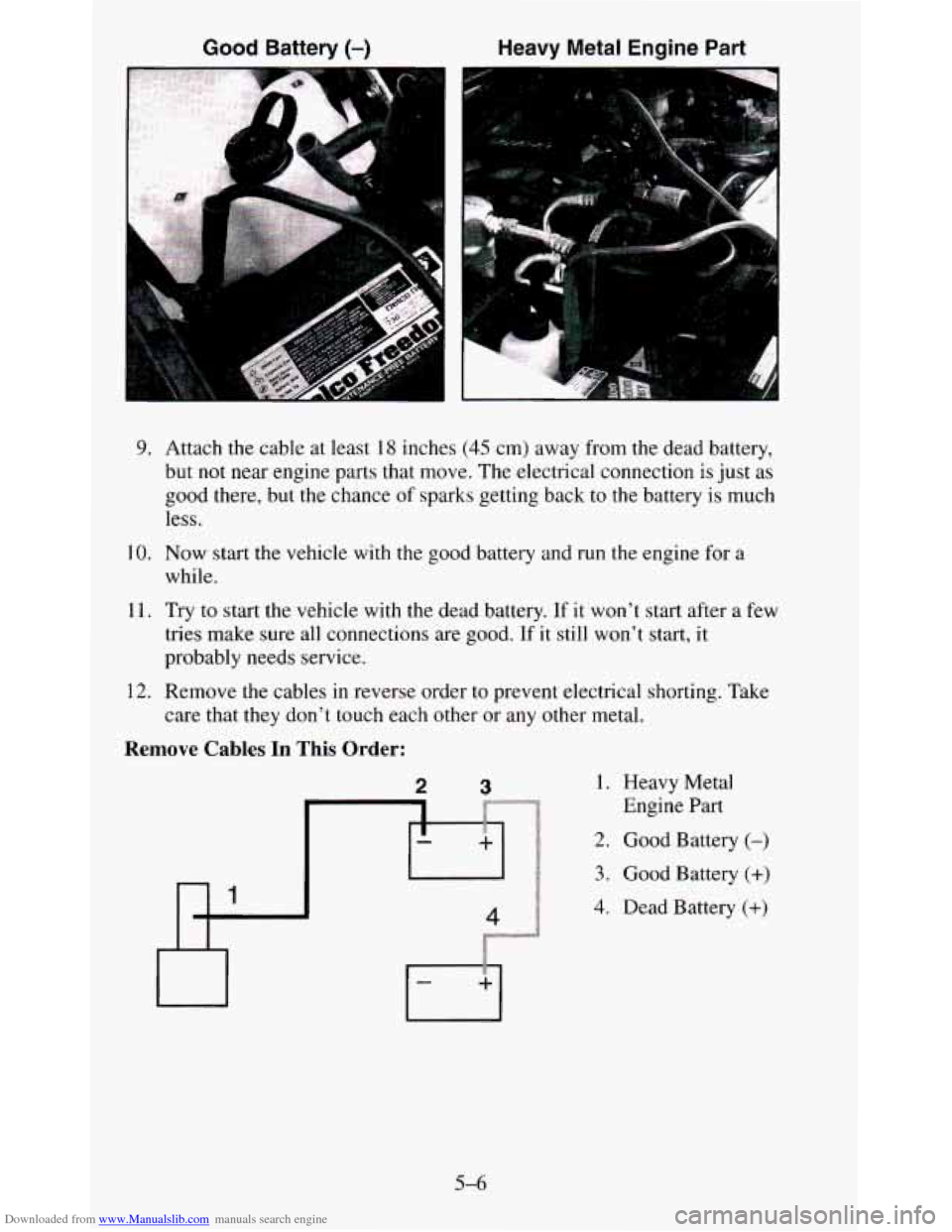
Downloaded from www.Manualslib.com manuals search engine Good Battery (-) Heavy Metal Engine Part
9. Attach the cable at least 18 inches (45 cm) away from the dead battery,
but
not near engine parts that move. The electrical connection is just as
good there, but the chance of sparks getting back to the batt\
ery
is much
less.
10. Now start the vehicle with the good battery and run the engin\
e for a
11. Try to start the vehicle with the dead battery. If it won’t start after a few
while.
tries make sure all connections are good.
If it still won’t start, it
probably needs service.
12. Remove the cables in reverse order to prevent electrical shorti\
ng. Take
care that they don’t touch each other or any other metal.
Remove Cables In This Order:
3 2
2 1. Heavy Metal
Engine Part
2. Good Battery (-)
3. Good Battery (+)
4. Dead Battery (+)
5-6
Page 270 of 380
Downloaded from www.Manualslib.com manuals search engine Replacing Brake System Parts
The braking system on a modern vehicle is complex. Its many parts have to
be
of top quality and work well together if the vehicle is to have really good
braking. Vehicles we design and test have top-quality
GM brake parts in
them, as your vehicle does when it is new. When you replace parts of your
braking system
- for example, when your brake linings wear down and
you have to have new ones put in
- be sure you get new genuine GM
replacement parts. If you don’t, your brakes may no longer work properly.
For example, if someone puts in brake linings that are wrong for your
vehicle, the balance between your front and rear brakes can change
- for
the worse. The braking performance you’ve come to expect can change in
many other ways if someone puts in the wrong replacement brake\
parts.
Battery
Every new vehicle has a Delco Freedom@ battery. You never have to add
water to one of these. When it’s time for a new battery, we recommend a
Delco Freedom@ battery. Get one that has the replacement number shown
on
the original battery’s label.
Vehicle Storage
If you’re not going to drive your vehicle for 25 days or more, take off the
black, negative
(-) cable from the battery. This will help keep your battery
from running down.
Contact your dealer to learn how to prepare your vehicle for longer storage
periods.
6-30
Page 301 of 380
Downloaded from www.Manualslib.com manuals search engine Headlamps
The headlamp wiring is protected by a circuit breaker in the light switch. An
electrical overload will cause the lights to go on and off, or in some cases to
remain
off. If this happens, have your headlamp wiring checked right away.
Windshield Wipers
The windshield wiper motor is protected by a circuit breaker and a fuse. If
the motor overheats due to heavy snow, etc., the wiper will stop until the
motor cools. If the overload is caused by some electrical problem and not
snow, etc., be sure to get it fixed.
Power Windows and Other Power Options
Circuit breakers in the fuse panel protect the power windows and other
power accessories. When the current load is too heavy, the cir\
cuit breaker
opens and closes, protecting the circuit until the problem is fixed.
Trailer Wiring Harness
The optional seven-wire trailer wiring harness is protected by an in-line
fuse in the battery feed wire. This fuse is near the junction block in the
front, driver’s side fender. See “Trailer Wiring Harness” in the
Features &
Controls section.
Fuse B/ock
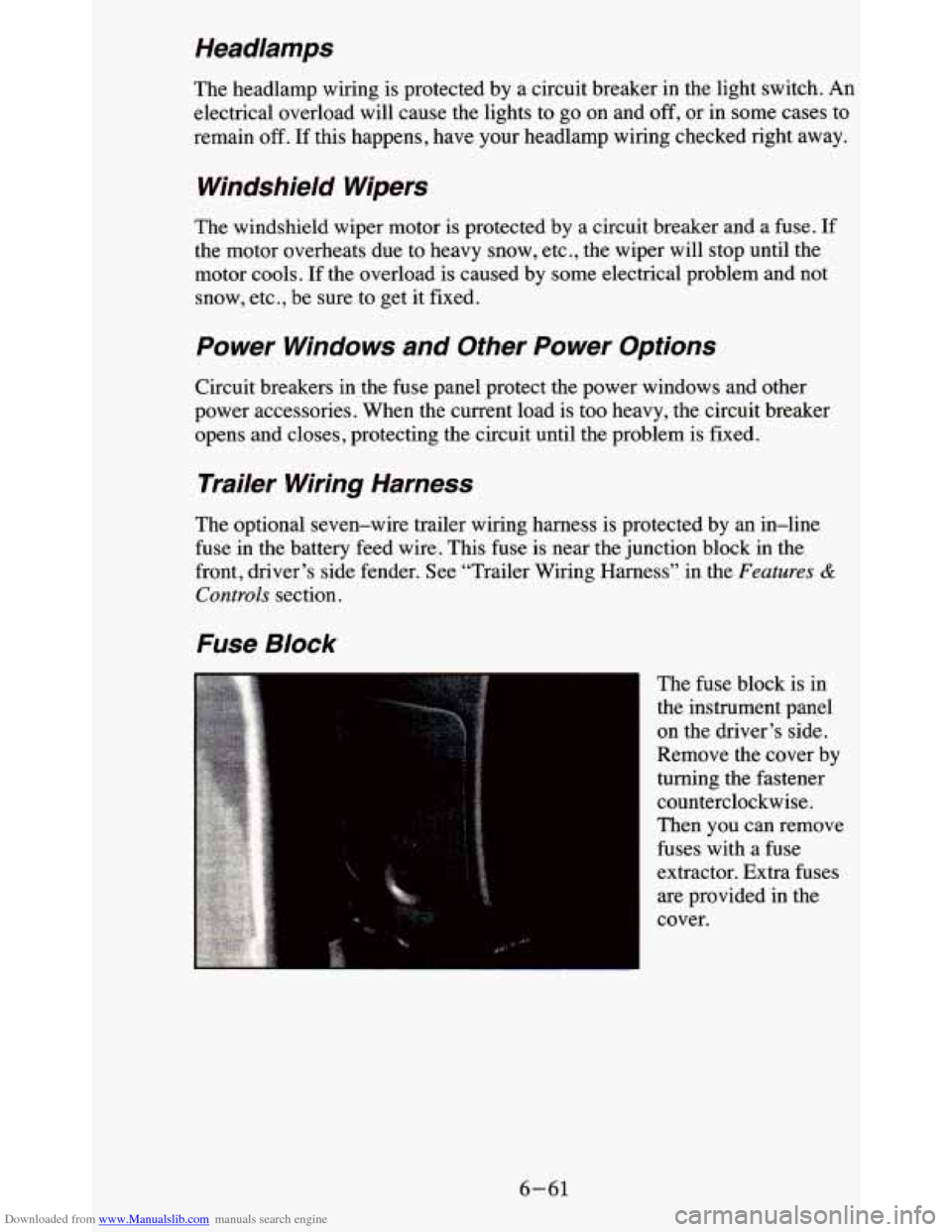
The fuse block is in
the instrument panel
on the driver’s side.
Remove the cover by
turning the fastener
counterclockwise.
Then you can remove
fuses with a fuse
extractor. Extra fuses
are provided in the
cover.
6-61
Page 308 of 380
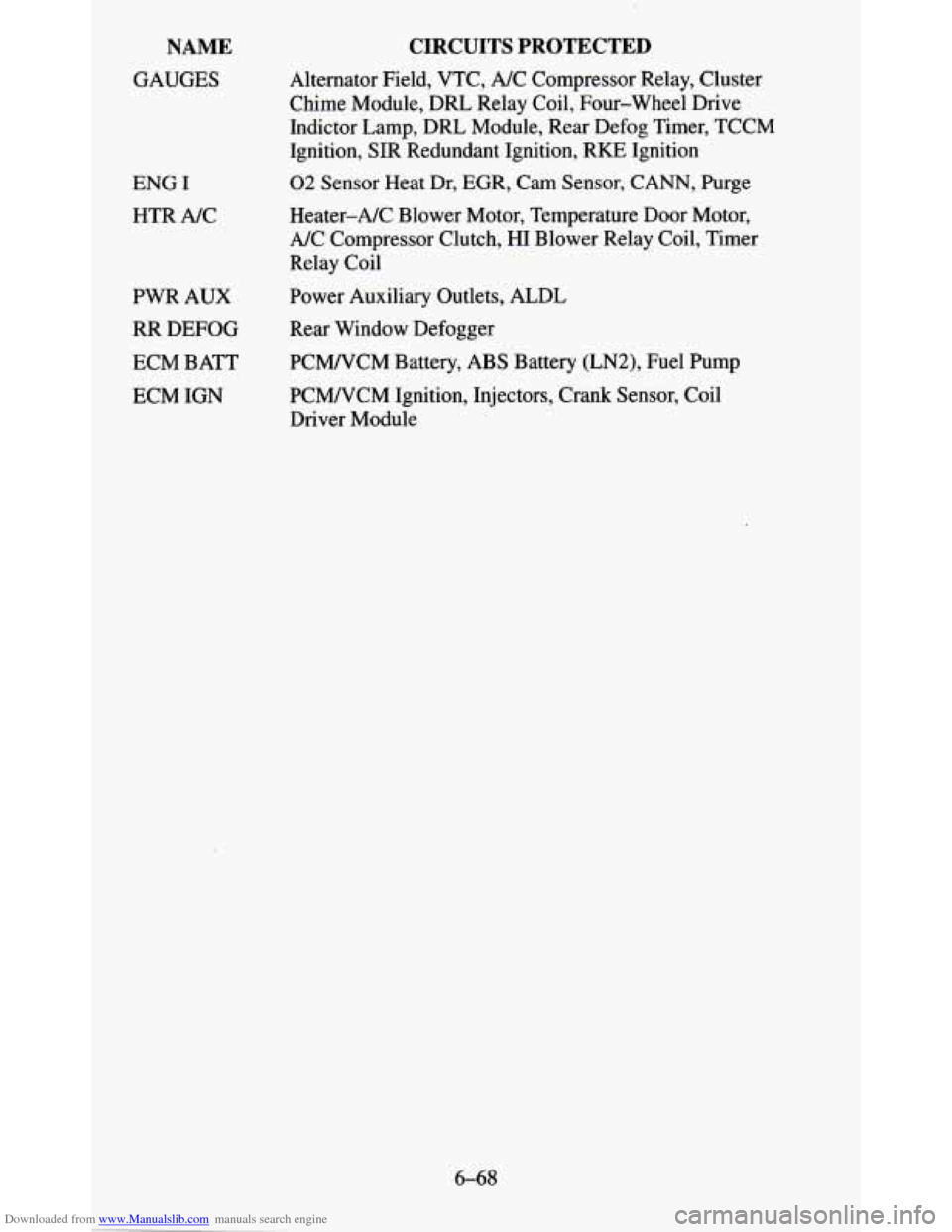
Downloaded from www.Manualslib.com manuals search engine NAME
GAUGES
ENG I HTR NC
PWR AUX
RR DEFOG
ECM BATT
ECM IGN
CIRCUITS PROTECTED
Alternator Field, VTC, A/C Compressor Relay, Cluster
Chime Module, DRL Relay Coil, Four-wheel Drive
Indictor Lamp, DRL Module, Rear Defog Timer, TCCM
Ignition,
SIR Redundant Ignition, RKE Ignition
02 Sensor Heat Dr, EGR, Cam Sensor, CANN, Purge
Heater-A/C Blower Motor, Temperature Door Motor,
A/C Compressor Clutch, HI Blower Relay Coil, Timer
Relay Coil
Power Auxiliary Outlets, ALDL
Rear Window Defogger
PCMNCM Battery, ABS Battery (LN2), Fuel Pump
PCMNCM Ignition, Injectors, Crank Sensor, Coil
Driver Module
6-68
Page 309 of 380
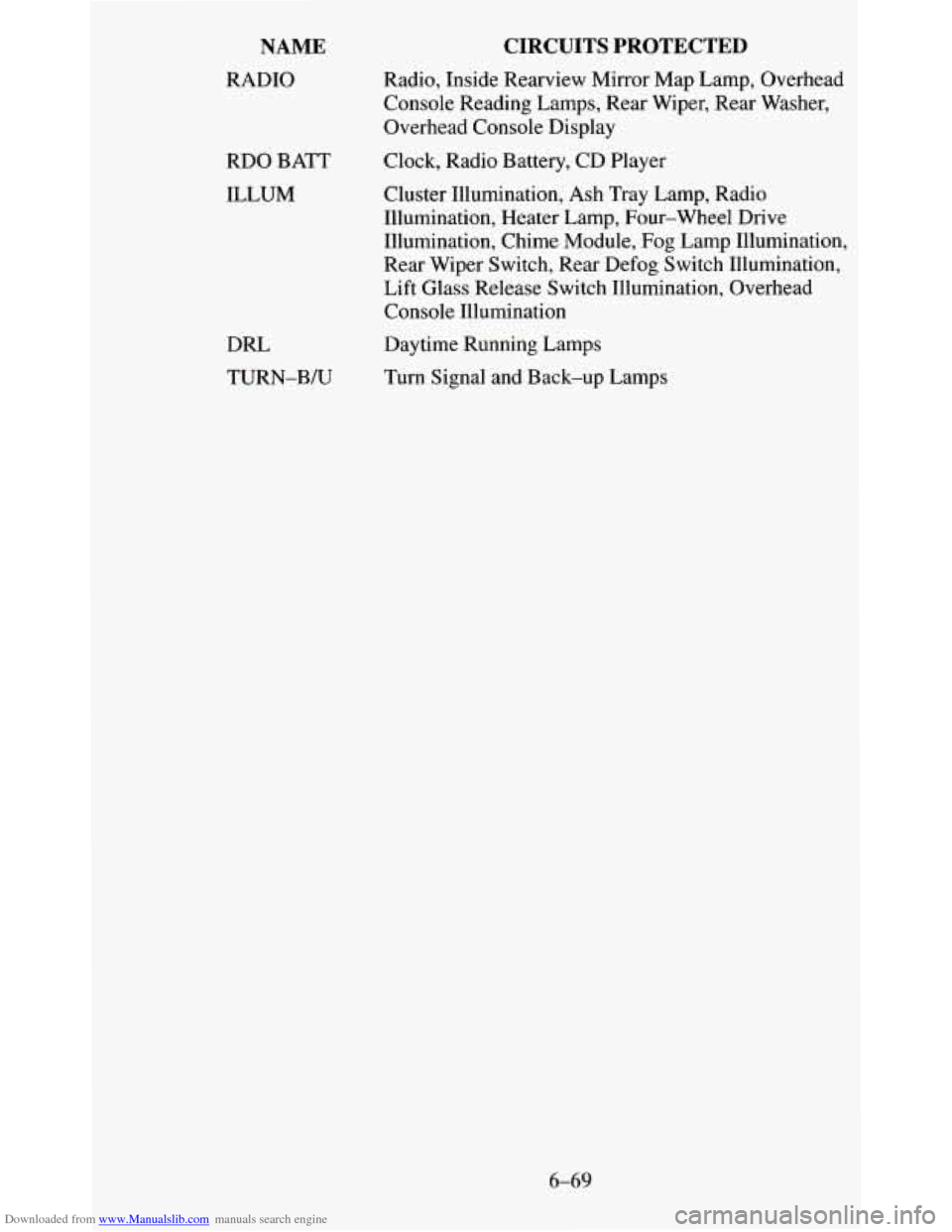
Downloaded from www.Manualslib.com manuals search engine NAME
RADIO RDO BATT
ILLUM
DRL
TURN-B/U
CIRCUITS PROTECTED
Radio, Inside Rearview Mirror Map Lamp, Overhead
Console Reading Lamps, Rear Wiper, Rear Washer,
Overhead Console Display Clock, Radio Battery, CD Player
Cluster Illumination,
Ash Tray Lamp, Radio
Illumination, Heater Lamp, Four-wheel Drive
Illumination, Chime Module, Fog Lamp Illumination, Rear Wiper Switch, Rear Defog Switch Illumination,
Lift Glass Release Switch Illumination, Overhead Console Illumination
Daytime Running Lamps
Turn Signal and Back-up Lamps
6-69
Page 369 of 380
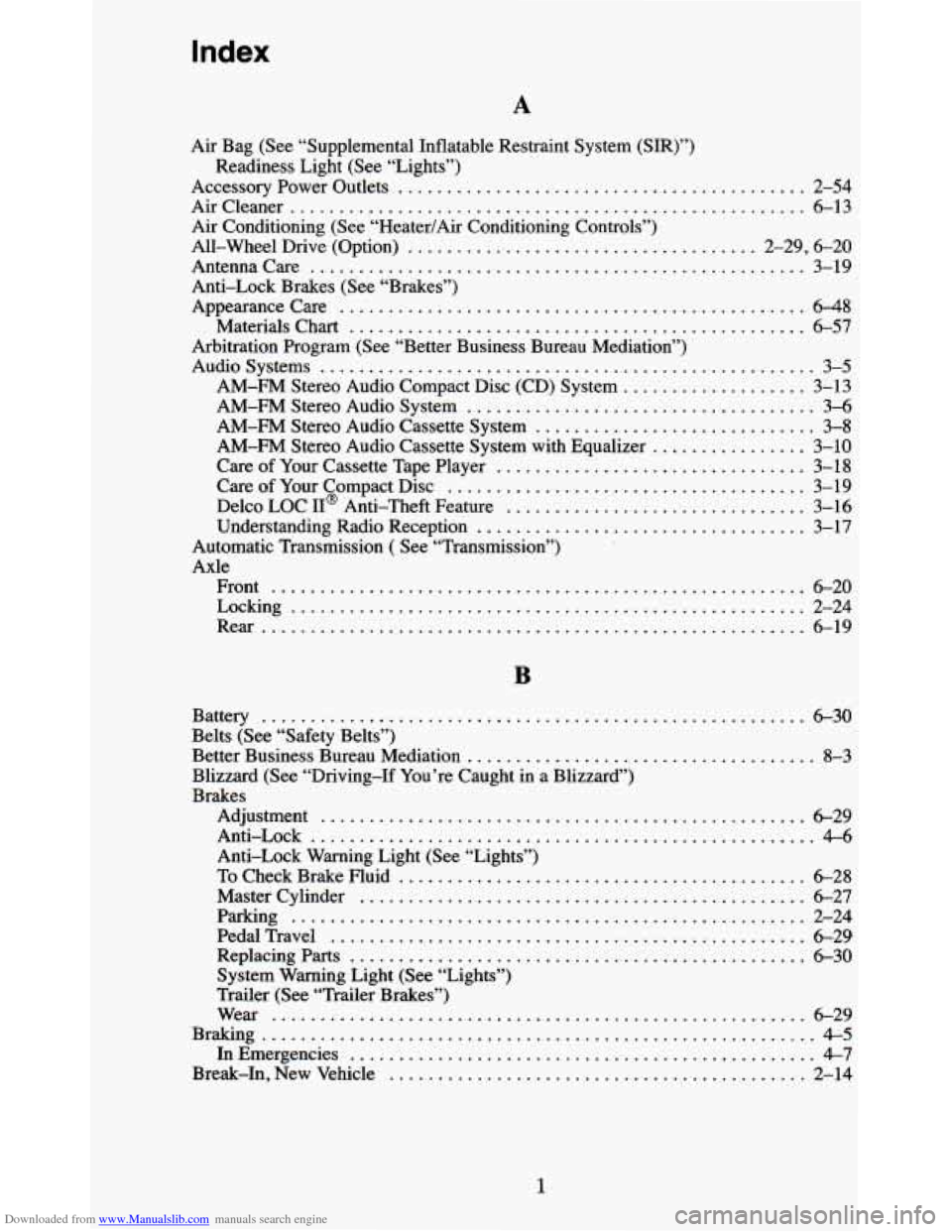
Downloaded from www.Manualslib.com manuals search engine Index
A
Air Bag (See “Supplemental Inflatable Restraint System (SIR)”)
Readiness Light (See “Lights”)
Accessory Power Outlets
.......................................... 2-54
Aircleaner ..................................................... 6-13
Air Conditioning (See “Heater/Air Conditioning Controls”)
All-Wheel Drive (Option)
.................................... 2-29. 6-20
Antennacare ................................................... 3-19
Anti-Lock Brakes (See “Brakes”)
Appearancecare
................................................ 6-48
Materials Chart ............................................... 6-57
Arbitration Program (See “Better Business Bureau Mediation”)
Audiosystems
................................................... 3-5
AM-FM Stereo Audio Compact Disc (CD) System ................... 3-13
AM-FM Stereo Audio System .................................... 3-6
AM-FM Stereo Audio Cassette System ............................. 3-8
Care of Your Cassette Tape Player ................................ 3-18
Care of Your Compact Disc ..................................... 3-19
Delco LOC II@ Anti-Theft Feature ............................... 3-16
AM-FM Stereo Audio Cassette System with Equalizer ................ 3-10
Understanding Radio Reception .................................. 3-17
Automatic Transmission ( See “Transmission”)
Axle
Front
....................................................... 6-20
Locking ..................................................... 2-24
Rear ........................................................ 6-19
Battery ........................................................ 6-30
Belts (See “Safety Belts”)
Better Business Bureau Mediation
.................................... 8-3
Blizzard (See “Driving-If You’re Caught in a Blizzard”)
Brakes Adjustment
.................................................. 6-29
Anti-Lock .................................................... 4-6
Anti-Lock Warning Light (See “Lights”)
To Check Brake Fluid .......................................... 6-28
Master Cylinder .............................................. 6-27
Parking ..................................................... 2-24
PedalTravel ................................................. 6-29
Replacing Parts ............................................... 6-30
System Warning Light (See “Lights”)
Trailer (See “Trailer Brakes”)
Wear
....................................................... 6-29
Braking ......................................................... 4-5
InEmergencies ................................................ 4-7
Break-In. New Vehicle ............................................ 2-14
1