Page 257 of 380
Downloaded from www.Manualslib.com manuals search engine How to Add Fluid
Refer to the Maintenance Schedule to determine what kind of transmission
fluid to use. See “Recommended Fluids and Lubricants” in the Index.
Add fluid only after checking the transmission fluid
HOT. (A COLD check
is used only
as a reference.) If the fluid level is low, add only enough of the
proper fluid to bring the level up to the
HOT area for a hot check. It doesn’t
take much fluid, generally less than a int.
Don ’t overfill. We recommend
you use only fluid labeled DEXRON -111, because fluid with that label is
made especially for your automatic transmission. Damage caused by fluid
other than DEXRON@-I11 is not covered by your new vehicle warranty. 8
After adding fluid, recheck the fluid level as described under “How to
Check.”
0 When the correct fluid level is obtained, push the dipstick back in all
the way; then flip the handle down to lock the dipstick in place.
Manual Transmission Fluid
When to Check
A good time to have it checked is when the engine oil is changed. However,
the fluid in your manual transmission doesn’t require changin\
g.
How to Check
Because this operation can be a little difficult, you may choose to have this
done at your GM dealership Service Department.
If you do it yourself, be sure
to follow all the instructions here, or you could
get a false reading.
I NOTICE:
Too much or too little fluid can damage your transmission. Too
much can mean that some of the fluid could come out and fall on
hot engine parts or exhaust system parts, starting
a fire. Be sure
to get an accurate reading if you check your transmission fluid.
Check the fluid level only when your engine is off, the vehicle is parked on
a level place and the transmission is cool enough for you to rest your fingers
on the transmission case.
6-17
Page 258 of 380
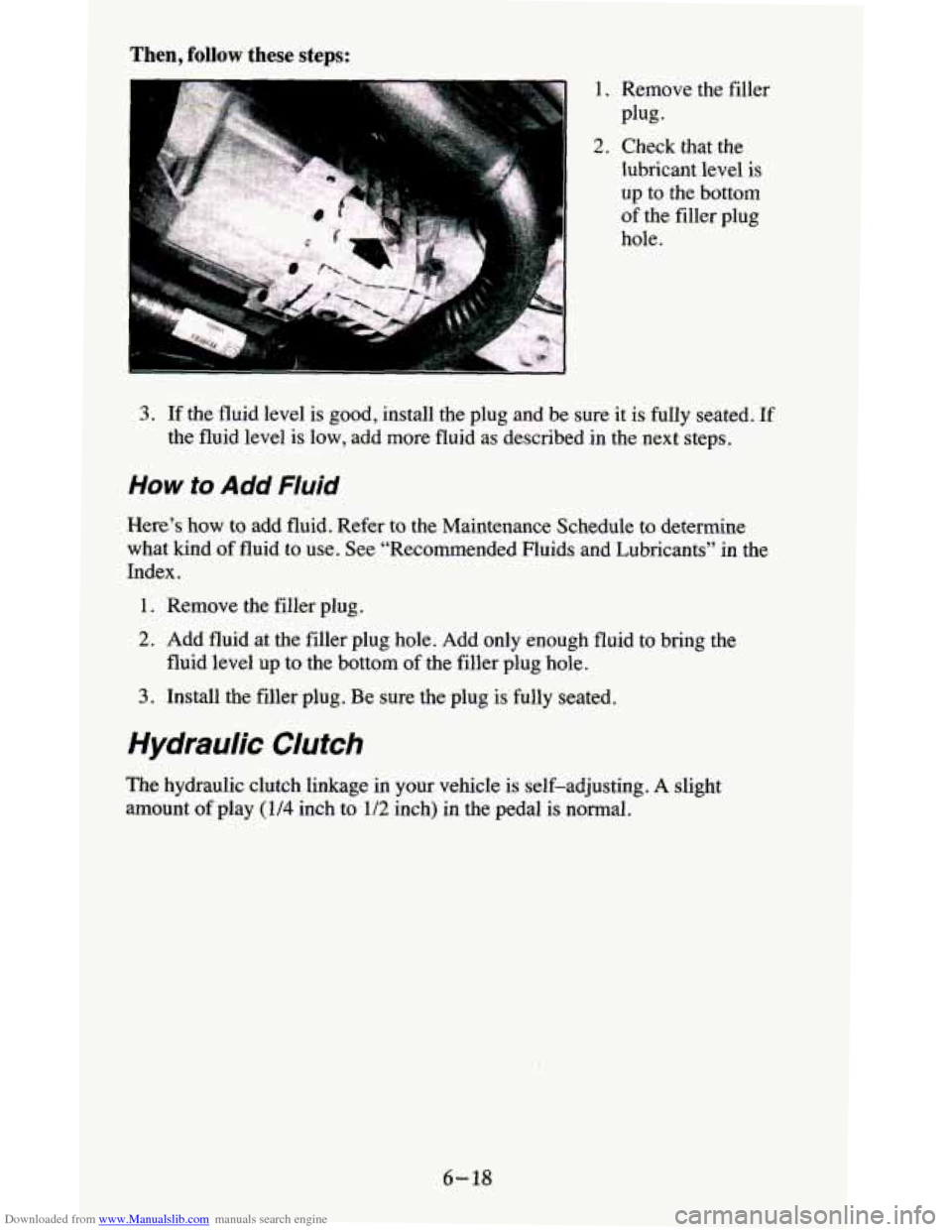
Downloaded from www.Manualslib.com manuals search engine Then, follow these steps:
1.
2.
Remove the filler
Plug-
Check that the
lubricant level is
up to the bottom
of the filler plug
hole.
3. If the fluid level is good, install the plug and be sure it is fully seated. If
the fluid level is low, add more fluid as described in the next steps.
How to Add Fluid
Here’s how to add fluid. Refer to the Maintenance Schedule to determine
what kind
of fluid to use. See “Recommended Fluids and Lubricants’’ in the
Index.
1. Remove the filler plug.
2. Add fluid at the filler plug hole. Add only enough fluid to bring the
fluid level up to the bottom
of the filler plug hole.
3. Install the filler plug. Be sure the plug is fully seated.
Hydraulic Clutch
The hydraulic clutch linkage in your vehicle is self-adjusting. A slight
amount
of play (1/4 inch to 1/2 inch) in the pedal is normal.
6-18
Page 259 of 380
Downloaded from www.Manualslib.com manuals search engine When to Checkand What to Use
P
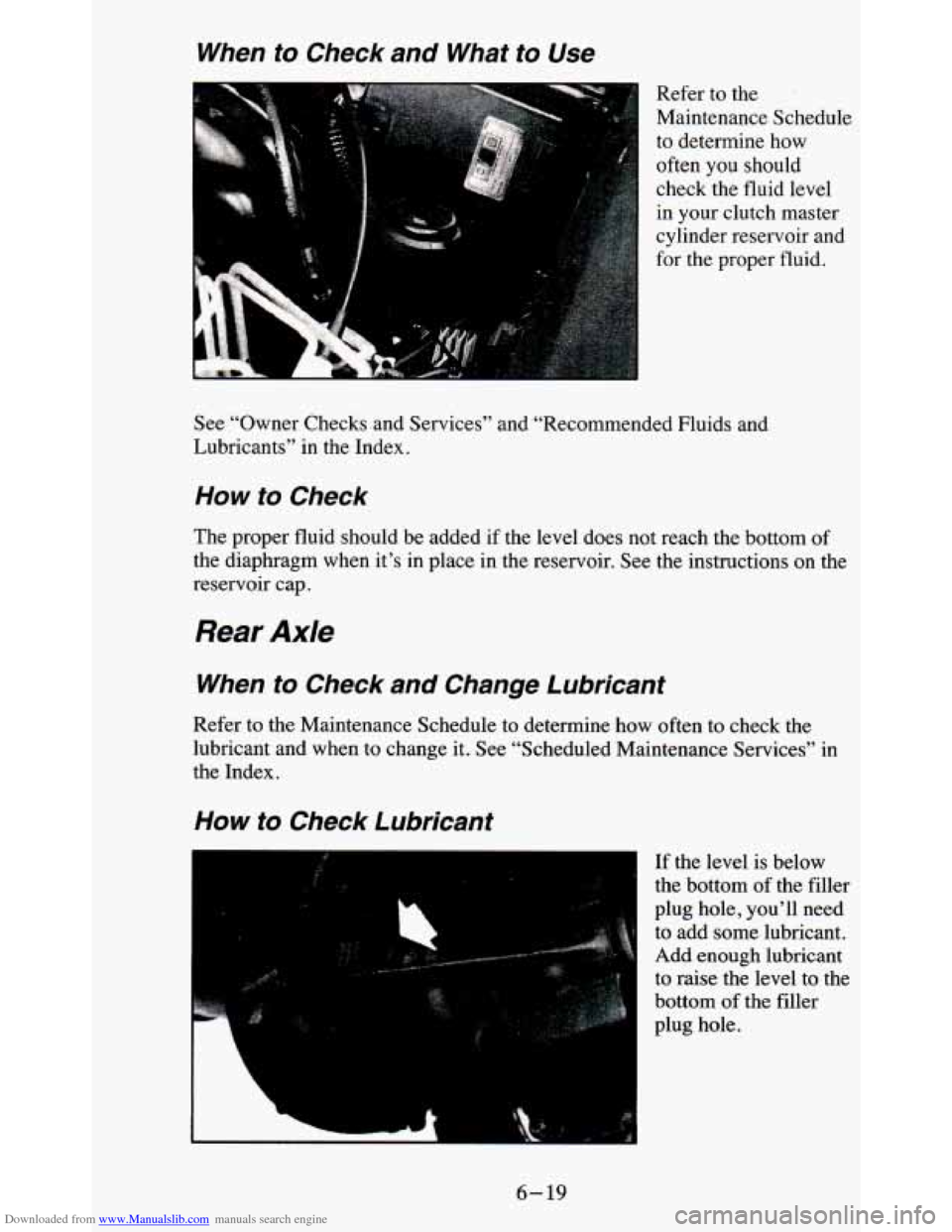
Refer to the
Maintenance Schedule
to determine how
often you should
check the fluid level
in your clutch master
cylinder reservoir and
for the proper fluid.
See “Owner Checks and Services” and “Recommended Fluids and
Lubricants” in the Index.
How to Check
The proper fluid should be added if the level does not reach the bottom of
the diaphragm when it’s in place in the reservoir. See the instructions on the
reservoir cap.
Rear Axle
When to Check and Change Lubricant
Refer to the Maintenance Schedule to determine how often to check the
lubricant and when to change it. See “Scheduled Maintenance Services” in
the Index.
How to Check Lubricant
If the level is below
the bottom of the filler
plug hole, you’ll need
to add some lubricant.
Add enough lubricant
to raise the level to the
bottom of
the filler
plug hole.
6- 19
Page 260 of 380
Downloaded from www.Manualslib.com manuals search engine What to Use
Refer to the Maintenance Schedule to determine what kind of lubricant to
use. See “Recommended Fluids and Lubricants” in the Index.
Four- Wheel and All- Wheel Drive
Most lubricant checks in this section also apply to four-wheel-drive and
all-wheel-drive vehicles. However, they have two additional syste\
ms that
need lubrication.
Transfer Case
When io Check Lubricani
Refer to the Maintenance Schedule to determine how often to check the
lubricant. See “Periodic Maintenance Inspections”
in the Index.
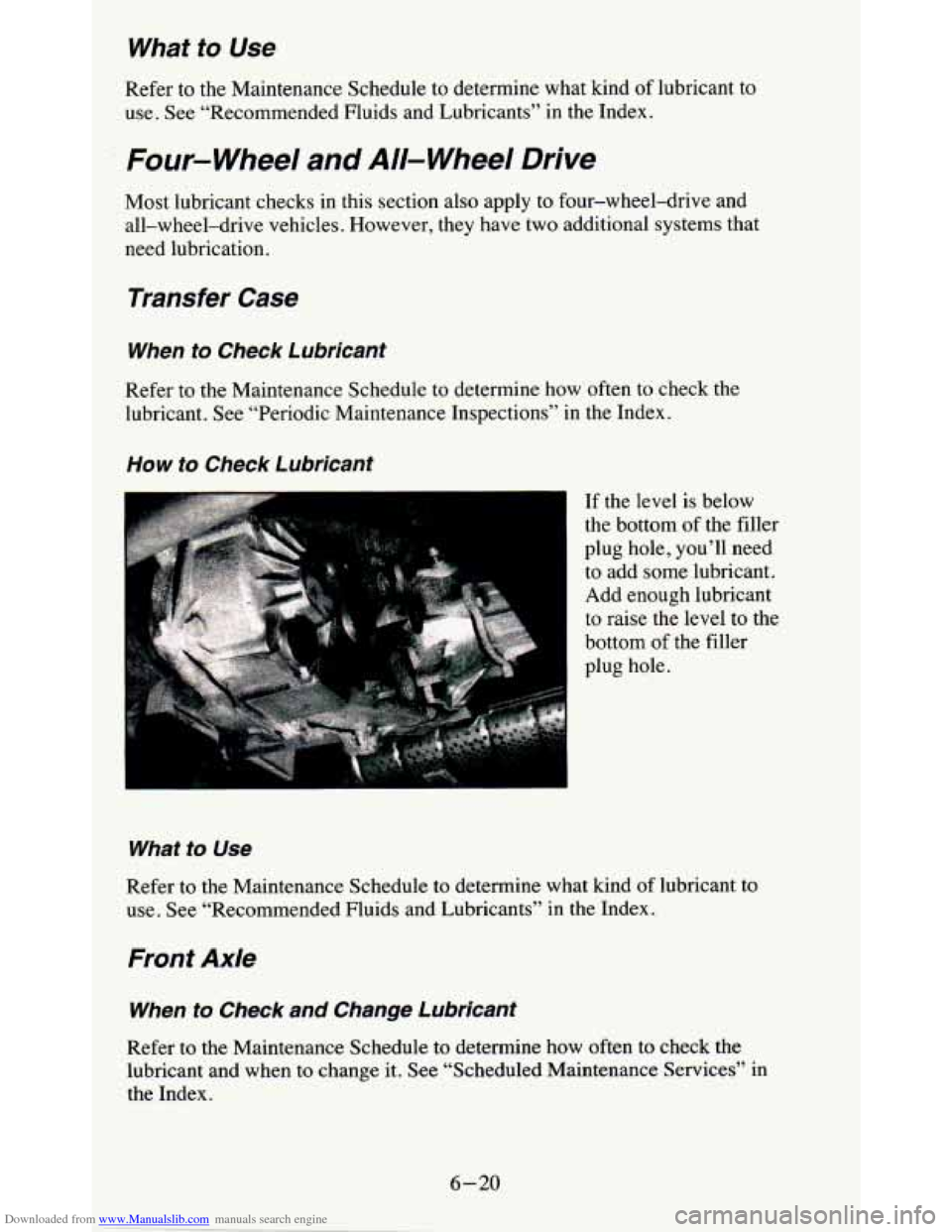
How to Check Lubricani
I If the level is below
the bottom
of the filler
plug hole, you’ll need to add some lubricant.
Add enough lubricant
to raise the level to the
bottom
of the filler
plug hole.
What to Use
Refer to the Maintenance Schedule to determine what kind of lubricant to
use. See “Recommended Fluids and Lubricants” in the Index.
Front Axle
When to Check and Change Lubricant
Refer to the Maintenance Schedule to determine how often to check the
lubricant and when to change it. See “Scheduled Maintenance Services” in
the Index.
6-20
Page 261 of 380
Downloaded from www.Manualslib.com manuals search engine How to Check Lubricant
,:
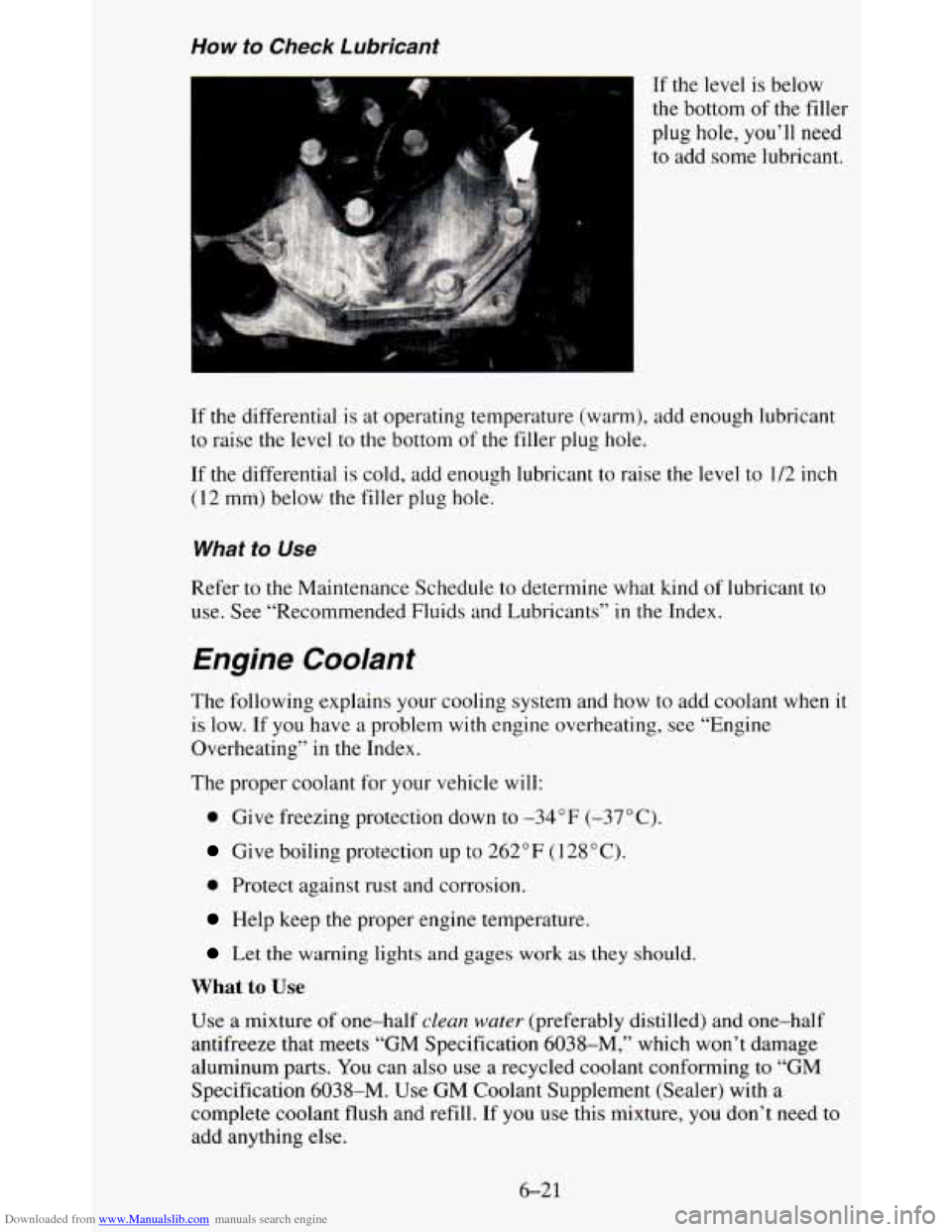
If the level is below
the bottom
of the filler
plug hole, you’ll need
to add some lubricant.
If the differential
is at operating temperature (warm), add enough lubricant
to raise the level to the bottom of the filler plug hole.
If the differential is cold, add enough lubricant to raise the le\
vel to 1/2 inch
(12 mm) below the filler plug hole.
What to Use
Refer to the Maintenance Schedule to determine what kind of lubricant to
use. See “Recommended Fluids and Lubricants”
in the Index.
Engine Coolant
The following explains your cooling system and how to add coolant \
when it
is low. If you have a problem with engine overheating, see “Engine
Overheating”
in the Index.
The proper coolant
for your vehicle will:
0 Give freezing protection down to -34°F (-37°C).
Give boiling protection up to 262°F (128°C).
0 Protect against rust and corrosion.
Help keep the proper engine temperature.
Let the warning lights and gages work as they should.
What to Use
Use a mixture of one-half clean water (preferably distilled) and one-half
antifreeze that meets “GM Specification 6038-M,” which won’t damage
aluminum parts.
You can also use a recycled coolant conforming to “GM
Specification 6038-M.
Use GM Coolant Supplement (Sealer) with a
complete coolant flush and refill. If
you use this mixture, you don’t need to
add anything else.
6-21
Page 265 of 380
Downloaded from www.Manualslib.com manuals search engine Power Steering Fluid
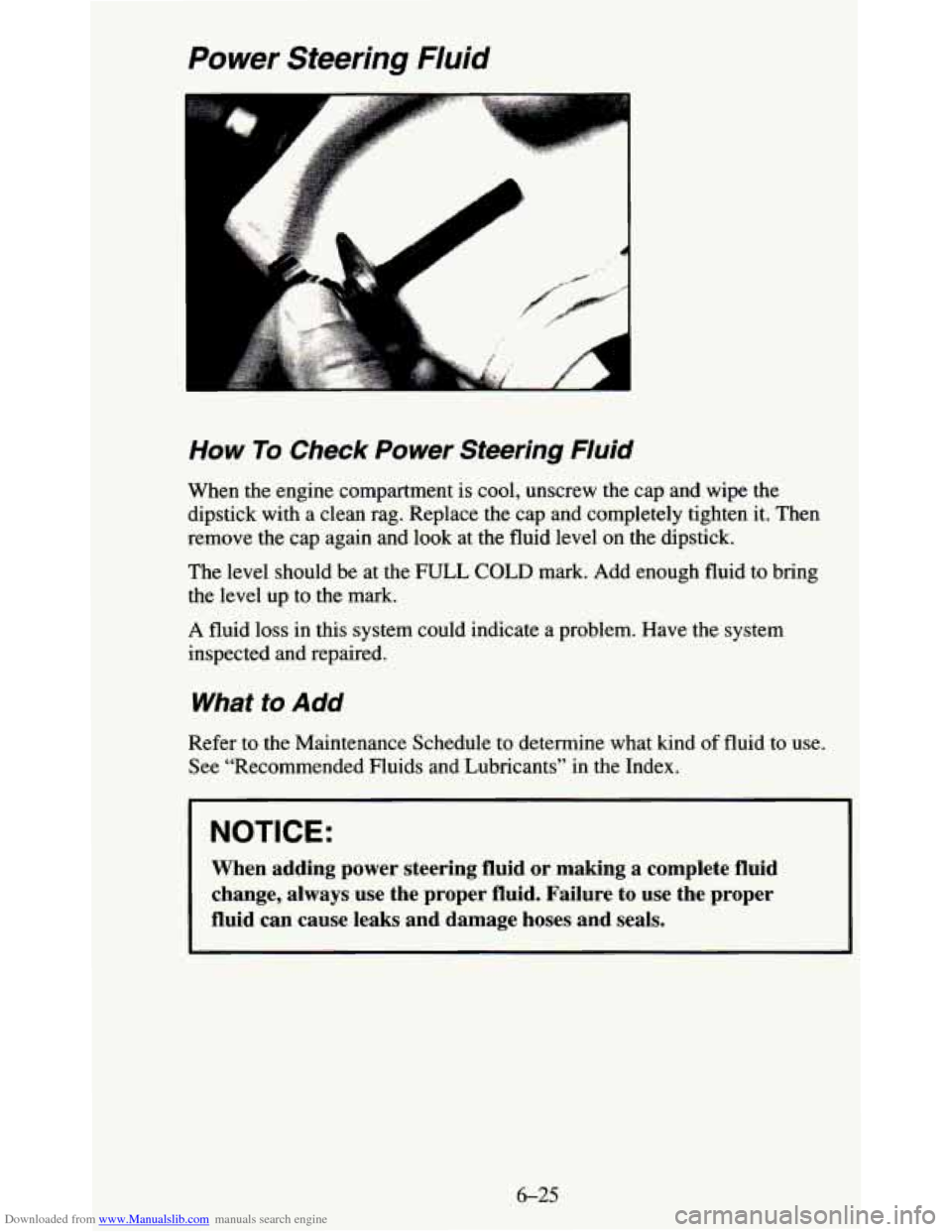
How To Check Power Steering Fluid
When the engine compartment is cool, unscrew the cap and wipe the
dipstick with a clean rag. Replace the cap and completely tighten it. Then
remove the cap again and look at the fluid level on the dips\
tick.
The level should be at the
FULL COLD mark. Add enough fluid to bring
the level up to the mark.
A fluid loss in this system could indicate a problem. Have the system
inspected and repaired.
What to Add
Refer to the Maintenance Schedule to determine what kind of fluid to use.
See “Recommended Fluids and Lubricants” in the Index.
NOTICE:
When adding power steering fluid or making a complete fluid
change, always use the proper fluid. Failure to use the proper\
fluid can cause leaks and damage hoses and seals.
6-25
Page 267 of 380
Downloaded from www.Manualslib.com manuals search engine Brakes
Brake Master Cylinder
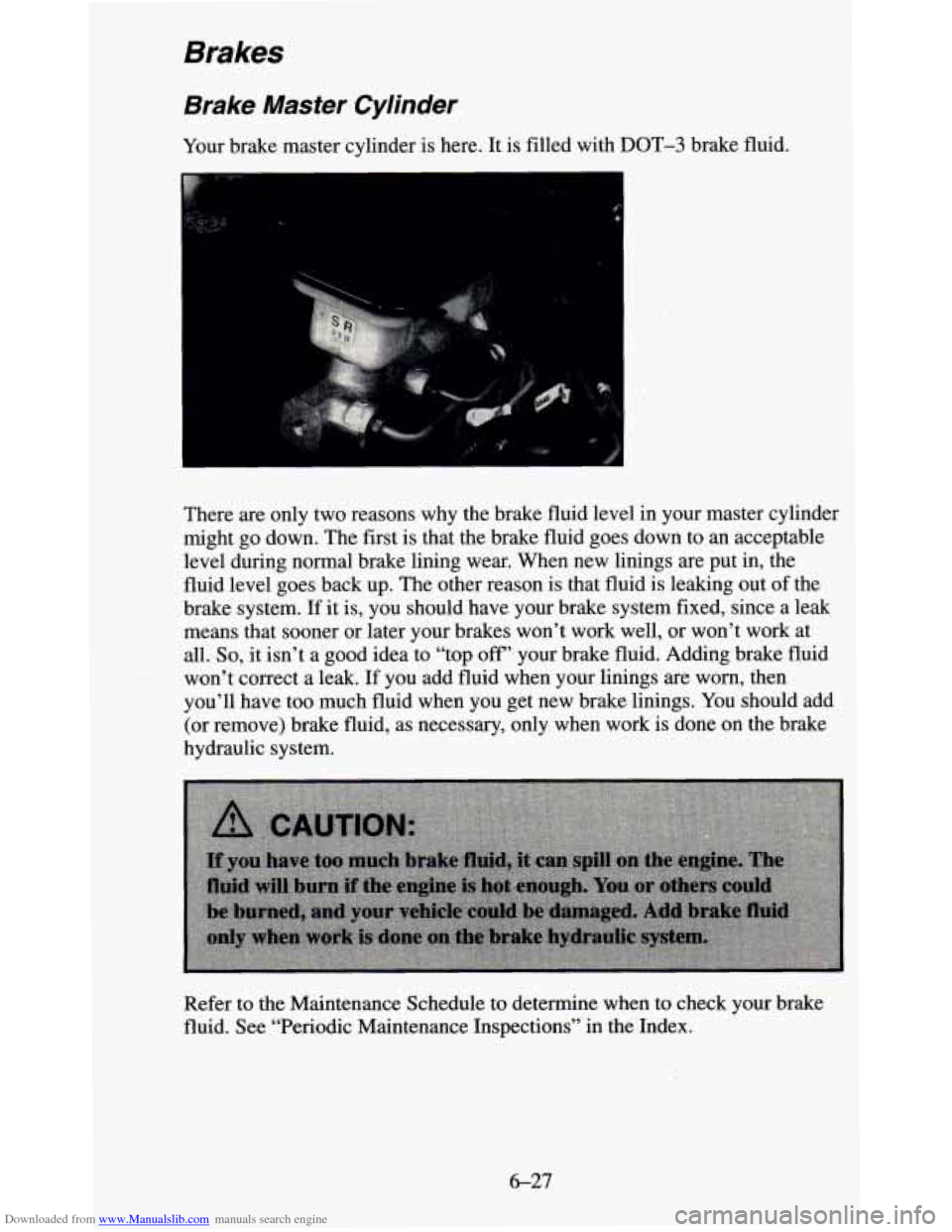
Your brake master cylinder is here. It is filled with DOT-3 brake fluid.
There are only two reasons why the brake fluid level in your master\
cylinder
might
go down. The first is that the brake fluid goes down to an acceptable
level during normal brake lining wear. When new linings are put in, the
fluid level goes back up. The other reason is that fluid is leaking out of the
brake system.
If it is, you should have your brake system fixed, since a leak
means that sooner or later your brakes won’t work well,
or won’t work at
all.
So, it isn’t a good idea to “top off’ your brake fluid. Adding brake fluid
won’t correct a leak. If you add fluid when your linings are worn, then
you’ll have too much fluid when you get new brake linings.
You should add
(or remove) brake fluid, as necessary, only when work is done on the brake
hydraulic system.
Refer to the Maintenance Schedule to determine when to check your brake
fluid. See “Periodic Maintenance Inspections”
in the Index.
6-27
Page 276 of 380
Downloaded from www.Manualslib.com manuals search engine Center High Mounted Stop Lamp (CHMSL)
A
P
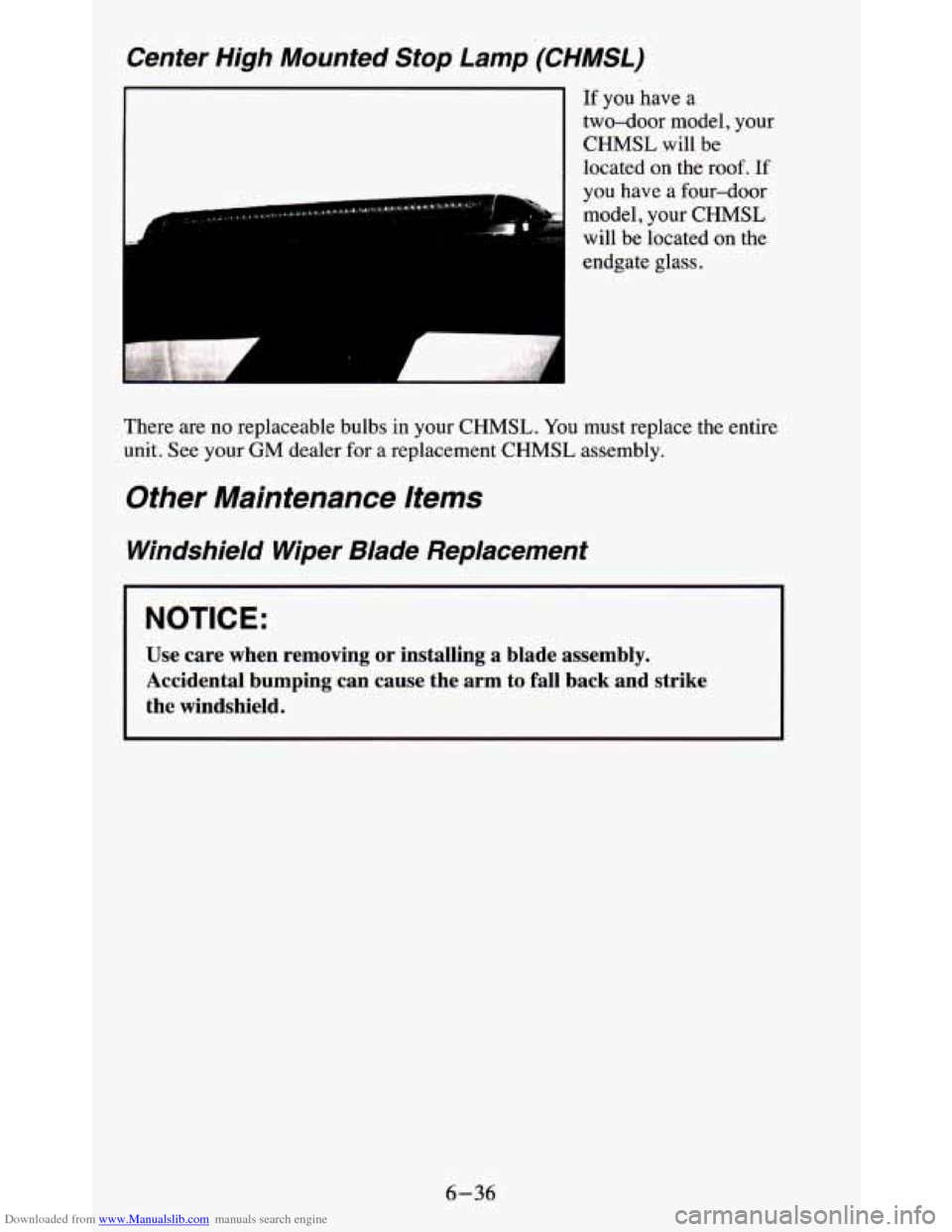
If you have a
two-door model, your
CHMSL will be
located on the roof. If
you have a four-door
model, your CHMSL
will be located on the
endgate glass.
There
are no replaceable bulbs in your CHMSL. You must replace the entire
unit. See your
GM dealer for a replacement CHMSL assembly.
Other Maintenance Items
Whdshield Wiper Blade Replacement
NOTICE:
Use care when removing or installing a blade assembly.
Accidental bumping can cause the arm to fall back and strike
the windshield.
6-36