Page 84 of 380
Downloaded from www.Manualslib.com manuals search engine Electronic Transfer Case
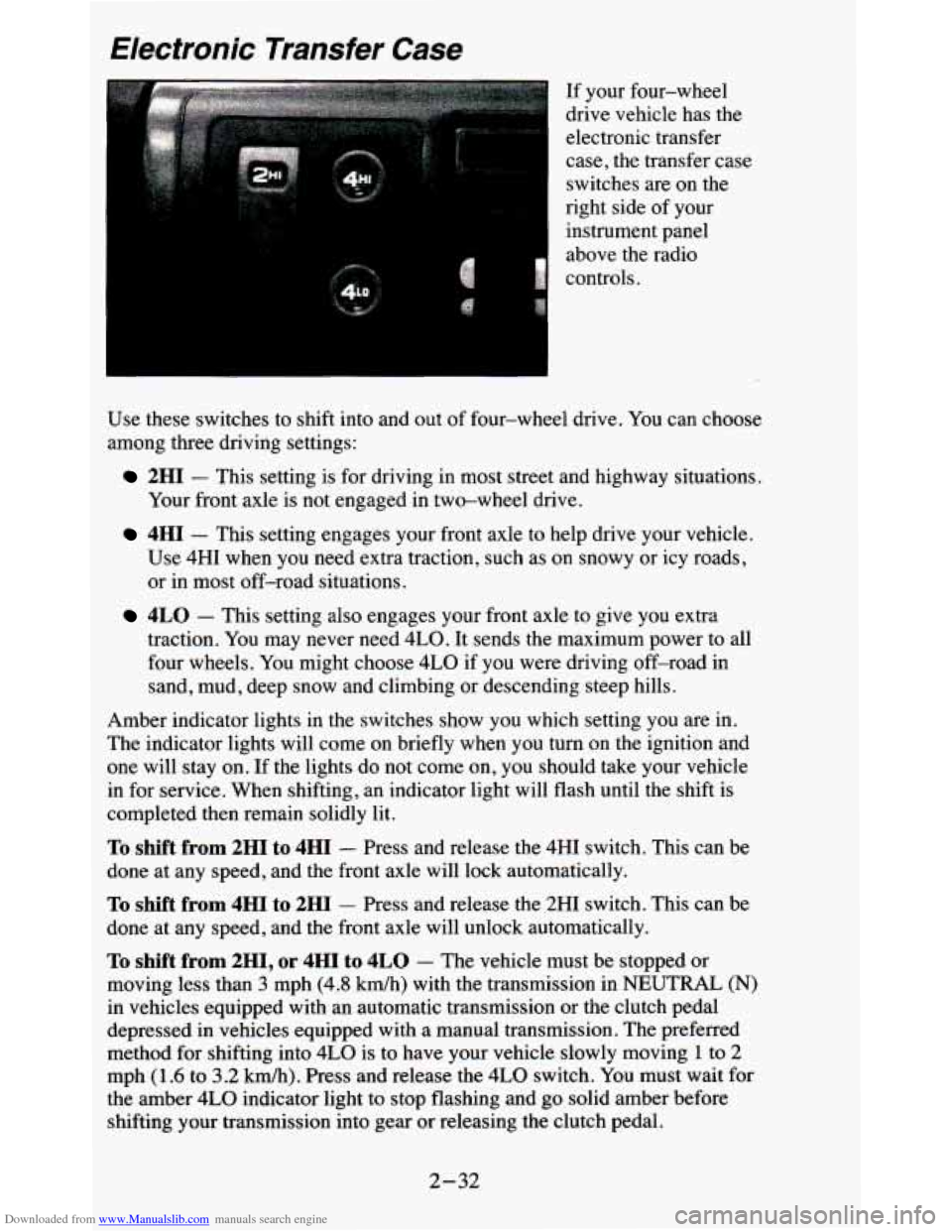
If your four-wheel
drive vehicle has the
electronic transfer
case, the transfer case
switches are on the
right side of your
instrument panel
above
the radio
controls.
Use these switches to shift into and out
of four-wheel drive. You can choose
among three driving settings:
2HI - This setting is for driving in most street and highway situations.
Your front axle is not engaged in two-wheel drive.
4HI - This setting engages your front axle to help drive your vehicle.
Use 4HI when you need extra traction, such as on snowy or icy roads,
or in most off-road situations.
4LO - This setting also engages your front axle to give you extra
traction. You may never need 4LO. It sends the maximum power to all
four wheels. You might choose
4LO if you were driving off-road in
sand, mud, deep snow and climbing or descending steep hills.
Amber indicator lights
in the switches show you which setting you are in.
The indicator lights will come on briefly when you turn on the ignition and
one will stay on. If the lights do not come on,
you should take your vehicle
in for service. When shifting,
an indicator light will flash until the shift is
completed then remain solidly lit.
To shift from 2HI to 4HI - Press and release the 4HI switch. This can be
done at any speed, and the front axle will lock automatically.
To shift from 4HI to 2HI - Press and release the 2HI switch. This can be
done at any speed, and the front axle will unlock automatically.
To shift from 2H1, or 4HI to 4LO - The vehicle must be stopped or
moving less than
3 mph (4.8 km/h) with the transmission in NEUTRAL (N)
in vehicles equipped with an automatic transmission or the clutch pedal
depressed
in vehicles equipped with a manual transmission. The preferred
method for shifting into
4LO is to have your vehicle slowly moving 1 to 2
mph (1.6 to 3.2 km/h). Press and release the 4LO switch. You must wait for
the amber
4LO indicator light to stop flashing and go solid amber before
shifting your transmission into gear or releasing the clutch pedal.
2-32
Page 86 of 380
Downloaded from www.Manualslib.com manuals search engine Windows
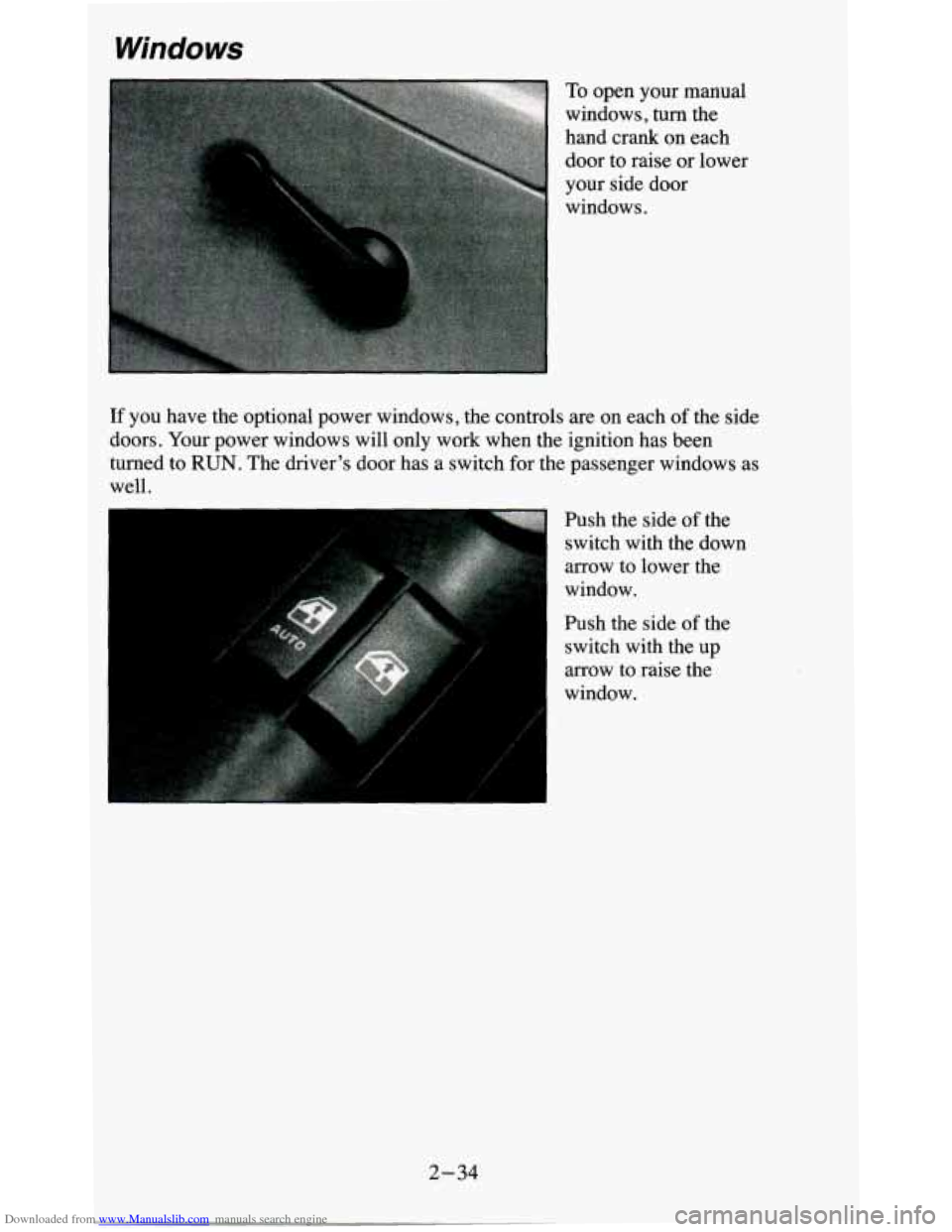
. . , .. , To open your manual
windows, turn the
hand crank on each
door to raise or lower
your side door
windows.
If you have the optional power windows, the controls are on each of the side
doors. Your power windows
will only work when the ignition has been
turned to
RUN. The driver’s door has a switch for the passenger windows as
well.
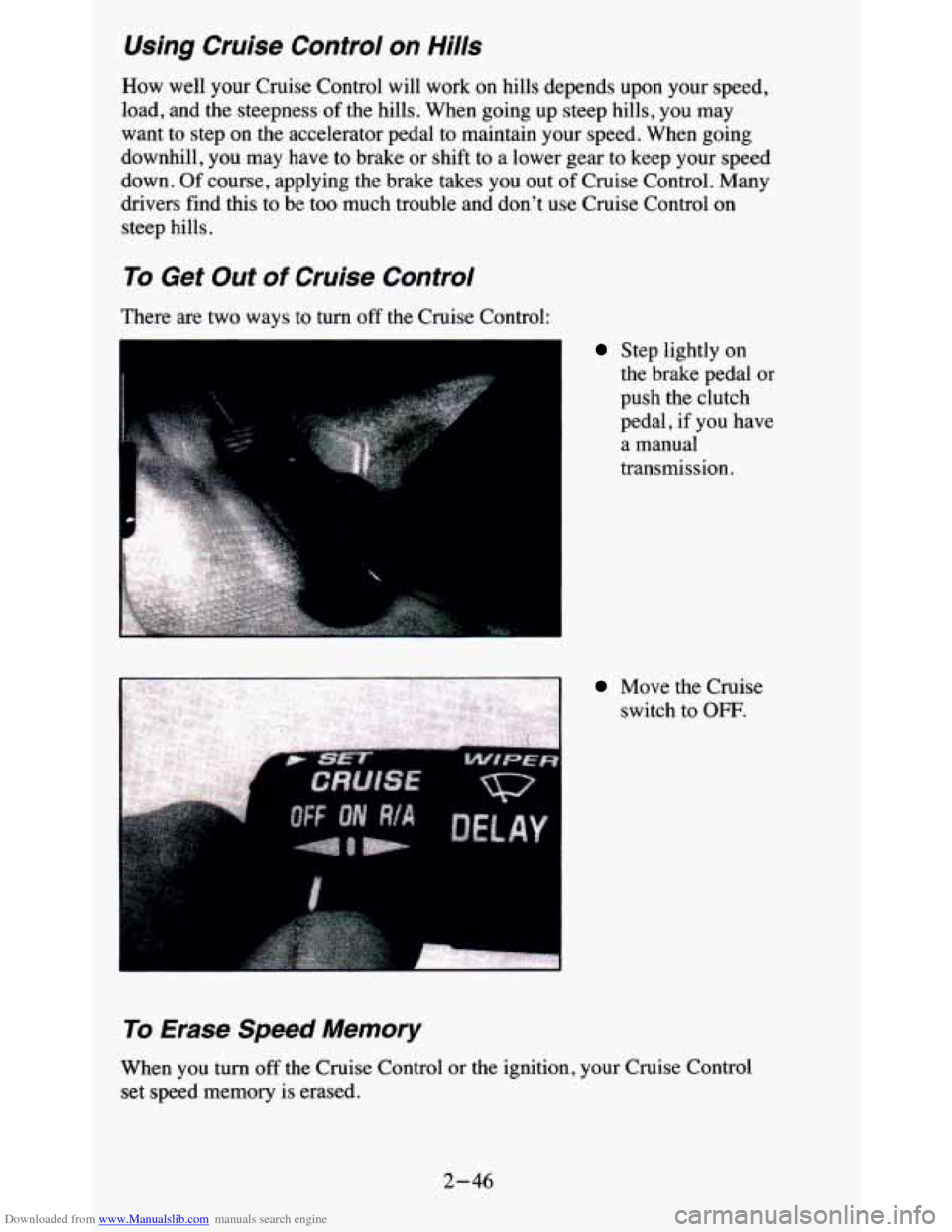
Push the side
of the
switch with the down
arrow to lower the
window.
Push the side
of the
switch with the up
window.
1 arrow to raise the
2-34
Page 98 of 380
Downloaded from www.Manualslib.com manuals search engine Using Cruise Control on Hills
How well your Cruise Control will work on hills depends upon your speed,
load, and the steepness of the hills. When going up steep hills, you may
want to step on the accelerator pedal to maintain your speed. When going
downhill, you may have to brake or shift to a lower gear to keep your speed
down. Of course, applying the brake takes you out of Cruise Control. Many
drivers find this to be too much trouble and don’t use Cruise Control on
steep hills.
To Get Out of Cruise Control
There are two ways to turn off the Cruise Control:
r
Step lightly on
the brake pedal
or
push the clutch
pedal,
if you have
a manual
transmission.
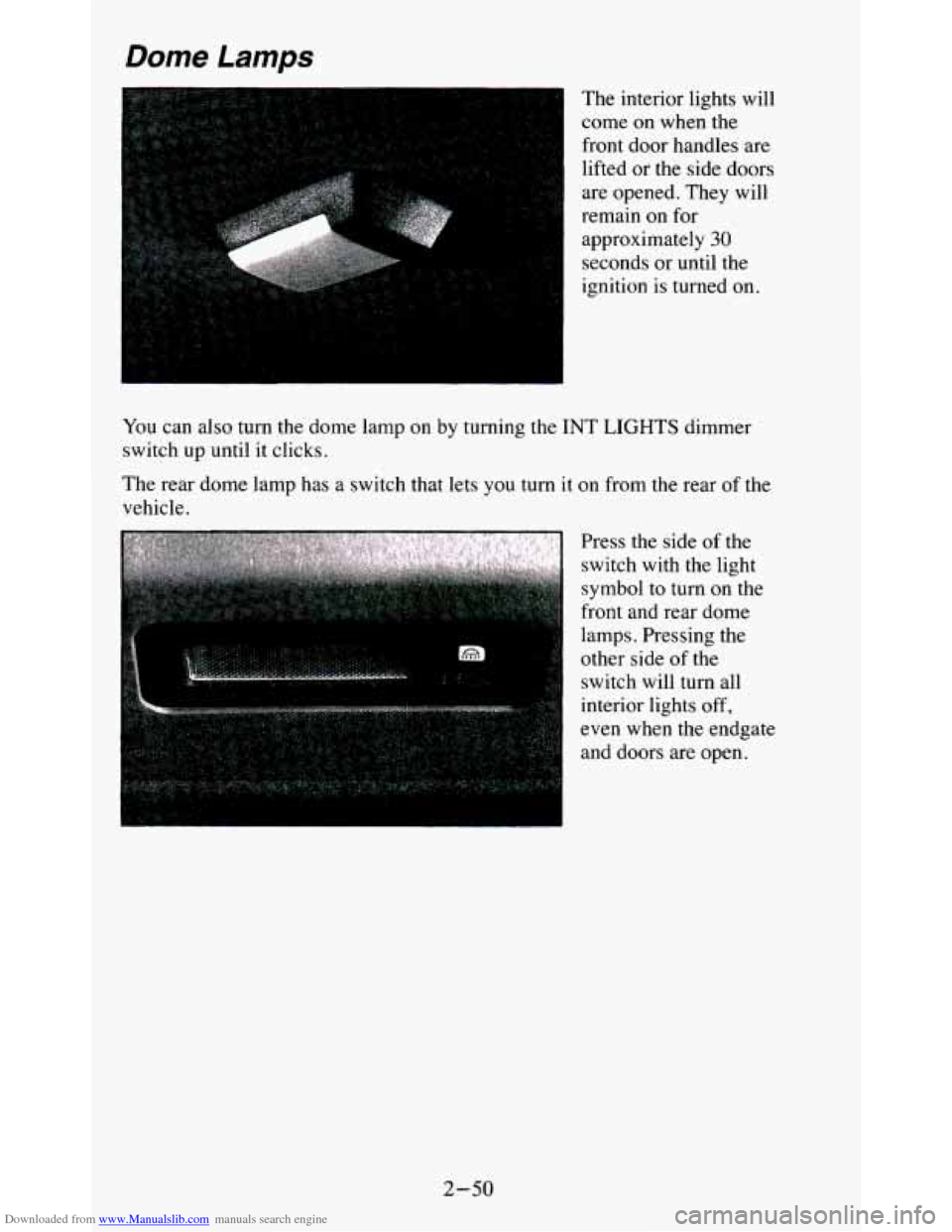
Move the Cruise
switch to
OFF.
To Erase Speed Memory
When you turn off the Cruise Control or the ignition, your Cruise Control
set speed memory
is erased.
2-46
Page 101 of 380
Downloaded from www.Manualslib.com manuals search engine Daytime Running Lamps (DRL) Indicator Light
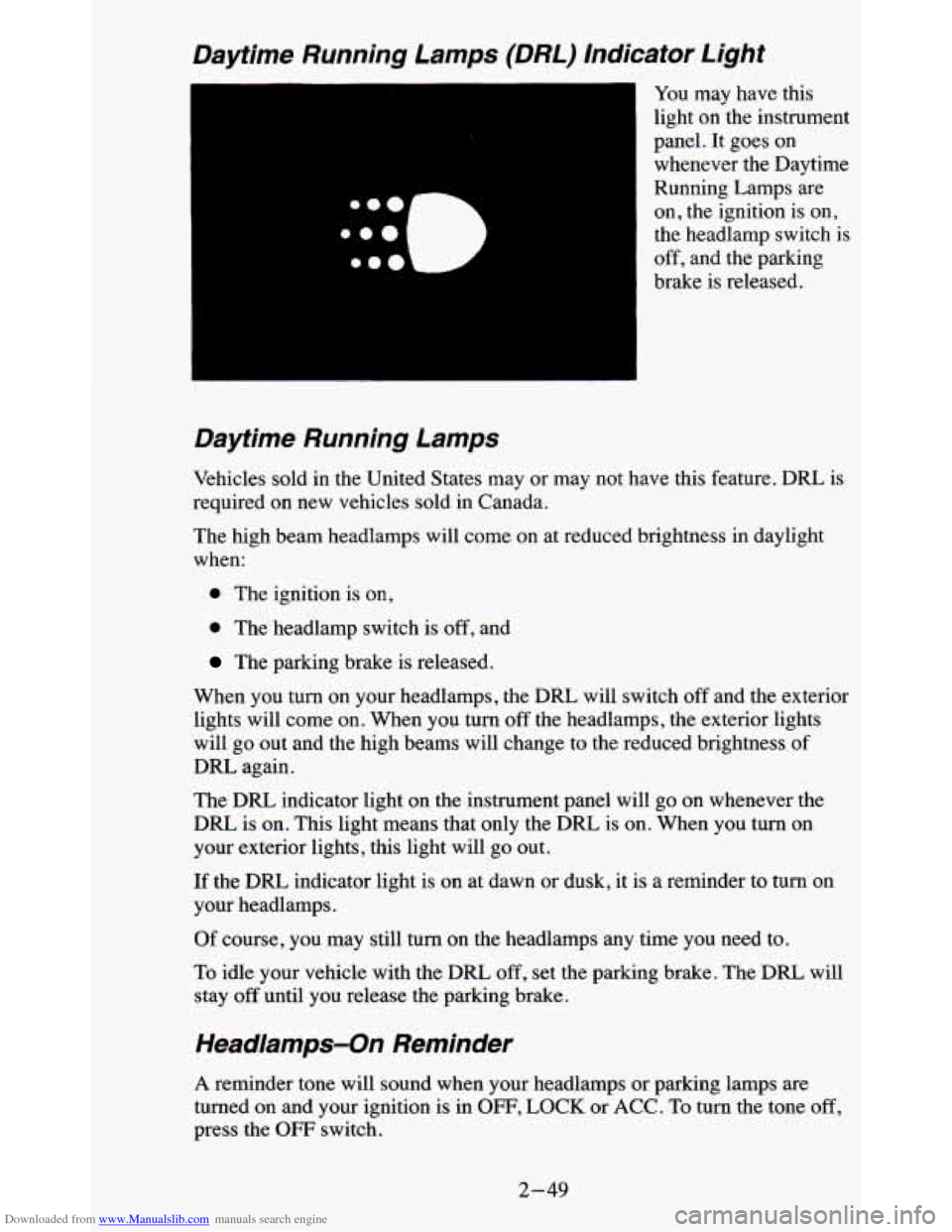
You may have this
light on the instrument
panel. It goes on whenever the Daytime
Running Lamps are
on, the ignition is on,
the headlamp switch is
off, and the parking
brake is released.
Daytime Running Lamps
Vehicles sold in the United States may or may not have this feature. DRL is
required on new vehicles sold in Canada.
The high beam headlamps will come on at reduced brightness in daylight
when:
0 The ignition is on,
0 The headlamp switch is off, and
The parking brake is released.
When you turn on your headlamps, the DRL will switch
off and the exterior
lights will come
on. When you turn off the headlamps, the exterior lights
will go out and the high beams will change to the reduced brightness
of
DRL again.
The
DRL indicator light on the instrument panel will go on whenever the
DRL is
on. This light means that only the DRL is on. When you turn on
your exterior lights, this light will go out.
If the DRL indicator light is on at dawn or dusk, it is a reminder to turn on
your headlamps.
Of course, you may still turn on the headlamps any time you need to.
To idle your vehicle with the
DRL, off, set the parking brake. The DRL will
stay
off until you release the parking brake.
Headlamps-On Reminder
A reminder tone will sound when your headlamps or parking lamps are
turned on and your ignition is in OFF, LOCK or ACC. To turn the tone off,
press the OFF switch.
2-49
Page 102 of 380
Downloaded from www.Manualslib.com manuals search engine Dome Lamps
The interior lights will
come on when the
front door handles are
lifted or the side doors
are opened. They will
remain
on for
approximately
30
seconds or until the
ignition is turned
on.
You can also turn the dome lamp on by turning the INT LIGHTS dimmer
switch up until it clicks.
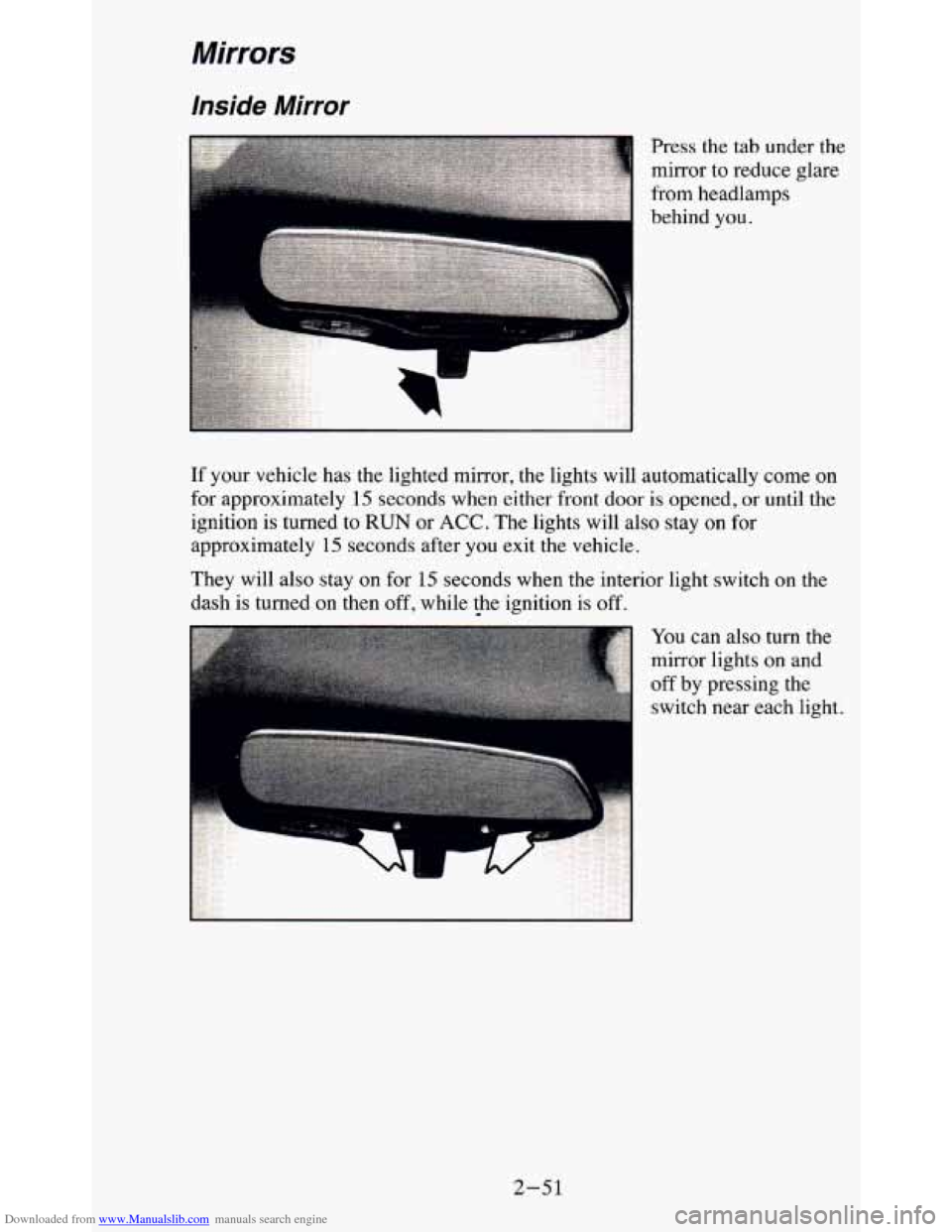
The rear dome lamp has a switch that lets
you turn it on from the rear of the
vehicle.
Press the side
of the
switch with the light
symbol to turn
on the
front and rear dome
lamps. Pressing the
other side
of the
switch will turn all
interior lights off,
even when the endgate
and doors are open.
2-50
Page 103 of 380
Downloaded from www.Manualslib.com manuals search engine Inside Mirror
Press the tab under the
mirror to reduce glare
from headlamps
behind
you.
If your vehicle has the lighted mirror, the lights will automatically come on
for approximately
15 seconds when either front door is opened, or until the
ignition is turned to
RUN or ACC. The lights will also stay on for
approximately
15 seconds after you exit the vehicle.
They will also stay
on for 15 seconds when the interior light switch on the
dash is turned on then
off, while the ignition is off.
You can also turn me
mirror lights on and
off by pressing the
switch near each light.
2-51
Page 111 of 380

Downloaded from www.Manualslib.com manuals search engine Temperature and Compass Display
The outside air
temperature and the
compass are displayed
at the front of the
overhead console. The
control switches are
located
on the driver's
side of the display.
Turn the display on or
off by pressing the ON/OFF switch. Display the
temperature in either degrees Fahrenheit (English) or Celsius (metric) by
pressing the US/MET switch.
Before you turn
on the ignition and move the vehicle, the temperature
indicated will be the last outside temperature recorded with the ignition on.
If the outside temperature is
37 "F (3 "C) or lower when you turn on the
ignition, ICE will appear
on the display. It's a caution to the driver that road
conditions may be icy, and that appropriate precautions should be taken.
Gompass Calibration
The compass is self-calibrating, so it does not need to be manually set.
However, when your vehicle is new, the compass may function er\
ratically. If
it does, CAL (Calibration) will appear
on the display. To correct the
problem, drive in a complete
360" circle three times, and the compass will
function normally.
2-59
Page 122 of 380
Downloaded from www.Manualslib.com manuals search engine You will see this light flash for a few seconds when you turn your ignition
to
RUN or START. Then the light should go out. This means the system is
ready.
If the air bag readiness light doesn’t come on when you start your vehicle,
or stays on,
or comes on when you are driving, your air bag system may not
work properly. Have your vehicle serviced right away.
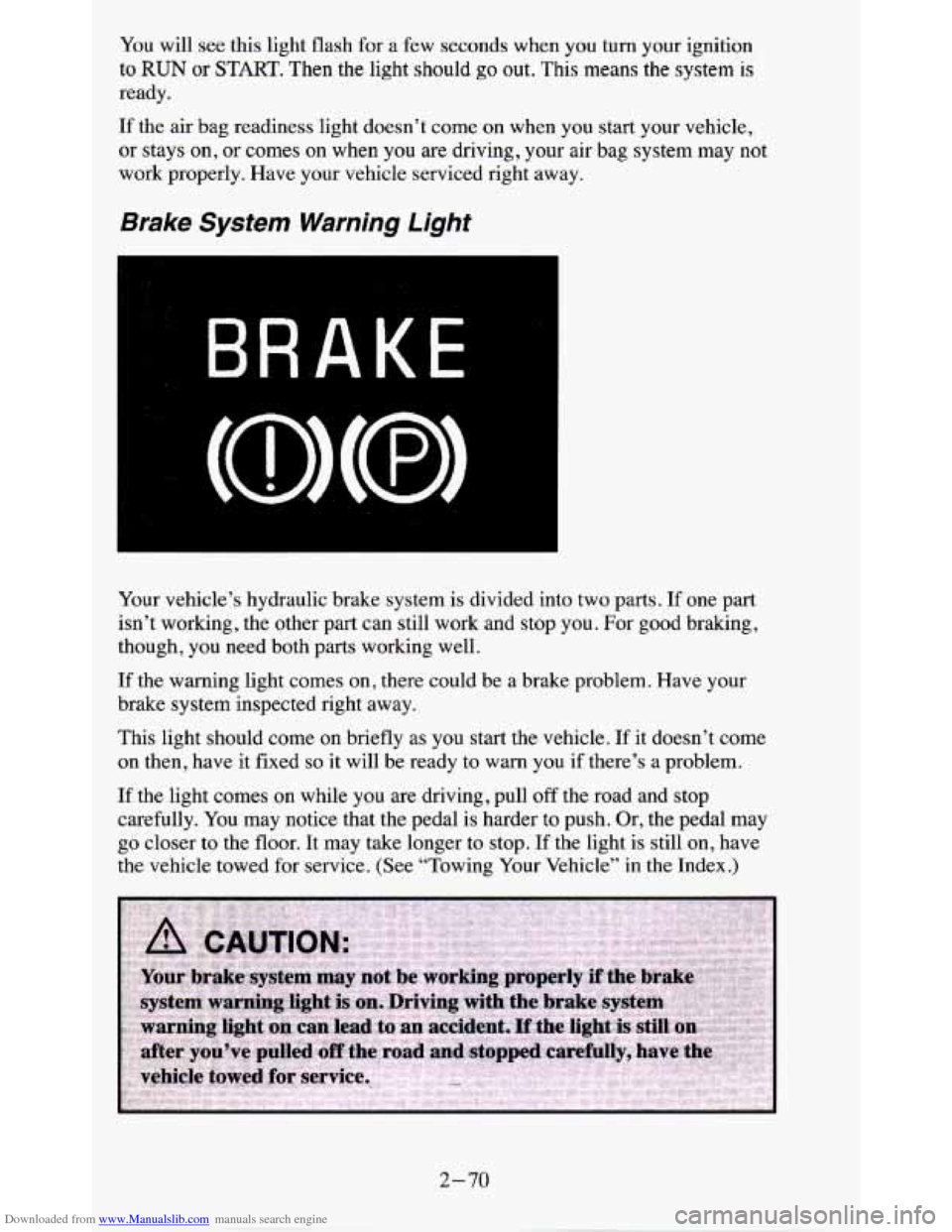
Brake System Warning Light
Your vehicle’s hydraulic brake system is divided into two parts. If one part
isn’t working, the other part can still work and stop
you. For good braking,
though, you need both parts working well.
If the warning light comes on, there could be a brake problem. Have your
brake system inspected right away.
This light should come on briefly
as you start the vehicle. If it doesn’t come
on then, have it fixed
so it will be ready to warn you if there’s a problem.
If the light comes on while you are driving, pull off the road and stop
carefully. You may notice that the pedal
is harder to push. Or, the pedal may
go closer to the floor. It may take longer to stop.
If the light is still on, have
the vehicle towed for service. (See “Towing Your Vehicle” in
the Index.)
2-70