Page 234 of 380
Downloaded from www.Manualslib.com manuals search engine f, : i
I
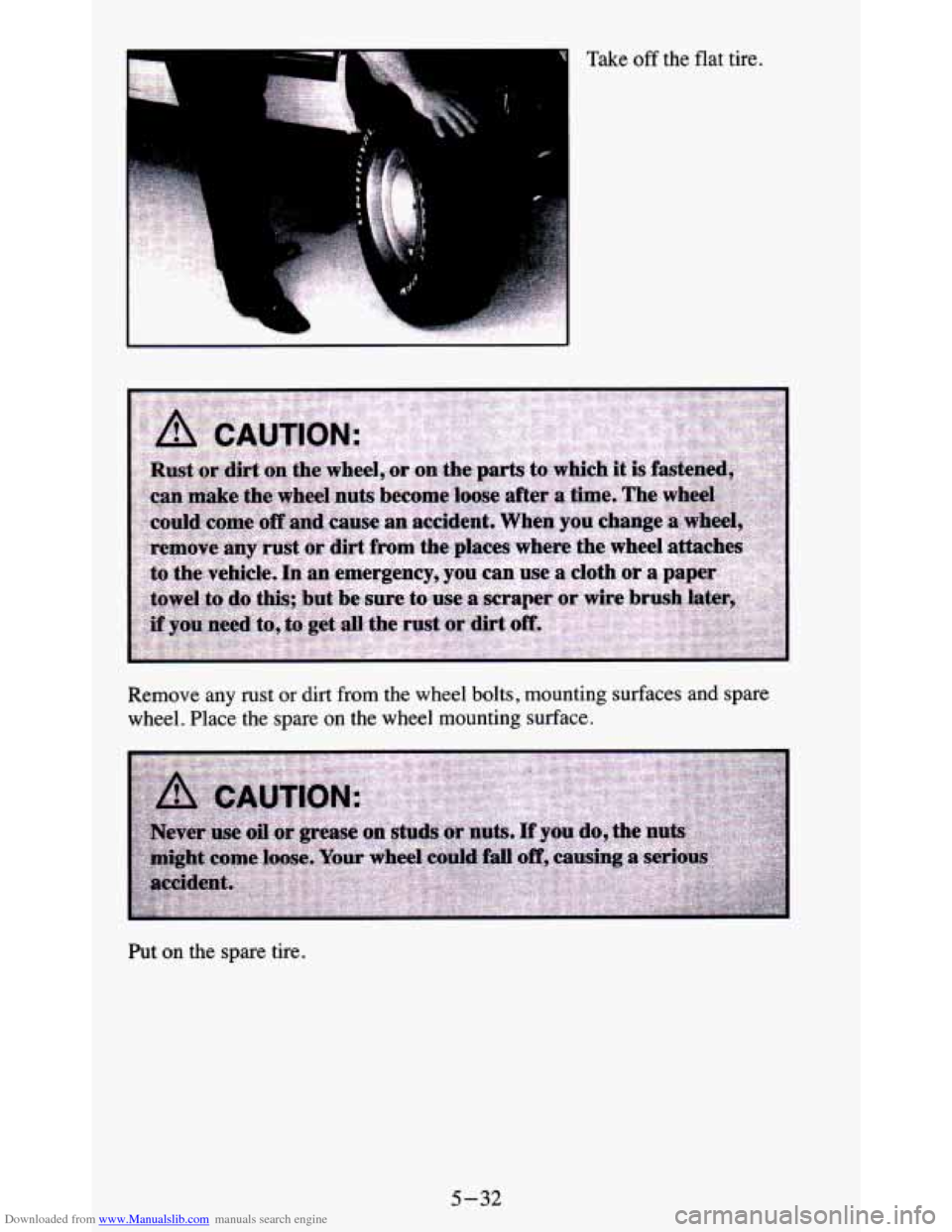
Take off the flat tire.
Remove any rust
or dirt from the wheel bolts, mounting surfaces and spare
wheel. Place the spare on the wheel mounting surface.
Put on the spare tire.
5-32
Page 236 of 380
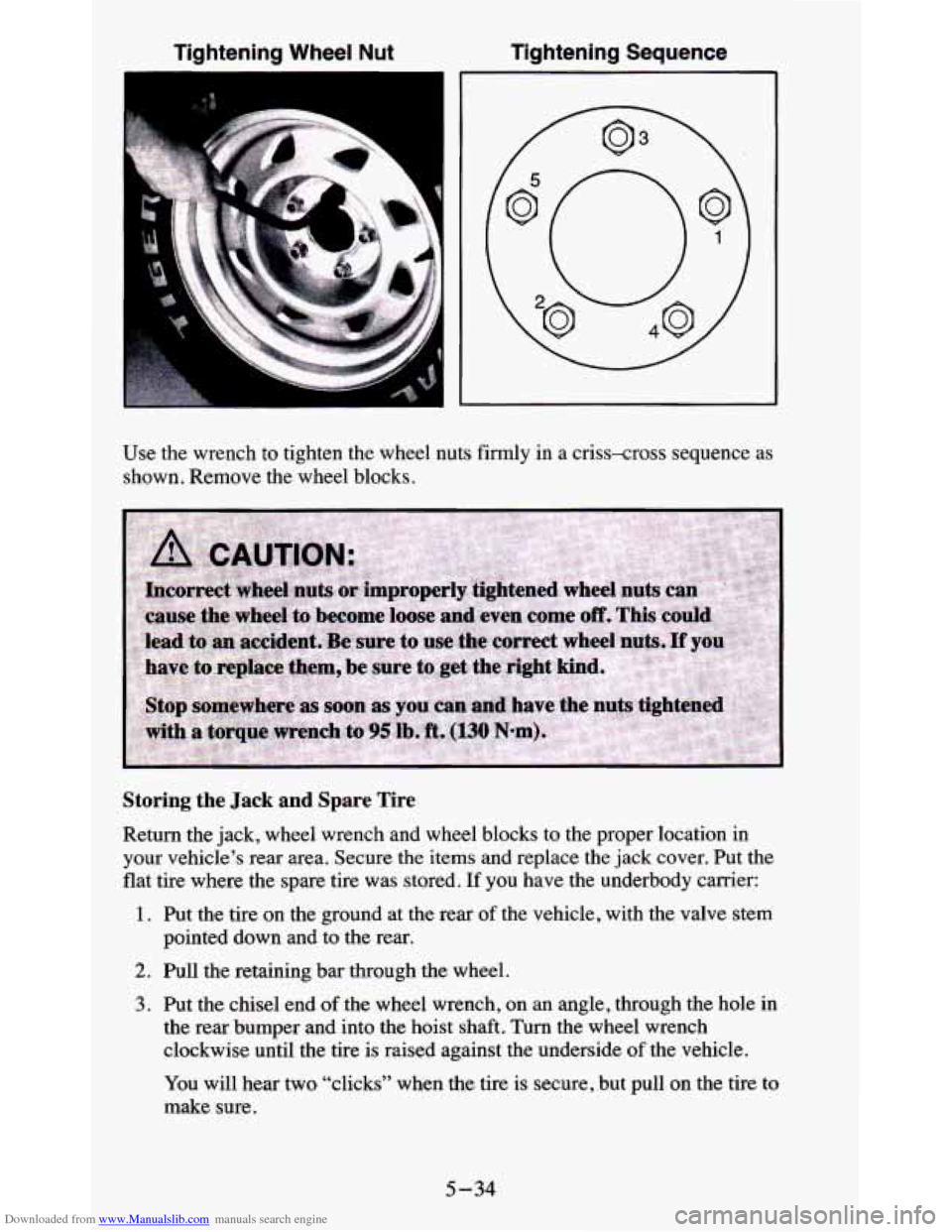
Downloaded from www.Manualslib.com manuals search engine Tightening Wheel Nut Tightening Sequence
Use
the wrench to tighten the wheel nuts firmly in a criss-cross sequence as
shown. Remove the wheel blocks.
Storing the Jack and Spare Tire
Return the jack, wheel wrench and wheel blocks to the proper location in
your vehicle’s rear area. Secure
the items and replace the jack cover. Put the
flat tire where the spare tire was stored. If you have the underbody carrier:
1. Put the tire on the ground at the rear of the vehicle, with the valve stem
pointed down and to the rear.
2. Pull the retaining bar through the wheel.
3. Put the chisel end of the wheel wrench, on an angle, through the hole in
the rear bumper and into the hoist shaft. Turn the wheel wrench
clockwise until the tire is raised against the underside
of the vehicle.
You will hear two “clicks” when the tire is secure, but pull
on the tire to
make sure.
5-34
Page 281 of 380
Downloaded from www.Manualslib.com manuals search engine Ma/function Indicator Lamp (SERVICE ENGINE
SOON)
This light on your instrument panel lets you know when your emission
system needs service. See “Malfunction Indicator Lamp” in the Index.
Tires
We don’t make tires. Your new vehicle comes with high quality tires made
by a leading tire manufacturer. These tires are warranted by the tire
manufacturers and their warranties
are delivered with every new vehicle. If
your spare tire is a different brand than your road tires, you will have a tire
warranty folder from each
of these manufacturers.
Inflation - lire Pressure
The Certificationire label which is on the driver’s door lock pillar, shows
the correct inflation pressures for your tires, when they’re cold. “Cold”
means your vehicle has been sitting for at least three hours or driven
no
more than a mile.
6-41
Page 282 of 380
Downloaded from www.Manualslib.com manuals search engine NOTICE:
Don’t let anyone tell you that underinflation or overinflation is
all right. It’s not.
If your tires don’t have enough air
(underinflation) you can get:
0 Too much flexing
0 Too much heat
0 Tire overloading
0 Bad wear
0 Bad handling
Bad fuel economy.
If your tires have too much air (overinflation), you can get:
Unusual wear
Bad handling
Rough ride
0 Needless damage from road hazards.
When to Check
Check your tires once a month or more. Also, check the tire pressure of the
spare tire.
How to Check
Use a good quality pocket-type gage to check tire pressure. Simply looking
at the tires will not tell you the pressure, especially if
you have radial tires
- which may look properly inflated even if they’re underinflated.
If your tires have valve caps, be sure to put them back on. They help prevent
leaks by keeping out dirt and moisture.
6-42
Page 283 of 380
Downloaded from www.Manualslib.com manuals search engine lire Inspection and Rotation
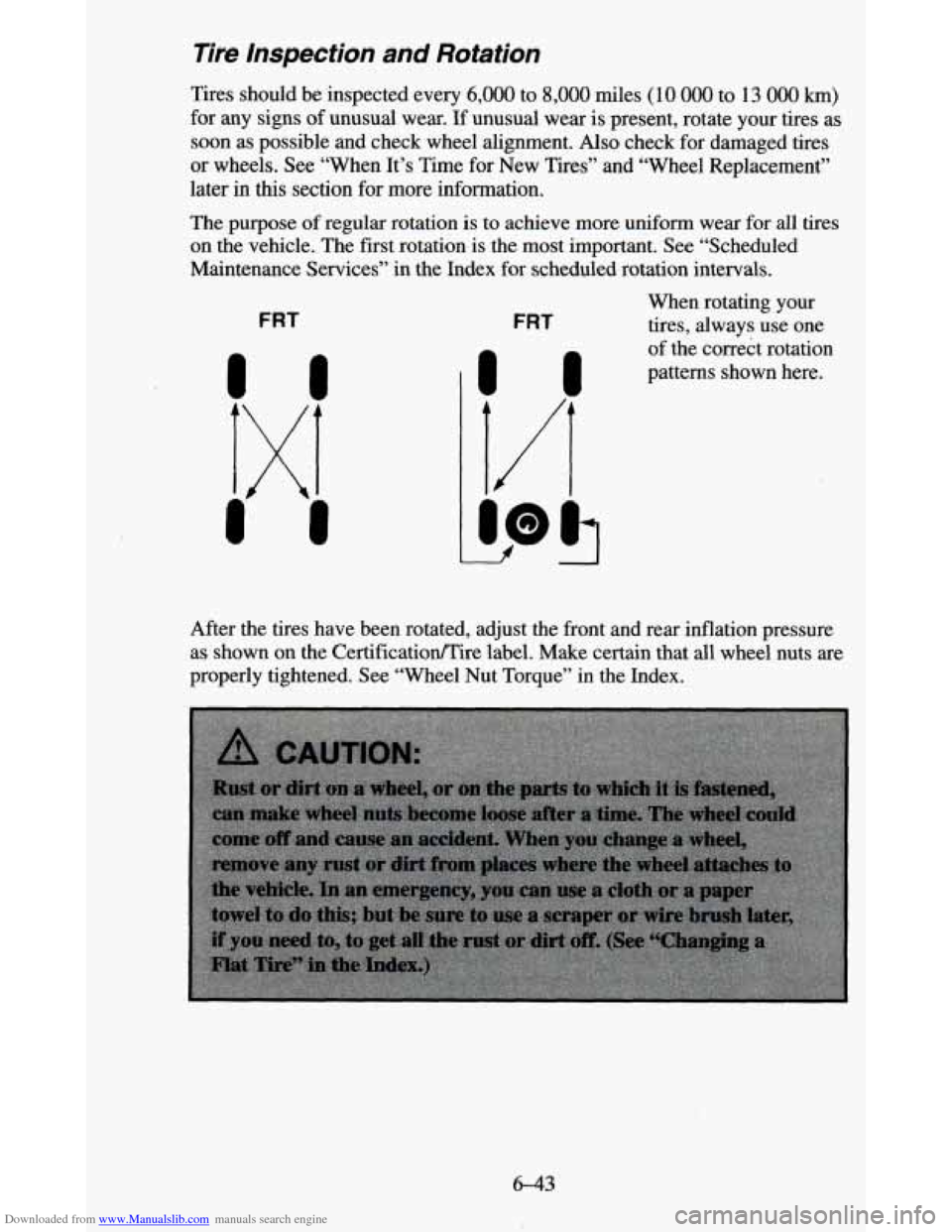
Tires should be inspected every 6,000 to 8,000 miles (10 000 to 13 000 km)
for any signs of unusual wear. If unusual wear is present, rotate your tires as
soon as possible and check wheel alignment. Also check for damaged tires
or wheels. See “When It’s Time for New Tires” and “Wheel Replacement”
later in this section for more information.
The purpose of regular rotation is to achieve more uniform wear for all tires
on the vehicle. The first rotation is the most important. See “Scheduled
Maintenance Services”
in the Index for scheduled rotation intervals.
FRT
n
FRT When
rotating your
tires, always use one of the correct rotation
patterns shown here.
After the tires have been rotated, adjust the front and rear inflation pressure
as shown on the Certificatioflire label. Make certain that
all wheel nuts are
properly tightened. See “Wheel Nut Torque” in the Index.
6-43
Page 286 of 380
Downloaded from www.Manualslib.com manuals search engine Warning: The temperature grade for this tire is established for a tire that is
properly inflated and not overloaded. Excessive speed, underinflation,
or
excessive loading, either separately or in combination, can cause heat
buildup and possible tire failure.
These grades are molded on the sidewalls
of passenger car tires.
While the tires available as standard or optional equipment on General
Motors vehicles may vary with respect
to these grades, all such tires meet
General Motors performance standards and have been approved for use on
General Motors vehicles. All passenger type
(P Metric) tires must conform
to Federal safety requirements in addition to these grades.
Wheel Alignment and Tire Balance
The wheels on your vehicle were aligned and balanced carefully at the
factory to give you the longest tire life and best overall performance.
In most cases, you will not need to have your wheels aligned again.
However, if you notice unusual tire wear or your vehicle pulling one way or
the other, the alignment may need to be reset. If you notice your vehicle
vibrating when driving on a smooth road, your wheels may need to be
rebalanced
.
Wheel Replacement
Replace any wheel that is bent, cracked, or badly rusted or corroded. If
wheel nuts keep coming loose, the wheel, wheel bolts, and wheel nuts
should be replaced. If the wheel leaks air, replace it (except some aluminum
wheels, which can sometimes be repaired). See your GM dealer if any of
these conditions exist.
Your dealer will know the kind
of wheel you need.
Each new wheel should have the same load carrying capacity, diameter,
width, offset, and be mounted the same way as the one it replaces.
If you need to replace any of your wheels, wheel bolts, or wheel nuts,
replace them only with
new GM original equipment parts. This way, you
will be sure to have the right wheel, wheel bolts, and wheel nuts for your
vehicle.
6-46
Page 313 of 380
Downloaded from www.Manualslib.com manuals search engine Scheduled Maintenance Services
Section
IMPORTANT:
KEEP ENGINE OIL
AT THE PROPER
LEVELAND CHANGE
AS RECOMMENDED
This section covers the maintenance required for your vehicle. Your vehicle
needs these services
to retain its safety, dependability and emission control
performance.
Protection
Plan
Have you purchased the GM Protection Plan? The Plan supplements your
new vehicle warranties. See your GM dealer for details.
Introduction
Your Vehicle and the Environment
Proper vehicle maintenance not only helps to keep your vehicle in good
working condition,
but also helps the environment. All recommended
maintenance procedures are important. Improper vehicle maintenance
or the
removal
of important components can significantly affect the quality of the
air we breathe. Improper fluid levels or even the wrong tire inflation can
increase the level of emissions from your vehicle. To help protect our
environment, and to help keep your vehicle
in good condition, please
maintain your vehicle properly.
7-1
Page 348 of 380
Downloaded from www.Manualslib.com manuals search engine €ngine Coolant Level
Check the engine coolant level and add the proper coolant mix if necessary.
See “Coolant” in the Index for further details.
Windshield Washer Fluid Level
Check the windshield washer fluid level in the windshield washe\
r tank and
add the proper fluid if necessary. See “Windshield Washer Fluid” in the
Index for further details.
At Least Once a Month
Tire Inflation
Check tire inflation. Make sure tires are inflated to the pressures specified
on the Certificatioflire label located on the driver’s door lock pillar. See
“Tires” in the Index for further details.
Cassette Deck
Clean cassette deck. Cleaning should be done every 50 hours of tape play.
See “Audio Systems” in the Index for further details.
At Least Once a Year
Key Lock Cylinders
Lubricate the key lock cylinders with the lubricant specified i\
n Part D.
Body Lubrication
Lubricate all body door hinges, the body hood, fuel door and rear
compartment hinges, latches and locks including interior glove box and
console doors, and any moving seat hardware. Lubricate the hood safety
lever pivot and prop rod pivot.
Part D tells you what to use. More frequent
lubrication may be required when exposed to
a corrosive environment.
7-36