1995 CHEVROLET BLAZER automatic transmission
[x] Cancel search: automatic transmissionPage 83 of 380
Downloaded from www.Manualslib.com manuals search engine dealer check your system. Turn the INT LIGHTS switch located to the righl
of your headlight switch to dim your transfer case indicator light when you1
headlights or parking lights are on. This will also cause your instrument
panel lights to dim.
2HI - This setting is for driving in most street and highway situations.
Your front axle is not engaged in two-wheel drive.
4HI - This setting engages your front axle to help drive your vehicle. Use
4HI when you need extra traction, such as on snowy or icy roads, or in mos
off-road situations.
N SET PARK BRAKE - Shift to this neutral setting only when your
vehicle needs to be towed.
4LO - This setting also engages your front axle to give you extra traction
and provides extra gear reduction. You may never need 4LO. It sends the
maximum power to all four wheels. You might choose 4LO if
you were
driving off-road in sand, mud, or deep snow and climbing or descending
steep hills.
You can shift from 2HI to 4HI or from 4HI to 2HI while the vehicle is
moving.
Do not press the transfer case shift lever button when shifting fron
2HI to 4HI or from 4HI to 2HI. Your front axle will engage faster
if you
take your foot off
of the accelerator for a few seconds after you shift.
To shift your transfer case into N SET PARK BRAKE:
1. Stop the vehicle and shift your transmission into NEUTRAL (N).
2. Set the parking brake. Your vehicle can roll unless the brakes are
3. Pull the transfer case shift lever into N SET PARK BRAKE.
applied.
To shift into or out
of 4LO:
1. The vehicle must be stopped or moving less than 3 mph (4.8 kdh)
with the transmission in NEUTRAL
(N) for an automatic transmission
or the clutch pedal depressed with a manual transmission.
2. Press the transfer case shift button and shift in one continuous motion.
Don’t pause in
N SET PARK BRAKE as you shift into or out of 4L0, or
your gears could clash.
Remember that driving in 4HI or 4LO may reduce fuel economy. Also,
driving in four-wheel
drive on dry pavement could cause your tires to wea
faster and make your transfer case harder to shift and reduce powertrain
longevity.
2-31
Page 84 of 380
Downloaded from www.Manualslib.com manuals search engine Electronic Transfer Case
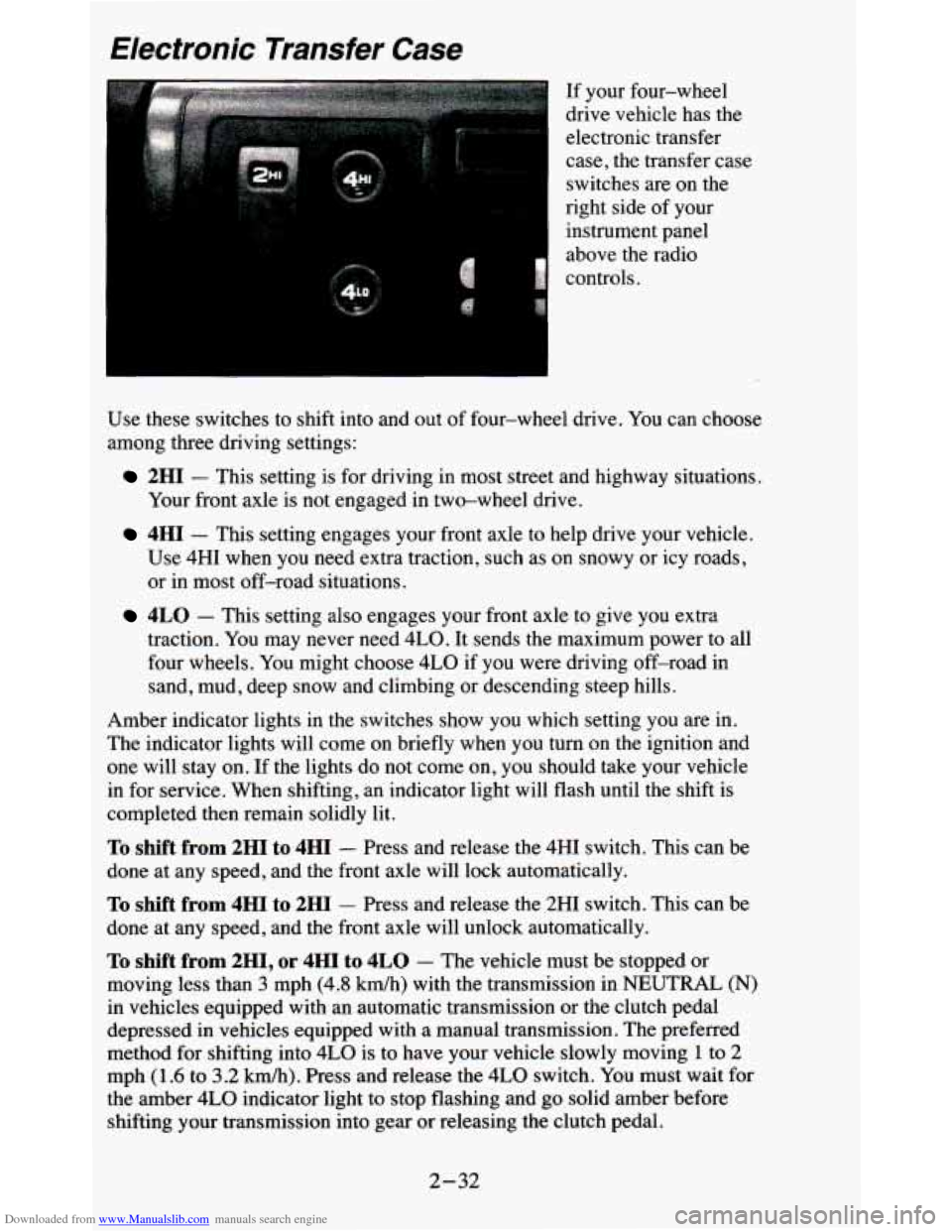
If your four-wheel
drive vehicle has the
electronic transfer
case, the transfer case
switches are on the
right side of your
instrument panel
above
the radio
controls.
Use these switches to shift into and out
of four-wheel drive. You can choose
among three driving settings:
2HI - This setting is for driving in most street and highway situations.
Your front axle is not engaged in two-wheel drive.
4HI - This setting engages your front axle to help drive your vehicle.
Use 4HI when you need extra traction, such as on snowy or icy roads,
or in most off-road situations.
4LO - This setting also engages your front axle to give you extra
traction. You may never need 4LO. It sends the maximum power to all
four wheels. You might choose
4LO if you were driving off-road in
sand, mud, deep snow and climbing or descending steep hills.
Amber indicator lights
in the switches show you which setting you are in.
The indicator lights will come on briefly when you turn on the ignition and
one will stay on. If the lights do not come on,
you should take your vehicle
in for service. When shifting,
an indicator light will flash until the shift is
completed then remain solidly lit.
To shift from 2HI to 4HI - Press and release the 4HI switch. This can be
done at any speed, and the front axle will lock automatically.
To shift from 4HI to 2HI - Press and release the 2HI switch. This can be
done at any speed, and the front axle will unlock automatically.
To shift from 2H1, or 4HI to 4LO - The vehicle must be stopped or
moving less than
3 mph (4.8 km/h) with the transmission in NEUTRAL (N)
in vehicles equipped with an automatic transmission or the clutch pedal
depressed
in vehicles equipped with a manual transmission. The preferred
method for shifting into
4LO is to have your vehicle slowly moving 1 to 2
mph (1.6 to 3.2 km/h). Press and release the 4LO switch. You must wait for
the amber
4LO indicator light to stop flashing and go solid amber before
shifting your transmission into gear or releasing the clutch pedal.
2-32
Page 85 of 380
Downloaded from www.Manualslib.com manuals search engine If the 4LO switch is pressed when your vehicle is in gear and/or moving, tht
amber 4LO indicator light will flash for
30 seconds and not complete the
shift unless your vehicle is below
3 mph (4.8 ludh) and the transmission is
in NEUTRAL (N) or the clutch pedal depressed.
On automatic transmission equipped vehicles: If your transfer case does not
shift into 4L0, your transmission indicator switch may require adjustment.
With your transmission in NEUTRAL (N), press and release the 4LO
switch. While the amber 4LO indicator light is flashing, shift your
transmission into PARK
(P).
Wait until the 4LO indicator light goes solid amber before shifting your
transmission into gear. This will get you into 4L0, but you should take your
vehicle in for service
so normal operation can be restored.
To shift from 4LO to 4HI - Your vehicle must be stopped or moving less
than
3 mph (4.8 kdh) with the transmission in NEUTRAL (N) or the clutcl
pedal depressed. The preferred method for shifting out of 4LO is to have
your vehicle slowly moving
1 to 2 mph (1.6 to 3.2 kdh). Press and release
the 4HI switch.
You must wait for the 4HI indicator light to stop flashing
and
go solid amber before shifting your transmission into gear or releasing
the clutch pedal.
If the 4HI switch is pressed when your vehicle
is in gear and/or moving, the
4HI indicator light will flash for
30 seconds but not complete the shift
unless the vehicle is below
3 mph (4.8 kmh) and the transmission is in
NEUTRAL (N) or the clutch pedal depressed.
On automatic transmission equipped vehicles: If your transfer case does not
shift into 4H1, your transmission indicator switch may require adjustment.
With your transmission in NEUTRAL (N), press and release the 4HI switch
While the 4HI indicator light is flashing, shift your transmission into PARK
(P). Wait until the 4HI indicator light goes solid amber before shifting your
transmission into gear. This will get you into 4H1, but you should take your
vehicle in for service
so normal operation can be restored.
2-33
Page 94 of 380
Downloaded from www.Manualslib.com manuals search engine automatically park on the endgate. When the glass is completely closed, the
wiper will resume the delay mode.
To turn on the wiper, press WASH.
a To wash the window, press and hold WASH. The wipers will continue
Press OFF to turn the wiper off.
to work after you release the switch.
The rear window washer uses the same fluid bottle as the windshield
washer. However, the rear window washer
will run out of fluid before the
windshield washer. If you can wash your windshield
but not your rear
window, check your fluid'level.
Cruise Control (Option)
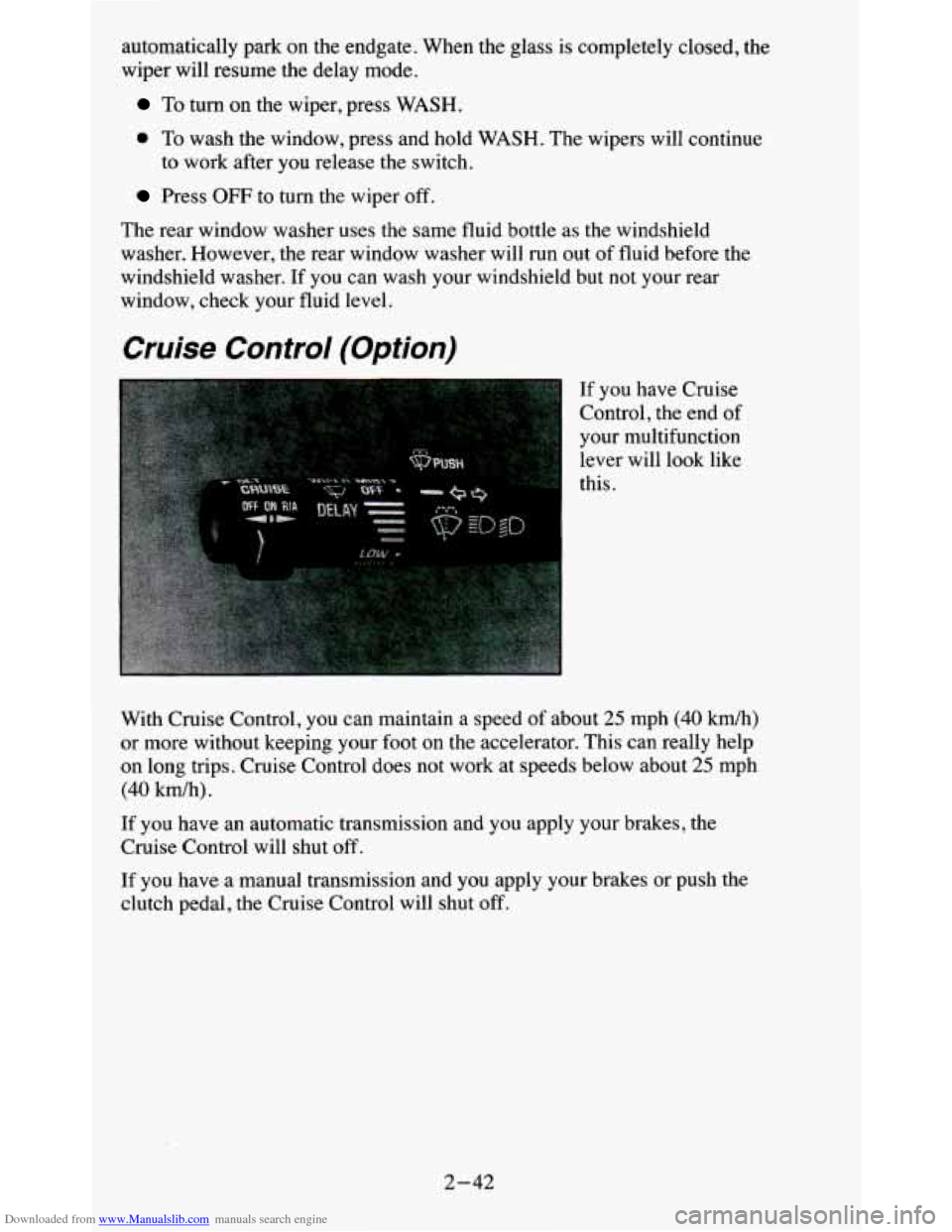
- . .. ,. If you have Cruise
Control, the end of
your multifunction lever will look like
this.
With Cruise Control, you can maintain a speed of about
25 mph (40 kdh)
or more without keeping your foot on the accelerator. This can really help
on long trips. Cruise Control does not work at speeds below about
25 mph
(40 km/h).
If you have an auromatic tran .ission and you apply your brakes, the
Cruise Control will shut
off.
If you have a manual transmission and you apply your brakes or push the
clutch pedal, the Cruise Control will shut off.
2-42
Page 120 of 380
Downloaded from www.Manualslib.com manuals search engine Normal operating range shows your engine speed during normal driving
conditions.
For example, when the needle points to 2, it means the engine is
running at 2,000 revolutions per minute (rpm). The tachometer needle will
vary all the time that the engine is running.
The red warning range tells you that your engine speed is reaching its upper
limits. Don’t drive very long with the tachometer in the red warning range.
If you have a manual transmission, shift to a higher gear as
soon as possible.
If you have an automatic transmission, lift your foot
off of the accelerator
pedal. If you drive for very long with the tachometer in the red danger
range, engine damage will result.
NOTICE:
Do not operate the engine with the tachometer in the red range,
or engine damage will occur.
The red danger range tells you that your engine speed is at its upper limits.
You should immediately shift to a higher gear, or lift your foot
off of the
accelerator pedal. If you drive for very long with the tachometer in the red
danger range, engine damage will result.
Warning Lights and Indicators
This part describes the warning lights and gages that may be on your
vehicle. The pictures will help you locate them.
Warning lights and gages can signal that something is wrong before it
becomes serious enough to cause an expensive repair or replacement.
Paying attention
to your warning lights and gages could also save you or
others from injury.
Warning lights come on when there may be or is a problem with one of your
vehicle’s functions.
As you will see in the details on the next few pages,
some warning lights come on briefly when you start the engine just to let
you know they’re working. If you are familiar with this section, you should
not be alarmed when this happens.
Gages caa indicate when there may be or is a problem with one of your
vehicle’s functions. Often gages and warning lights work together to let you
know when there’s a problem with your vehicle.
When one of the warning lights comes on and stays on when you are
driving, or when one of the gages shows there may be a problem, check the
section that tells you what
to do about it. Please follow this manual’s advice.
Waiting to
do repairs can be costly - and even dangerous. So please get to
know your warning lights and gages. They’re a big help.
2-68
Page 189 of 380
Downloaded from www.Manualslib.com manuals search engine Run your engine only as long as you must. This saves fuel. When you run
the engine, make it go a little faster than just idle. That is, push the
accelerator slightly. This uses less fuel for the heat that you get and it keeps
the battery charged. You will need a well-charged battery to restart the
vehicle, and possibly for signaling later on with your headlights. Let the
heater run for awhile.
Then, shut the engine
off and close the window almost all the way to
preserve the heat. Start the engine again and repeat this only when you feel
really uncomfortable from the cold. But do it as little as possible. Preserve
the
fuel as long as you can. To help keep warm, you can get out of the
vehicle and do some fairly vigorous exercises every half hour
or so until
help comes.
Power Winches
If you wish to use a power winch on your vehicle, only use it when your
vehicle is stationary or anchored.
NOTICE:
Operating a power winch with an automatic transmission in
PARK (P) or a manual transmission in gear may damage the
transmission. Always put the transmission in a Neutral position \
while operating a power winch.
I
Use the regular brakes, set the parking brake or block the wheels to keep
your vehicle from rolling.
If your vehicle is equipped with an airbag, see "Adding Equipment to Your
Air Bag-Equipped Vehicle" in the Index.
4-35
Page 190 of 380
Downloaded from www.Manualslib.com manuals search engine Recreational Vehicle Towing (Four- Wheel
Drive Only)
If your vehicle has four-wheel drive, you may tow it behind another vehicle
providing it
does not have the optional electronic shift transfer case or
all-wheel drive.
Do not tow the vehicle by the rear bumper bar.
NOTICE:
Recreational vehicle towing is not recommended for vehicles
with the optional electronic shift transfer case or all-wheel d\
rive
because the transfer cases have
no neutral position.
Before towing, you should:
1. Set the parking brake firmly.
2. Place the automatic transmission in PARK (P) or the manual
transmission in the lowest gear (FIRST).
3. Firmly attach the vehicle being towed to the tow vehicle. Refe\
r to the
hitch manufacturer’s instructions.
4. Place the transfer case shift lever in NEUTRAL (N).
NOTICE:
Removal of either propeller shaft is unnecessary.
~~ ~~
1. Release the parking brake only after the vehicle being towed i\
s firmly
attached to the tow vehicle.
4-36
Page 195 of 380
Downloaded from www.Manualslib.com manuals search engine e
0
e
Don’t tow a trailer at all during the first 500 miles (800 km) your new
vehicle is driven. Your engine, axle or other parts could be damaged.
Then, during the first
500 miles (800 km) that you tow a trailer, don’t
drive over
50 mph (80 kdh) and don’t make starts at full throttle. This
helps your engine and other parts of your vehicle wear in
at the heavier
loads,
If you have an automatic transmission, you should use
DRIVE (D) (or,
as you need to, a lower gear) when towing
a trailer. Operating your
vehicle in DRIVE (D) when towing a trailer will minimize heat
build-up and extend the life
of your transmission. If you have a manual
transmission and you are towing a trailer, it’s better not to use FIFTH
(5) gear. Just drive in FOURTH (4) gear (or, as you need to, a lower
gear).
Three important considerations have to do with weight:
Weight of the Traikr
How heavy can a trailer safely be?
It depends on how you plan to use your rig. For example, speed, altitude,
road grades, outside temperature and how much your vehicle is used to pull
a trailer are all important. And, it can also depend on any special equipment
that you have on your vehicle.
You can ask your dealer for our trailering information or advice, or you can
write
us at the address listed in your Warranty and Owner Assistance
Information booklet.
In Canada, write to:
General Motors
of Canada Limited
Customer Assistance Center
1908 Colonel Sam Drive
Oshawa, Ontario
L1H 8W
Weight of the Trailer Tongue
The tongue load (A) of any trailer is an important weight to measure
because it affects the total or gross weight of your vehicle. The gross vehicle
weight (GVW) includes the curb weight of the vehicle, any cargo you may
carry in it, and the people who will be riding in the vehicle. And if you will
tow a trailer, you must add the tongue load to the GVW because your
vehicle will be carrying that weight, too. See “Loading Your Vehicle”
in the
Index for more information about your vehicle’s maximum load capacity.
4-41