1995 CHEVROLET ASTRO CARGO VAN warning light
[x] Cancel search: warning lightPage 109 of 342
Downloaded from www.Manualslib.com manuals search engine If the light stays on, or comes on when you’re driving, your vehicle needs
service.
If the regular brake system warning light isn’t on, you still have
brakes, but you don’t have anti-lock brakes. If the regular brake system
warning light
is also on, you don’t have anti-lock brakes and there’s a
problem with your regular brakes. See “Brake System Warning Light”
earlier in this part.
Malfunction Indicator Lamp
(SERVICE ENGINE
SOON)
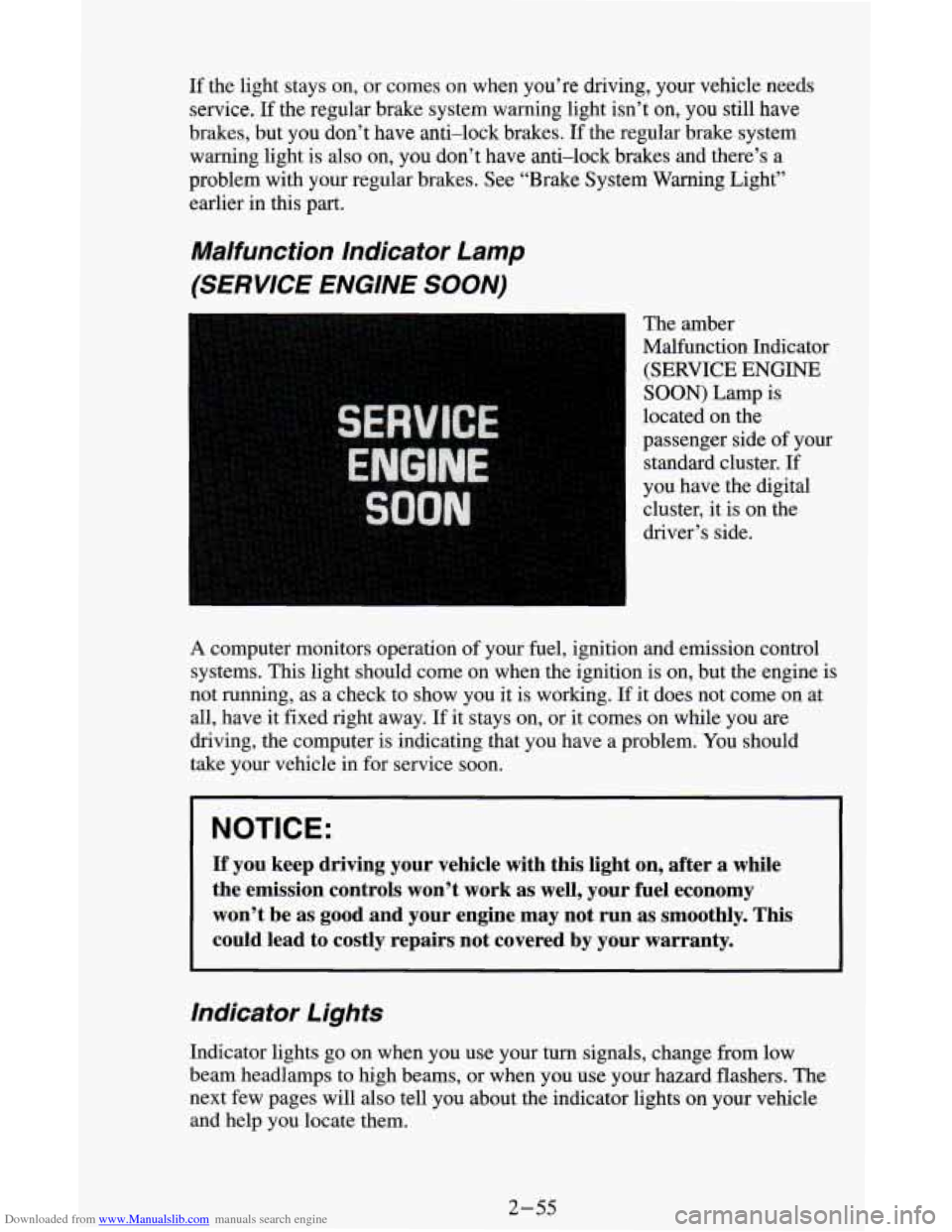
The amber
Malfunction Indicator
(SERVICE
ENGINE
SOON) Lamp is
located on the
passenger side of your
standard cluster. If
you have the digital
cluster, it is
on the
driver’s side.
A computer monitors operation of your fuel, ignition and emission control
systems. This light should come on when the ignition is
on, but the engine is
not running, as a check to show you it is working.
If it does not come on at
all, have it fixed right away.
If it stays on, or it comes on while you are
driving, the computer is indicating that you have a problem. You should
take your vehicle in for service soon.
NOTICE:
If you keep driving your vehicle with this light on, after a whi\
le
the emission controls won’t work as well, your fuel economy \
won’t be as good and your engine may not run as smoothly. \
This
could lead to costly repairs not covered by your warranty.
Indicator Lights
Indicator lights go on when you use your turn signals, change from low
beam headlamps to high beams, or when you use your hazard flashers.
The
next few pages will also tell you about the indicator lights on your vehicle
and help you locate them.
2-55
Page 153 of 342
Downloaded from www.Manualslib.com manuals search engine Some Other Rainy Weather Tips
Turn on your low-beam headlamps - not just your parking lamps -
0 Besides slowing down, allow some extra following distance. And be
to help make you more visible to others.
especially careful when you pass another vehicle. Allow yourself more
clear room ahead, and be prepared to have your view restricted by road
spray.
Have good tires with proper tread depth. (See “Tires” in the Index.)
City Driving
a
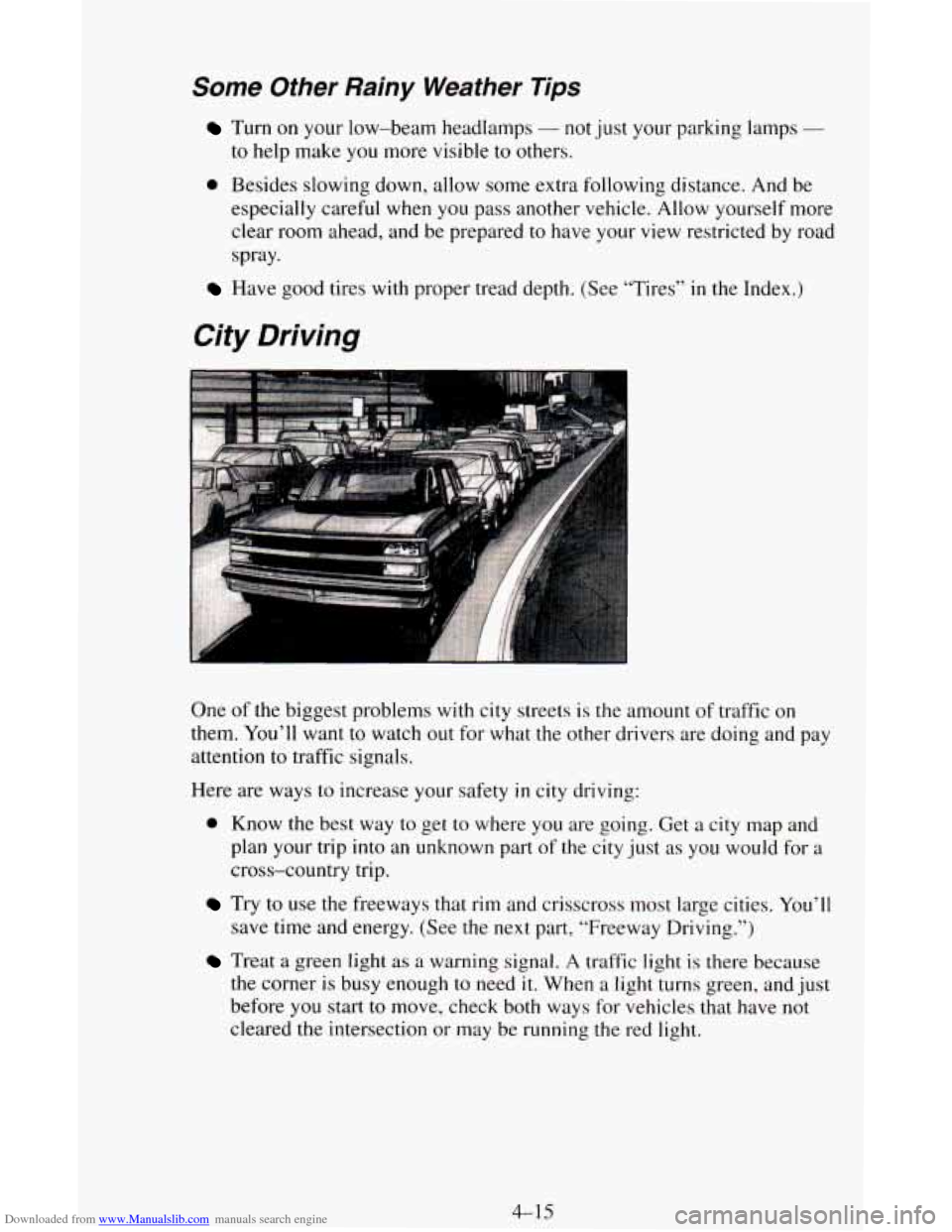
One of the biggest problems with city streets is the amount of traffic on
them. You’ll want to watch out for what the other drivers are doing and pay
attention
to traffic signals.
Here are ways to increase your safety
in city driving:
0 Know the best way to get to where you are going. Get a city map and
plan your trip into an unknown part
of the city just as you would for a
cross-country trip.
save time and energy. (See the next part, “Freeway Driving.”)
Treat a green light as a warning signal. A traffic light is there because
the corner is busy enough to need
it. When a light turns green, and just
before
you start to move, check both ways for vehicles that have not
cleared the intersection or may be running
the red light.
Try to use the freeways that rim and crisscross most large cities. You’ll
4-15
Page 158 of 342
Downloaded from www.Manualslib.com manuals search engine Include an ice scraper, a small brush or broom, a supply of windshield
washer fluid, a rag, some winter outer clothing, a small shovel, a flashlight,
a red cloth, and a couple of reflective warning triangles. And, if you will be
driving under severe conditions, include a small bag of sand, a piece of old
carpet or
a couple of burlap bags to help provide traction. Be sure you
properly secure these items in your vehicle.
Driving on Snow or Ice
Most of the time, those places where your tires meet the road probably have
good traction.
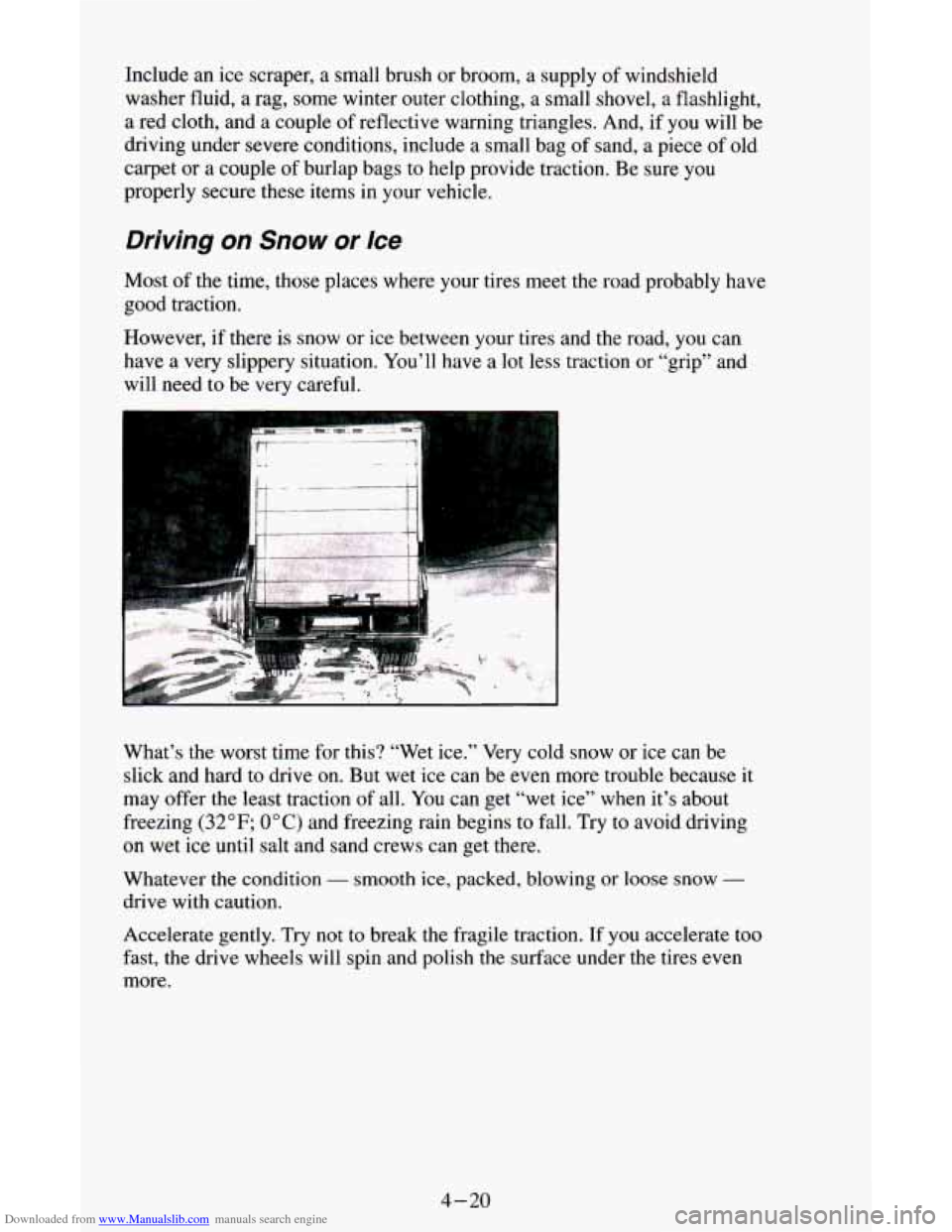
However, if there is snow or ice between your tires and the road, you can
have a very slippery situation. You’ll have a lot less traction or “grip” and
will need to be
very careful.
r tr“r“‘ ................... ..-......--.-
-- ..
I-.! .................. I
ii ,,-~ . .........._I........-.X i
What’s the worst time for this? “Wet ice.” Very cold snow or ice can be
slick and hard to drive
on. But wet ice can be even more trouble because it
may offer the least traction of all. You can get “wet ice” when it’s about
freezing
(32°F; 0°C) and freezing rain begins to fall. Try to avoid driving
on wet
ice until salt and sand crews can get there.
Whatever the condition
- smooth ice, packed, blowing or loose snow -
drive with caution.
Accelerate gently. Try not to break the fragile traction. If you accelerate too
fast, the drive wheels will spin and polish the surface under the tires even
more.
4-20
Page 174 of 342
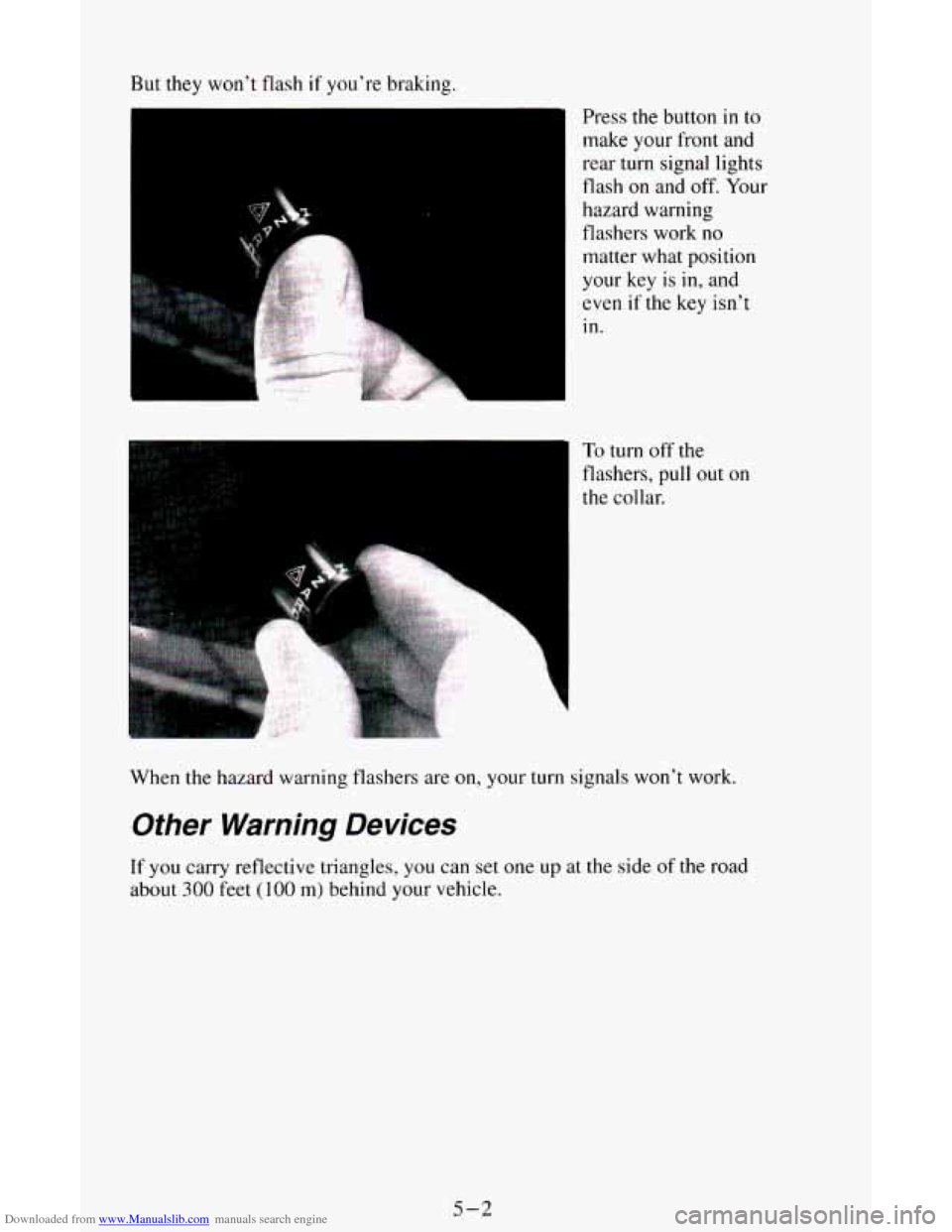
Downloaded from www.Manualslib.com manuals search engine But they won’t flash if you’re braking. Press the button
in to
make your front and
rear turn signal lights
flash
on and off. Your
hazard warning
flashers work no
matter what position
your key
is in, and
even
if the key isn’t
in.
To turn off the
flashers, pull out on
the collar.
When the hazard warning flashers are on, your turn signals
won’t work.
Other Warning Devices
If you carry reflective triangles, you can set one up at the side of the road
about
300 feet (100 m) behind your vehicle.
5-2
Page 231 of 342
Downloaded from www.Manualslib.com manuals search engine What to Use
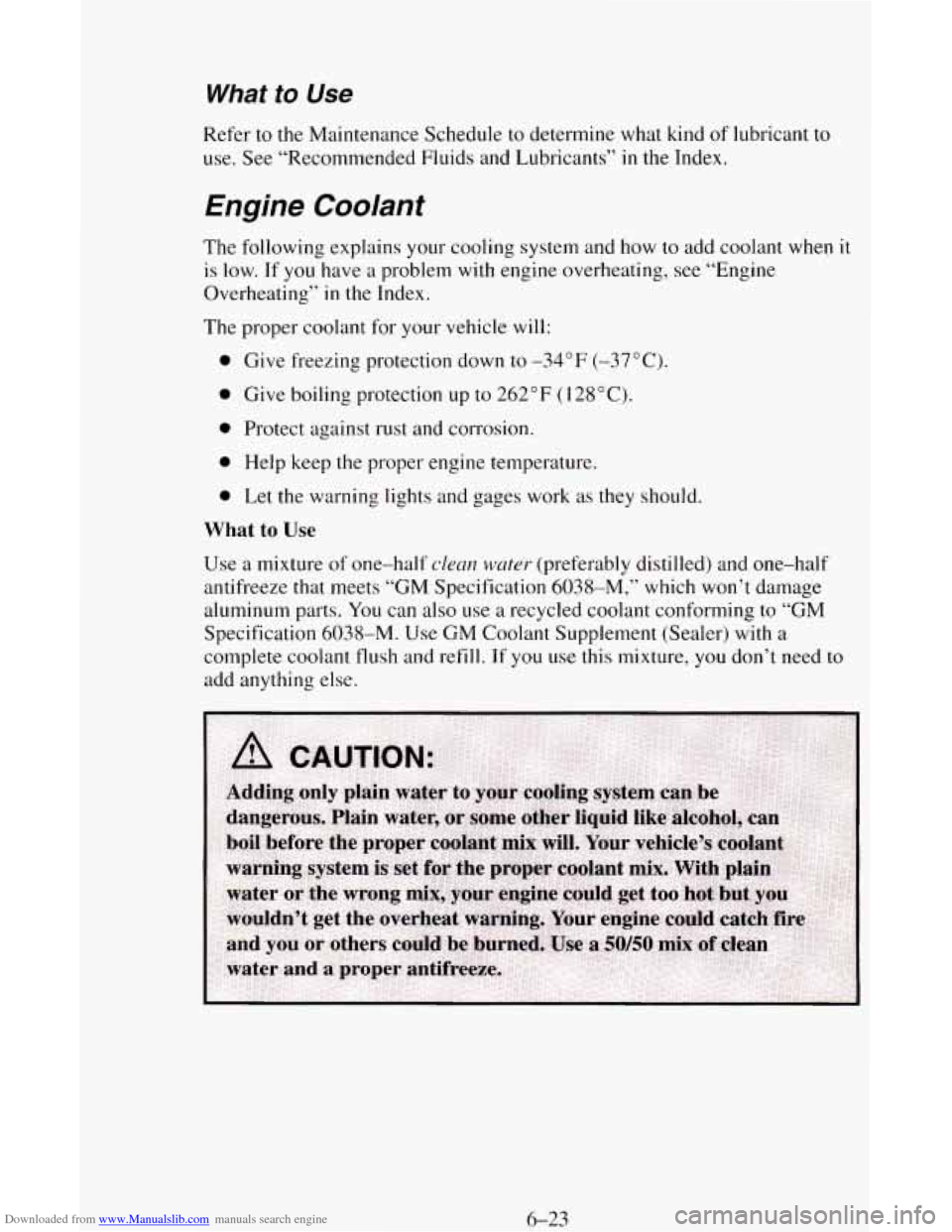
Refer to the Maintenance Schedule to determine what kind of lubricant to
use. See “Recommended Fluids and Lubricants”
in the Index.
Engine Coolant
The following explains your cooling system and how to add coolant when it
is low. If you have a problem with engine overheating, see “Engine
Overheating”
in the Index.
The proper coolant
for your vehicle will:
0 Give freezing protection down to -34°F (-37°C).
0 Give boiling protection up to 262 OF ( 1 28 O C).
0 Protect against rust and corrosion.
0 Help keep the proper engine temperature.
0 Let the warning lights and gages work as they should.
What to Use
Use a mixture of one-half clean wafer (preferably distilled) and one-half
antifreeze that meets
“GM Specification 6038-M,” which won’t damage
aluminum parts. You can also use a recycled coolant conforming to “GM
Specification 6038-M. Use
GM Coolant Supplement (Sealer) with a
complete coolant flush and refill.
If you use this mixture, you don’t need to
add anything else.
6-23
Page 239 of 342
Downloaded from www.Manualslib.com manuals search engine Brake Wear
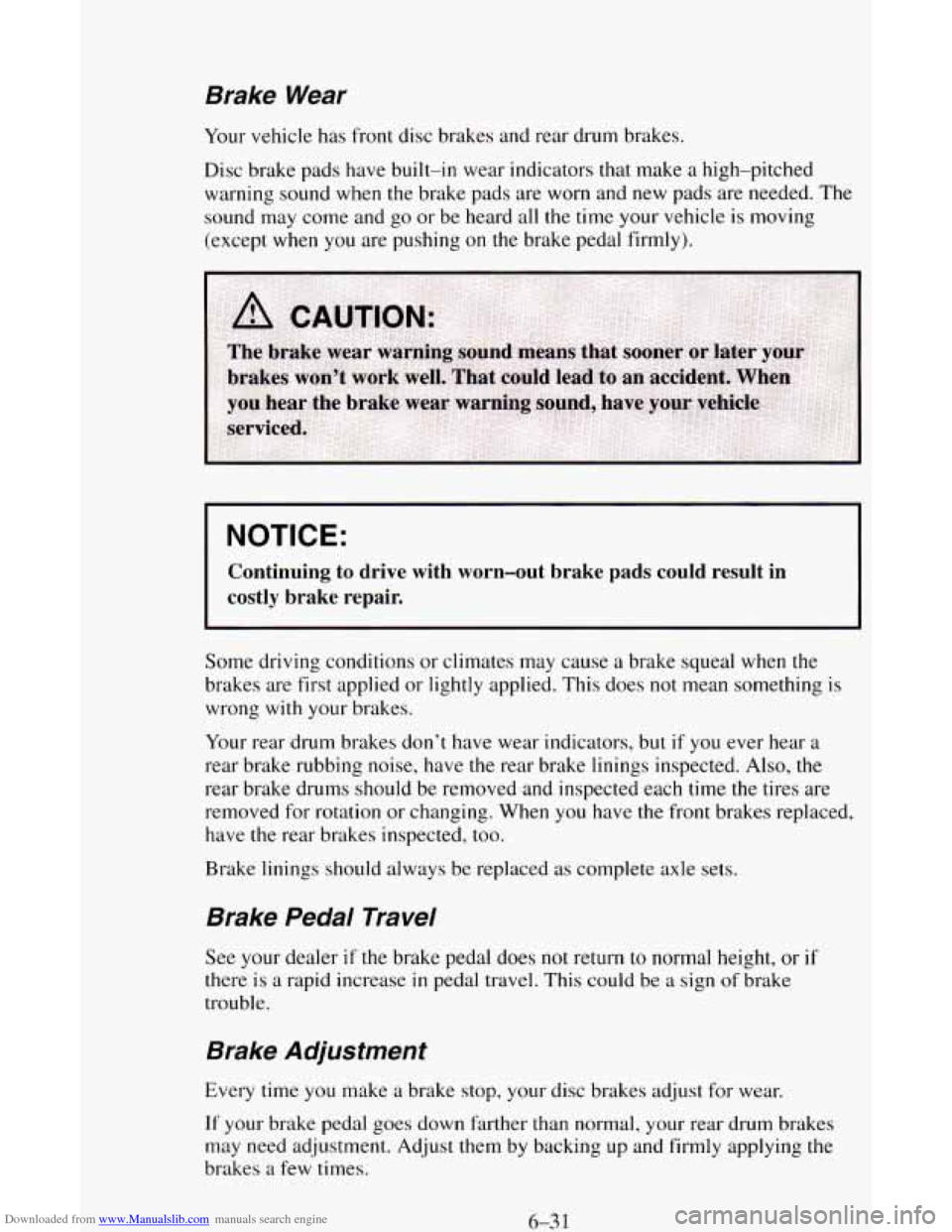
Your vehicle has front disc brakes and rear drum brakes.
Disc brake pads have built-in wear indicators that make
a high-pitched
warning sound when the brake pads are worn and new pads are needed. The
sound may come and go or be heard all the time your vehicle is moving
(except when you are pushing
on the brake pedal firmly).
NOTICE:
Continuing to drive with worn-out brake pads could result in
costly brake repair.
Some driving conditions or climates may cause a brake squeal when the
brakes are first applied or lightly applied. This does not mean something is
wrong with your brakes.
Your rear drum brakes don’t have wear indicators, but
if you ever hear a
rear brake rubbing noise, have the rear brake linings inspected. Also,
the
rear brake drums should be removed and inspected each time the tires are
removed for rotation or changing. When you have the front brakes replaced,
have
the rear brakes inspected, too.
Brake linings should always be replaced
as complete axle sets.
Brake Pedal Travel
See your dealer if the brake pedal does not return to normal height, or if
there is a rapid increase in pedal travel. This could be a sign of brake
trouble.
Brake Adjustment
Every time you make a brake stop, your disc brakes adjust for wear.
If your brake pedal goes down Farther than normal, your rear drum brakes
may need adjustment. Adjust them by backing
up and firmly applying the
brakes a few times.
6-3 1
Page 333 of 342
Downloaded from www.Manualslib.com manuals search engine index
A
Adding Equipment to Your Air Bag-Equipped Vehicle (See “Supplemental
Inflatable Restraint System (SIR)”)
Air Bag (See “Supplemental Inflatable Restraint System (SIR)”)
Readiness Light (See “Lights”)
Air Cleaner (See “Engine-Air Cleaner”)
Air Conditioning (See “Heater/Air Conditioning Controls”)
All-Wheel Drive (Option)
.................................... 2.27, 6.21
How to Check
................................................ 6-21
Whentocheck
............................................... 6-21
Antennacare
................................................... 3-20
Anti-Lock Brakes (See “Brakes”)
Appearance Care
................................................. 6-48
Materials Chart
............................................... 6-56
Arbitration Program (See “Better Business Bureau Mediation”)
Assist Handles
.................................................. 2-47
Care of Your Cassette Player and Tape
............................. 3-19
Care of Compact Discs
......................................... 3-20
Delco LOC II@ Anti-Theft Feature
............................... 3-17
ETR@ AM Radio
.............................................. 3-7
ETR@ AM-FM Stereo Audio Cassette System
....................... 3-9
ETR@ AM-FM Stereo Audio Cassette System with Equalizer
.......... 3-12
ETR@ AM-FM Stereo Audio Compact Disc (CD) System
............. 3-14
ETR@ AM-FM Stereo Audio System
.............................. 3-8
Understanding Radio Reception
.................................. 3-18
Audiosystems
................................................... 3-6
Automatic Transmission
( See “Transmission”)
Axle Front
....................................................... 6-21
LockingRear
................................................. 2-22
Rear
........................................................ 6-22
Battery
........................................................ 6-32
Belts (See “Safety Belts”)
Better Business Bureau Mediation
.................................... 8-3
Beveragecooler
................................................. 2-48
Blizzard (See “Driving-If You’re Caught
in a Blizzard”)
Brakes Adjustment
.................................................. 6-31
Anti-Lock (ABS)
.............................................. 4-6
Anti-Lock Warning Light (See “Lights”)
Master Cylinder
............................................... 6-29
PedalTravel
................................................. 6-31
System Warning Light (See “Lights”)
To Check Brake Fluid
.......................................... 6-30
Trailer (See “Trailer-Brakes”)
Wear
....................................................... 6-31
Parking
..................................................... 2-21
Replacingparts
............................................... 6-32
1
Page 336 of 342
Downloaded from www.Manualslib.com manuals search engine Engine (continued) Oil (See “Oil”)
Overheating
.................................................. 5-13
RunningWhileParked
......................................... 2-26
Starting
..................................................... 2-15
Exhaustsystem
................................................. 6-40
Filter Replacement Chart (See “Service-Replacement Parts and Filter
Recommendations”)
Fluid Capacities (See “Capacities and Specification”)
FluidLeakCheck
................................................ 6-33
Fluids (See “Scheduled Maintenance Services”)
Fuel FillingYourTmk
.............................................. 6-4
Foreign Countries .............................................. 64
Gage (See “Gages”)
Cholines for Cleaner Air
........................................ 6-3
Tank Capacity
................................................ 6-62
Fuses and Circuit Breakers
................................... 6-60. 6-65
FuseBlock
.................................................. 6-61
G
Gages Engine Coolant Temperature Gage
................... ........ 2-58
Odometer
................................................... 2-50
Speedometer
................................................. 2-50
FuelGage ................................................. 2-60
Oil Pressure Gage
............................................. 2-59
Tamper Resistant Odometer
..................................... 2-50
Trip Odometer
................................................ 2-51
Voltlneter .................................................... 2-61
Halogen Bulbs (See “Bulb Replacement”)
Head Restraints (See “Seats”)
Headlamps
Hazard Warning Flashers
........................................... 5- . 1
High Beam Indicator Light (See
“Lights”)
High-Low Beamchanger
...................................... 2-31
Reminder
.................................................... 2-42
Replacement (See “Bulb Replacement”)
Heatercontrols
.................................................. 3-1
Rear Heater (Option)
............................................ 3-3
HeatedAir Conditioning Controls
............................... 3-2, 6-40
Rear Air Conditioning (Option)
................................... 3-4
Refrigerant Capacity
........................................... 6-68
Highway Hypnosis (See “Driving-Highway Hypnosis”)
Hitches (See “Towing-Hitches”)
4