Page 151 of 410
Downloaded from www.Manualslib.com manuals search engine Anti-Lock Brake System Warning Light
ANTI-
LOCK (0 ABS)
With the anti-lock brake system, this light will come on when you start
your engine and may stay on
for several seconds. That’s normal. If the
light doesn’t come on, have it fixed
so it will be ready to warn you if there
is a problem.
If the light stays on, turn the ignition off. Or, if the light comes on when
you’re driving, stop as soon as possible and turn the ignition
off. Then
start the engine again to reset the system. If the light still stays
on, or
comes on again while you’re driving, your Cadillac needs service.
If the
regular brake system warning light isn’t on, you still have brakes, but you
don’t have anti-lock brakes.
If the regular brake system warning light is
also on, you don’t have anti-lock brakes and there’s
a problem with your
regular brakes.
See “Brake System Warning Light” earlier in this part.
Traction Disabled Message
If this message is displayed, there’s a problem with your traction control
system and your vehicle needs service. When this message is displayed,
the system will not limit wheel spin. Adjust your driving accordingly.
-,.
c-
2-80
Page 161 of 410
Downloaded from www.Manualslib.com manuals search engine Driver Information Center Messages
These messages will appear if there is a problem sensed in one of your
vehicle’s systems. Vehicles that are first sold in Canada will have
a number
after each message. This number helps to identify the message which is
only displayed in English.
APPLY BRAKE TO SHIFT - 46
This message will appear if your vehicle is in PARK (P) for about 15
seconds and the brake is not pressed in. If you do not want this message to
appear, you can cancel it by holding the
OFF and the blue (cooler) button
on the Electronic Climate Control panel for about
five seconds. Hold the
same
two buttons again to have this message displayed again.
A/C OVERHEATED - A/C COMPRESSOR OFF - 15
If the refrigerant system ever reaches an over-pressure condition, this
message will appear to tell
you that the air conditioning compressor has
been turned
off. Air conditioned air will not be delivered to cool your
vehicle. If the pressure returns to a normal operating range, you must
select
AUTO, DEFOG or DEFROST to start the compressor. If this
message continues to appear, have the system repaired as soon
as possible
to avoid compressor damage.
BATTERY NO CHARGE - 07
This message will appear if your battery is not being charged. Have your
electrical system checked by your Cadillac dealership at your earliest
convenience.
BATTERY VOLTS HIGH - 08
This message shows that the electrical charging system is overcharging
(more than
16 volts). To avoid being stranded have the electrical system
checked
by your Cadillac dealership. You can reduce the charging
overload by using the accessories. Turn
on the lamps and radio, set the
climate control on
AUTO and the fan speed on HI, and turn the rear
window defogger on.
You can monitor battery voltage on the Driver
Information Center
by toggling the INFORMATION button. The normal
range is
11.5 to 15.5 volts when the engine is running.
c
2-90
-d
Page 162 of 410
Downloaded from www.Manualslib.com manuals search engine BATTERY VOLTS LOW - 06
_L-.
This message will appear when the electrical system is charging less than
10 volts or if the battery has been drained. If this message appears
immediately after starting, it is possible that the generator can still
recharge the battery. The battery should recharge after driving a few miles
and the message should go out.
If this message appears while driving or
after starting your vehicle and stays on, have it checked immediately to
-~ determine the cause of this problem. To help the generator recharge the
battery quickly you can reduce the load on the electrical system by turning
off your accessories. You can monitor battery voltage on the Driver
Information Center by toggling the INFORMATION button. The normal
range is
11.5 to 15.5 volts.
-
CHANGE TRANS FLUID - 47
~- This message will appear when it is time to replace the transaxle fluid. See
your maintenance schedule booklet
for the proper fluid and change
intervals.
CHECK BRAKE FLUID - 37
This message is displayed to inform the driver that the brake reservoir
fluid level
is low. Check the brake reservoir level and add as needed. Have
the brake system serviced by
a Cadillac technician as soon as possible. If
the brake warning light is on, follow the directions in that part.
CHECK COOLANT LEVEL - 04
This message will appear when there is a low level of engine coolant.
Have the cooling system serviced by a Cadillac technician
as soon as
possible.
CHECK FUEL GAGE - 39
This message will appear when your fuel supply is less than four gallons
and your display
is turned off.
Page 193 of 410
Downloaded from www.Manualslib.com manuals search engine DEFENSIVE DRWTNG
The best advice anyone can give about driving is: Drive defensively.
Please start with a very important safety device in your Cadillac: Buckle
up. (See “Safety Belts”
in the Index.)
Defensive driving really means “be ready for anything.”
On city streets,
rural roads, or freeways,
it means “always expect the unexpected.”
Assume that pedestrians or other drivers are going
to be careless and
make mistakes. Anticipate what they might do. Be ready for their
mistakes.
Rear-end collisions are about the most preventable of accidents. Yet they
are common. Allow enough following distance. It’s the best defensive
driving maneuver, in both city and rural driving. You never know when
the vehicle in front of you is going to brake
or turn suddenly.
DRUNICEN DMNG
Death and injury associated with drinking and driving is a national
tragedy. It’s the number one contributor to the highway death toll,
claiming thousands
of victims every year.
Alcohol affects four things that anyone needs to drive a vehicle:
0 Judgment
Muscular Coordination
Vision
0 Attentiveness
L-i
c
Police records show that almost half of all motor vehicle-related deaths
involve alcohol.
In most cases, these deaths are the result of someone who -
was drinking and driving. In recent years, some 18,000 annual motor
vehicle-related deaths have been associated with the use of alcohol, with
more than
300,000 people injured.
Page 197 of 410
Downloaded from www.Manualslib.com manuals search engine CONTROL OFA VEHICLE 7
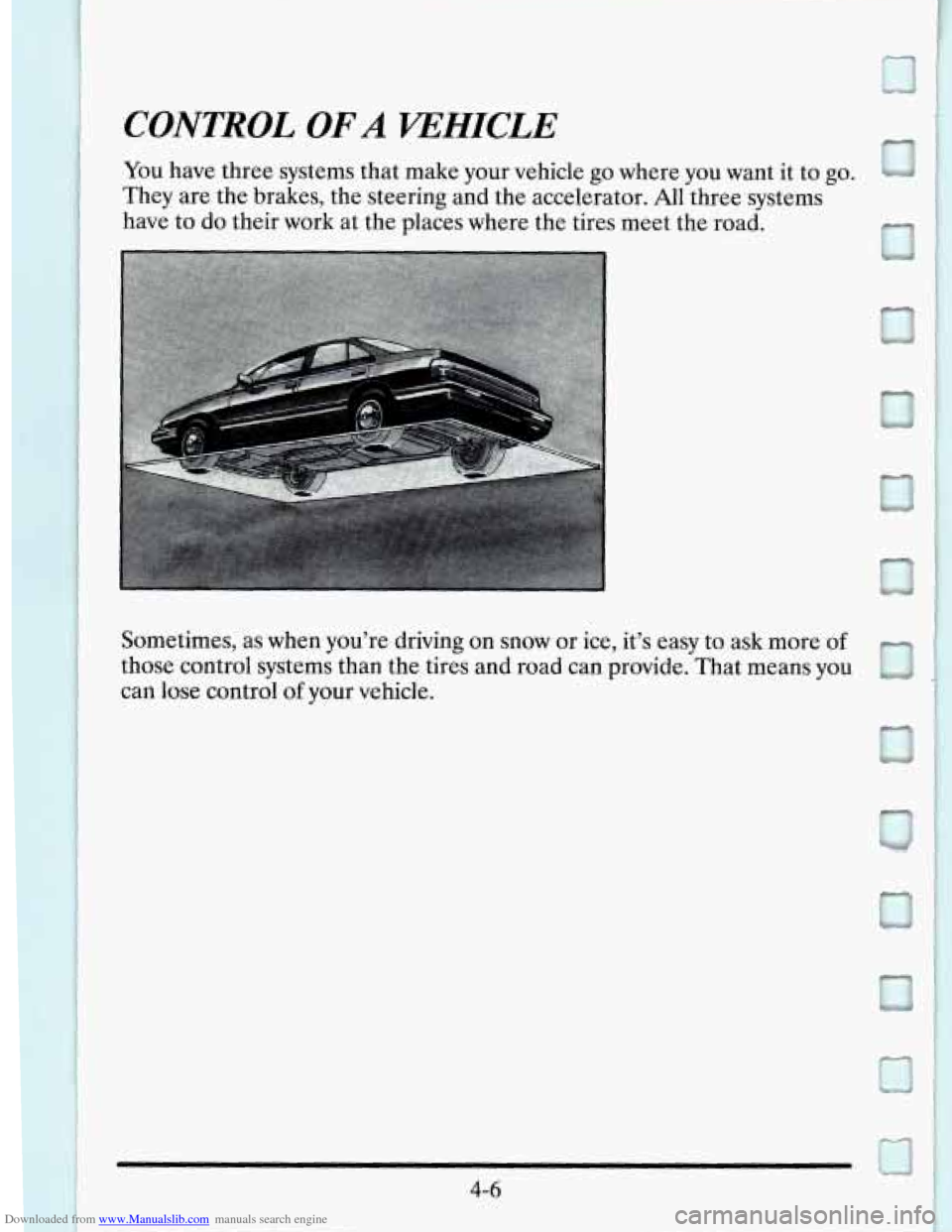
You have three systems that make your vehicle go where you want it to go. cd
They are the brakes, the steering and the accelerator. All three systems
have to do their work at the places where the tires meet the road.
Sometimes, as when you're driving on snow or ice, it's easy to ask more
of
those control systems than the tires and road can provide. That means you
can lose control
of your vehicle.
4-6
Page 198 of 410
Downloaded from www.Manualslib.com manuals search engine Braking action involves perception time and reaction time.
First,
you have to decide to push on the brake pedal. That’sperception
time. Then you have to bring up your foot and do it. That’s reaction time.
Average reaction time is about
3/4 of a second. But that’s only an average.
It might be less with one driver and as long as
two or three seconds or
more with another. Age, physical condition, alertness, coordination, and
eyesight all play a part.
So do alcohol, drugs and frustration. But even in
3/4
of a second, a vehicle moving at 60 mph (100 km/h) travels 66 feet
(20 m). That could be a lot of distance in an emergency, so keeping
enough space between your vehicle and others is important.
And,
of course, actual stopping distances vary greatly with the surface of
the road (whether it’s pavement or gravel); the condition of the road
(wet, dry, icy); tire tread; and the condition
of your brakes.
Avoid needless heavy braking. Some people drive in spurts
-- heavy
acceleration followed by heavy braking
-- rather than keeping pace with
traffic. This is a mistake. Your brakes may not have time to cool between
hard stops. Your brakes will wear out much faster if
you do a lot of heavy
braking.
If you keep pace with the traffic and allow realistic following
distances, you will eliminate a lot
of unnecessary braking. That means
better braking and longer brake life.
If your engine ever stops while you’re driving, brake normally but don’t
pump your brakes. If you do, the pedal may get harder to push down. If
your engine stops, you will still have some power brake assist. But
you
will use it when you brake. Once the power assist is used up, it may take
longer to stop and the brake pedal will be harder to push.
4-7
Page 199 of 410
Downloaded from www.Manualslib.com manuals search engine Anti-Lock Brakes (ABS)
Your Cadillac has an advanced electronic braking system that will help
prevent a braking skid.
ANTI-
LOCK (0 ABS)
This light on the instrument panel will come on briefly when you start
your vehicle.
When you start your vehicle and begin to drive away, you may hear a
momentary motor or clicking noise.
And you may even notice that your
brake pedal moves a little while this is going on. This is the
ABS system
testing itself.
If there’s a problem with the anti-lock brake system, the
anti-lock brake system warning light will stay on.
See “Anti-Lock Brake System Warning Light” in the Index.
c-
-
c ..*
4-8
Page 200 of 410
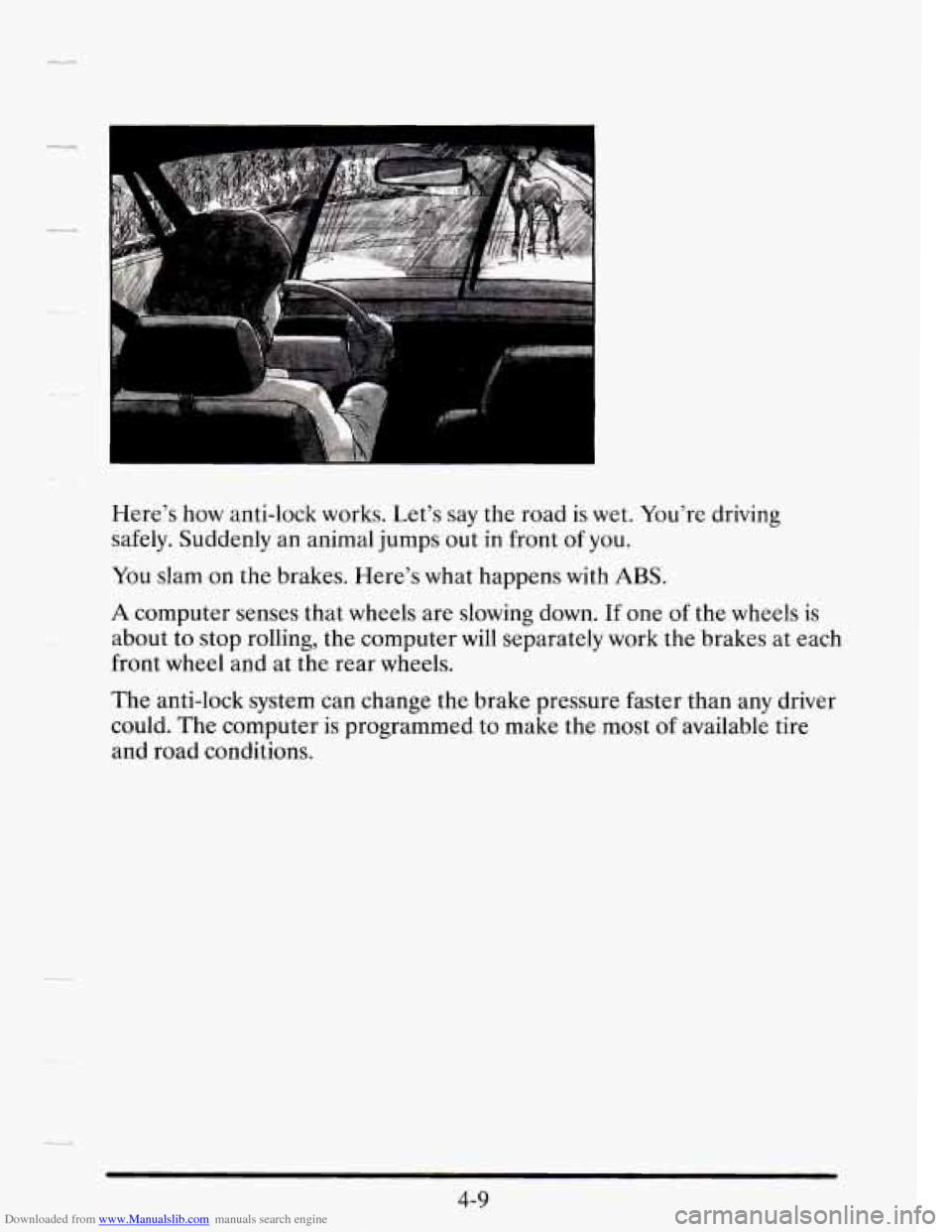
Downloaded from www.Manualslib.com manuals search engine Here’s how anti-lock works. Let’s say the road is wet. You’re driving
safely. Suddenly an animal jumps out
in front of you.
You slam on the brakes. Here’s what happens with
ABS.
A computer senses that wheels are slowing down. If one of the wheels is
about to stop rolling, the computer
will separately work the brakes at each
front wheel and at the rear wheels.
The anti-lock system can change the brake pressure faster than any driver
could.
The computer is programmed to make the most of available tire
and road conditions.