1995 CADILLAC ELDORADO lights
[x] Cancel search: lightsPage 200 of 395
Downloaded from www.Manualslib.com manuals search engine 0
0
c
0
0
0
0
0 0
0
“Drive ahead.” Look down the road, to the sides, and to crossroads for
situations that might affect your passing patterns.
If you have any doubt
whatsoever about making a successful pass, wait for a better time.
Watch for traffic signs, pavement markings, and lines. If you can see a
sign up ahead that might indicate a turn or an intersection, delay your
pass.
A broken center line usually indicates it’s all right to pass
(providing the road ahead is clear). Never cross a solid line
on your
side of the lane or a double solid line, even
if the road seems empty of
approaching traffic.
Do not get too close to the vehicle
you want to pass while you’re
awaiting an opportunity.
For one thing, following too closely reduces
your area of vision, especially
if you’re following a larger vehicle. Also,
you won’t have adequate space if the vehicle ahead suddenly slows or
stops. Keep back a reasonable distance.
When it looks like a chance to pass
is coming up, start to accelerate
but stay in the right lane and don’t get too close. Time your move
so
you will be increasing speed as the time comes to move into the other
lane.
If the way is clear to pass, you will have a “running start” that
more than makes up for the distance you would lose
by dropping back.
And
if something happens to cause you to cancel your pass, you need
only slow down and drop back again and wait for another opportunity.
If other cars are lined up to pass a slow vehicle, wait your turn. But
take care that someone isn’t trying to pass
you as you pull out to pass
the
slow vehicle. Remember to glance over your shoulder and check
the blind spot.
Check your mirrors, glance over your shoulder, and start your left lane
change signal before moving out
of the right lane to pass. When you
are far enough ahead
of the passed vehicle to see its front in your
inside mirror, activate your right lane change signal and move back
into the right lane. (Remember that your right outside mirror is
convex. The vehicle
you just passed may seem to be farther away from
you than it really is.)
Try not to pass more than one vehicle at a time on two-lane roads.
Reconsider before passing the next vehicle.
Don’t overtake a slowly moving vehicle too rapidly. Even though the
brake lights are not flashing, it may be slowing down or starting to turn.
If you’re being passed, make it easy for the following driver to get
ahead
of you. Perhaps you can ease a little to the right.
4-13
Page 203 of 395
Downloaded from www.Manualslib.com manuals search engine Night Vision
No one can see as well at night as in the daytime. But as we get older
these differences increase.
A SO-year-old driver may require at least twice
as much light to see the same thing at night as a 20-year-old.
What you do
in the daytime can also affect your night vision. For example,
if you spend the day in bright sunshine you are wise to wear sunglasses.
Your eyes will have less trouble adjusting to night. But
if you’re driving,
don’t wear sunglasses at night. They may cut down
on glare from
headlamps, but
they also make a lot of things invisible.
You can be temporarily blinded by approaching lights. It can take a
second or
two, or even several seconds, for your eyes to readjust to the
dark. When you are faced with severe glare
(as from a driver who doesn’t
lower the high beams,
or a vehicle with misaimed headlamps), slow down
a little. Avoid staring directly into the approaching lights.
Keep your windshield and all the glass on your vehicle clean
-- inside and
out. Glare at night is made much worse by dirt on the glass. Even the
inside
of the glass can build up a film caused by dust. Dirty glass makes
lights dazzle and flash more than clean glass would, making the pupils
of
your eyes contract repeatedly.
Remember that your headlamps light up
far less of a roadway when you
are
in a turn or curve. Keep your cyes moving; that way, it’s easier to pick
out dimly lighted objects. Just as your headlamps should be checked
regularly for proper aim,
so should your eyes be examined regularly.
Some drivers suffer from night blindness
-- the inability to see in dim
light
-- and aren’t even aware of it.
Page 224 of 395

Downloaded from www.Manualslib.com manuals search engine Driving with a Trailer
n Towing a trailer requires a certain amount of experience. Before setting
out for the open road, you’ll want to get to
know your rig. Acquaint
yourself with the feel
of handling and braking with the added weight of
the trailer. And always keep in mind that the vehicle you are driving is
now a good deal longer and not nearly as responsive as your vehicle is by
itself.
Before you start, check the trailer hitch and platform (and attachments),
safety chains, electrical connector, lamps, tires and mirror adjustment. If
the trailer has electric brakes, start your vehicle and trailer moving and
then apply the trailer brake controller by hand to be sure the brakes are
working. This lets you check your electrical connection at the same time.
. During your trip, check occasionally to be sure that the load is secure, and
that the lights and any trailer brakes are still working.
Following Distance
Stay at least twice as far behind the vehicle ahead as you would when
driving your vehicle without a trailer. This can help you avoid situations
that require heavy braking and sudden turns.
Passing
You’ll need more passing distance up ahead when you’re towing a trailer.
And, because you’re a good deal longer, you’ll need to
go much farther
beyond the passed vehicle before you can return to your lane.
Backing Up
Hold the bottom of the steering wheel with one hand. Then, to move the
trailer to the left, just move that hand to the left.
To move the trailer to
the right, move your hand to the right. Always back up slowly and,
if
possible, have someone guide you.
4-37
Page 282 of 395
Downloaded from www.Manualslib.com manuals search engine C
ENGINE COOLANT
The following explains your cooling system and how to add coolant when
it is low. If you have a problem with engine overheating, see “Engine
Overheating”
in the Index.
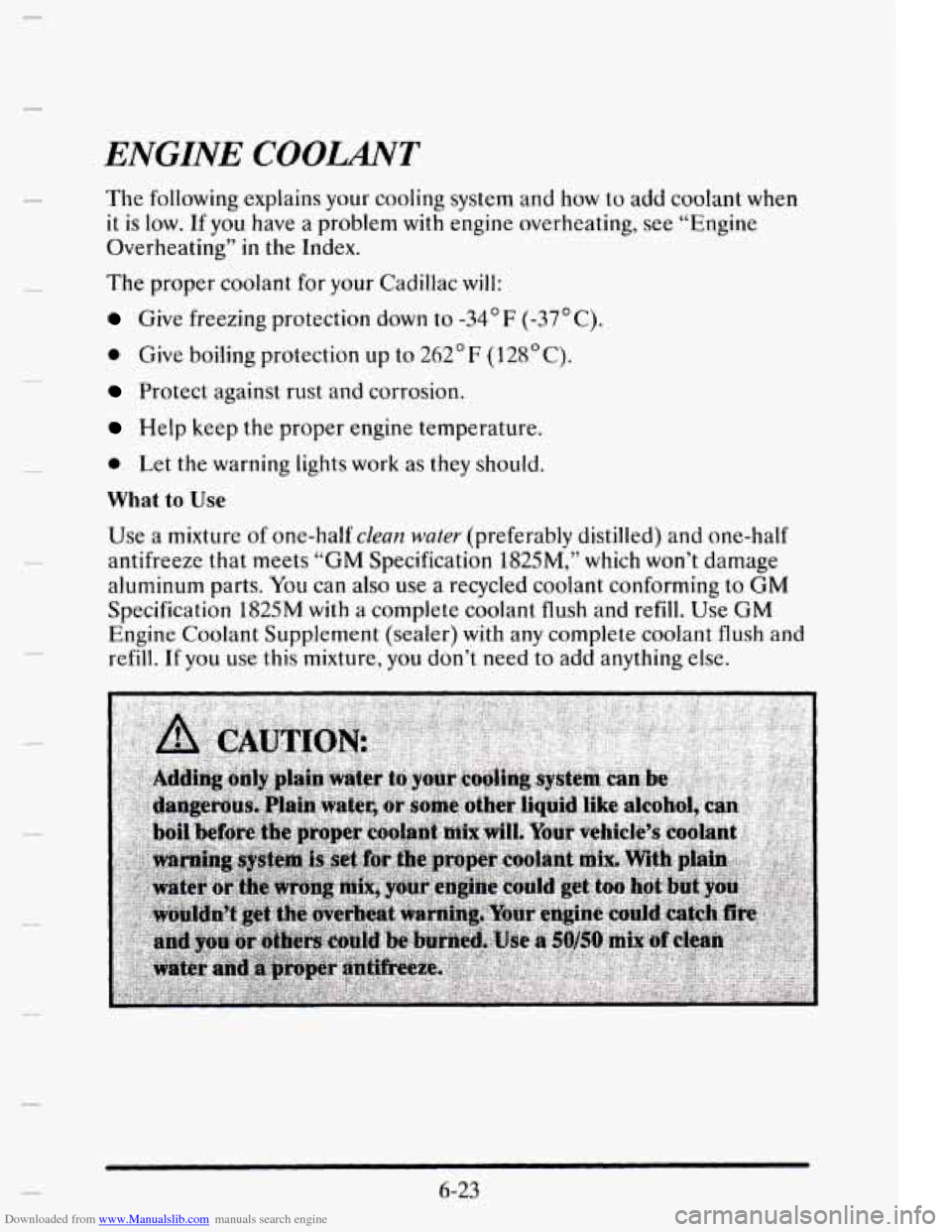
The proper coolant for your Cadillac
will:
Give freezing protection down to -34’F (-37OC).
0 Give boiling protection up to 262’F (128OC).
Protect against rust and corrosion.
Help keep the proper engine temperature.
0 Let the warning lights work as they should.
What to Use
Use a mixture of one-half clean water (preferably distilled) and one-half
antifreeze that meets
“GM Specification 1825M,” which won’t damage
aluminum parts. You can also use
a recycled coolant conforming to GM
Specification 1825M with a complete coolant flush and refill. Use GM
Engine Coolant Supplement (sealer) with any complete coolant flush and
refill. If you use this
mixture, you don’t need to add anything else.
6-23
Page 293 of 395
Downloaded from www.Manualslib.com manuals search engine 6. With the car in OVERDRIVE (a), turn the Electronic Climate
7. Turn your engine off.
Control to AUTO and let the engine idle for three minutes or more.
Now your computer is programmed.
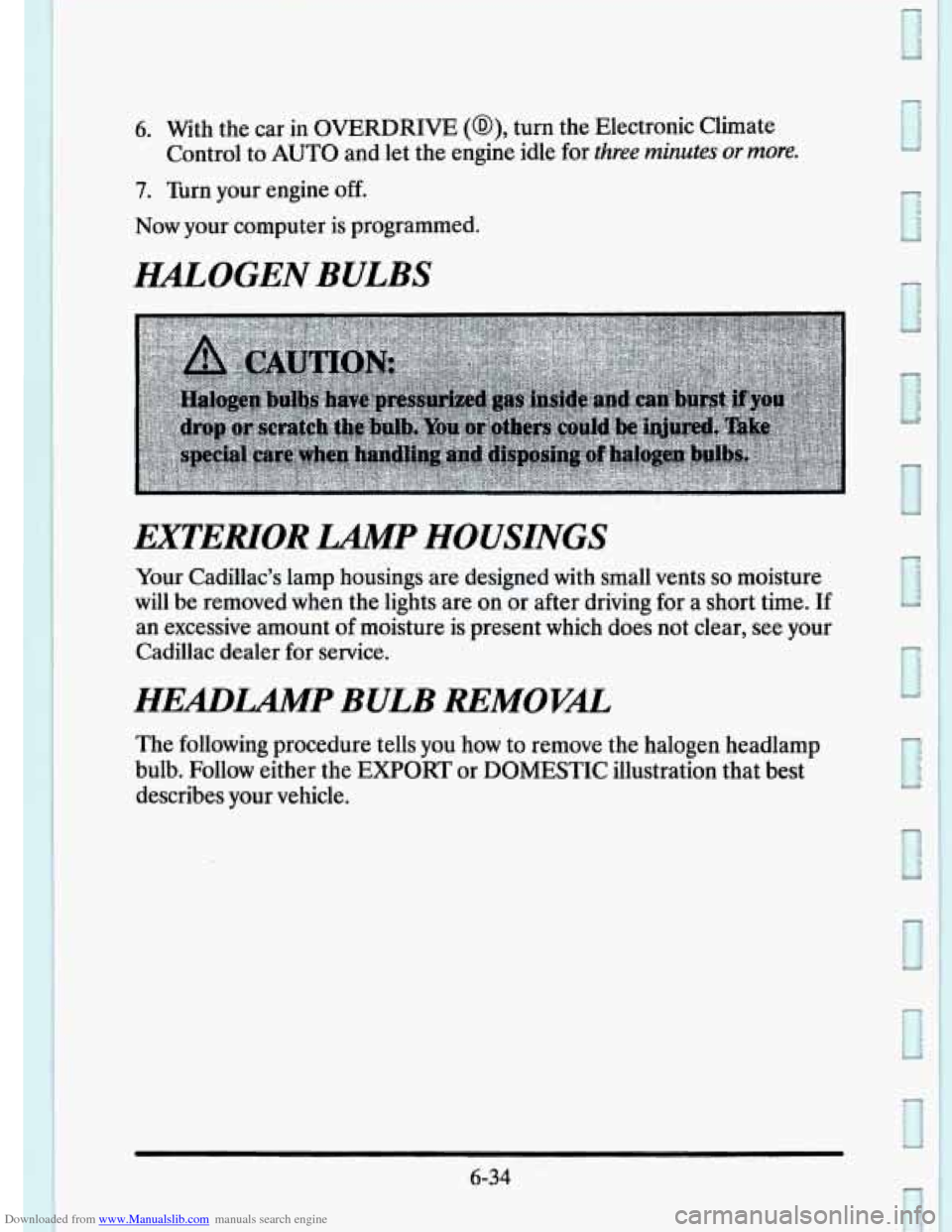
EQUOGEN BULBS
EXTERIOR LAMP HOUSINGS
Your Cadillac's lamp housings are designed with small vents so moisture
will be removed when the lights are on or after driving for a short time. If
an excessive amount of moisture is present which does not clear, see your
Cadillac dealer for service.
HEmWP BULB REMOVXL,
The following procedure tells you how to remove the halogen headlamp
bulb. Follow either the
EXPORT or DOMESTIC illustration that best
describes your vehicle.
6-34
I
Page 328 of 395

Downloaded from www.Manualslib.com manuals search engine CNSL FAN
CIGAR
BODY 2
r
L PRK LP
I
R PRK LP
I RAD (BAT)
I ANT/TRK PLD
Rear Compartment Fuse Block (Continued) 1
FUSE c
m
I.
-.
-.
-.
-.
-.
-.
-3
-
Headlamps
USAGE
Rear Blower Motor; Rear Blower Relay
Front Cigarette Lighter; Chime Module
Power Mirror Switch;
RAP Relay; Lock-Out Inhibit Relay “B”
(Trunk Comp. 1 Micro Relay Center); Panel Lights Inhibit Relay
“F” (Trunk Comp. 3 Micro Relay Center)(Export); Courtesy Lamps
Relay
“C” (Trunk Comp. 2 Micro Relay Center); RAP Relay “E”
(Trunk Comp. 2 Micro Relay Center); Keyless Entry Module; Trunk
Lamp; Seat Belt Retractor Solenoids
Front Door Lock Switches; Glove
Box Lam ; Left and Right
Footwell Courtesy Lamps; Headlamp Switc
R
Left and Right Front Header Lamp; Left and Ri ht Vanity Mirror;
Garage Door Opener; Left and Right Rear Hea f er Lamps
Left Rear Tail/Stop/Turn Lamps; Left Front Park/Turn Lamps;
Front and Rear Left Side Marker Lamps; Radio Control Head;
Headlamp Switch; Instrument Panel Cluster
Right Tail/Stop/Tlurn Lamps; Right Front and Rear Side Marker
Lamps; Right Front Park and Turn Lamps; Engine Comp. Lamp;
License Plate Lamps
Radio
Trunk Lid
Pull Down Motor; Power Antenna
Electronic Level Control (ELC)
Passengers Heated Seat
Driver’s Heated Seat
The headlamp wiring has an individual fuse which is powered by a
MAXI” fuse. An electrical overload in the headlamp wiring may cause
your headlamps
to go off and remain off. You will need to have your
Cadillac serviced immediately.
Windshield Wipers
The windshield wiper motor is powered by a MAXI TM fuse. An electrical
overload in the motor wiring may cause your wipers
to stop working. If
this happens
you will need to have your Cadillac serviced.
Power Windows and Other Power Options
Circuit breakers in the fuse panel protect the power windows and other
power accessories. When the current load is too heavy (such
as a switch being
held on with the window completely up), the circuit breaker opens and
closes, protecting the circuit until the problem
is fixed or the load is removed.
6-69
Page 386 of 395
Downloaded from www.Manualslib.com manuals search engine .
.
.
.
.
.
.
.
.
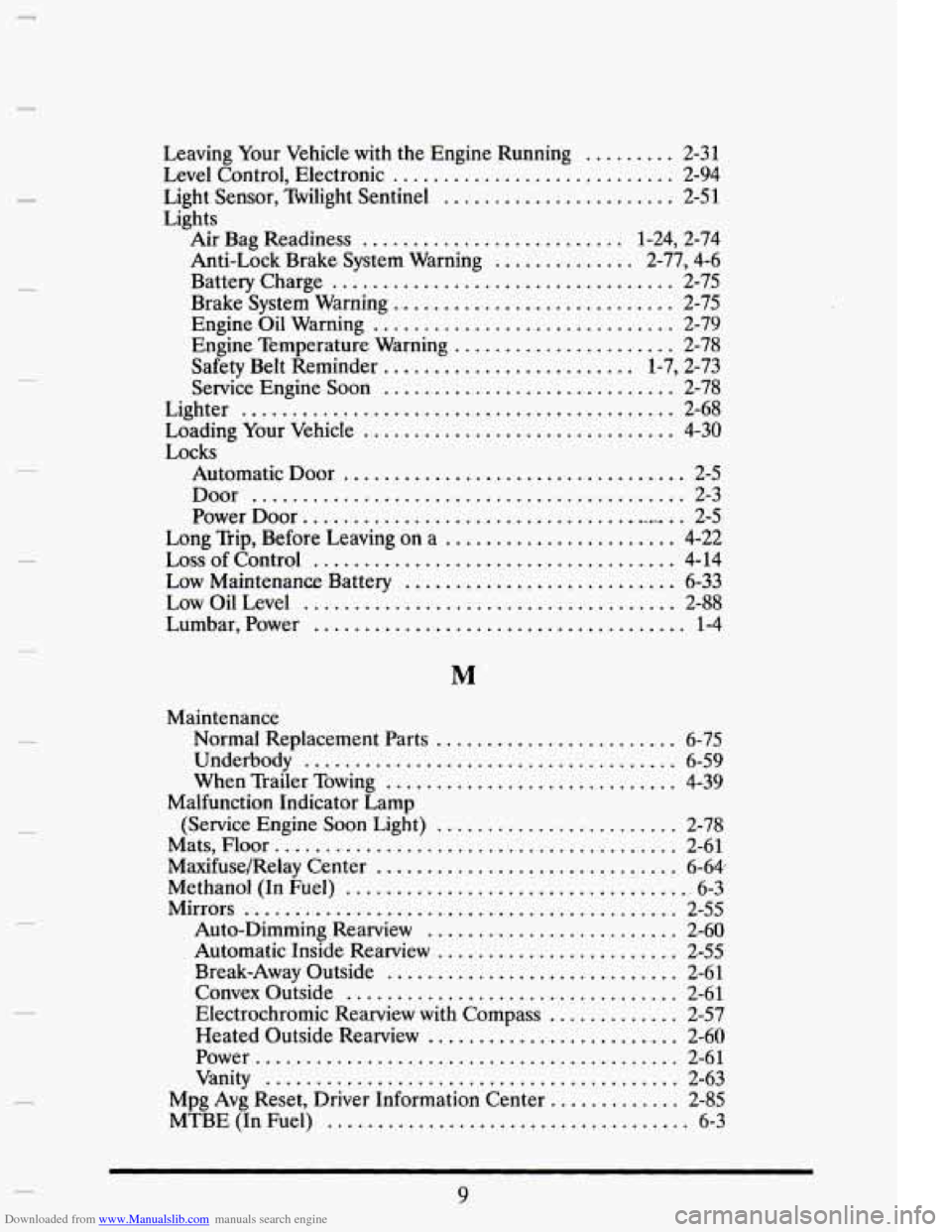
Leaving Your Vehicle with the Engine Running ......... 2-31
Light Sensor. Twilight Sentinel ....................... 2-51
Level Control. Electronic ............................ 2-94
Lights
Air Bag Readiness
.......................... 1.24. 2.74
Anti-Lock Brake System Warning .............. 2.77. 4.6
Battery Charge .................................. 2-75
Brake System Warning ............................. 2-75
Engine Oil Warning .............................. 2-79
Engine Temperature Warning ...................... 2-78
Safety Belt Reminder ......................... 1.7. 2.73
Service Engine Soon ............................. 2-78
Lighter ........................................... 2-68
Loading Your Vehicle ............................... 4-30
Locks
Automatic Door
.................................. 2-5
Door ........................................... 2-3
Power Door ......................................... 2-5
Long Trip, Before Leaving on a ....................... 4-22
Loss of Control .................................... 4-14
Low Maintenance Battery ........................... 6-33
Low Oil Level ..................................... 2-88
Lumbar. Power ..................................... 1-4
Maintenance
Normal Replacement Parts
........................ 6-75
Underbody ..................................... 6-59
When Trailer Towing ............................. 4-39
Malfunction Indicator Lamp
(Service Engine
Soon Light) ........................ 2-78
Mats. Floor ........................................ 2-61
Maxifuse/Relay Center .............................. 6-64
Methanol (In Fuel) ................................... 6.3
Mirrors ........................................... 2-55
Auto-Dimming Rearview ......................... 2-60
Automatic Inside Rearview ........................ 2-55
Break-Away Outside ............................. 2-61
Convex Outside ................................. 2-61
Heated Outside Rearview ......................... 2-60
Power .......................................... 2-61
Vanity ......................................... 2-63
Electrochromic Rearview with Compass ............. 2-57
Mpg Avg Reset. Driver Information Center ............. 2-85
MTBE (In Fuel) .................................... 6-3
.
.
9
Page 393 of 395
Downloaded from www.Manualslib.com manuals search engine W
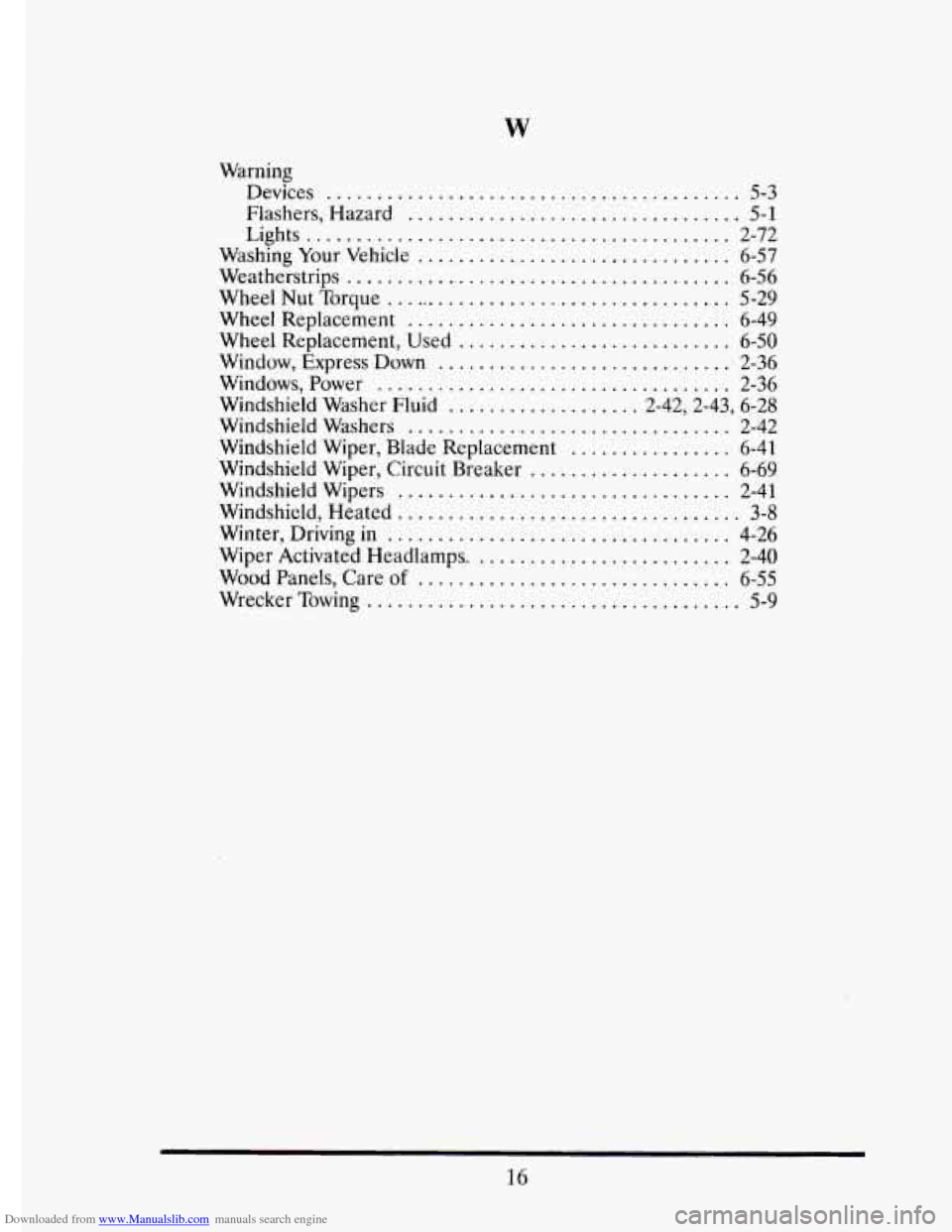
Warning Devices
......................................... 5-3
Lights .......................................... 2-72
Flashers.
Hazard
................................. 5-1
washing Your Vehicle ............................... 6-57
Weatherstrips
....................................... 6-56
Wheel
Nut Torque ................................... 5-29
Wheel Replacement
................................ 6-49
Wheel Replacement. Used
........................... 6-50
Window. Express Down
............................. 2-36
Windows. Power
................................... 2-36
Windshield Washer Fluid ................... 2-42. 2-43. 6-28
Windshield Washers ................................ 2-42
Windshield Wiper. Blade Replacement ................ 6-41
Windshield Wiper. Circuit Breaker .................... 6-69
Windshield Wipers
................................. 2-41
Windshield. Heated
.................................. 3-8
Winter. Driving in .................................. 4-26
Wiper Activated Headlamps
......................... 2-40
Wood Panels. Care
of ............................... 6-55
Wrecker Towing
..................................... 5-9
16