1995 CADILLAC ELDORADO brake light
[x] Cancel search: brake lightPage 193 of 395
Downloaded from www.Manualslib.com manuals search engine Avoid needless heavy braking. Some peoplc drive in spurts -- heavy
acceleration followed by heavy braking
-- rather than keeping pace with
traffic. This is a mistake. Your brakes may
not have time to cool between
hard stops.
Your brakes will wear out much faster if you do a lot of heavy
braking. If you keep pace with the traffic and allow realistic following
distances,
you will eliminate a lot of unnecessary braking. That means
better braking and longer brake
life.
If your engine ever stops while you’re driving, brake normally but don’t
pump your
brakes. If you do, the pedal may get harder to push down. If
your engine stops, you will still have some power brake assist. But you will
use it when you brake. Oncc thc power assist is used up, it may take
longer to stop and the brake pedal
will be harder to push.
Anti-Lock Brakes (ABS)
Your Cadillac has an advanced electronic braking system that will help
prevent
a braking skid.
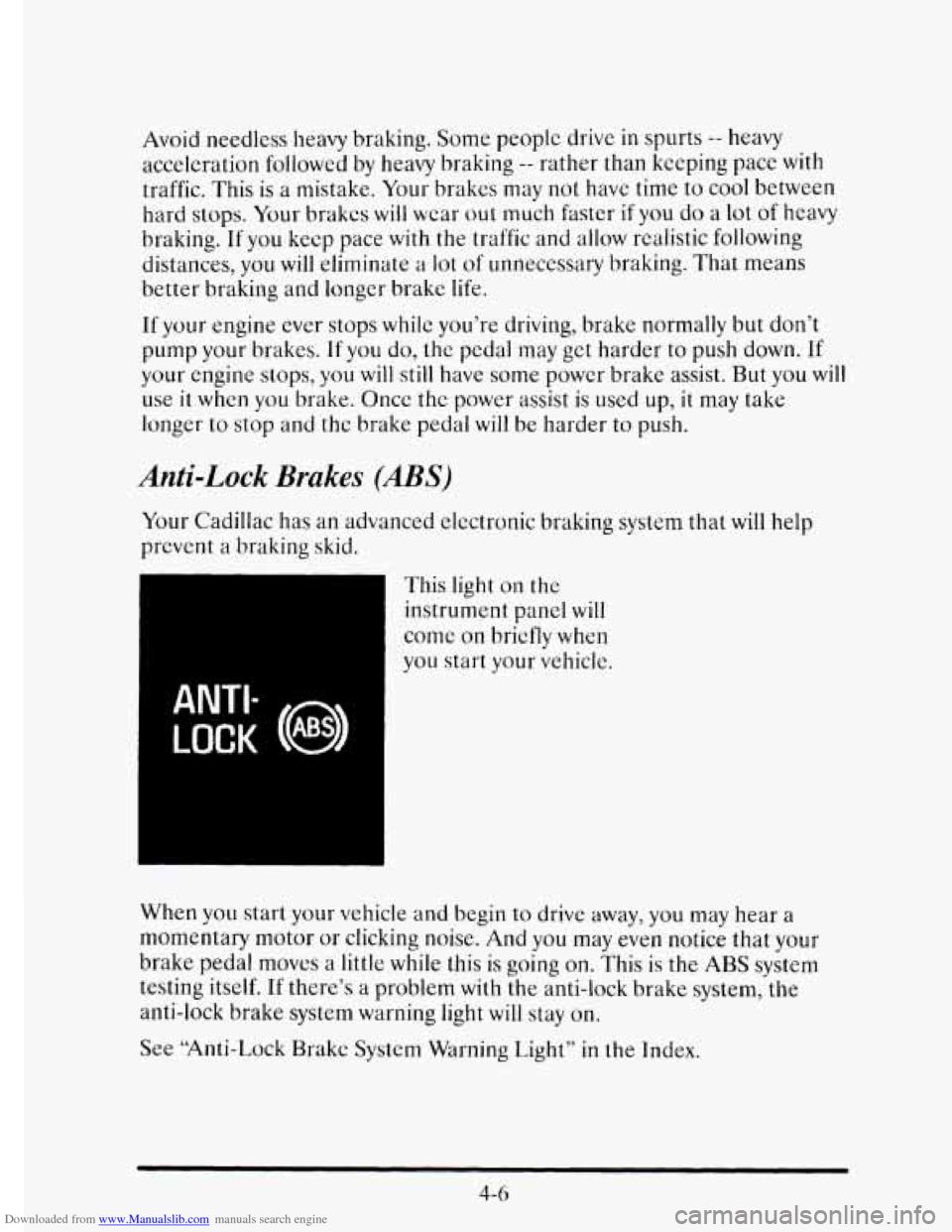
ANTI-
LOCK (@)
This light on the
instrument panel will
come on briefly when
you start your vehicle.
When
you start your vehicle and begin to drive away, you may hear a
momentary motor
or clicking noise. And you may even notice that your
brake pedal mows a little while this is going
on. This is the ABS system
testing itself.
If there’s a problem with the anti-lock brake system, the
anti-lock brake system
warning light will stay on.
See “Anti-Lock Brakc System Warning Light”
in the Index.
4-6
Page 200 of 395
Downloaded from www.Manualslib.com manuals search engine 0
0
c
0
0
0
0
0 0
0
“Drive ahead.” Look down the road, to the sides, and to crossroads for
situations that might affect your passing patterns.
If you have any doubt
whatsoever about making a successful pass, wait for a better time.
Watch for traffic signs, pavement markings, and lines. If you can see a
sign up ahead that might indicate a turn or an intersection, delay your
pass.
A broken center line usually indicates it’s all right to pass
(providing the road ahead is clear). Never cross a solid line
on your
side of the lane or a double solid line, even
if the road seems empty of
approaching traffic.
Do not get too close to the vehicle
you want to pass while you’re
awaiting an opportunity.
For one thing, following too closely reduces
your area of vision, especially
if you’re following a larger vehicle. Also,
you won’t have adequate space if the vehicle ahead suddenly slows or
stops. Keep back a reasonable distance.
When it looks like a chance to pass
is coming up, start to accelerate
but stay in the right lane and don’t get too close. Time your move
so
you will be increasing speed as the time comes to move into the other
lane.
If the way is clear to pass, you will have a “running start” that
more than makes up for the distance you would lose
by dropping back.
And
if something happens to cause you to cancel your pass, you need
only slow down and drop back again and wait for another opportunity.
If other cars are lined up to pass a slow vehicle, wait your turn. But
take care that someone isn’t trying to pass
you as you pull out to pass
the
slow vehicle. Remember to glance over your shoulder and check
the blind spot.
Check your mirrors, glance over your shoulder, and start your left lane
change signal before moving out
of the right lane to pass. When you
are far enough ahead
of the passed vehicle to see its front in your
inside mirror, activate your right lane change signal and move back
into the right lane. (Remember that your right outside mirror is
convex. The vehicle
you just passed may seem to be farther away from
you than it really is.)
Try not to pass more than one vehicle at a time on two-lane roads.
Reconsider before passing the next vehicle.
Don’t overtake a slowly moving vehicle too rapidly. Even though the
brake lights are not flashing, it may be slowing down or starting to turn.
If you’re being passed, make it easy for the following driver to get
ahead
of you. Perhaps you can ease a little to the right.
4-13
Page 205 of 395
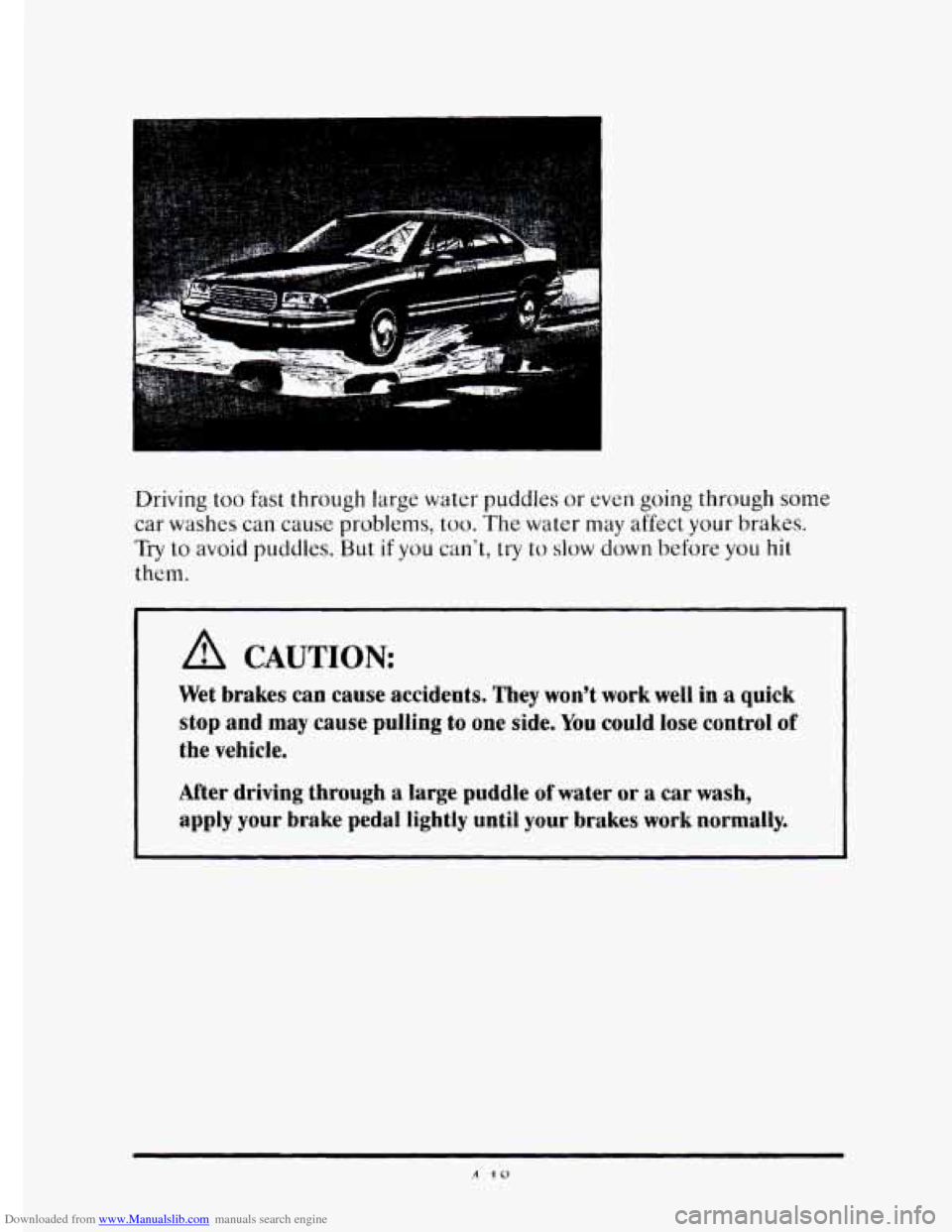
Downloaded from www.Manualslib.com manuals search engine Driving too fast through large water puddles or even going through some
car washes can cause problems,
too. The water may affect your brakes.
Try to avoid puddles. But if you can't, try to slow down before you hit
them.
I A CAUTION:
Wet brakes can cause accidents. They won't work well in a quick
stop and may cause pulling to one side. You could lose control of
the vehicle.
After driving through
a large puddle of water or a car wash,
apply your brake pedal lightly until your brakes work normally.
A 10
Page 224 of 395

Downloaded from www.Manualslib.com manuals search engine Driving with a Trailer
n Towing a trailer requires a certain amount of experience. Before setting
out for the open road, you’ll want to get to
know your rig. Acquaint
yourself with the feel
of handling and braking with the added weight of
the trailer. And always keep in mind that the vehicle you are driving is
now a good deal longer and not nearly as responsive as your vehicle is by
itself.
Before you start, check the trailer hitch and platform (and attachments),
safety chains, electrical connector, lamps, tires and mirror adjustment. If
the trailer has electric brakes, start your vehicle and trailer moving and
then apply the trailer brake controller by hand to be sure the brakes are
working. This lets you check your electrical connection at the same time.
. During your trip, check occasionally to be sure that the load is secure, and
that the lights and any trailer brakes are still working.
Following Distance
Stay at least twice as far behind the vehicle ahead as you would when
driving your vehicle without a trailer. This can help you avoid situations
that require heavy braking and sudden turns.
Passing
You’ll need more passing distance up ahead when you’re towing a trailer.
And, because you’re a good deal longer, you’ll need to
go much farther
beyond the passed vehicle before you can return to your lane.
Backing Up
Hold the bottom of the steering wheel with one hand. Then, to move the
trailer to the left, just move that hand to the left.
To move the trailer to
the right, move your hand to the right. Always back up slowly and,
if
possible, have someone guide you.
4-37
Page 289 of 395
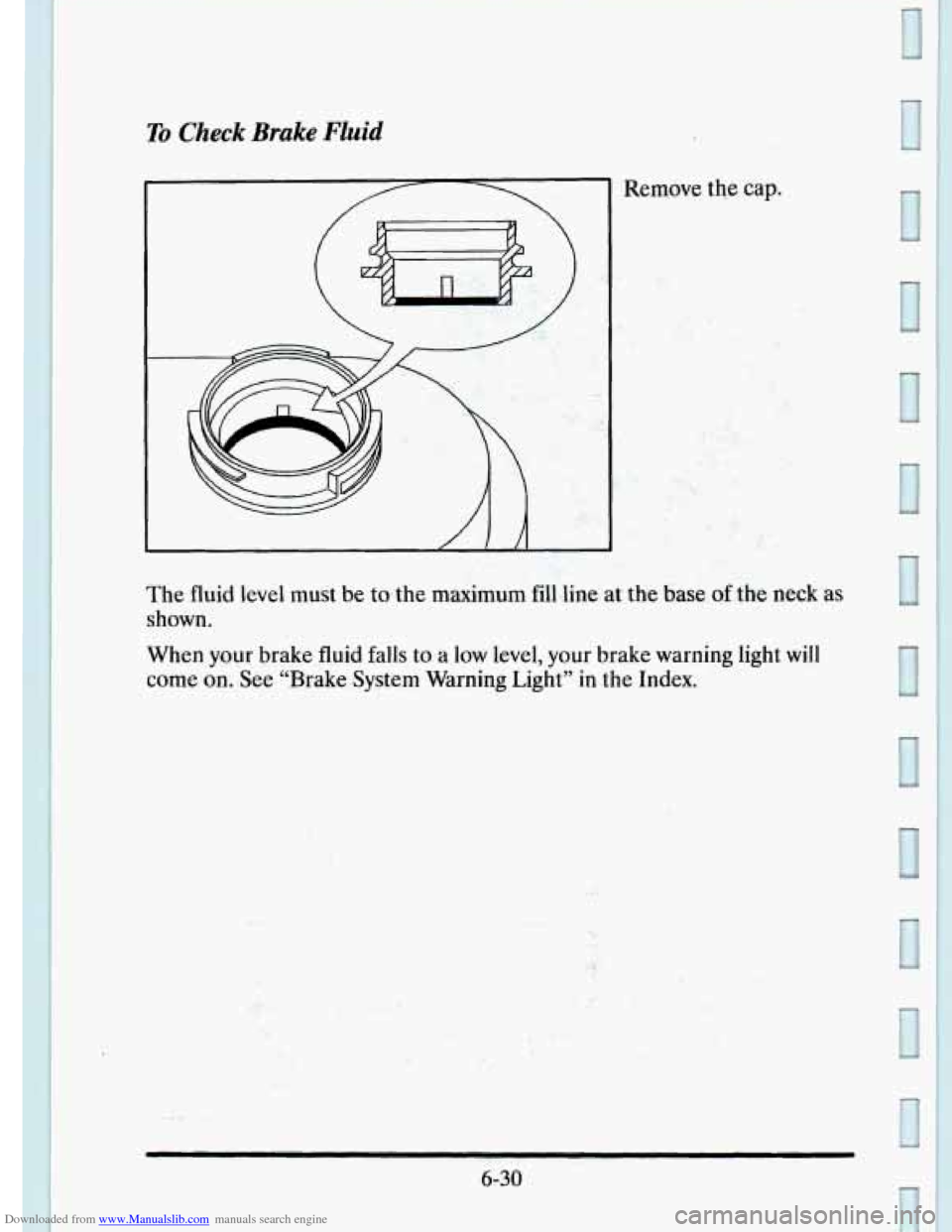
Downloaded from www.Manualslib.com manuals search engine To Check Brake Fluid
Remove the cap.
. .. .. . , ... r .._ ..:- . , -.
The fluid level must be to the maximum fill line at the base of the neck as
shown.
When your brake fluid>$alis
to a low level, your brake warning light will
come
on. See "Brake System Warning Light" in the Index.
,
6-30
Page 291 of 395
Downloaded from www.Manualslib.com manuals search engine NOTICE:
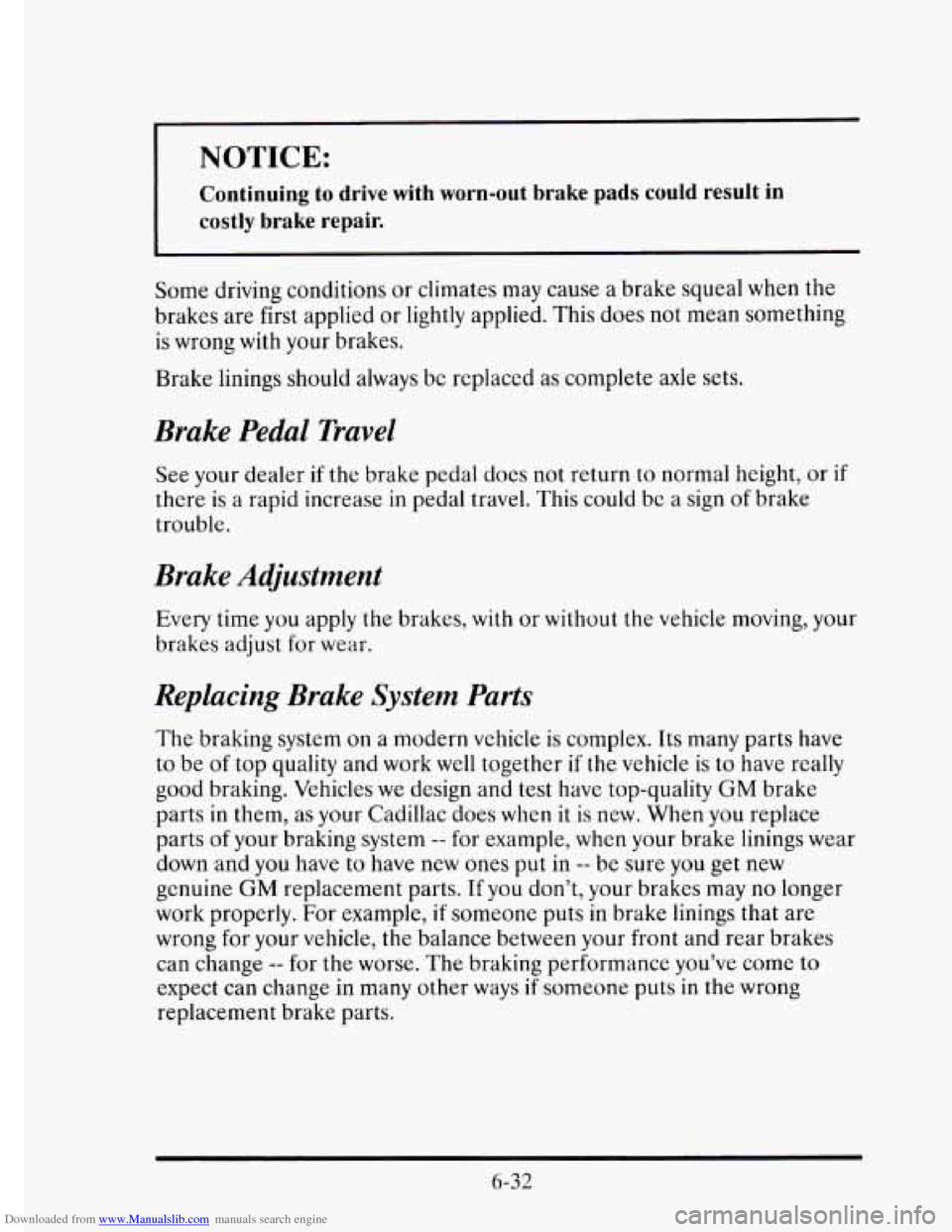
Continuing to drive with worn-out brake pads could result in
costly brake repair.
Some driving conditions or climates may cause a brake squeal when the
brakes are first applied
or lightly applied. This does not mean something
is wrong
with your brakes.
Brake linings should always be replaced as complete axle sets.
Brake Pedal Travel
See your dealer if the brake pedal does not return to normal height, or if
there is a rapid increase in pedal travel. This could bc a sign of brake
trouble.
Brake Adjustment
Every time you apply the brakes, with or without the vehicle moving, your
brakes adjust for wear.
Replacing Brake System Parts
The braking system on a modern vehicle is complex. Its many parts have
to be
of top quality and work wcll together if the vehicle is to have really
good braking. Vehicles
we design and test have top-quality GM brake
parts in them,
as your Cadillac does when it is new. When you replace
parts of your braking system
-- for example, when your brake linings wear
down and
you have to have new ones put in -- be sure you get new
genuine
GM replacement parts. If you don’t, your brakes may no longer
work properly. For example,
if someone puts in brake linings that are
wrong for your vehicle,
the balance between your front and rear brakes
can change
-- for the worse. The braking performance you’ve come to
expect can change in many
other ways if someone puts in the wrong
replacement brake parts.
6-32
Page 324 of 395
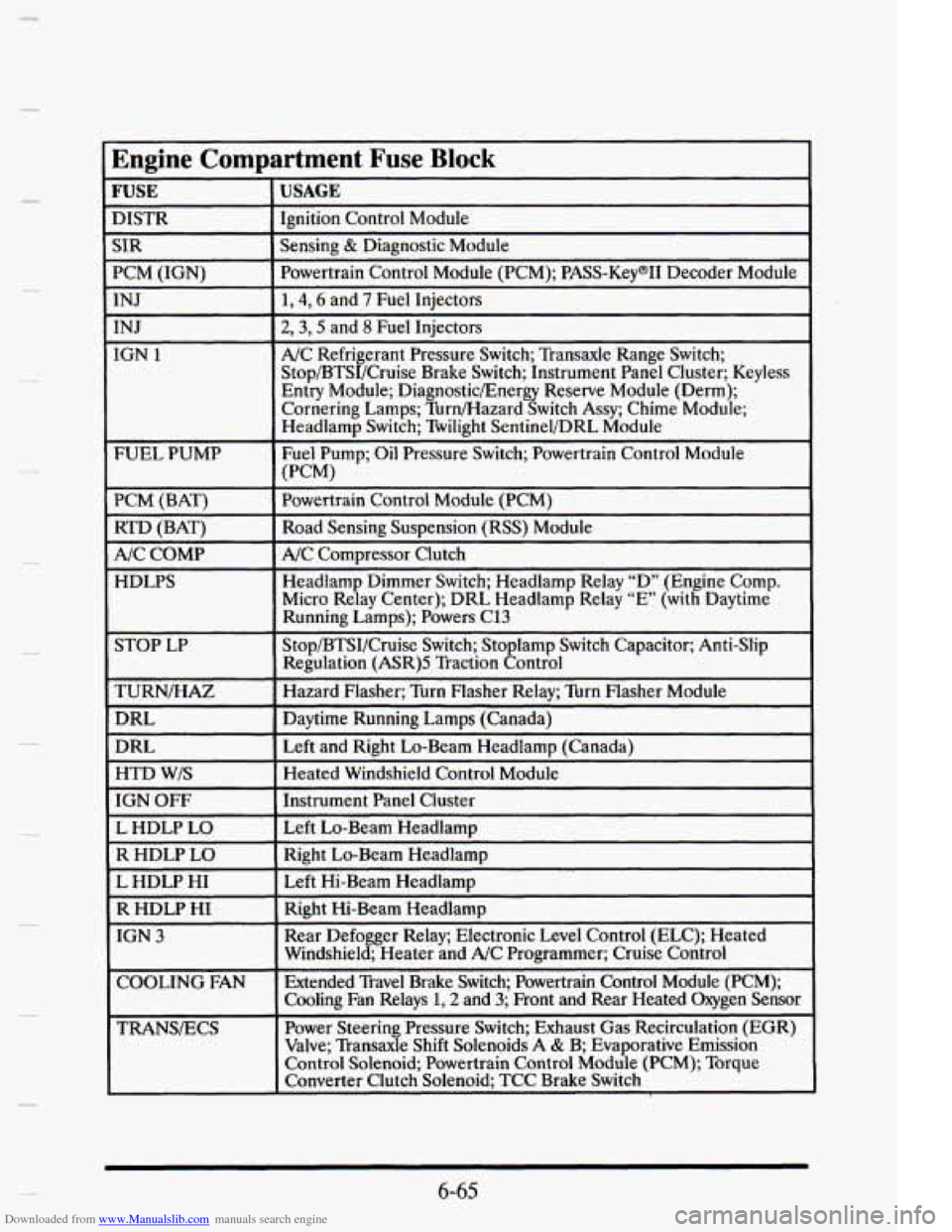
Downloaded from www.Manualslib.com manuals search engine [Engine Compartment Fuse Block
~~~
E DISTR
USAGE I
INJ
IGN 1
FUEL PUMP
PCM (BAT) RTD (BAT)
F
A/C COMP
HDLPS
TURN/HAZ
DRL
DRL
HTD W/S
IGN OFF
L HDLP
LO
I R HDLP LO Ignition
Control Module
I
L HDLP HI
R HDLP HI
I
I
TRANSECS Sensing
& Diagnostic Module
Powertrain Control Module (PCM); PASS-KeymII Decode llodule
1,4,6 and 7 Fuel Injectors
2,3,5 and 8 Fuel Injectors
A/C Refrigerant Pressure Switch; Transaxle Range Switch;
Stop/BTSI/Cruise Brake Switch; Instrument Panel Cluster; Keyless
Entry Module; DiagnosticEnergy Reserve Module (Derm);
Cornering Lamps; Tbrn/Hazard Switch Assy; Chime Module;
Headlamp Switch; Twilight Sentinel/DRL Module
Fuel Pump; Oil Pressure Switch; Powertrain Control Module
Powertrain Control Module (PCM)
Road Sensing Suspension (RSS) Module
NC Compressor Clutch
Headlamp Dimmer Switch; Headlamp Relay “D” (Engine Comp.
Micro Relay Center); DRL Headlamp Relay
“E’ (with Daytime
Running Lamps); Powers C13
Stop/BTSI/Cruise Switch; Sto lamp Switch Capacitor; Anti-Slip
Regulation (ASR)S Traction 8ontrol
Hazard Flasher; Turn Flasher Relay; Turn Flasher Module
Daytime Running Lamps (Canada)
Left and Right Lo-Beam Headlamp (Canada)
Heated Windshield Control Module
Instrument Panel Cluster
Left Lo-Beam Headlamu
(PCM)
Right Lo-Beam Headlamp
Left Hi-Beam Headlamp
Right Hi-Beam Headlamp
Rear Defogger Relay; Electronic Level Control (ELC); Heated
Windshield; Heater and A/C Programmer; Cruise Control
Extended Travel Brake Switch; Powertrain Control Module (PCM); \
Cooling Fan Relays
1,2 and 3; Front and Rear Heated Oxygen Sensor
Power Steering Pressure Switch; Exhaust Gas Recirculation (EGR)
Valve; Transaxle Shift Solenoids A
& B; Evaporative Emission
Control Solenoid; Powertrain Control Module (PCM); Torque
Converter Clutch Solenoid; TCC Brake Switch
6-65
Page 379 of 395
Downloaded from www.Manualslib.com manuals search engine ..
.. ..
...
Ashtrays ..................................... 2.67. 2.68
Assist Handles ..................................... 2-54
Astroroof. Express Open ............................ 2-64
Audio Systems ...................................... 3-9
Automatic Door Locks ............................... 2-5
Automatic Inside Rearview Mirror .................... 2-55
Automatic Overdrive Position. Automatic Transaxle ...... 2-25
Automatic Pull-Down Feature ........................ 2-11
Automatic Transaxle ................................ 2-23
Chart .......................................... 6-72
Fluid ................................. 6.19.6.20. 6-22
Avg Mph Reset. Driver Information Center ............ 2-85
Battery ........................................... 6-33
Charge Light .................................... 2-75
No Charge Message .............................. 2-86
Power Loss ..................................... 6-33
Replacement. Remote Keyless Entry ................. 2-9
Volts High Message .............................. 2-86
Volts Low Message .............................. 2-87
Warnings .................................... 5.3. 5.5
BBB Auto Line ..................... See Owner Assistance
Blizzard
........................................... 4-28
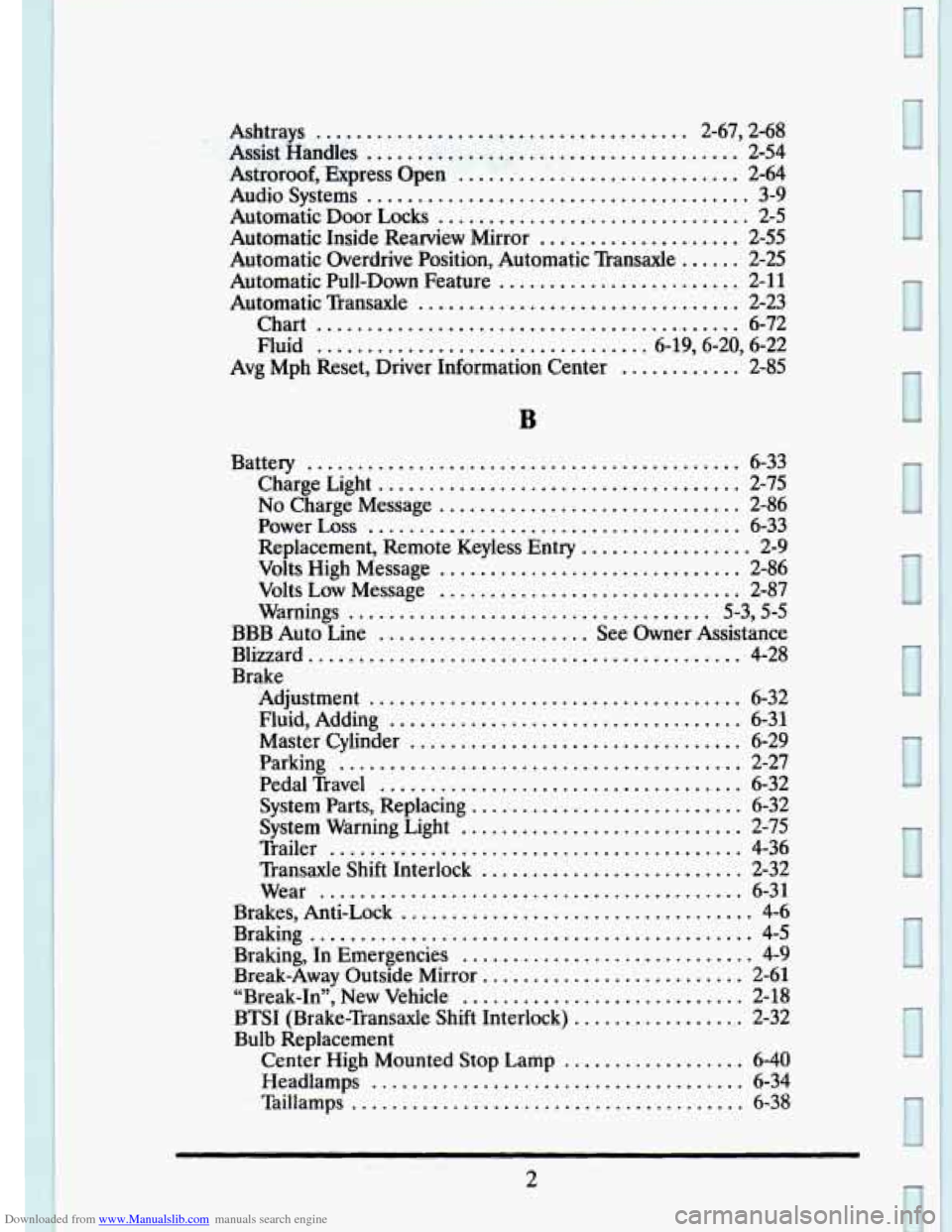
Brake
Adjustment
..................................... 6-32
Fluid. Adding ................................... 6-31
Master Cylinder ................................. 6-29
Parking ........................................ 2-27
Pedal Travel .................................... 6-32
System Parts. Replacing ........................... 6-32
System Warning Light ............................ 2-75
Trailer ......................................... 4-36
Transaxle Shift Interlock .......................... 2-32
Wear .......................................... 6-31
Brakes. Anti-Lock ................................... 4-6
Braking ............................................ 4-5
Braking. In Emergencies .............................. 4-9
Break-Away Outside Mirror .............. .- ........... 2-61
“Break.1n”. New Vehicle ............................ 2-18
BTSI (Brake-Transaxle Shift Interlock) .................. 2-32
Bulb Replacement
Center
High Mounted Stop Lamp .................. 6-40
Headlamps ..................................... 6-34
Taillamps ....................................... 6-38
2
a
1
I