1995 BUICK REGAL change wheel
[x] Cancel search: change wheelPage 87 of 340
On four-door models, the driver’s window controls also
include a lock-out switch. Press
LOCK to stop front and
rear passengers from using their window switches. The
driver can still control all the windows with the lock on.
Press the other side of the
LOCK button for normal
window operation.
Horn
Press either horn symbol on your steering wheel to
sound the horn.
Tilt Steering Wheel
A tilt steering wheel allows
you to adjust the steering
wheel before you drive.
You
can also raise it to the
highest level to give your
legs more room when you
exit and enter the vehicle.
To tilt the wheel, hold the steering wheel and pull the
lever. Move the steering wheel to a comfortable level,
then release the lever to lock the wheel in place.
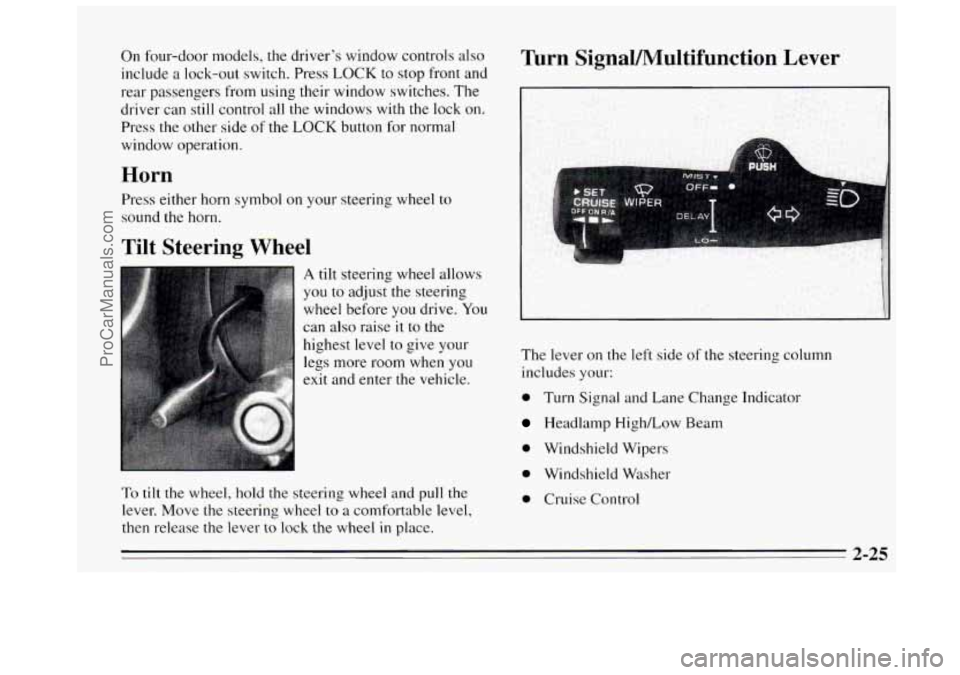
Turn Signal/Multifunction Lever
The lever on the left side of the steering column
includes your:
0 Turn Signal and Lane Change Indicator
Headlamp High/Low Beam
0 Windshield Wipers
0 Windshield Washer
0 Cruise Control
2-25
ProCarManuals.com
Page 136 of 340
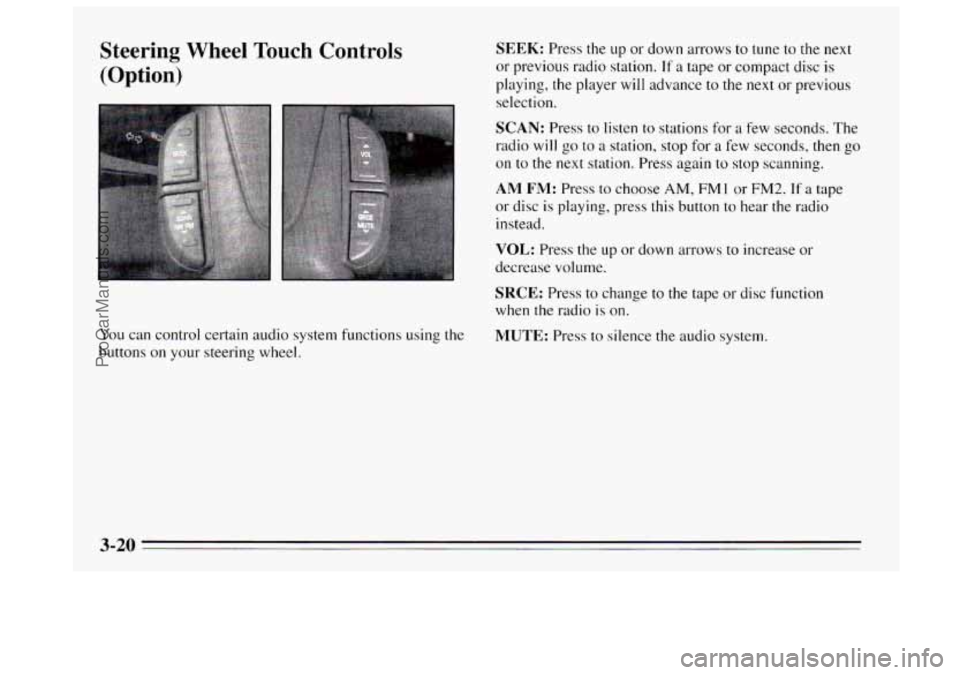
Steering Wheel Touch Controls
(Option)
You can control certain audio system functions using the
buttons on your steering wheel.
SEEK: Press the up or down arrows to tune to the next
or previous radio station.
If a tape or compact disc is
playing, the player will advance to the next or previous
selection.
SCAN: Press to listen to stations for a few seconds. The
radio will go
to a station, stop for a few seconds, then go
on to the next station. Press
again to stop scanning.
AM FM: Press to choose AM, FM1 or FM2. If a tape
or disc
is playing, press this button to hear the radio
instead.
VOL: Press the up or down arrows to increase or
decrease volume.
SRCE: Press to change to the tape or disc function
when the radio is on.
MUTE: Press to silence the audio system.
3-20
ProCarManuals.com
Page 145 of 340
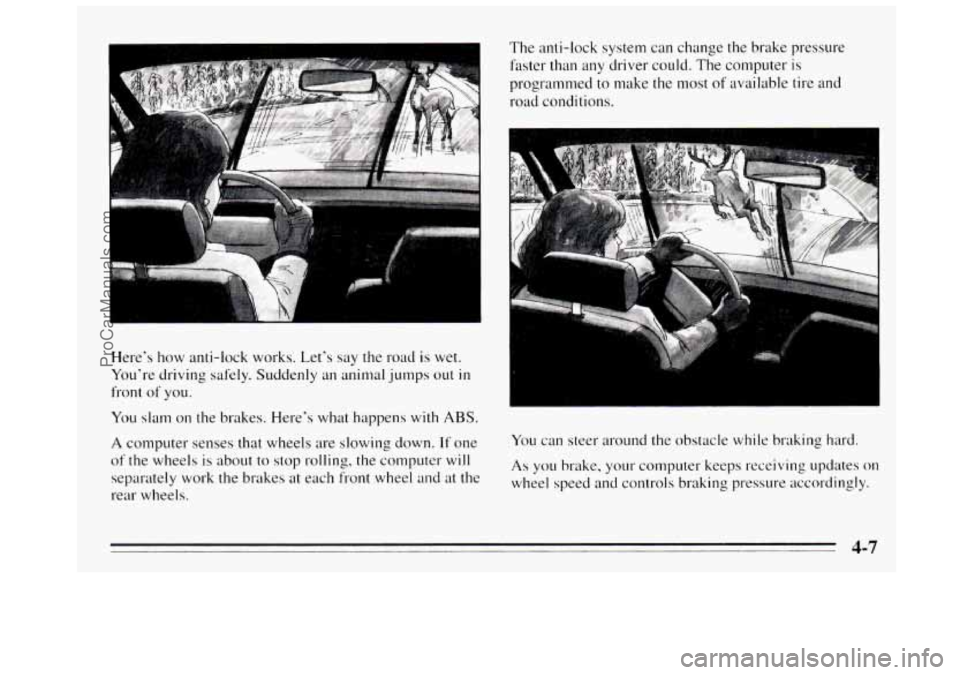
Here‘s how anti-lock works. Let’s say the road is wet.
You’re driving safely. Suddenly an animal jumps
out in
front of you.
You slam on the brakes. Here’s what happens with
ABS.
A colnputer senses that wheels are slowing down. If one
of the wheels is about to stop rolling, the computer will
separately work the brakes at each
front wheel and at the
rear wheels. The
anti-lock system can change the brake pressure
faster than any driver could. The computer
is
programmed to make the most of available tire and
road conditions.
You can steer around the obstacle while braking hard.
As you brake, your computer keeps receiving updates on
wheel speed and controls braking pressure accordingly.
4-7
ProCarManuals.com
Page 146 of 340
Remember: Anti-lock doesn’t change the time you need
to get your foot up to the brake pedal. If you get too
close to the vehicle in front of you, you won’t have time
to apply your brakes
if that vehicle suddenly slows or
stops. Always leave enough room up ahead
to stop, even
though you have anti-lock brakes.
To Use Anti-Lock
Don’t pump the brakes. Just hold the brake pedal down
and let anti-lock work for you. You may feel the system
working, or
you may notice some noise, but this is
normal. When your anti-lock system is adjusting brake
pressure to help avoid a braking skid, the
LOW TRAC
light will come on. See “Anti-Lock Brake System
Active Light”
in the Index.
Braking in Emergencies
Use your anti-lock braking system when you need to.
With anti-lock,
you can steer and brake at the same
time. In many emergencies, steering can help
you more
than even the very best braking.
Steering
Power Steering
If you lose power steering assist because the engine
stops or the system is not functioning, you can steer but
it will take much more effort.
Steering Tips
Driving on Curves
It’s important to take curves at a reasonable speed.
A lot of the “driver lost control” accidents mentioned on
the news happen on curves. Here’s why:
Experienced driver or beginner, each
of us is subject to
the same laws of physics when driving on curves. The
traction
of the tires against the road surface makes it
possible for the vehicle to change its path when you turn
the front wheels. If there’s no traction, inertia will keep
the vehicle going
in the same direction. If you’ve ever
tried to steer
a vehicle on wet ice, you’ll understand this.
The traction you can get in a curve depends on the
condition
of your tires and the road surface, the angle at
which the curve
is banked, and your speed. While
you’re
in a curve, speed is the one factor you can
control.
ProCarManuals.com
Page 150 of 340
Check your mirrors, glance over your shoulder, and
start your left lane change signal before moving out
of the right lane to pass. When you are far enough
ahead
of the passed vehicle to see its front in your
inside mirror, activate your right lane change signal
and move back
into the right lane. (Remember that
your right outside mirror is convex. The vehicle you
just passed may seem
to be farther away from you
than it really is.)
Try not to pass more than one vehicle at a time on
two-lane roads. Reconsider before passing the next
vehicle.
Don’t overtake a slowly moving vehicle too rapidly.
Even though the brake lights are
not flashing, it may
be slowing down or starting to turn.
If you’re being passed, make it easy for the
following driver
to get ahead of you. Perhaps you
can ease
a little to the right.
Loss of Control
Let’s review what driving experts say about what
happens when the three control systems (brakes, steering
and acceleration) don’t have enough friction where the
tires meet the road
to do what the driver has asked.
In any emergency, don’t give up. Keep trying to steer
and constantly seek an escape route or area
of less
danger.
Skidding
In a skid, a driver can lose control of the vehicle.
Defensive drivers avoid most skids by taking reasonable
care suited to existing conditions, and by not
“overdriving” those conditions.
But skids are always
possible.
The three
types of skids correspond to your Buick’s
three control systems. In the braking skid your wheels
aren’t rolling. In the steering or cornering skid,
too
much speed or steering in a curve causes tires to slip and
lose cornering force. And
in the acceleration skid too
much throttle causes the driving wheels to spin.
4-12
ProCarManuals.com
Page 166 of 340
Towing a Trailer
advice and information about towing a trailer
with your vehicle.
I’
~ NOTICE:
~ Pulling a trailer improperly can damage your
vehicle and result in costly repairs not covered by
~ your warranty. TO pull a trailer correctly, follow
the advice in this part, and see your Buick dealer
for important information about. towing a trailer
with your vehicle. Your
vehicle can tow a trailer.
To identify what the
vehicle trailering capacity is for your vehicle,
you
should read the information in “Weight of the Trailer”
that appears later
in this section. But traiiering is
different than just driving your vehicle by itself.
Trailering means changes
in handling, durability, and
fuel economy. Successful, safe trailering takes correct
equipment, and
it has to be used properly.
That’s the reason for this part.
In it are many
time-tested, important trailering tips and safety rules.
Many of these are important for your safety and that of
your passengers.
So please read this section carefully
before you pull
a trailer.
Load-pulling components such
as the engine, transaxle,
wheel assemblies, and tires are forced to work harder
against the drag of the added weight. The engine is
required
to operate at relatively higher speeds and under
greater loads, generating extra heat. What’s more, the
trailer adds considerably to wind resistance. increasing
the pulling requirements.
4-28
ProCarManuals.com
Page 181 of 340
Towing Your Vehicle
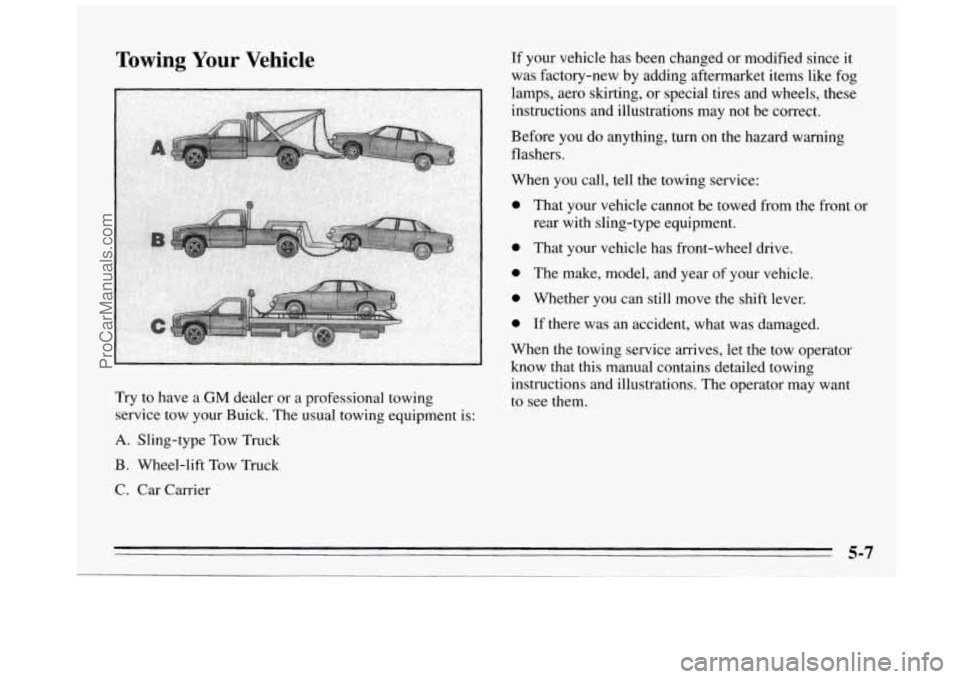
Try to have a GM dealer or a professional towing
service tow your Buick. The usual towing equipment is:
A. Sling-type Tow Truck
B. Wheel-lift Tow Truck
C. Car Carrier
If your vehicle has been changed or modified since it
was factory-new by adding aftermarket items like fog
lamps, aero skirting, or special tires and wheels, these
instructions and illustrations may not be correct.
Before you do anything, turn
on the hazard warning
flashers.
When you call, tell the towing service:
0
0
0
0
0
That your vehicle cannot be towed from the front or
rear with sling-type equipment.
That your vehicle has front-wheel drive.
The make, model, and year
of your vehicle.
Whether you can still move the shift lever.
If there was an accident, what was damaged.
When the towing service arrives, let the tow operator
know that this manual contains detailed towing instructions and illustrations. The operator may want
to see them.
5-7
ProCarManuals.com
Page 198 of 340
If a Tire Goes Flat
It’s unusual for a tire to “blow out” while you’re driving,
especially if you maintain your tires properly. If air goes
out
of a tire, it’s much more likely to leak out slowly.
But
if you should ever have a “blowout,” here are a few
tips about what
to expect and what to do:
If a front tire fails, the flat tire will create a drag that
pulls the vehicle toward that side. Take your foot off the
accelerator pedal and grip
the steering wheel firmly.
Steer to maintain lane position, then gently brake
to a
stop well
out of the traffic lane.
A rear blowout, particularly on a curve, acts much like a
skid and may require the same correction you’d use
in a
skid. In any rear blowout, remove your foot from the
accelerator pedal. Get
the vehicle under control by
steering the way
you want the vehicle to go. It may be
very bumpy and noisy, but
you can still steer. Gently
brake
to a stop, well off the road if possible.
If a tire goes flat, the next part shows how to use your
jacking equipment to change
a flat tire safely.
5-24
ProCarManuals.com