1995 BUICK REGAL instrument panel
[x] Cancel search: instrument panelPage 119 of 340
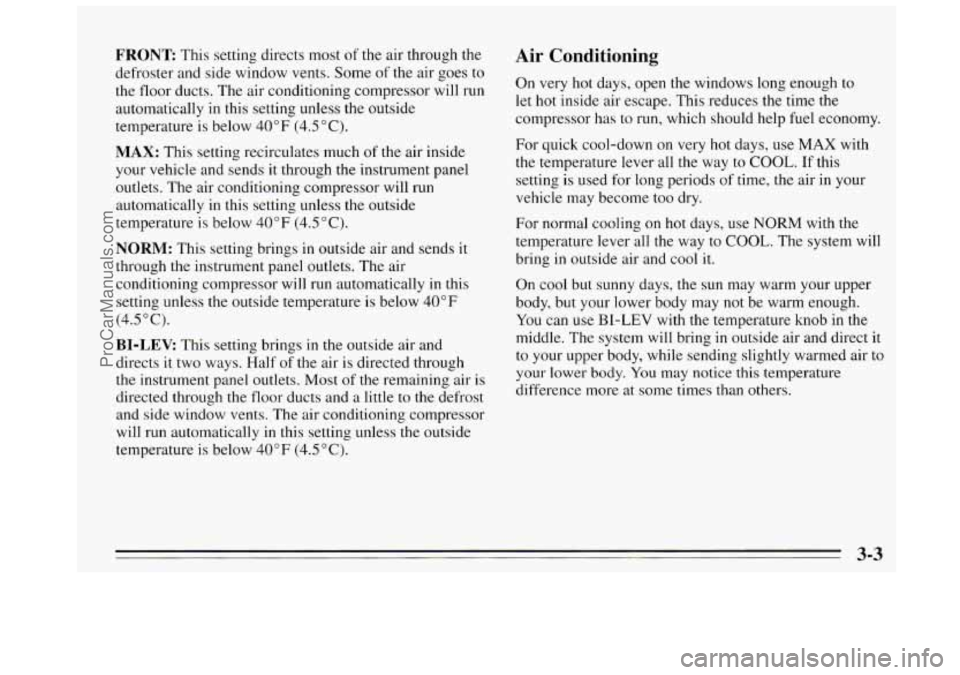
FRONT This setting directs most of the air through the
defroster and side window vents. Some
of the air goes to
the floor ducts. The air conditioning compressor will run
automatically in this setting unless the outside
temperature is below 40°F (4.5"C).
MAX: This setting recirculates much of the air inside
your vehicle and sends it through the instrument panel
outlets. The air conditioning compressor will run
automatically in this setting unless the outside
temperature is below 40°F (4.5"C).
NORM: This setting brings in outside air and sends it
through the instrument panel outlets. The air
conditioning compressor will run automatically in this
setting unless the outside temperature
is below 40°F
(4.5
" C).
BI-LEV This setting brings in the outside air and
directs it two ways. Half of the air is directed through
the instrument panel outlets. Most
of the remaining air is
directed through the floor ducts and a little
to the defrost
and side window vents. The air conditioning compressor
will run automatically
in this setting unless the outside
temperature
is below 40°F (4.5"C).
Air Conditioning
On very hot days, open the windows long enough to
let hot inside air escape. This reduces the time
the
compressor has to run, which should help fuel economy.
For quick cool-down on very hot days, use
MAX with
the temperature lever all the way to
COOL. If this
setting is used for long periods of time, the air in your
vehicle may become too dry.
For normal cooling on hot days, use
NORM with the
temperature lever all the way to
COOL. The system will
bring in outside air and cool
it.
On cool but sunny days, the sun may warm your upper
body, but your lower body may not be warm enough.
You can use
BI-LEV with the temperature knob in the
middle. The system will bring
in outside air and direct it
to your upper body, while sending slightly warmed air to
your lower body.
You may notice this temperature
difference more at some times than others.
3-3
ProCarManuals.com
Page 144 of 340
Avoid needless heavy braking. Some people drive
in spurts -- heavy acceleration followed by heavy
braking
-- rather than keeping pace with traffic. This is a
mistake. Your brakes may not have time to cool between
hard stops. Your brakes will wear out much fidster
if YOLI
do a lot of heavy braking. If you keep pace with the
traffic and allow realistic following distances, you will
eliminate a lot of unnecessary braking. That means
better braking and longer brake life.
If your engine ever stops while you’re driving, brake
normally but don’t pump your brakes. If
you do, the
pedal may get harder to push down. If your engine
stops, you will still have some power brake assist. But
you will use it when you brake. Once the power assist is
used up,
it may take longer to stop and the brake pedal
will be harder to push.
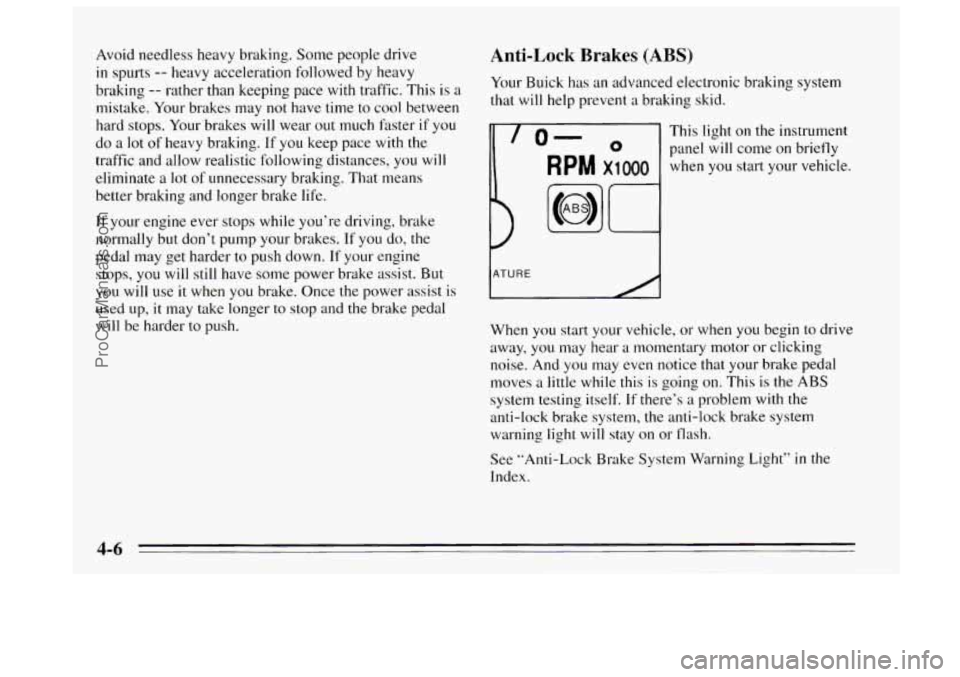
Anti-Lock Brakes (ABS)
Your Buick has an advanced electronic braking system
that will help prevent
a braking skid.
This light on the instrument
panel
will come on briefly
when you start your vehicle.
When you start your vehicle, or when
you begin to drive
away, you may hear
a momentary motor or clicking
noise. And
you may even notice that your brake pedal
moves
a little while this is going on. This is the ABS
system testing itself.
If there’s a problem with the
anti-lock brake system, the anti-lock brake system
warning light
will stay on or flash.
See ”Anti-Lock Brake System Warning Light”
in the
Index.
4-6
ProCarManuals.com
Page 171 of 340
Making Turns
NOTICE:
Making very sharp turns while trailering could
cause the trailer to come in contact with the
vehicle. Your vehicle could be damaged. Avoid
making very sharp turns while trailering.
When you’re turning with a trailer, make wider turns
than normal.
Do this so your trailer won’t strike soft
shoulders, curbs, road signs, trees, or other objects.
Avoid jerky or sudden maneuvers. Signal well
in
advance.
Turn Signals When Towing a Trailer
When you tow a trailer, your vehicle has to have a
different turn signal flasher and extra wiring. The green
arrows on your instrument panel will flash whenever
you signal
a turn or lane change. Properly hooked up,
the trailer lamps will also flash, telling other drivers
you’re about to turn, change lanes or stop. When
towing
a trailer, the green arrows on your
instrument panel will flash for turns even
if the bulbs on
the trailer are burned out. Thus, you may
think drivers
behind
you are seeing your signal when they are not. It’s
important to check occasionally
to be sure the trailer
bulbs are still working.
Driving On Grades
Reduce speed and shift to a lower gear Oefbve you start
down
a long or steep downgrade. If you don’t shift
down,
you might have to use your brakes so much that
they would get hot and no longer work well.
On
a long uphill grade, shift down and reduce your
speed to around
45 mph (70 km/h) to reduce the
possibility of engine and transaxle overheating.
If you are towing
a trailer that weighs more than
1,000 pounds (450 kg), you may prefer to drive in
THIRD (3) instead of DRIVE (D) (or, as you need to,
a lower gear).
4-33
ProCarManuals.com
Page 188 of 340
Engine Overheating
You will find a coolant temperature gage and a warning
light about
a hot engine on your instrument panel. See
“Engine Coolant Temperature Gage” and “Engine
Coolant Temperature Warning Light”
in the Index. You
also have a low coolant light on your instwrnent panel.
See “Low Coolant Light”
in the Ilrdex.
If Steam Is Coming From Your Engine
A CAUTION:
Steam from an overheated engine can burn you
badly, even if you just open the hood. Stay away
from the engine
if you see or hear steam corning
from it. Just turn
it off and get everyone away
from the vehicle until it cools down. Wait until
there is no sign of steam
or coolant before
opening the hood.
If you keep driving when your engine is
overheated, the liquids in it can catch fire. You or
others could be badly burned. Stop your engine
if
it overheats, and get out of the vehicle until the
engine is cool.
ProCarManuals.com
Page 215 of 340

Hood Release
To open the hood, first pull
the handle inside the
vehicle.
Then go to
the front of the
vehicle and release the
secondary hood release. Lift
the hood. Before closing the
hood, be sure
all the filler caps are on
properly. Then just pull the
firmly.
Engine Oil
hood down and close it
If the LOW OIL LEVEL
light on the instrument
panel comes on, it means
you need to check your
engine oil level right away.
For more information, see
“Low Oil Level Light” in
the Index.
You should check your engine oil level regularly; this is
an added reminder.
It’s
a good idea to check your engine oil every time you
get fuel. In order to get an accurate reading, the oil must
be warm and the vehicle must be on level ground.
6-7
ProCarManuals.com
Page 249 of 340
Cleaning the Top of the Instrument Panel
Use only mild soap and water to clean the top surfaces
of the instrument panel. Sprays containing silicones or
waxes may cause annoying reflections
in the windshield
and even make it difficult to see through the windshield
under certain conditions.
Care of Safety Belts
Keep belts clean and dry.
Glass
Glass should be cleaned often. GM Glass Cleaner (GM
Part No. 1050427) or a liquid household glass cleaner
will remove
aormal. tobacco smoke and dust films.
Don’t use abrasive cleaners on glass, because they may
cause scratches. Avoid placing decals
on the inside rear
window, since they may have to be scraped off later. If
abrasive cleaners are used
on the inside of the rear
window, an electric defogger element may be damaged.
Any temporary license should
not be attached across the
defogger grid.
Cleaning the Outside of the
Windshield and Wiper Blades
If the windshield is not clear after using the windshield
washer,
or if the wiper blade chatters when running, wax
or other material may be on the blade or windshield.
Clean
the outside of the windshield with GM
Windshield Cleaner, Bon-Ami Powder@ (GM Part
No. 105001 I ). The windshield is clean if beads do not
form when
you rinse it with water.
Clean
the blade by wiping vigorously with a cloth
soaked in full strength windshield washer solvent. Then
rinse the blade with water.
Wiper blades should be checked on
a regular basis and
replaced when worn.
6-41
ProCarManuals.com
Page 254 of 340
Vehicle Identification Number (VIN)
ENGINE ,/ 1995 ASSEMBLY
?
CODE MODEL YEAR PLANT
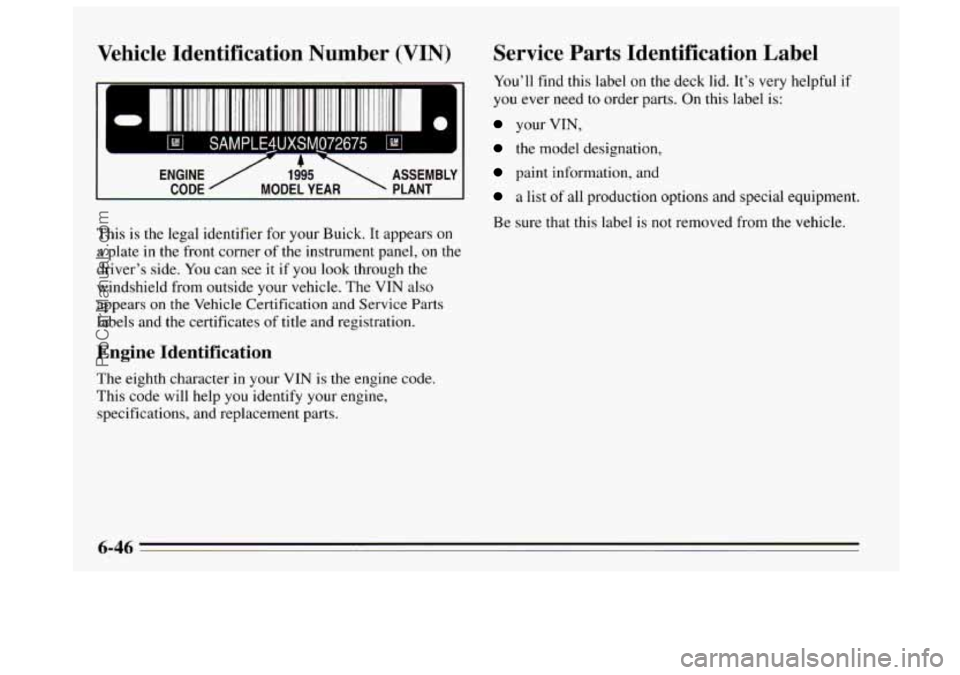
This is the legal identifier for your Buick. It appears on
a plate in the front corner
of the instrument panel, on the
driver’s side. You can see it if you
look through the
windshield from outside your vehicle. The VIN also
appears
on the Vehicle Certification and Service Parts
labels and the certificates of title and registration.
Engine Identification
The eighth character in your VIN is the engine code.
This code will help you identify your engine,
specifications, and replacement parts.
Service Parts Identification Label
You’ll find this label on the deck lid. It’s very helpful if
you ever need
to order parts. On this label is:
your VIN,
the model designation,
paint information, and
a list of all production options and special equipment.
Be sure that this label is
not removed from the vehicle.
6-46
ProCarManuals.com
Page 255 of 340
Add-on Electrical Equipment Fuses and Circuit Breakers
NOTICE:
Don’t add anything electrical to your Buick unless
you check with your dealer first. Some electrical
equipment can damage your vehicle and the
damage wouldn’t be covered by your warranty.
Some add-on electrical equipment can keep other
components from working as they should.
Your vehicle has an air bag system. Before attempting to
add anything electrical to your Buick, see “Servicing
Your Air Bag-Equipped Buick”
in the Index. The wiring
circuits
in your vehicle are protected from
short circuits by
a combination of fuses, circuit breakers,
and fusible thermal links in the wiring itself. This
greatly reduces the chance of fires caused
by electrical
problems.
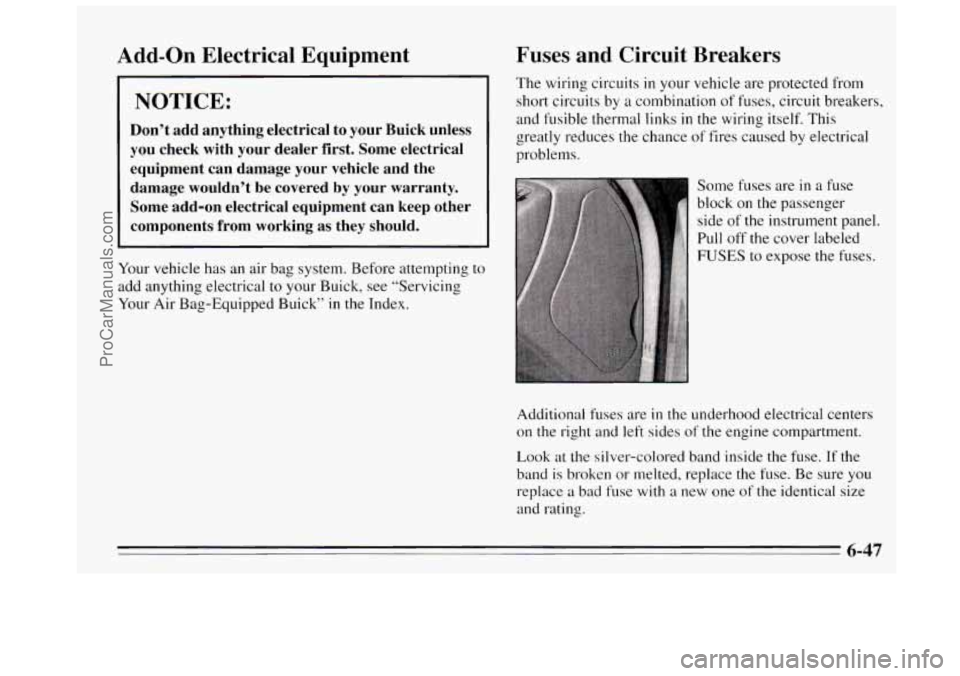
Some fuses are
in a fuse
block on the passenger
side of the instrument panel.
Pull off
the cover labeled
FUSES to expose the fuses.
Additional fuses are
in the underhood electrical centers
on the right and left sides of the engine compartment.
Look at the silver-colored band inside the fuse. If the
band is broken or melted, replace the fuse. Be sure
you
replace a bad fuse with a new one of the identical size
and rating.
6-47
ProCarManuals.com