Page 212 of 340
Gasolines for Cleaner Air
Your use of gasoline with deposit control additives will
help prevent deposits from forming in your engine and
fuel system. That helps keep your engine in tune and
your emission control system working properly. It’s
good for your vehicle, and you’ll be doing your part for
cleaner air.
Many gasolines are now blended with oxygenates.
General Motors recommends that
you use gasolines with
these blending materials, such as MTBE and ethanol. By
doing
so, you can help clean the air, especially in those
parts
of the country that have high carbon monoxide
levels.
In addition, some gasoline suppliers are now producing
reformulated gasolines. These gasolines are specially
designed to reduce vehicle emissions. General Motors
recommends that you use reformulated gasoline.
By
doing so, you can help clean the air, especially in those
parts
of the country that have high ozone levels.
You should ask your service station operators
if their
gasolines contain deposit control additives and
oxygenates, and if they have been reformulated to
reduce vehicle emissions.
Fuels in Foreign Countries
If you plan on driving in another country outside the
U.S. or Canada, unleaded fuel may be hard to find. Do
not use leaded gasoline. If you use even one tankful,
your emission controls won’t work well or at all. With
continuous use, spark plugs can get fouled, the exhaust
system can corrode, and your engine oil can deteriorate
quickly. Your vehicle’s oxygen sensor will be damaged.
All of that means costly repairs that wouldn’t be covered
by your warranty.
To check on fuel availability, ask an auto club, or
contact a major oil company that does business
in the
country where you’ll be driving.
You can also write us at the following address for
advice. Just
tell us where you’re going and give your
Vehicle Identification Number (VIN).
General Motors Overseas Distribution Corporation
North American Export Sales
(NAES)
1908 Colonel Sam Drive
Oshawa, Ontario
L1H 8P7
6-4
ProCarManuals.com
Page 213 of 340
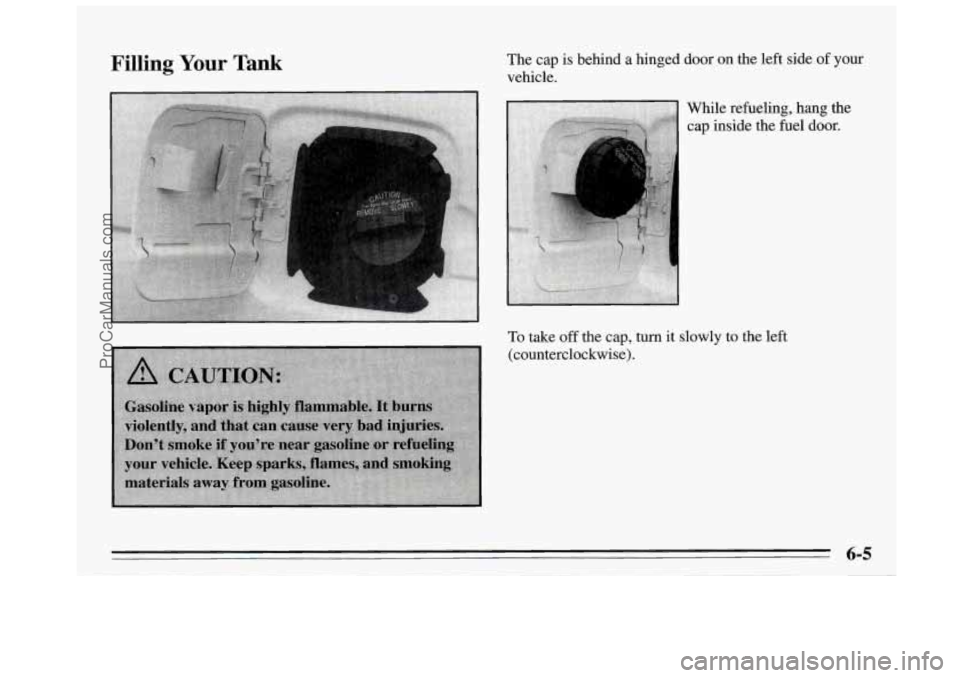
Filling Your Tank The cap is behmd a hinged door on the left side of your
vehicle.
While refueling, hang the
cap inside the fuel door.
To take off the cap, turn
(counterclockwise). it
slowly to the left
6-5
ProCarManuals.com
Page 214 of 340
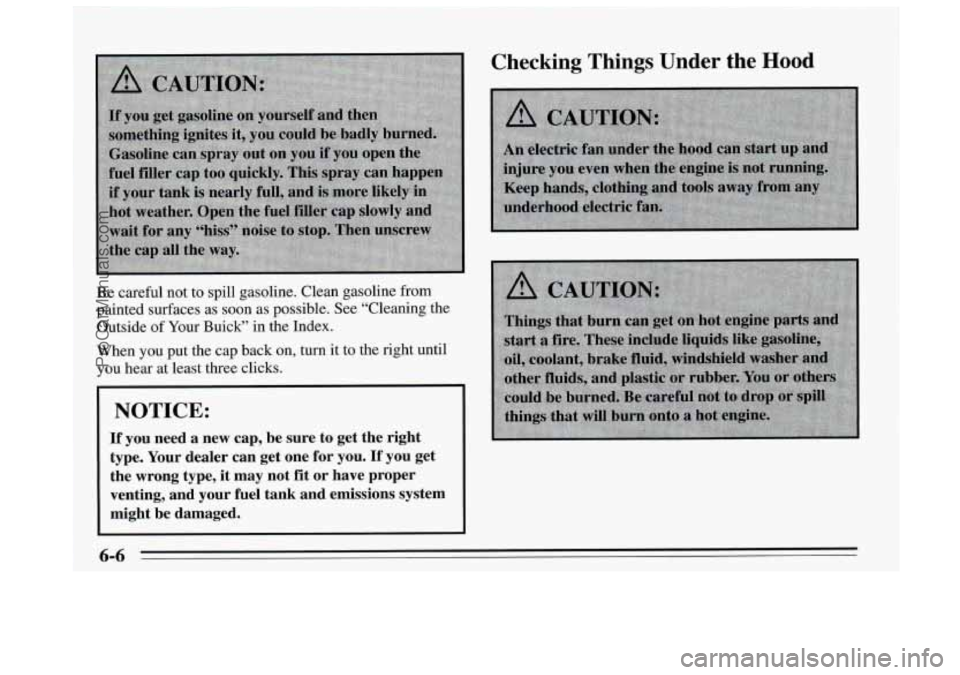
Be careful not to spill gasoline. Clean gasoline from
painted surfaces as soon as possible. See “Cleaning the
Outside
of Your Buick” in the Index.
When you put the cap back on, turn it to the right until
you hear at least
three clicks.
L
NOTICE:
If you need a new cap, be sure to get the right
type. Your dealer can get one for you.
If you get
the wrong type, it may not fit or have proper
venting, and your fuel tank and emissions system
might be damaged.
Checking Things Under the Hood
1
6-6 I
ProCarManuals.com
Page 215 of 340
Hood Release
To open the hood, first pull
the handle inside the
vehicle.
Then go to
the front of the
vehicle and release the
secondary hood release. Lift
the hood. Before closing the
hood, be sure
all the filler caps are on
properly. Then just pull the
firmly.
Engine Oil
hood down and close it
If the LOW OIL LEVEL
light on the instrument
panel comes on, it means
you need to check your
engine oil level right away.
For more information, see
“Low Oil Level Light” in
the Index.
You should check your engine oil level regularly; this is
an added reminder.
It’s
a good idea to check your engine oil every time you
get fuel. In order to get an accurate reading, the oil must
be warm and the vehicle must be on level ground.
6-7
ProCarManuals.com
Page 218 of 340
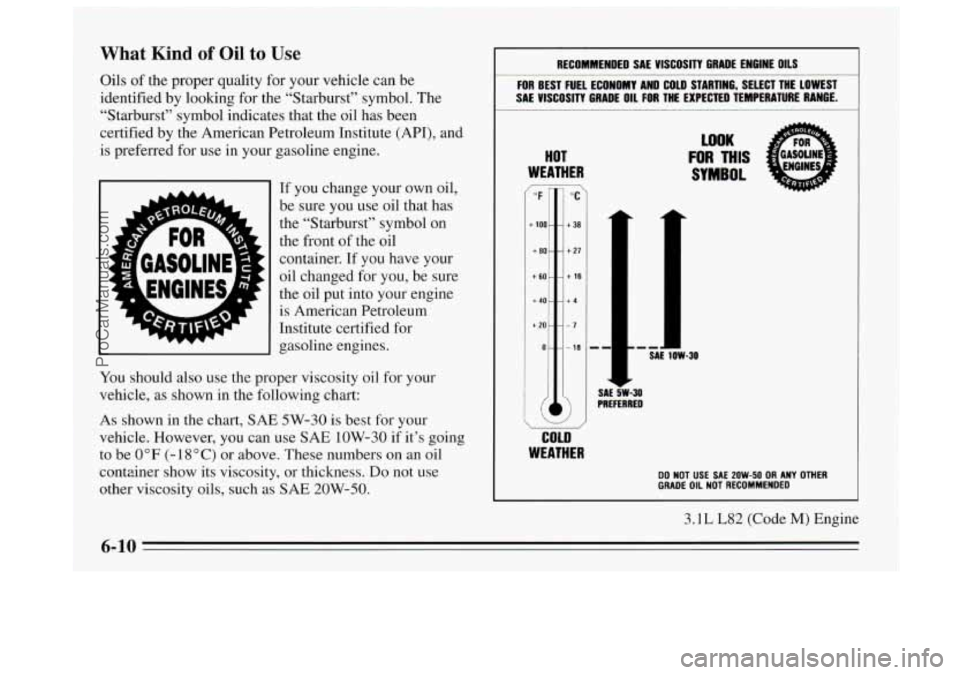
What Kind of Oil to Use
Oils of the proper quality for your vehicle can be
identified by looking for the “Starburst” symbol. The
“Starburst” symbol indicates that the oil has been
certified by the American Petroleum Institute (API), and
is preferred for use in your gasoline engine.
If you change your own oil,
be sure you use oil that has
the “Starburst” symbol on
the front of the oil
container.
If you have your
oil changed for you, be sure
the oil put into your engine
is American Petroleum
Institute certified for
gasoline engines.
You should also use the proper viscosity oil for your
vehicle, as shown in the following chart:
As shown in the chart, SAE 5W-30 is best for your
vehicle. However, you can use SAE 1OW-30 if it’s going
to be
0°F (- 18°C) or above. These numbers on an oil
container show its viscosity, or thickness.
Do not use
other viscosity oils, such as SAE
20W-50.
RECOMMENDED SAE VISCOSITY GRADE ENGINE OILS ~~~~~ ~ ~ ~~ ~~~
FOR BEST FUEL ECONOMY AND COLD STARTING, SELECT THE LOWEST
SAE VISCOSITY GRADE OIL
FOR THE EXPECTED TEMPERATURE RANGE.
HOT
WEATHER
COLD
WEATHER
FOR THIS
LOOK
SYMBOL @&
SAE 1OW-30
r
RED
DO NOT USE SAE 2OW-50 OR ANY OTHER
GRADE OIL NOT RECOMMENDED
3.1L L82 (Code M) Engine
6-10
~
ProCarManuals.com
Page 219 of 340
RECOMMENDED SAE VISCOSITY GRADE ENGINE OILS
FOR BEST FUEL ECONOMY AND COLD STARTING, SELECT THE LOWEST
SAL VISCOSITY GRADE
OIL FOR THE EXPECTED TEMPERATURE RANGE. -
HOT
WEATHER
- "F "C
-100- - +38
+BO- - +27
+60--+16
+40--+4
+20---7
0---18
SAL SW-30
LOOK
FOR THIS
SYMBOL
SAE 1OW-30 PREFERRE0 above 0°F (-18OC)
COLD
WEATHER
DO NOT USE SAE 2OW-50 OR ANY OTHER
GRADE OIL NOT RECOMMENDED
3.8L L27 (Code L) Engine
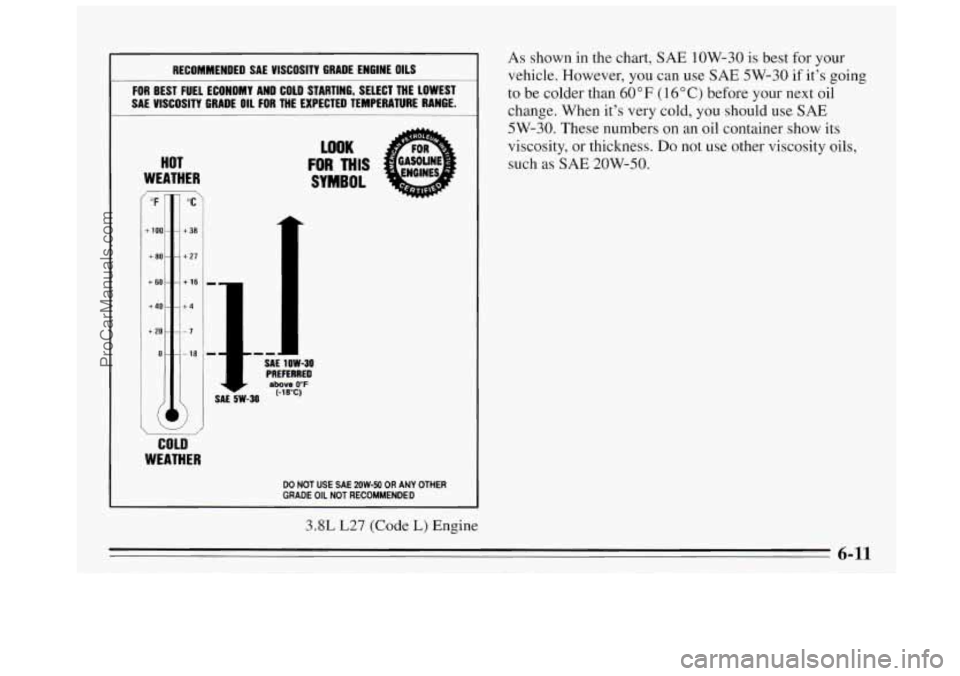
As shown in the chart, SAE 1OW-30 is best for your
vehicle. However, you can use
SAE 5W-30 if it's going
to be colder than
60°F ( 16" C) before your next oil
change. When it's very cold, you should use
SAE
5W-30. These numbers on an oil container show its
viscosity, or thickness.
Do not use other viscosity oils,
such as
SAE 20W-50.
6-11
ProCarManuals.com
Page 239 of 340
Inflation - Tire Pressure
The Tire-Loading Information label which is inside the
trunk lid shows the correct inflation pressures for your tires,
when they’re cold. “Cold” means your vehicle has been
sitting for at least three hours or driven no more than a mile.
NOTICE:
Don’t let anyone tell you that underinflation or
overinflation is all right. It’s not.
If your tires
don’t have enough
air (underinflation) you can
get:
Too much flexing
Too much heat
Tire overloading
Bad wear
Bad handling
Bad fuel economy.
If your tires have too much air (overinflation),
you can get:
Unusual wear
Bad handling
Rough ride
Needless damage from road hazards. When to Check
Check
your tires once a month or more.
Don’t forget your compact spare tire. It should be at
60 psi (420 kPa).
How
to Check
Use a good quality pocket-type gage to check tire
pressure. Simply looking at the tires will
not tell you the
pressure, especially
if you have radial tires -- which
may look properly inflated even if they’re underinflated.
If your tires have valve caps, be sure
to put them back
on. They help prevent leaks by keeping out dirt and
moisture.
6-31
ProCarManuals.com
Page 252 of 340
Underbody Maintenance
Chemicals used for ice and snow removal and dust
control can collect
on the underbody. If these are not
removed, accelerated corrosion (rust) can occur on the
underbody parts such as fuel lines, frame, floor pan, and
exhaust system even though they have corrosion
protection.
At least every spring, flush these materials from the
underbody with plain water. Clean any areas where mud
and other debris can collect. Dirt packed
in closed areas
of the frame should be loosened before being flushed.
Your dealer or an underbody vehicle washing system
can do this for you.
Fiberglass Springs
~~ ~
NOTICE:
Don’t use corrosive or acidic cleaning agents,
engine degreasers, aluminum cleaning agents or
other harsh solvents
to clean fiberglass springs;
they’ll damage the springs.
Chemical Paint Spotting
Some weather and atmospheric conditions can create
a chemical fallout. Airborne pollutants can fall upon
and attack painted surfaces on your vehicle. This
damage can take two forms: blotchy, ringlet-shaped
discolorations, and small irregular dark spots etched into
the paint surface.
Although
no defect in the paint job causes this, Buick
will repair, at
no charge to the owner, the surfaces of
new vehicles damaged by this fallout condition within
12 months or 12,000 miles (20
000 km) of purchase,
whichever comes first.
6-44
ProCarManuals.com