1995 BUICK REGAL light
[x] Cancel search: lightPage 71 of 340

PASS-Key@II
Your vehicle is equipped
with the PASS-Key%
(Personalized Automotive
Security System) theft
deterrent system.
PASS-Key% is a passive
theft deterrent system. This
means
you don’t have to do
anything different
to arm or
disarm the system.
It works when you insert or remove the key from
the
ignition. PASS-Key% uses a resistor pellet in the ignition
key that matches
a decoder in your vehicle.
When the PASS-Key% system senses that someone is
using the wrong key, it shuts down the vehicle’s starter and
fuel systems. For about three minutes, the starter won’t work and fuel won’t go to the engine. If someone tries to
start your vehicle again or uses another key during this
time, the vehicle will
not start. This discourages someone
from randomly trying different keys with different resistor
pellets in
an attempt to make a match.
The ignition key must be clean and dry before it’s
inserted in the ignition or the engine may not start. If the
engine does not
start and the SECURITY light is on, the
key may be dirty or wet. Turn the ignition off. Clean and dry the
key. Wait about three minutes and try
again. The security light may remain on during this
time. If the starter still won’t work, and the key appears
to be clean and dry, wait about three minutes and try
another ignition key. At this time, you may also want
to
check the fuse (see “Fuses and Circuit Breakers” in the
Index). If the starter won’t work with the other key, your
vehicle needs service. If your vehicle does start,
the first
ignition key may be faulty. See your Buick dealer or a
locksmith who can service
the PASS-Key@II.
If you accidentally use a key that has a damaged or
missing resistor pellet, the starter won’t work, and the
SECURITY light will flash. But
you don’t have to wait
three minutes before trying another ignition key.
See your Buick dealer or a locksmith who can service
the PASS-Key%
to have a new key made.
If you’re ever driving and the SECURITY light comes
on, you will be able to restart your engine if you turn it
off. Your PASS-Key% system, however, is not
working properly and must be serviced by
your Buick
dealer. Your vehicle is not protected by the
PASS-Key@II system.
If you lose or damage a PASS-Key% ignition
key,
see your Buick dealer or a locksmith who can service
PASS-Key@II
to have a new key made.
2-9
ProCarManuals.com
Page 73 of 340
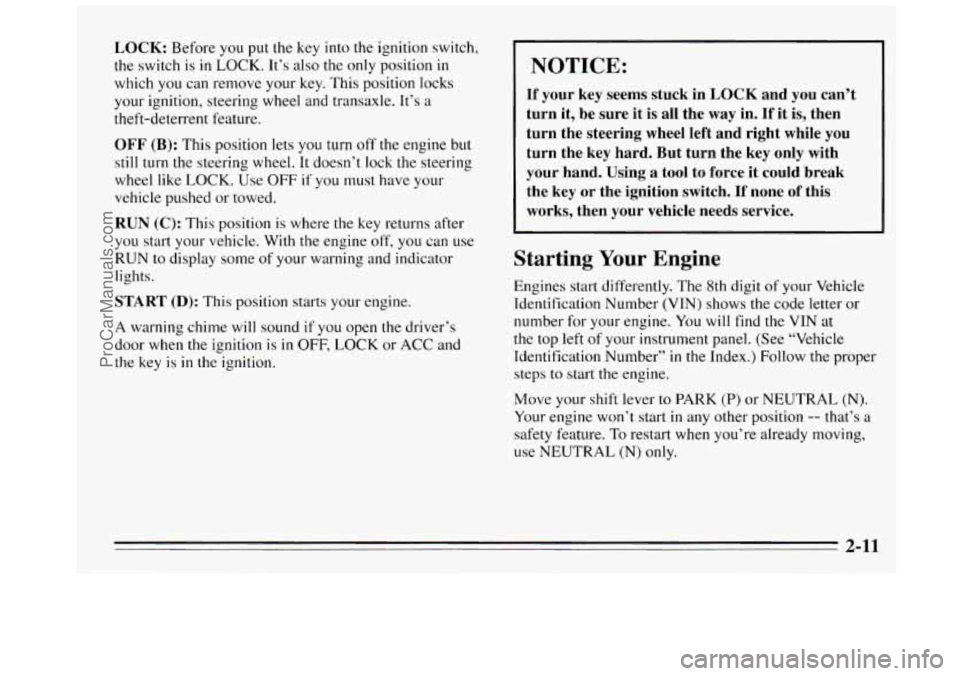
LOCK: Before you put the key into the ignition switch,
the switch is in
LOCK. It’s also the only position in
which you can remove your key. This position locks
your ignition, steering wheel and transaxle. It’s a
theft-deterrent feature.
OFF (B): This position lets you turn off the engine but
still turn the steering wheel. It doesn’t lock the steering
wheel
like LOCK. Use OFF if you must have your
vehicle pushed or towed.
RUN (C): This position is where the key returns after
you start your vehicle. With the engine off,
you can use
RUN to display some
of your warning and indicator
lights.
START (D): This position starts your engine.
A warning chime will sound if you open the driver’s
door when
the ignition is in OFF, LOCK or ACC and
the key is
in the ignition.
NOTICE:
If your key seems stuck in LOCK and you can’t
turn it, be sure it is all the
way in. If it is, then
turn the steering wheel left and right while you
turn the key hard. But turn the key only with
your hand. Using a tool to force it could break
the key or the ignition switch. If none of this
works, then your vehicle needs service.
Starting Your Engine
Engines start differently. The 8th digit of your Vehicle
Identification Number (VIN) shows the code letter
or
number for your engine. You will find the VIN at
the top
left of your instrument panel. (See “Vehicle
Identification Number” in
the Index.) Follow the proper
steps to start
the engine.
Move your shift lever
to PARK (P) or NEUTRAL (N).
Your engine won’t start
in any other position -- that’s a
safety feature. To restart when you’re already moving,
use NEUTRAL
(N) only.
2-11
ProCarManuals.com
Page 76 of 340
Driving Through Deep Standing
Water
NOTICE:
If you drive too quickly through deep puddles or
standing water, water can come in through your
engine’s
air intake and badly damage your
engine. Never drive through water that
is slightly
lower than the underbody
of your vehicle. If you
can’t avoid deep puddles or standing water, drive
through them very slowly.
Engine Coolant Heater (Option)
To use the coolant heater:
I. Turn off the engine.
2. Open the hood and unwrap the electrical cord.
3. Plug it into a normal, grounded 110-volt outlet.
In very cold weather,
0°F (- 18 O C) or colder, the engine
coolant heater can help. You’ll get easier starting and
better fuel economy during engine warm-up. Usually,
the coolant heater should be plugged in a minimum
of
four hours prior to starting your vehicle.
2-14
ProCarManuals.com
Page 88 of 340
Turn Signal and Lane Change Indicator
The turn signal has two upward (for right) and two
downward (for left) positions. These positions allow you
to signal a turn or a lane change.
To signal
a turn, move the lever all the way up or down.
When
the turn is finished, the lever will return
automatically.
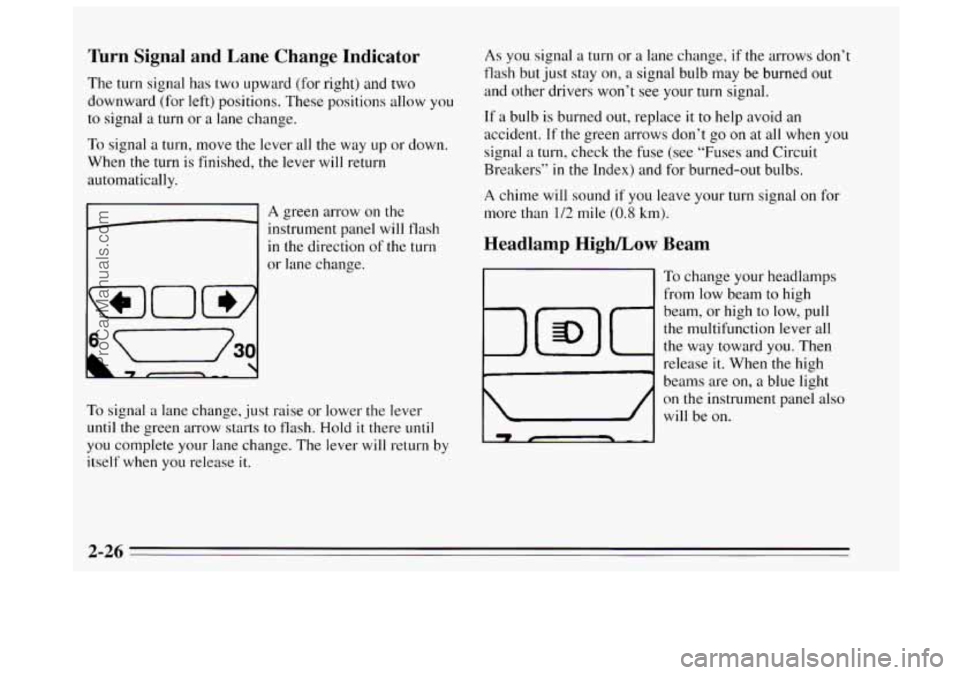
A green arrow on the
instrument panel will flash
in the direction of the turn
or lane change.
To signal a lane change, just raise or lower the lever
until the green arrow starts to flash. Hold it there until
you complete your lane change. The lever will return by
itself when you release it.
As you signal a turn or a lane change, if the arrows don’t
flash but just stay on, a signal bulb may be burned out
and other drivers won’t see
your turn signal.
If a bulb is burned out, replace
it to help avoid an
accident. If the green arrows don’t go on at all
when you
signal a turn, check the fuse (see
“Fuses and Circuit
Breakers”
in the Index) and for burned-out bulbs.
A chime will sound if you leave your turn signal on for
more than 1/2 mile
(0.8 km).
Headlamp High/Low Beam
bmd
To change your headlamps
from low beam to high
beam, or high to low, pull
the multifunction lever all
the way toward you. Then
release
it. When the high
beams are on,
a blue light
on the instrument panel
also
will be on.
2-26
ProCarManuals.com
Page 89 of 340
Windshield Wipers
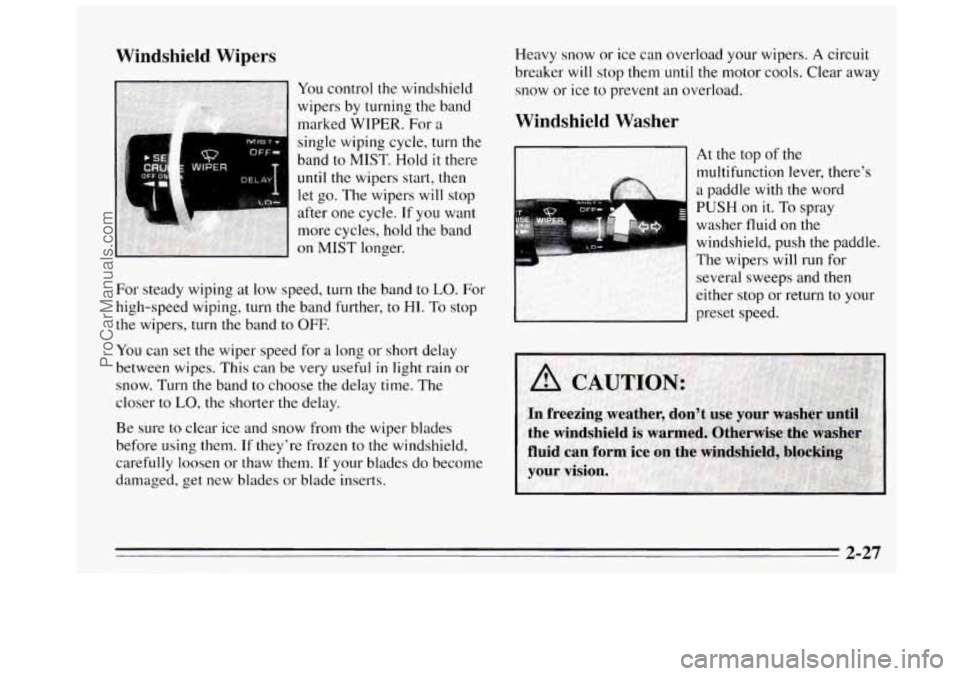
For steady wiping at low speed, turn the band to LO. For
high-speed wiping, turn the band further, to HI. To stop
the wipers, turn the band to
OFF.
You can set the wiper speed for a long or short delay
between wipes. This can
be very useful in light rain or
snow. Turn the band
to choose the delay time. The
closer to
LO, the shorter the delay.
Be sure
to clear ice and snow from the wiper blades
before using them.
If they're frozen to the windshield,
carefully loosen or thaw them.
If your blades do become
damaged, get new blades or blade inserts. Heavy snow
or ice can overload your wipers.
A circuit
breaker will stop them until the motor cools. Clear away
snow or ice to prevent an overload.
Windshield Washer
At the top of the
multifunction lever, there's a paddle with the word
PUSH
on it. To spray
washer fluid on the
windshield, push the paddle.
The wipers will run for
several sweeps and
then
either stop or return to your
preset speed.
2-27
ProCarManuals.com
Page 91 of 340
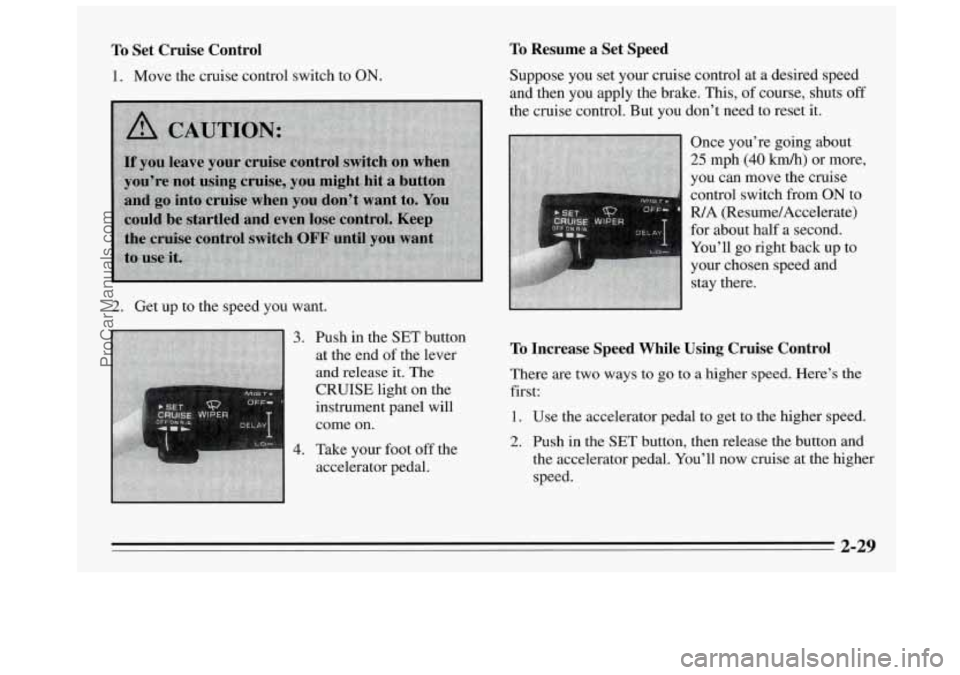
To Set Cruise Control
1. Move the cruise control switch to ON.
2. Get up to the speed you want.
3.
4.
Push
in the SET button
at the end of the lever
and release
it. The
CRUISE light on the
instrument panel will
come on.
Take your foot off the
accelerator pedal.
To Resume a Set Speed
Suppose you set your cruise control at a desired speed
and then you apply the brake. This, of course, shuts
off
the cruise control. But you don’t need to reset it.
Once you’re going about
25 mph (40 km/h) or more,
you can move the cruise
control switch from
ON to
WA (Resume/Accelerate)
for about half
a second.
You’ll go right back up to
your chosen speed and
stay there.
To Increase Speed While Using Cruise Control
There are two ways to go to a higher speed. Here’s the
first:
1.
2.
Use the accelerator pedal to get to the higher speed.
Push in the
SET button, then release the button and
the accelerator pedal. You’ll now cruise at the higher
speed.
2-29
ProCarManuals.com
Page 92 of 340
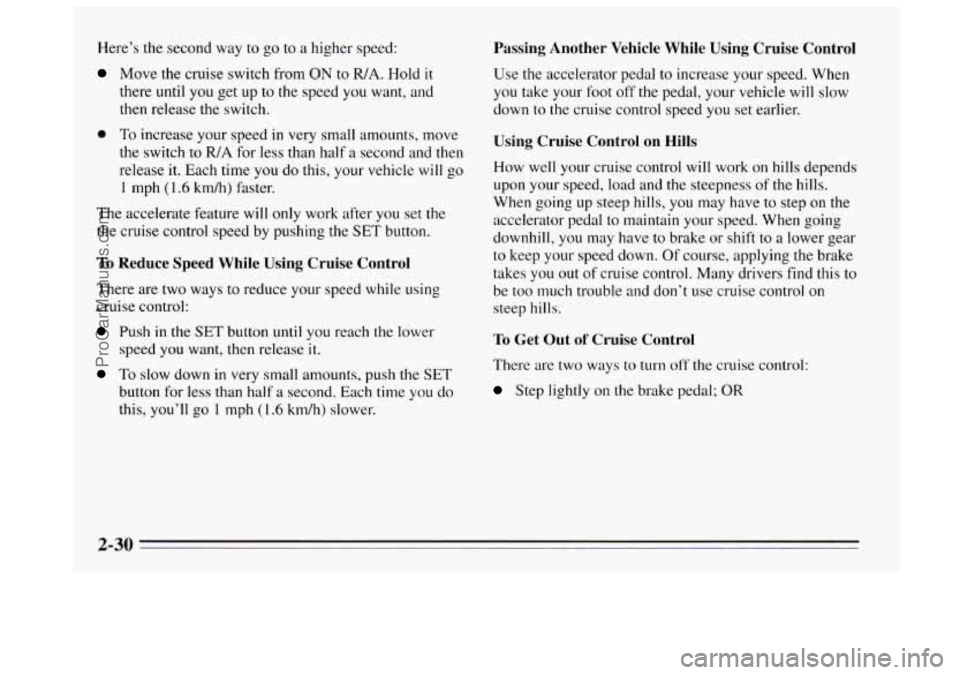
Here’s the second way to go to a higher speed:
Move the cruise switch from ON to FUA. Hold it
there until you get up to the speed you want, and
then release the switch.
0 To increase your speed in very small amounts, move
the switch to
R/A for less than half a second and then
release it. Each time
you do this, your vehicle will go
1 mph (1.6 km/h) faster.
The accelerate feature will
only work after you set the
the cruise control speed by pushing the
SET button.
To Reduce Speed While Using Cruise Control
There are two ways to reduce your speed while using
cruise control:
Push in the SET button until you reach the lower
speed you want, then rele~
~ : it.
To slow down in very small amounts, push the SET
button for less than half
a second. Each time you do
this, you’ll go 1 mph (1.6 km/h) slower.
Passing Another Vehicle While Using Cruise Control
Use the accelerator pedal to increase your speed. When
you take your foot
off the pedal, your vehicle will slow
down to
the cruise control speed you set earlier.
Using Cruise Control on Hills
How well your cruise control will work on hills depends
upon your speed, load and
the steepness of the hills.
When going
up steep hills, you may have to step on the
accelerator pedal to maintain your speed. When going
downhill, you may have to brake or shift to
a lower gear
to keep your speed down. Of course, applying the brake
takes you out of cruise control. Many drivers find this
to
be too much trouble and don’t use cruise control on
steep hills.
To Get Out of Cruise Control
There are two ways to turn off the cruise control:
Step lightly on the brake pedal; OR
2-30 ,. . .
ProCarManuals.com
Page 94 of 340
Instrument Panel Lamps
You can brighten or dim the instrument panel lamps by
moving the PANEL
LAMPS dial. If you turn the dial
past
HI, your courtesy or interior lamps will conle on.
Daytime Running Lamps (Canada Only)
Daytime Running Lamps (DRL) can make it easier for
others to see the front of your vehicle during the day.
DRL can be helpful in many different driving
conditions, but they can be especially helpful
in the
short periods after dawn and before sunset.
A light sensor on top of the instrument panel makes the
DRL work,
so be sure it isn’t covered,
The
DRL system will make your low-beam headlamps
come on at a reduced brightness when: When the DRL
are
on, only your low-bearn headlamps
will be on. The taillamps, sidemarker and other lamps
won‘t be
on. Your instrument panel won’t be lit up either.
When it’s dark enough outside, your low-beam
headlamps will change to
full brightness. The other lamps
that come
on with your headlamps will also come on.
When it’s bright enough outside, the regular lamps
will
go off, and your low-beam headlamps change to the
reduced brightness of DRL.
To idle your vehicle with the DRL off, set the parking brake
while the ignition is
in OFF or LOCK. Then start your vehicle.
The
DIU will stay off until you release the parking brake.
As with any vehicle, you should turn on the regular
headlamp system any time you need it.
0 The ignition is on,
0 The headlamp switch is off, and
0 The parking brake is released.
2-32
ProCarManuals.com