1995 BUICK REGAL engine overheat
[x] Cancel search: engine overheatPage 194 of 340
How to Add Coolant to the Radiator
NOTICE:
Your engine has a specific radiator fill procedure.
Failure to
follow this procedure could cause your
engine to overheat and be severely damaged.
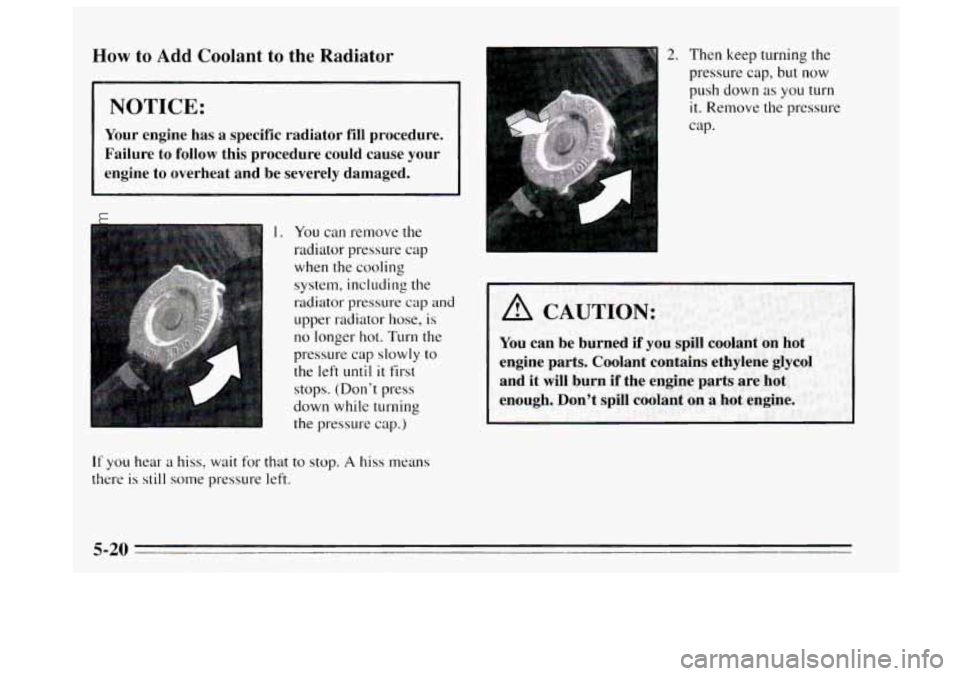
1. You can remove the
radiator pressure cap
when the cooling
system, including the
radiator pressure
cap and
upper radiator hose,
is
no longer hot. Turn the
pressure
cap slowly to
the left until it first
stops. (Don’t press
down while turning
the pressure cap.)
IC you hear a hiss, wait for that to stop. A hiss means
there
is still some pressure left.
2. Then keep turning the
pressure cap, but now
push down
as you turn
it. Remove the pressure
cap.
5-20
ProCarManuals.com
Page 207 of 340

If You’re Stuck: In Sand, Mud, Ice or
Snow
What you don’t want to do when your vehicle is stuck is
to spin your wheels too hst. The method known as
“rocking” can help you get out when you’re stuck, but
you must use caution.
A CAUTION:
If you let your tires spin at high speed, they can
explode and you or others could be injured. And,
the transaxle or other parts of the vehicle can
overheat. That could cause an engine
compartment fire or other damage. When you’re
stuck, spin the wheels
as little as possible. Don’t
spin the wheels above
35 mph (55 kdh) as shown
on the speedometer.
NOTICE:
Spinning your wheels can destroy parts of your
vehicle as well as the tires. If you spin the wheels
too fast while shifting your transaxle back and
forth, you can destroy your transaxle.
For information about using tire chains on your vehicle,
see “Tire Chains”
in the Index.
Rocking your vehicle to get it out:
1 First, turn your steering wheel left and right. That will
clear the area around
your front wheels. Then shift back
and forth between
REVERSE (R) and a forward gear,
spinning the wheels as little
as possible. Release the
accelerator pedal while you shift, and press lightly
on
the accelerator pedal when the transaxle is in gear. If
that doesn’t get you out after a few tries, you may need
to be towed
out. If you do need to be towed out, see
“Towing Your Vehicle”
in the Index.
- 5-33
ProCarManuals.com
Page 225 of 340

How to Add Fluid
Refer to the Maintenance Schedule to determine what
kind of transaxle fluid to use. See “Recommended
Fluids and Lubricants”
in the Index.
If the fluid level is low, add only enough of the proper
fluid to bring the level into the cross-hatched area on the
dipstick.
1. Pull out the dipstick.
2. Using a long-neck funnel, add enough fluid at the
dipstick hole
to bring it to the proper level.
It doesn’t take much fluid, generally less than a pint
(OSL). Don ’t ouefill. We recommend you use only fluid
labeled DEXRON@-111, because fluid with that label is
made especially for your automatic transaxle. Damage
caused by fluid other than DEXRON@-I11 is not covered
by your new vehicle warranty.
After adding fluid, recheck the fluid level as
described under “How
to Check.”
When the correct fluid level is obtained, push the
dipstick back in all the way.
Engine Coolant
The following explains your cooling system and how to
add coolant when it is low. If you have a problem with
engine overheating or if
you need to add coolant to your
radiator, see “Engine Overheating” in the Index.
The proper coolant for your Buick will:
Give freezing protection down to -34°F (-37°C).
Give boiling protection up to 262 OF (1 28 O C).
Protect against rust and corrosion.
Help keep the proper engine temperature.
Let the warning lights work as they should.
What to Use
Use a mixture of one-half clean water (preferably
distilled) and one-half antifreeze that meets “GM
Specification
1825-M,” which won’t damage aluminum
parts. You can also use a recycled coolant conforming to
GM Specification 1825-M with a complete coolant flush
and refill. Use GM Engine Coolant Supplement (sealer)
with any complete coolant flush and refill.
If you use
this mixture, you don’t need to add anything else.
~
6-17
ProCarManuals.com
Page 226 of 340
I NOTICE:
If you use an improper coolant mix, your engine
could overheat and be badly damaged. The
repair cost wouldn’t be covered by your
warranty. Too much water in the mix can freeze
and crack the engine, radiator, heater core and
other parts.
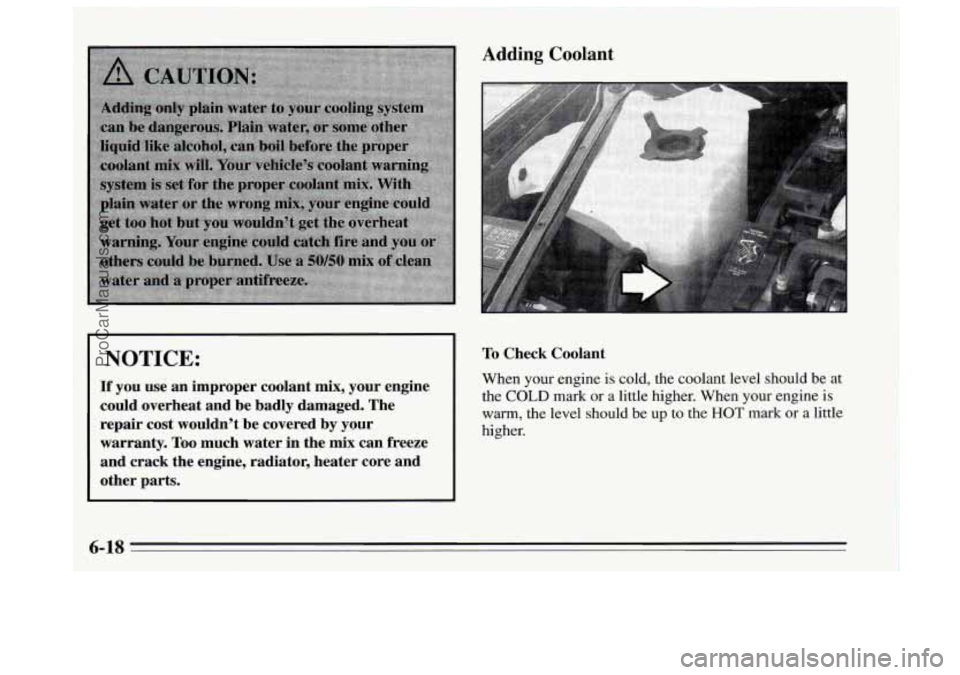
Adding Coolant
To Check Coolant
When your engine is cold, the coolant level should be at
the
COLD mark or a little higher. When your engine is
warm, the level should be up to the HOT mark or a little
higher.
ProCarManuals.com
Page 227 of 340
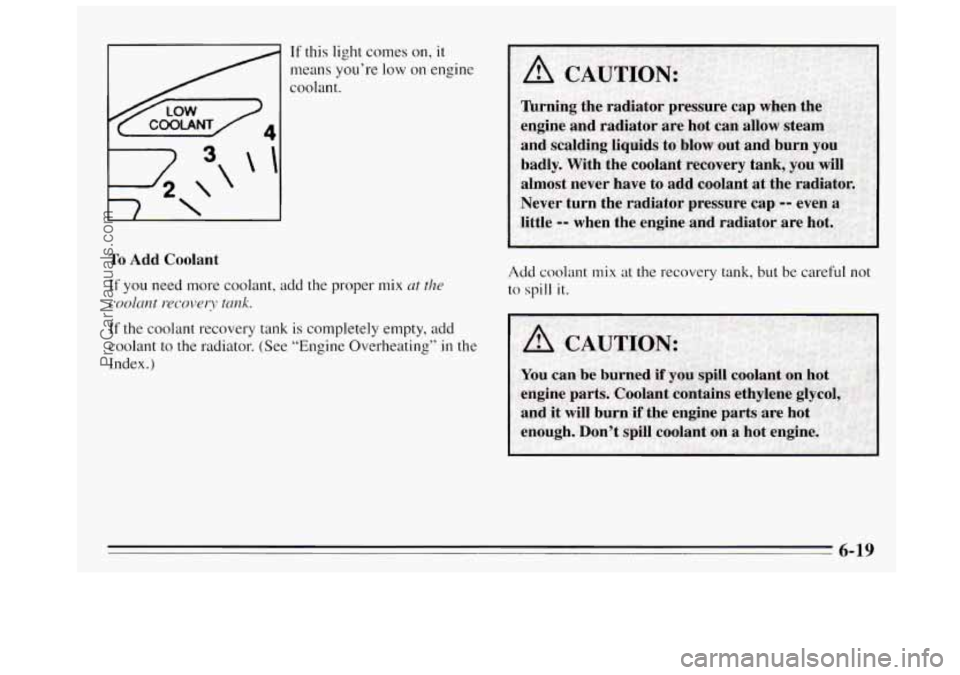
To Add Coolant
If this light comes on, it
means you’re low on engine
coolant.
If you need more coolant, add the proper mix at the
coolant recovery tank.
If the coolant recovery tank is completely empty, add
coolant to
the radiator. (See “Engine Overheating” in the
Index
.)
Add coolant mix at the recovery tank, but be careful not
to spill
it.
6-19
ProCarManuals.com
Page 228 of 340
Radiator Pressure Cap Power Steering Fluid
NOTICE:
Your radiator cap is a 15 psi (105 kPa)
pressure-type cap and must be tightly installed to
prevent coolant loss and possible engine damage
from overheating. Be sure the arrows
on the cap
line up with the overflow tube on the radiator
filler neck.
When you replace your radiator pressure cap, an AC@
cap is recommended.
Thermostat
Engine coolant temperature is controlled by a thermostat
in the engine coolant system. The thermostat stops the
flow of coolant through the radiator until the coolant
reaches a preset temperature.
When you replace your thermostat, an
AC@ thermostat
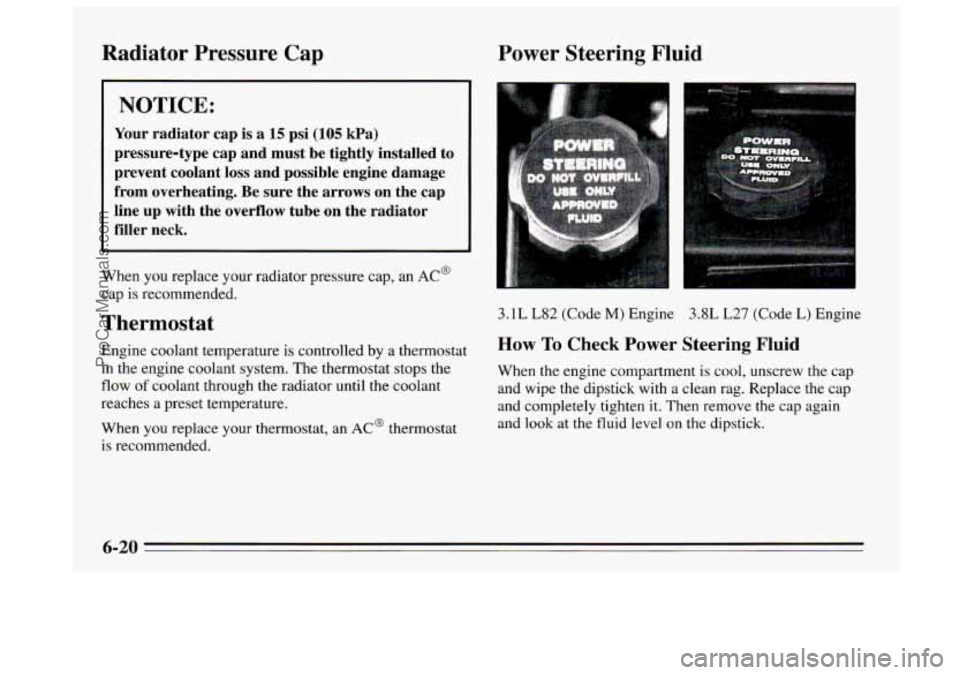
is recommended. 3.1L
L82 (Code M) Engine
3.8L L27 (Code L) Engine
How To Check Power Steering Fluid
When the engine compartment is cool, unscrew the cap
and wipe the dipstick with a clean rag. Replace the cap
and completely tighten
it. Then remove the cap again
and look at the fluid level
on the dipstick.
6-20
ProCarManuals.com
Page 330 of 340
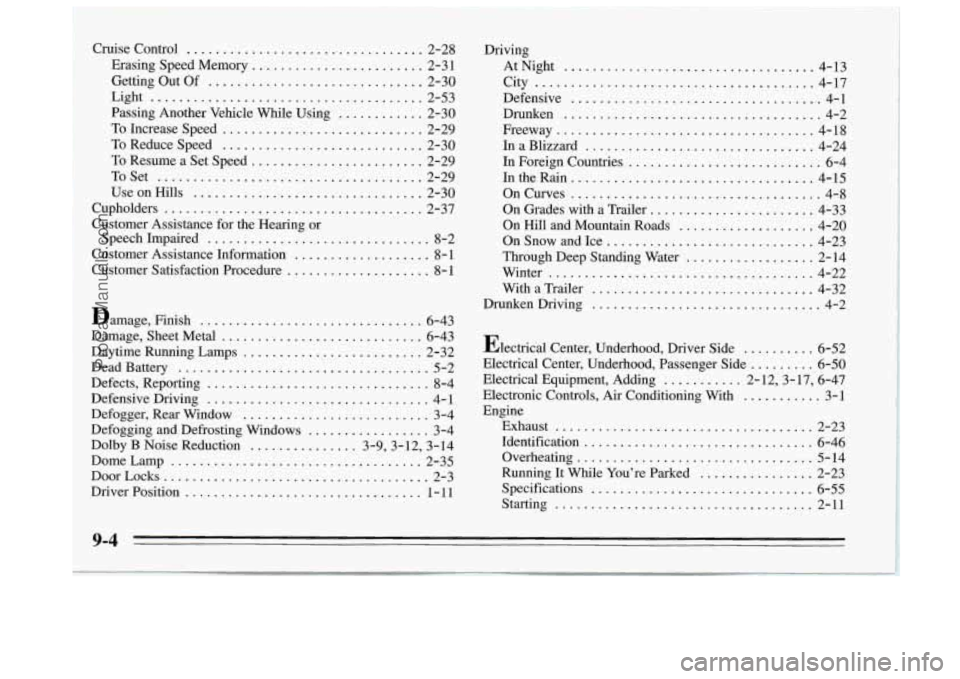
Cruise Control ................................. 2-28
Erasing Speed Memory
........................ 2-31
Getting Out
Of .............................. 2-30
Passing Another Vehicle
While Using ............ 2-30
ToIncreaseSpeed
............................ 2-29
To Resume a Set Speed
........................ 2-29
Light
...................................... 2-53
ToReduceSpeed
............................ 2-30
ToSet
..................................... 2-29
UseonHills
................................ 2-30
Cupholders
.................................... 2-37
Customer Assistance for the Hearing or
SpeechImpaired
............................... 8-2
Customer Assistance Information
................... 8- 1
Customer Satisfaction Procedure .................... 8- 1
Damage. Finish ............................... 6-43
Damage. Sheet Metal
............................ 6-43
Daytime Running Lamps
......................... 2-32
Dead Battery
................................... 5-2
Defects. Reporting
............................... 8-4
Defensive Driving
............................... 4- 1
Defogger. Rear Window .......................... 3-4
Defogging and Defrosting Windows
................. 3-4
Dolby B Noise Reduction
............... 3.9.3.12. 3.14
DomeLamp
................................... 2-35
DoorLocks
..................................... 2-3
DriverPosition
................................. 1-11 Driving
At Night
................................... 4-13
City
....................................... 4-17
Defensive
................................... 4-1
Drunken
.................................... 4-2
Freeway
.................................... 4-18
InaBlizzard
................................ 4-24
In Foreign Countries
........................... 6-4
IntheRain
.................................. 4-15
OnCurves
................................... 4-8
On Grades with
a Trailer ....................... 4-33
On
Hill and Mountain Roads ................... 4-20
OnSnowandIce
............................. 4-23
Through Deep Standing Water
.................. 2-14
With a Trailer
............................... 4-32
Winter
..................................... 4-22
DrunkenDriving
................................ 4-2
Electrical Center. Underhood. Driver Side
.......... 6-52
Electrical Center. Underhood. Passenger Side
......... 6-50
Electrical Equipment. Adding
........... 2.12.3.17. 6.47
Electronic Controls. Air Conditioning With
........... 3-1
Identification
................................ 6-46
Overheating
................................. 5-14
Running It While You’re Parked
................ 2-23
Specifications
............................... 6-55
Engine
Exhaust
.................................... 2-23
Starting
.................................... 2-11
9-4
ProCarManuals.com
Page 334 of 340
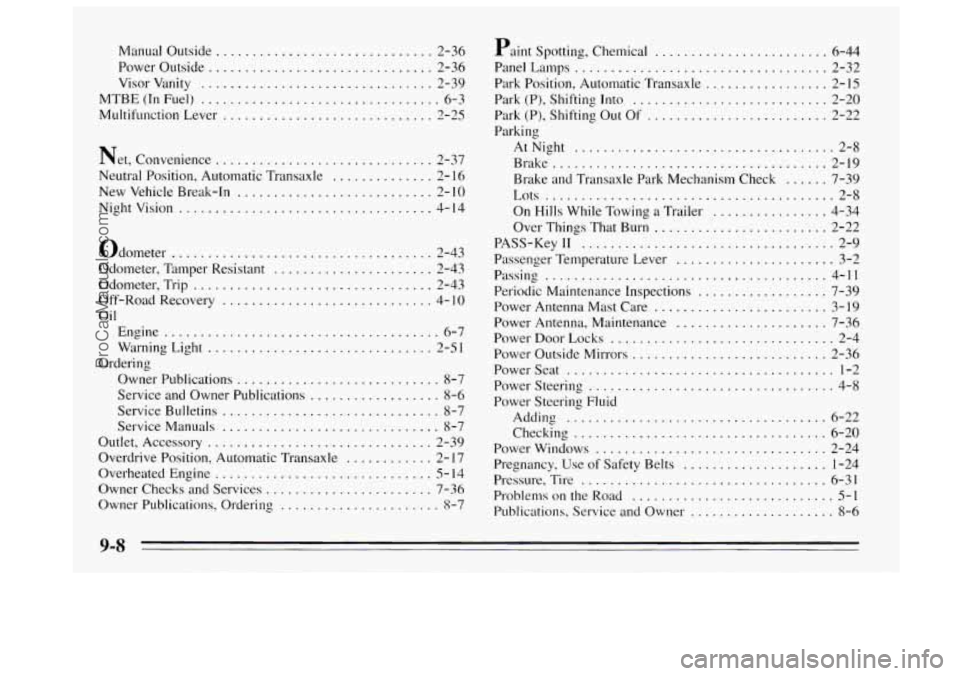
Manual Outside .............................. 2-36
Power Outside
............................... 2-36
Visor Vanity
................................ 2-39
MTBE(1nFuel)
................................. 6-3
Multifunction Lever
............................. 2-25
Net. Convenience
.............................. 2-37
Neutral Position. Automatic Transaxle
.............. 2-
New Vehicle Break-In
........................... 2-
Night Vision
................................... 4-
Odometer
.................................... 2-43
Odometer. Tamper Resistant
...................... 2-43
Odometer. Trip
................................. 2-43
Off-Road Recovery
............................. 4- 10
Warning Light ............................... 2-5 1
Owner Publications ............................ 8-7
Service and Owner Publications
.................. 8-6
Service Bulletins
.............................. 8-7
Service Manuals
.............................. 8-7
Outlet. Accessory
............................... 2-39
Overdrive Position. Automatic Transaxle
............ 2- 17
Overheated Engine
.............................. 5- 14
Owner Checks and Services
....................... 7-36
Owner Publications. Ordering ...................... 8-7
Oi
I
Engine ...................................... 6-7
Ordering
16
IO
14
Paint Spotting. Chemical ........................ 6-44
Panel Lamps
................................... 2-32
Park Position, Automatic Transaxle
................. 2-15
Park (P), Shifting Into
........................... 2-20
Park (P), Shifting Out
Of ......................... 2-22
Parking AtNight
.................................... 2-8
Brake
...................................... 2-19
Brake and Transaxle Park Mechanism Check
...... 7-39
Lots
........................................ 2-8
On Hills While Towing
a Trailer ................ 4-34
Over Things
That Burn ........................ 2-22
PASS-Key
I1 ................................... 2-9
Passenger Temperature Lever
...................... 3-2
Passing
....................................... 4-11
Periodic Maintenance Inspections
.................. 7-39
Power Antenna Mast Care
........................ 3-19
Power Antenna, Maintenance
..................... 7-36
Power Door Locks
............................... 2-4
Power Outside Mirrors
........................... 2-36
Powerseat
..................................... 1-2
Power Steering .................................. 4-8
Power Steering Fluid
Adding
.................................... 6-22
Checking
................................... 6-20
Power Windows
................................ 2-24
Pregnancy, Use
of Safety Belts .................... 1-24
Pressure, Tire
.................................. 6-31
Problems on the Road
............................ 5-1
Publications . Service and Owner .................... 8-6
9-8
ProCarManuals.com