1995 BMW M3 head
[x] Cancel search: headPage 3 of 759
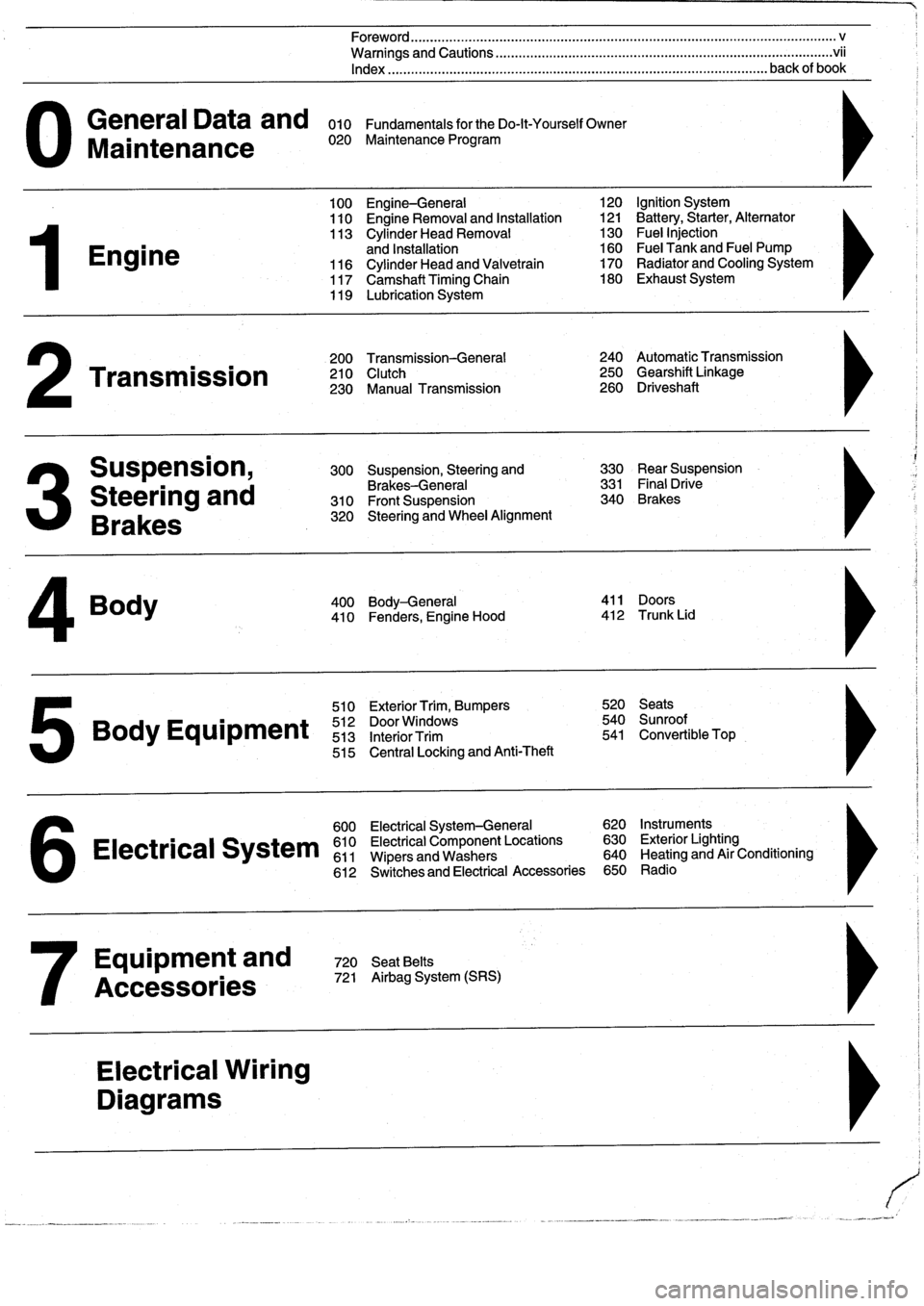
General
Data
and
010
FundamentalsfortheDo-lt-YourselfOwner
Maintenance
020
Maintenance
Program
Engine
Transmission
Suspension,
Steering
and
Brakes
4
Body
100
Engine-General
110
Engine
Removal
and
Installation
113
Cylinder
Head
Removal
and
Installation
116
Cylinder
Head
and
Valvetrain
117
Camshaft
Timing
Chain
119
Lubrication
System
200
Transmission-General
210
Clutch
230
Manual
Transmission
510
Exterior
Trim,
Bumpers
520
Seats
Bo
y
Equipment
512
DoorWTdws
540
nr
t
513
InteriorTrim
541
Convertible
Top
515
Central
Locking
and
Anti-Theft
600
Electrical
System-General
620
Instruments
Electrical
S
stem
610
Electrical
Component
Locations
630
Exterior
Lighting
611
Wipers
and
Washers
640
Heating
and
Air
Conditioning
6
612
Switches
and
Electrical
Accessories
650
Radio
Equipment
and
720
SeatBelts
Accessories
721
Airbag
System
(SRS)
Electrical
Wiring
Diagrams
Foreword
.
...
.
.
.
..................
.
.
.
.....
.
............
.
...
.
.
.
.
.
................
.
.
.
.....
.
......
.
................
.
.
.
.....
v
Warnings
and
Cautions
.....
.
...
.
.
.
.
.
..........
.
...
.
.
.
.
.
......
.
.........
.
.
.
...
.
.
.
......
.
.
.
.
.
............
.
.
.
.
.
.
.vii
Index
..............
.
.
.
.....
.
............
.
...
.
.
.
.
.
........
.
...
.
.
.
.
.
.......
.
......
.
...
.
.
.
.
.
.
.
........
.
.
.
..
back
of
book
300
Suspension,
Steering
and
330
RearSuspension
Brakes-General
331
Final
Drive
310
Front
Suspension
340
Brakes
320
Steering
and
Wheel
Alignment
400
Body-General
411
Doors
410
Fenders,
Engine
Hood
412
Trunk
Lid
120
Ignition
System
121
Battery,Starter,
Alternator
130
Fue¡
Injection
160
Fuel
Tank
and
Fuel
Pump
170
Radiator
and
Cooling
System180
Exhaust
System
240
Automatic
Transmission
250
Gearshift
Linkage
260
Driveshaft
Page 7 of 759

Please
read
these
warnings
and
cautions
before
proceeding
with
maintenance
and
repair
work
.
WARNING-
"
Friction
materials
(such
as
brake
pads
or
shorts
or
clutchdiscs)
contain
asbestos
fibers
or
other
friction
materials
.
Do
notcreate
"
See
also
Cautionson
page
viü
dustby
grinding,
sanding,
orby
cleaning
with
compressed
air
.
"
Some
repairs
may
be
beyond
your
capability
.
If
you
lack
the
Avoid
breathing
dust
.
Breathing
any
friction
material
dust
can
lead
skills,
tools
and
equipment,
or
a
suitable
workplace
for
any
proce-
to
serious
diseases
and
may
result
in
death
.
duredescribed
in
this
manual,
we
suggestyou
leave
such
repairs
"
Batteries
give
off
explosive
hydrogen
gas
during
charging
.
to
an
authorized
BMW
dealer
service
department
or
other
quali-
Keep
sparks,
lighted
matches
and
open
flame
away
from
the
top
fied
shop
.
of
the
battery
If
hydrogen
gas
escaping
from
the
cap
vents
is
"Do
not
re-use
any
fasteners
that
are
worn
or
deformed
in
normal
ignited,
it
will
ignite
gas
trapped
in
the
cells
and
cause
the
battery
use
.
Many
fasteners
are
designed
to
be
used
only
once
and
to
explode
.
become
unreliable
and
may
fail
when
used
a
second
time
.
This
"
Connect
and
disconnect
battery
cables,
jumper
cablesora
bat-
includes,
but
is
not
limited
to,
nuts,
bolts,
washers,
self-locking
nuts
or
bolts,
circlips
and
cotterpins
.
Always
replace
these
fasteners
with
new
parts
.
"Do
not
quick-charge
the
battery
(for
boost
starting)
for
longer
"
Never
work
under
a
lifted
car
unless
it
is
solidly
supportedon
than
one
minute
.
Wait
at
least
one
minute
before
boosting
the
bat-
stands
designed
for
the
purpose
.
Do
not
support
a
car
on
cinder
tery
a
second
time
.
blocks,
hollow
tiles
or
other
props
that
may
crumble
under
contin-
uous
load
.
Never
work
under
acar
that
is
supported
solely
by
a
"Do
not
allow
battery
charging
voltage
to
exceed
16
.5
volts
.
If
the
jack
.
Never
work
under
thecar
while
the
engine
is
running
.
battery
beginsproducing
gas
or
boiling
violently,
reduce
the
charg-
ing
rate
.
Boosting
a
sulfated
battery
at
a
high
charging
rate
can
"
If
you
are
going
to
work
under
acar
on
the
ground,
make
sure
cause
an
explosion
.
that
the
ground
is
level
.
Block
the
wheels
to
keep
the
carfrom
roll-
ing
.
Disconnect
the
battery
negative
(-)
terminal
(ground
strap)to
"
The
air-conditioning
system
is
filled
with
chemical
refrigerant,
prevent
others
from
starting
thecar
while
youare
under
it
.
which
is
hazardous
.
TheA/C
system
should
be
servicedonly
by
trained
technicians
using
approved
refrigerant
recovery/recycling
"
Never
run
the
engine
unless
the
work
area
is
well
ventilated
.
equipment,
trained
in
related
safetyprecautions,
and
familiar
with
Carbon
monoxide
kills
.
regulations
governing
the
discharging
and
disposal
of
automotive
"
Finger
rings,
bracelets
and
other
jewelry
shouldbe
removed
so
chemical
refrigerants
.
tery
charger
only
with
the
ignition
switched
off,
to
prevent
sparks
.
Do
not
disconnect
the
battery
while
the
engine
is
running
.
that
theycannot
cause
electrical
shorts,
get
caught
in
running
"
Do
not
expose
any
partof
the
A/Csystem
to
high
temperatures
machinery,
or
be
crushed
by
heavy
parts
.
suchas
open
flame
.
Excessiveheat
will
increase
system
pressure
"
Tie
long
hair
behind
your
head
.
Do
not
wear
a
necktie,
a
scarf,
and
may
cause
the
system
to
burst
.
loose
clothing,
or
a
necklace
when
you
work
near
machine
tools
or
"
Some
aerosol
tire
inflators
are
highly
flammable
.
Be
extremely
running
engines
.
If
your
hair,
clothing,
or
jewelry
were
to
get
caught
cautious
when
repairing
a
tire
that
may
havebeen
inflated
using
in
the
machinery,
severe
injury
could
result
.
an
aerosol
tire
inflator
.
Keep
sparks,
open
flame
or
other
sources
"
Do
not
attempt
to
work
onyourcar
if
you
do
not
feel
well
.
You
of
ignition
away
from
the
tire
repair
area
.
Inflate
and
deflate
the
tire
increase
the
danger
of
injury
toyourself
and
others
if
you
are
tired,
at
least
four
times
before
breaking
the
bead
from
therim
.
Com-
upset
or
have
takenmedication
or
any
other
substance
that
may
Pletely
remove
the
tire
from
the
rim
beforeattempting
any
repair
.
keep
you
from
being
fully
alert
.
"
Illuminate
your
work
areaadequately
but
safety
.
Use
a
portable
safety
light
for
working
inside
or
under
thecar
.
Make
surethe
bulb
is
enclosedbya
wire
cage
.
The
hot
filament
of
an
accidentally
bro-
ken
bulb
can
ignite
spilled
fuel
or
oil
.
"
Catch
draining
fuel,
oil,
orbrake
fluid
in
suitable
containers
.
Do
not
use
food
or
beverage
containers
that
mightmislead
someone
into
drínking
from
them
.
Store
flammable
fluids
away
from
fire
haz-
ards
.
Wipe
up
spills
at
once,
but
do
not
store
the
oily
rags,
which
can
ignite
and
burn
spontaneously
.
"
Always
observe
good
workshop
practices
.
Wear
goggles
when
youoperate
machine
tools
or
work
with
battery
acid
.
Gloves
or
other
protectioeclothing
should
be
worn
whenever
thejob
requires
working
with
harmful
substances
.
"
Greases,
lubricants
and
other
automotive
chemicals
contain
toxic
substances,
many
of
which
are
absorbed
directly
through
the
skin
.
Read
the
manufacturer's
instructions
and
warnings
carefully
.
Use
hand
andeye
protection
.
Avoid
direct
skin
contact
"
Cars
covered
by
this
manual
are
equipped
with
a
supplemental
restraint
system
(SRS),
that
automatically
deploys
an
airbag(s)
in
theevent
of
a
frontal
ímpact
.
The
airbag(s)
is
inflated
byan
explo-
sive
device
.
Handled
improperly
or
without
adequate
safeguards,
can
be
accidently
activated
and
cause
serious
injury
.
"
The
ignition
system
produces
high
voltages
that
can
be
fatal
.
Avoid
contact
with
exposed
terminals
and
use
extreme
care
when
working
ona
car
with
the
engine
running
or
the
ígnition
switched
on
.
"
Place
jack
stands
only
at
locations
specified
bymanufacturer
.
The
vehicle
lifting
jacksupplied
with
the
vehicle
is
intended
for
tire
changes
only
.
A
heavy
duty
floor
jack
shouldbe
used
to
lift
vehicle
before
installing
jack
stands
.
See
010
Fundamentals
for
theDo-
.
it-Yourself
Owner
.
"
Battery
acid
(electrolyte)
can
cause
severeburns
.
Flush
contact
area
with
water,
seek
medical
attention
.
"
Aerosolcleaners
and
solvents
may
contain
hazardous
ordeadly
vapors
and
are
highly
flammable
.
Use
only
in
a
wellventilated
area
.
Do
not
use
on
hot
surfaces
(engines,
brakes,
etc
.)
.
"
Disconnect
the
battery
negative
(-)
terminal
(Ground
strap)
"
Do
not
remove
coolant
reservoir
or
radiator
cap
with
theengine
whenever
you
work
on
the
fuel
system
orthe
electrical
system
.
Do
hot
.
Danger
of
bums
and
engine
damage
.
not
smoke
or
work
near
heaters
or
other
fire
hazards
.
Keep
an
approved
fire
extinguisher
handy
.
continued
on
next
page
vii
Page 9 of 759
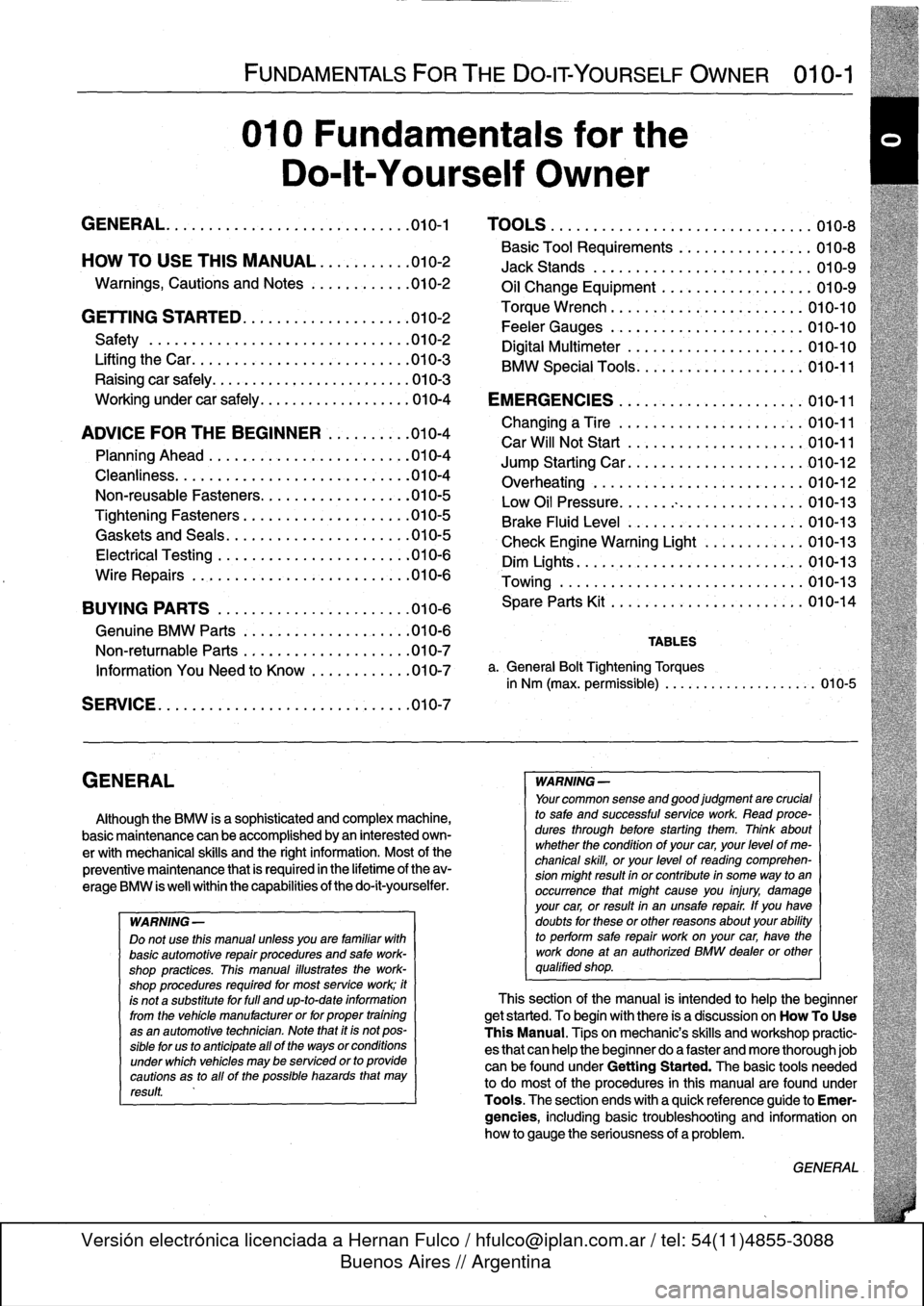
GENERAL
FUNDAMENTALS
FORTHE
DO-IT
YOURSELF
OWNER
010-1
010
Fundamentals
for
the
Do-lt-Yourself
Owner
GENERAL
.......
.
.
.
......
.
.........
.
.
.010-1
TOOLS
.
.
...
.
............
.
............
010-8
Basic
Tool
Requirements
......
.
.
.
.
.
.
.
.
.
.
010-8
HOW
TO
USE
THIS
MANUAL
.
...
.
...
.
.
.
010-2
JackStands
.
.
.
.
.
.
.
.
.
.......
.
.
.
.
...
.
.
010-9
Warnings,
Cautions
and
Notes
.........
.
.
.
010-2
Oil
Change
Equipment
.
....
.
......
.
...
.
.
010-9
GETTING
STARTED
.
.......
.
.
.
.
.
......
.010-2
Torque
Wrench
....
.
.
.
....
.
..
.
.
.
.
.
...
.
010-10
Feeler
Gauges
.
...
.
.
.
.......
.
.
.
.
.
.
.
.
.
010-10
Safety
....
.
.....
.....
.
.
.
.
.
...
.
.
.
.
.
.
.
010-2
Digital
Multimeter
.
.
.
.
.
.....
.
.
.
.
.
.
.
.
.
.
.
010-10
Lífting
the
Car
...........
.
.
.
.
.
.
.
.
.
...
.
.
.
010-3
gMW
Special
Tools
...
.
....
..
.....
.
...
.
010-11
Raising
car
safely
...
..
...
.
...
.
.....
.
...
010-3
Working
under
car
safely
...
..
....
.
.....
.
...
010-4
EMERGENCIES
.
.
.
.
.
.
.....
.
.
.
.
.
.
.
...
.
010-11
ADVICE
FOR
THE
BEGINNER
.......
.
.
.
010-4
Changing
a
Tire
.
.
.
.
.
.
....
..
.
.
.
.
.
.
.
.
.
.010-11
Car
Will
Not
Start
....
.
....
.
.
.
........
.010-11
Planning
Ahead
....
.
...........
.
....
.
.
.
010-4
Jump
Starting
Car
..
.
.
.
....
.
...........
010-12
Cleanliness
.
.
.
.
.
.
.
..
....
.
.
.
.
.
.
.
.
.
.
.
.
.
.
.
010-4
Overheating
.
.....
.
.
.
.........
.
.
.
...
.
010-12
Non-reusable
Fasteners
...
.
.
.
.
.
.
.
.
.
.
.
.
.
.
.
010-5
Low
Oil
Pressure
...
...
.
.
...
.
.
.
..
...
....
010-13
Tightening
Fasteners
.....
.
.
.
...
.
.
.
.
.
.
.
.
.
010-5
Brake
Fluid
Level
.
.
.....
.
.
.
.
.
...
.
.....
010-13
Gaskets
and
Seals
.......
.
.
.
...
.
.....
.
.
.
010-5
Check
Engine
Warning
Light
.
.
.
...
.
.....
010-13
Electrical
Testing
.
.
.
.
.
.
.
.
.
.
.
.
.
.
.
.
.
...
.
.
.
010-6
pim
Lights
.....
.
..
.
.
.
....
.
.
.
.........
010-13Wire
Repairs
.
.
.
.
.
.
.
.
.
.
...
.
.
.
.
.
.
.
......
010-6
Towíng
.
.
...
.
.
.
.
.
.
.
.
.
.
.
...
.
.
.
.
.
...
.
.010-13
BUYINGPARTS
.
.
.
.....
.
.
.
...
.
.
.
...
.
.
.
010-6
Spare
Parts
Kit
.
.
.
.
.
.
.......
.
.
.
.
.
.....
010-14
Genuine
BMW
Parts
.
.
.
.
.
.
.
.
.
.
.
.
.
.
......
010-6
Non-returnable
Parts
.
.
.
.
.
.
.
.
.
.
.
.
.
.
......
010-7
TABLES
Information
You
Need
to
Know
.
.
.
.
.
.
......
010-7
a
.
General
Bolt
Tightening
Torques
SERVICE
.
.
.
.
.
.
.
.
.
.
.
.
.......
.
..........
010-7
Although
the
BMW
is
a
sophisticated
and
complex
machine,
basic
maintenance
can
be
accomplished
byan
interested
own-
er
with
mechanical
skills
and
the
right
information
.
Most
of
the
preventive
maintenance
that
is
required
in
the
lifetime
of
theav-
erage
BMW
is
weil
within
the
capabilitiesof
the
do-it-yourseifer
.
WARNING
-
Do
not
use
this
manual
unless
you
are
familiar
with
basicautomotive
repair
procedures
and
sale
work-
shop
practices
.
This
manual
illustrates
the
work-
shop
procedures
required
for
most
service
work
;it
is
not
a
substitute
for
full
and
up-to-date
information
from
the
vehicle
manufacturer
or
for
proper
training
asan
automotive
technician
.
Note
that
it
is
not
pos-
sible
for
us
to
anticipate
al¡
of
the
ways
orconditions
underwhich
vehicles
may
be
serviced
or
to
provide
cautions
as
to
all
of
the
possible
hazards
that
may
result
'
in
Nm
(max
.
permissible)
.
..
.
...
............
.
010-5
WARNING
-
Your
common
sense
and
good
judgment
are
crucial
tosale
and
successful
service
work
.
Read
proce-
dures
through
before
starting
them
.
Thinkabout
whether
the
condition
ofyour
car,
your
leve¡
of
me-
chanical
skill,
or
your
leve¡
of
reading
comprehen-
sion
might
result
in
orcontribute
in
some
way
to
an
occurrence
that
might
cause
you
injury
damage
your
car,
or
result
in
an
unsafe
repair
.
lf
you
havedoubts
for
these
or
other
reasonsaboutyour
abilíty
to
perform
sale
repair
work
onyour
car,
have
the
work
done
at
an
authorized
BMW
dealer
or
other
qualified
shop
.
This
section
of
the
manual
is
intended
to
helpthe
beginner
get
started
.
To
begin
with
there
is
a
discussion
on
How
To
Use
This
Manual
.
Tips
on
mechanicas
skills
and
workshop
practic-
es
that
can
help
the
beginner
do
a
faster
and
more
thorough
job
can
be
foundunderGettingStarted
.
The
basic
tools
needed
to
do
most
of
the
procedures
in
this
manual
are
foundunder
Tools
.
The
section
ends
with
a
quick
reference
guide
to
Emer-
gencies,
including
basictroubleshooting
and
information
on
how
to
gauge
the
seriousness
of
a
problem
.
GENERAL
Page 10 of 759
010-2
FUNDAMENTALS
FOR
THE
DO-ITYOURSELF
OWNER
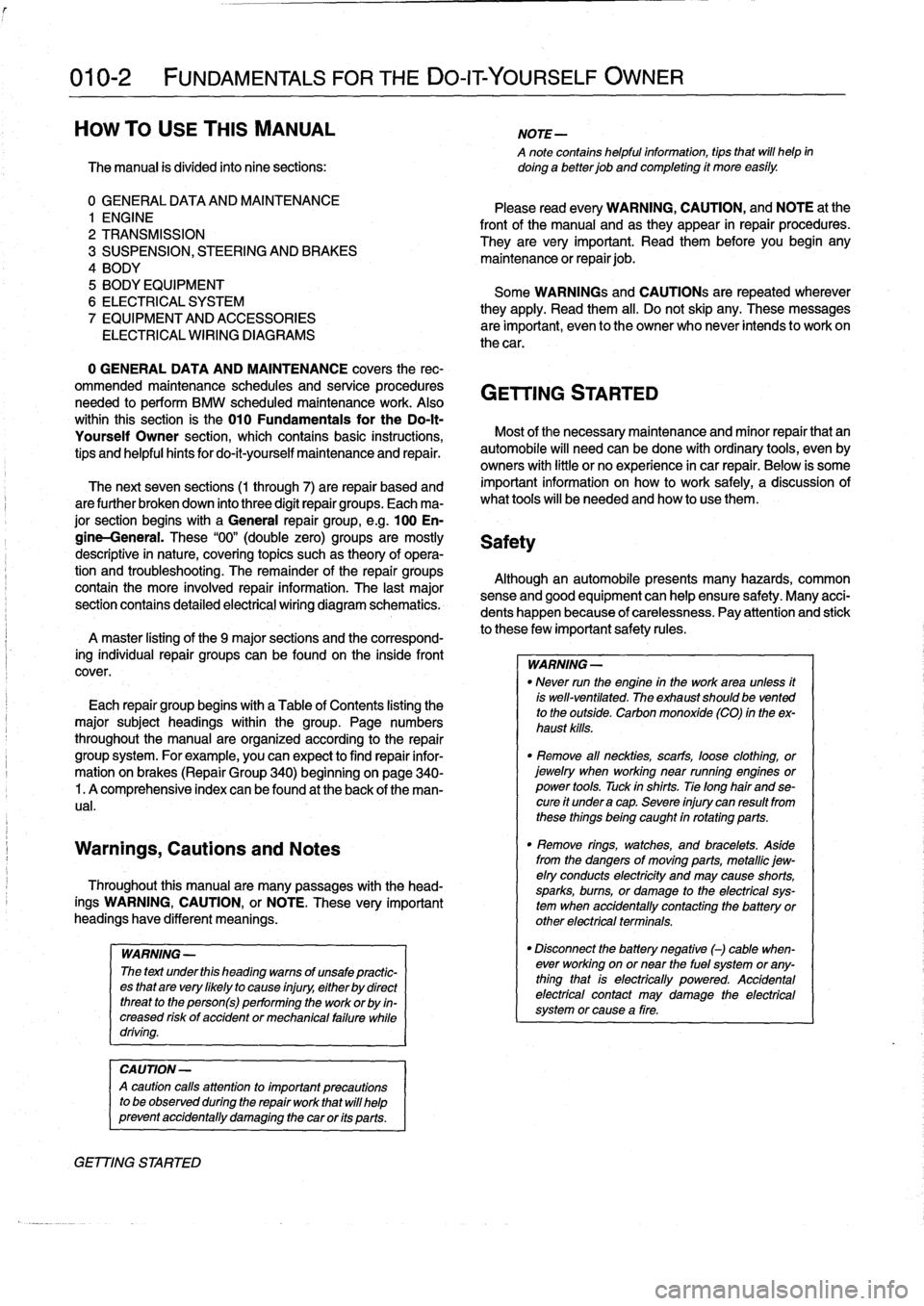
HOW
TO
USE
THIS
MANUAL
A
note
contains
helpfulinformation,
tipsthat
will
hefp
in
The
manual
is
divided
into
ninesections
:
doinga
better
job
and
completing
!t
more
easíly
.
0
GENERAL
DATA
AND
MAINTENANCE
1
ENGINE
2
TRANSMISSION
3
SUSPENSION,
STEERING
AND
BRAKES
4
BODY
5
BODY
EQUIPMENT
6
ELECTRICAL
SYSTEM
7
EQUIPMENTANDACCESSORIES
ELECTRICAL
WIRING
DIAGRAMS
0
GENERAL
DATA
AND
MAINTENANCE
coversthe
rec-
ommended
maintenance
schedules
and
service
procedures
needed
to
perform
BMW
scheduled
maintenance
work
.
Also
within
this
section
is
the
010
Fundamentals
for
the
Do-It-
Yourself
Owner
section,
which
contains
basic
instructions,
tips
and
helpful
hints
for
do-it-yourself
maintenance
and
repair
.
The
next
seven
sections
(1
through
7)
are
repair
based
and
are
further
broken
down
into
three
digit
repair
groups
.
Each
ma-
jor
section
begins
with
a
General
repair
group,
e
.g
.
100En-
gine-General
.
These
"00"
(doublezero)
groups
aremostly
descriptive
in
nature,
covering
topics
suchas
theory
of
opera-
tion
and
troubleshooting
.
The
remainder
of
the
repair
groups
contain
the
more
involved
repair
information
.
The
last
major
section
contains
detailed
electrical
wiring
diagram
schematics
.
A
master
listing
of
the
9major
sections
and
the
correspond-
ing
individual
repair
groups
can
befoundon
the
inside
front
cover
.
Each
repair
group
begins
with
a
Table
of
Contents
listing
the
majos
subject
headings
within
the
group
.
Page
numbers
throughout
the
manual
are
organizedaccording
to
the
repair
groupsystem
.
For
example,
youcan
expect
tofind
repair
infor-
mation
on
brakes
(Repair
Group
340)
beginning
on
page
340-
1
.
A
comprehensive
index
can
be
found
at
the
back
of
the
man-
ual
.
Warnings,
Cautions
and
Notes
Throughout
this
manualare
many
passages
with
the
head-
ings
WARNING,
CAUTION,
or
NOTE
.
These
very
important
headings
have
diflerent
meanings
.
WARNING
-
The
text
under
this
heading
warns
of
unsafe
practic-
es
thatare
very
likelyto
cause
ínjury,
eitherby
dírect
threat
to
the
person(s)
pertorming
the
work
or
by
in-
creased
risk
of
accident
or
mechanfcal
fallure
whíle
driving
.
CAUTION-
A
caution
calls
attention
to
important
precautions
to
beobserved
during
the
repair
work
that
will
helo
prevent
accidentally
damaging
the
caror
its
parts
.
GETTING
STARTED
Safety
NOTE-
Please
read
every
WARNING,
CAUTION,
and
NOTE
at
the
front
of
the
manual
and
as
they
appear
in
repair
procedures
.
They
are
very
important
.
Read
them
before
you
begin
any
maintenance
or
repair
job
.
Some
WARNINGs
and
CAUTIONs
are
repeated
wherever
they
apply
.
Read
them
all
.
Do
not
skip
any
.
These
messages
are
important,
even
to
the
owner
who
never
intends
to
workon
thecar
.
GETTING
STARTED
Most
of
the
necessary
maintenance
and
minor
repair
that
an
automobile
will
need
canbe
done
with
ordinary
tools,
evenby
owners
with
little
or
no
experience
in
car
repair
.
Below
is
some
important
information
on
how
to
work
safely,
a
discussion
of
what
tools
will
be
needed
and
how
to
use
them
.
Although
an
automobile
presents
many
hazards,
common
sense
and
good
equipment
can
helo
ensure
safety
.
Many
acci-
dents
happen
because
of
carelessness
.
Pay
attention
and
stick
to
these
few
important
safety
rules
.
WARNING
-
"
Never
run
the
engine
in
the
work
area
unless
it
is
well-ventflated
.
Theexhaustshouldbe
vented
to
the
outside
.
Carbon
monoxide
(CO)
in
theex-
haust
kilts
.
"
Remove
all
neckties,
scarts,
loose
clothing,
or
jewelry
when
working
near
running
engines
or
power
tools
.
Tuck
in
shirts
.
Tie
long
haír
and
se-
cure
it
under
a
cap
.
Severe
injury
can
result
from
these
things
beíngcaught
in
rotating
parts
.
"
Remove
ríngs,
watches,
and
bracelets
.
Asíde
from
the
dangersof
moving
parts,
metallic
jew-
elry
conducts
electricity
and
may
cause
shorts,
sparks,
bums,
or
damage
to
the
electrical
sys-
tem
when
accidentally
contacting
the
battery
or
other
electrical
terminals
.
"
Disconnect
the
battery
negative
()
cable
when-
ever
working
on
ornear
the
fuel
system
or
any-
thlng
that
is
electrically
powered
.
Accidental
electrícal
contact
may
damage
the
electrical
system
or
cause
a
fire
.
Page 12 of 759

010-
4
FUNDAMENTALS
FOR
THE
DO-ITYOURSELF
OWNER
Fig
.
3
.
BMW
supplied
jack
correctly
positioned
in
front
jacking
point
.
Most
of
the
repairs
and
maintenance
tasks
described
in
this
manual
can
be
successfully
completedby
anyone
with
basic
tools
and
abilities
.
To
prevent
getting
in
too
deep,
know
what
WARNING-
the
wholejob
requires
before
starting
.
Read
the
procedure
thor-
"
Do
not
rely
on
thetransmission
or
the
emergen-
oughly,
from
beginning
to
end,
in
order
to
know
just
what
to
ex
cybrake
to
keep
thecar
from
rolling
.
They
are
pect
and
what
parts
will
have
to
be
replaced
.
nota
substitute
for
positively
blocking
the
oppo-
site
wheel
.
"
Never
work
undera
car
that
is
supported
only
by
ajack
Use
jack
stands
that
are
properly
de-
signed
to
support
the
car
.
See
Tools
.
Working
under
car
safely
1
.
Disconnect
negative
(-)
cable
from
battery
so
that
no
one
else
can
start
thecar
.
Let
others
know
what
you
will
be
doing
.
CAUTION-
Prior
to
disconnecting
the
battery
read
the
battery
disconnection
cautions
given
at
the
front
of
this
manual
on
page
vüi
.
2
.
Raisecar
slowly
as
described
above
.
3
.
Use
at
least
two
jack
stands
to
support
thecar
.
A
jack
is
atemporary
lifting
device
and
should
not
be
used
alone
to
support
the
car
while
you
are
under
it
.
Use
jack
stands
designed
for
the
purpose
of
supporting
a
car
.
For
more
information
on
jack
stands,
see
Toolsbelow
.
WARNING
-
Do
notusewood,
concrete
blocks,
orbricks
to
sup-
port
acar
.
Woodmay
split
.
Blocks
or
bricks,
while
strong,
are
not
designed
for
that
kind
of
load,
and
may
brakkor
collapse
.
ADVICE
FOR
THE
BEGINNER
4
.
Place
jack
stands
on
firm,
solid
surface
.
If
necessary,
use
a
flat
board
or
similar
solid
object
to
provide
a
firm
footing
.
5
.
Lower
car
slowly
until
its
weight
is
fully
supportedby
jack
stands
.
Watch
to
make
sure
that
the
jack
stands
do
not
tip
orlean
as
thecar
settles
on
them
.
6
.
Observe
all
jacking
precautions
again
when
raising
car
to
remove
jack
stands
.
ADVICE
FORTHE
BEGINNER
The
tips
in
the
paragraphs
that
follow
are
general
advice
to
help
any
do-it-yourself
BMW
owner
perform
repairs
and
main-
tenance
tasks
more
easily
and
more
professionally
.
Planning
Ahead
Cleanliness
Keeping
things
organized,
neat,
and
clean
is
essential
to
do-
ing
a
good
job
.
When
working
under
the
hood,
fender
covers
will
protect
the
finish
from
scratches
and
other
damage
.
Make
sure
the
car
is
relatively
clean
so
thatdi
rt
under
the
cover
does
not
scratch
the
finish
.
Any
repair
job
will
be
less
troublesome
if
the
parts
are
clean
.
For
cleaning
old
parts,
there
are
many
solvents
and
parts
cleaners
commercially
available
.
For
cleaning
parts
priorto
assembly,
commercially
available
aerosol
cans
of
parts
cleaner
or
brake
cleaner
are
handy
to
use,
and
the
cleaner
will
evaporate
completely
.
WARNING
-
Virtually
all
solvents
used
for
cleaning
parts
are
highly
flammable,
especially
in
aerosol
form
.
Use
wíth
extreme
care
.
Do
not
smoke
.
Do
not
use
these
products
near
any
source
of
heat,
sparksor
flame
.
Let
any
solvent
orcleaning
product
dry
completely
.
Low-
pressure,
dry
compressed
air
is
helpful
if
available
.
Also,
use
only
lint-free
rags
for
cleaning
and
drying
.
Page 13 of 759

FUNDAMENTALS
FOR
THEDO-ITYOURSELF
OWNER
010-
5
WARNING
-
Avoid
getting
tools
or
clothing
near
the
battery
.
Bat-tery
electrolyte
is
a
corrosive
acid
.
Be
careful
with
brake
fluid,
as
it
can
damage
the
cars
paint
Finally,
keep
rubber
parts
such
as
hoses
and
bolts
free
from
oil
orgasoline,
as
they
will
cause
the
material
to
soften
and
fail
prematurely
.
Non-reusable
Fasteners
Many
fasteners
usedon
the
cars
coveredby
this
manual
mustbe
replaced
with
new
osesonce
they
are
removed
.
These
Fig
.
4
.
General
sequence
for
alternately
tightening
multiple
fasten-
include
butarenot
limited
to
:
bolts,
nuts
(self-locking,
nylock,
ers
.
etc
.),
cotterpins,
studs,
brake
fittings,
rol¡
pins,clips
and
wash-
ers
.
Genuine
BMW
parts
should
be
the
only
replacement
parts
NOTE-
used
for
this
purpose
.
"
Metric
bolt
classes
or
grades
are
markedon
the
bolt'
head
.
Some
bolts
are
designed
to
stretch
during
assembly
and
are
permanently
altered
rendering
them
unreliable
once
removed
.
These
are
known
as
torque-to-yield
fasteners
.
Always
replace
fasteners
where
instructed
to
doso
.
Failure
to
replace
these
fasteners
could
cause
vehicle
damage
and
personal
injury
.
See
an
authorized
BMW
dealer
for
applications
and
ordering
information
.
Tightening
Fasteners
When
tighteningthe
bolts
ornuts
that
attach
acomponent,
it
is
always
good
practice
to
tighten
the
bolts
gradually
and
evenly
to
avoid
misalignment
or
over
stressing
anyone
portion
of
the
component
.
For
components
sealed
with
gaskets,
this
method
helps
to
ensure
that
thegasket
will
seal
properly
and
complete-
ly
.
Where
there
are
severa¡
fasteners,
tighten
them
in
a
se-
quence
alternating
between
opposite
sides
of
the
component
.
Fig
.
4
shows
such
a
sequence
for
tightening
six
bolts
attaching
a
typical
component
.
Repeat
the
sequence
until
al¡
the
bolts
are
evenly
tightened
to
theproper
specification
.
"
Do
not
confuse
wrench
sizewithbolt
diameter
size
.
Fora
listing
of
the
common
wrenches
used
on
vari-
ous
bolt
diameters,
see
Basic
Tool
Requirements
.
Table
a
.
General
Bolt
Tightening
Torques
in
Nm
(max
.
permissible)
Bolt
Class
(according
to
DIN
267)
Bolt
diameter
5
.6
5
.8
6
.8
8
.8
10
.9
12
.9
M5
2
.5
3
.5
4
.5
6810
M6
4
.5
6
7
.5
10
14
`
17
M8
11
15
-
18
24
34
40
M10
233036476679
M12
3952
62
82115140
M14
6282
98
130
180220
M16
9426150
200280340
M18
130174210280
390
470
For
some
repairs
a
specific
tightening
sequence
is
neces-
sary,
or
a
particular
order
of
assembly
is
required
.
Such
special
Gaskets
and
Seals
conditions
are
noted
in
the
text,
and
the
necessary
sequence
is
described
or
illustrated
.
Where
no
specific
torque
is
listed,
Ta-
The
smoothest
metal
mating
surfaces
still
have
imperfec
blea
can
be
used
as
a
general
guide
for
tightening
fasteners
.
tions
that
can
allow
leakage
.
To
prevent
leakage
atcritica¡
joints,
gaskets
of
soft,
form-fitting
material
are
used
to
fill
in
the
WARNING
-
imperfections
.
Table
ais
a
general
reference
only
.
The
values
list-
ed
in
the
table
are
not
intended
to
be
used
asa
sub-
To
be
most
effective,
gaskets
are
designed
to
crush
and
be-
stitutefor
torques
specifically
called
out
in
the
text
come
thinner
as
the
mating
parts
are
bolted
together
.
Once
a
throughout
this
manual
.
gasket
has
been
used,
it
is
no
longer
capable
of
makingas
good
a
sea¡
as
when
new,
and
is
muchmore
likely
toleak
.
For
this
reason,
gaskets
should
not
be
reused
.
Always
plan
to
use
new
gaskets
for
any
reassembly
.
Some
gaskets-such
as
head
gaskets-are
directional
.
Make
sure
that
these
are
in-
stalled
correctly
.
This
same
logic
applies
to
any
part
used
for
sealing,
including
rubber
O-rings
and
copper
sealing
washers
.
ADVICE
FOR
THE
BEGINNER
Page 16 of 759

010-
8
FUNDAMENTALSFORTHE
DO-ITYOURSELF
OWNER
TOOLS
Mostmaintenance
can
be
accomplished
with
a
small
selec-
tion
of
the
right
tools
.
Toolsrange
in
quality
from
inexpensive
junk,
which
may
brakk
at
first
use,
tovery
expensive
and
well-
made
tools
for
the
professional
.
The
best
tools
for
most
do-it
yourself
BMW
owners
He
somewhere
in
between
.
O
Many
reputable
tool
manufacturers
offer
good
quality,
mod-
erately
priced
tools
with
a
lifetime
guarantee
.
These
are
your
best
buy
.
They
cost
a
little
more,
but
they
are
good
quality
tools
that
will
dowhat
is
expected
of
them
.
Sears'
Craftsman®
line
is
one
such
source
of
good
quality
tools
.
Some
of
the
repairs
covered
in
this
manual
require
the
use
of
special
tools,
suchas
a
custom
puller
or
specialized
electrical
test
equipment
.
These
special
tools
are
called
out
in
the
text
andcan
be
purchased
through
an
authorized
BMW
dealer
.
As
an
alternative,
some
special
tools
mentioned
may
be
pur-
chased
from
the
following
tool
manufacturers
andlor
distribu-
tors
:
"
Assenmacher
Specialty
Tools
6440
Odell
Place,Boulder,
CO
80301
(303)
530-2424
"
Baum
Tools
Unlimited
.
Inc
.
PO
.
Box
87,
Longboat
Key,
FL
34228
(800)
848-6657
"
Schley
Products
Inc
.
5350
E
.
Hunter
Ave
.,
Anaheim
Hills,
CA
92807
(714)
693-7666
"
Zelenda
Machine
and
Tool
Corp
.
66-02
Austin
Street,
Forest
Hills,
NY
11375
(718)
896-2288
Basic
Tool
Requirements
The
basic
hand
tools
described
below
canbe
used
to
accom-
plish
most
of
thesimple
maintenance
and
repair
tasks
.
Fig
.
8
.
Types
of
wrench
heads
.
From
left,
open-end,
12-point
box-
Screwdrivers
.
The
common
fíat-blade
type
and
the
Phillips
end,6-point
box-end,
fiare
nut
.
type
will
handlealmost
all
screws
used
on
BMWs
.
Two
orthree
different
sizes
of
each
type
will
be
required,
since
a
screwdriver
The
cómbination
wrench
is
the
most
universal
.
It
hasone
of
the
wrong
size
will
damage
the
screw
head
.
See
Fig
.
7
.
open-end
andone
box-end
.
10mm
and
13mm
wrenches
arethe
most
common
sizes
needed
.
A
more
complete
set
of
A
complete
set
of
screwdrivers
should
also
include
Torx@
wrenches
would
inciude
6mm
through
19mm
sizes
.
typescrewdrivers
.
Wrenches
.
Wrenches
come
in
different
styles
for
different
uses
.
Fig
.
8
shows
several
.
The
basic
open-end
wrench
is
the
most
widely
used,
but
grips
on
only
two
sides
.
It
can
spread
apart
and
slip
off
more
easily
.
The
box-end
wrench
has
better
grip,
on
al¡
six
sides
of
a
nut
or
bolt
.
A
12-point
box-end
can
loosen
a
nut
or
bolt
where
there
is
less
room
for
movement,
while
a
6-point
box-end
provides
bet-
ter
grip
.
Forhex
fasteners
on
fluid
lines,
like
brake
lines
and
fuel
lines,
a
fiare-nut
wrench
offers
the
acivantages
of
a
box-end
wrench
with
a
slot
that
ailows
it
to
fit
over
the
line
.
TOOLS
B005FNG
Fig
.
7
.
Common
flat-blade
(top)
and
Phillips
(bottom)
screwdrivers
.
Offset
screwdríver
(right)
is
used
for
screws
with
limited
ac-
cess
.
B002FNG
Sockets
.
Socketsperform
the
same
job
asbox-end
wrench-
es,
but
offer
greater
flexibility
.
They
are
used
with
a
ratchet
han-
dle
for
speed
and
conveniente
and
can
be
combined
with
extensions
and
universal
joints
(swivels)
to
reach
fasteners
more
easily
.
Sockets
come
with
different
size
connections
to
drive
handies
or
extensions,
called
the
drive
size
.
The
most
common
drive
sizes
are
1
/4
in
.,
318
in
.,
and
1
/2
in
.
Sockets
come
in
6-point
and
12-point
styles
.
For
use
with
a
ratchet,
the
6-point
offers
a
better
grip
on
tight
nuts
and
bolts
.
6mm
to
19mm
sockets
arethe
most
needed
sizes
.
Below
is
a
list
oftypical
bolt
diameters
and
the
corresponding
wrench
siz-
es
.
Page 20 of 759

010-12
FUNDAMENTALSFOR
THE
DO-IT
YOURSELF
OWNER
Jump
Starting
Car
Cars
with
discharged
or
dead
batteries
can
be
jump-started
using
the
good
battery
from
another
car
.
When
jump-starting
the
engine,
always
note
the
following
warnings
.
WARNING
-
"
Battery
acid
(electrolyte)
can
cause
severe
burns,
and
will
damage
the
car
and
clothing
.
lf
electrolyte
is
spilled,
wash
the
surface
with
large
quantities
of
water
.
lfit
gets
finto
eyes,
flush
them
with
water
for
severa¡
minutes
and
cal¡
a
doctor
.
"
Batteries
produce
explosive
and
noxious
gas-
ses
.
Keep
sparks
and
flames
away
.
Do
not
smoke
near
batteries
.
"
Do
not
jump-start
the
engine
if
you
suspect
that
the
battery
is
frozen
.
Trapped
gas
may
explode
.
Allow
the
battery
to
thaw
first
.
"
Do
not
quick-charge
the
battery
(for
boost
start-
ing)for
longer
than
one
minute,
and
donot
ex-
ceed
15
volts
at
the
battery
with
the
boosting
cables
attached
.
Wait
at
least
one
minutebefore
boosting
the
battery
a
second
time
.
"
Some
electrical
system
'comfort"
features
may
not
function
correctly
once
battery
power
is
restored
.
For
example,
the
front
window
one-touch-up
func-
tion
may
be
disabled
.
Some
electrical
systems
will
need
to
be
reinitialized
Consult
the
appropriate
re-
pairgroup
formore
specific
information
.
1
.
Place
cars
close
together,
but
do
not
allow
them
to'touch
each
other
.
Turn
off
the
engine
of
thecar
with
the
good
battery
.
2
.
Connect
oneend
of
the
positive
(+)
cable
to
the
positive
(+)
post
of
the
good
battery
.
Remove
the
coverfromthe
positive
(B+)
junction
post
in
the
engine
compartment
of
the
dead
car
and
connect
the
other
end
of
the
posi-
tive
(+)
cable
to
the
junction
post
.
See
Fig
.
17
.
EMERGENCIES
3
.
Connect
one
end
of
the
negative
(-)
cable
to
the
nega-
tive
(-)
battery
post
of
the
good
battery
.
Connect
oppo-
site
end
of
the
negative
cable
(-)
to
the
engine
block
of
thecar
with
the
dead
battery
.
4
.
Start
thecar
with
the
good
battery
and
runthe
engine
at
about2,000
rpm,
then
start
the
car
with
the
dead
bat-
tery
.
5
.
With
the
engine
at
¡dle,
switch
on
the
headlights,
blower
motor
and
rear
window
defogger
to
avoid
damaging
the
cars
electrical
system
.
Carefully
disconnect
the
jumper
cables,
starting
with
the
negative
cable
on
the
engine
block
.
Turn
all
electrical
consumers
off
.
NOTE-
The
engineshould
be
run
for
at
least
an
hour
to
re-
charge
the
battery
.
Overheating
lf
the
temperature
gauge
needle
goes
into
the
red
band
on
the
gauge
face,
the
coolant
temperature
is
too
high
.
Find
a
safe
place
to
stop
and
turn
the
engine
off
.
Open
the
hood
and
allow
the
engine
to
cool
until
the
temperature
gauge
needle
is
at
the
lower
thirdof
the
scale
.
Continuing
to
drive
an
overheated
car
can
cause
extensive
engine
damage
.
WARNING
-
Do
not
remove
the
coolant
reservoir
or
radíator
cap
with
the
engine
hot
.
Undoing
either
couldspray
hot
coolant
and
cause
burns
or
damage
the
engine
.
CAUTION-
Do
not
add
cold
water
or
coolant
to
a
hot
engine
.
Engine
damage
could
result
from
the
sudden
tem-
perature
change
.
NOTE-
If
the
enginecannot
be
safely
tumed
off,
make
sure
the
air
condifioner
isoff
and
turn
the
heater
to
high
.
This
will
helo
cool
the
engine
until
a
salestopping
place
canbe
reached
.
Overheating
may
be
caused
bylow
coolant
leve¡
or
a
dam-aged
engine
drive
belt
.
Visually
check
the
coolant
leve¡
and
en-
gine
belts
as
described
in
020
Maintenance
Program
.
lf
the
coolant
leve¡
is
low,
check
the
filler
cap,hoses,
clamps
and
ra-
diator
for
signs
of
leakage
.
Check
for
leaks
at
the
water
pump
on
the
frontof
theengine
.
lf
no
leaks
are
found,
add
coolant
after
the
engine
has
cooled
.
The
carcan
be
driven,
but
have
the
cooling
system
thoroughly
checked
assoonas
possible
.
lf
replacement
cool
0013245
-
ant
is
not
available,
then
plain
water
canbe
used,
butthe
cool-
antshould
later
be
drained
and
refilled
with
theproper
mixture
Fig
.
17
.
Battery
jump
starting
posts
(arrows)
behind
right
frontstrut
of
anti-freeze
and
water
.
tower
.
Lift
cover
to
access
positive
post
.