1994 PONTIAC GRAND-AM high beam
[x] Cancel search: high beamPage 6 of 274

Vehicle Symbols
These are some of the symbols you may find on your vehicle.
For example,
these symbols
are used on an
original battery:
PROTECT
EYES BY
SHIELDING
CAUSTIC
BURNS
AVOID
SPARKS
OR
FLAMES
SPARK OR ,\I/,
COULD FLAME
EXPLODE BATTERY
These symbols
are important
for you and
your passengers
whenever your
vehicle is
driven:
DOOR LOCK
UNLOCK
FASTEN SEAT 4
BELTS
POWER
WINDOW
These symbols
have
to do with
your lights:
SIGNALS e
TURN
HIGH BEAM OR = =o
FOG LAMPS $0
These symbols
are
on some of
your controls:
WIPER Q
WINDSHIELD
WASHER
wlNDSHIELDw DEFROSTER
WINDOW REAR
DEFOGGER.
VENTILATING ca
FAN c.
These symbols
are used
on
warning and
indicator lights:
COOLANT F-
TEMP --
ENGINE
CHARGING BATTERY
SYSTEM
BRAKE (0)
RADIATOR a
COOLANT
FUEL
ENGINE OIL
PRESSURE
-4
TEMP OIL &
ANTILOCK (e)
BRAKE
Here are some
other symbols
you may
see:
FUSE *
RADIO
VOLUME
AIR
CONDITIONING
RELEASE TRUNK
LIGHTER
SPEAKER
b
ProCarManuals.com
Page 74 of 274

Turn
SignalJMultifunction
Lever
‘he lever on the left side of the steering
olumn includes your:
1 Turn Signal and Lane Change
Indicator
Headlight High-Low Beam
Flash-To-Pass Feature
Cruise Control (Option)
a
Turn Sl’na! and Lane
>hange Indicator ..
he turn signal has two upward (for
.ight) and two downward (for Left)
ositiuns. These positions allow you to
.gnal a
turn or a lane change.
o signal a turn, move the lever all the
lay up or down. When the
turn is
nished, the lever will return
ltomatically.
. green arrow on the instrument panel
,ill flash in the direction
of the turn or
.ne change.
To signal a lane change, just raise cnr
lower the lever until the green arrow starts
to flash. Hold
it there until you complete
your lane change. The lever will return by
itself when you release
it.
As you signal a turn or a lane change, if
the arrows don’t flash but just stay on, a
signal bulb may be burned out and other
drivers won’t see your turn signal.
If a bulb is burned out, replace it to help
avoid an accident. If the green arrows
don’t
go on at all when you signal a turn,
check the fuse (see “Fuses
& Circuit
Breakers”
in the Index) and for
burned-out bulbs.
ProCarManuals.com
Page 78 of 274

rn Light Controls
Parking Lights:
Rotate the switch up to PC to turn on:
Parking Lights
0 Side Marker Lights
Taillights
Instrument Panel Lights
Headlights:
Rotate the switch to ’ , to turn on:
0 Headlights
0 Parking Lights
0 Side Marker Lights
0 Taillights
0 Instrument Panel Lights
Rotate the switch
to OFF to turn all the
lights off.
-‘a-
Operation of Lights
Although your vehicle’s lighting system
(headlights, parking lights, fog lamps,
side marker lights and taillights)
meet all
applicable federal lighting requirements,
certain states and provinces may apply
their own lighting regulations that may
require special attention before you
operate these lights.
For example, some jurisdictions may
require that you operate your lower beam
lights with fog lamps at all times, or that
headlights be turned
on whenever you
must use your windshield wipers.
In
addition, most jurisdictions prohibit
driving solely with parking lights,
especially at dawn or dusk.
It is
recommended that you check with your
own state or provincial highway authority
for applicable lighting regulations.
Lights On Reminder
If you open the driver’s door while
leaving the lights
on, you will hear a
warning chime.
Daytime Running Lights
(CANADA ONLY)
Your DRL work with a light sensor on top
of the instrument panel. Don’t cover
it up.
The high beam headlights will come
on at
reduced brightness in daylight when:
0 The ignition is on
0 The headlight switch is off, and
0 The parking brake is released on a
manual transaxle; or
77 a I
ProCarManuals.com
Page 79 of 274

Features & Controls
Daytime Running Lights
(CANADA ONLY) (CONT.)
The shift lever is shifted out of PARK
(P) or NEUTRAL (N) on an automatic
transaxle.
At dusk, the exterior lights and headlights
will come on automatically. At dawn, the
exterior lights will go out and the high
beams will change to the reduced
brightness of DRL again (if the headlight
switch is off).
Of course, you may still turn on the
headlights any time you need to.
To idle your vehicle with the DRL off, set
the parking brake
on a manual transaxle
or put the vehicle
in PARK (P) or
NEUTRAL
(N) on an automatic
transaxle, while the ignition is in the OFF
or LOCK position. Then start the vehicle.
The DRL will stay off until
you release
the parking brake on a manual transaxle
or shift out of PARK (P) or NEUTRAL
(N) on an automatic transaxle.
Yeadlight High-Low Beam
%anger
To change the headlights from low beam
o high or high to low, pull the turn signal
ever all the way toward you. Then
elease it. When the high beams are on,
his blue light on the instrument panel
dso will be on.
Flash-To-Pass
(EXCEPT CANADA)
Flash-to-pass lets you use your high
beam headlights to signal a driver
in front
of you that you want to pass.
To use it, pull the turn signal/
multifunction lever toward you.
If Your Headlights are Off
Your high beam headlights will turn on.
They’ll stay on as long as you hold the
lever there. Release the lever to turn them
off.
If Your Headlights are On:
No flash-to-pass. Use the lever to change
between high and low beams.
mm.78
ProCarManuals.com
Page 80 of 274

Instrument Panel Intensity Control
You can brighten or dim your instrument
cluster lights by rotating the instrument
panel intensity control switch. Rotate the switch all the way to the right to turn on
the interior courtesy lights. Rotate the
switch to the left to turn
off the instrument
cluster lights and displays.
Fog Lights
The switch for your fog lights is next to
the instrument panel intensity control.
Push the top of the switch to turn the fog
lights on.
When using fog lights, the parking lights
or low beam headlights must be on.
Fog lights will go off whenever the high
beam headlights come on. When the high
beams go off, the fog lights will come on
again.
Front Reading Lights
(OPTION)
These lights and the interior courtesy
lights will come on when
you open the
doors.
To turn on a reading light when the doors
are closed, press the button. Press it again
to turn the light off.
79.8.
ProCarManuals.com
Page 131 of 274

Your Driving ,and the Road ’
Night Vision (CONT.)
You can be temporarily blinded by
approaching lights. It can take a second or
two, or even several seconds, for your
eyes to readjust to the dark. When you are
faced with severe glare (as from a driver
who doesn’t lower the high beams, or a
vehicle with misaimed headlights), slow
down a little. Avoid staring directly into
the approaching lights.
Keep your windshield and all the glass on
your vehicle clean
-- inside and out.
Glare at night is made much worse by dirt
on
the glass. Even the inside of the glass
can build up a film caused by dust. Dirty
glass makes lights dazzle and flash more
than clean glass would, making the pupils
of your eyes contract repeatedly.
Remember that your headlights light up
far less of a roadway when you are in a
turn or curve. Keep your eyes moving;
that way, it’s easier to pick out dimly
lighted objects. Just as your headlights
should be checked regularly for proper
aim,
so should your eyes be examined
regularly. Some drivers suffer from night
blindness
-- the inability to see in dim
light
-- and aren’t even aware of it.
130
Driving in the Rain
Rain and wet roads can mean driving
trouble. On a wet road
you can’t stop,
accelerate or turn as well because your
tire-to-road traction isn’t as good as on
dry roads. And, if your tires don’t have
much tread left, you’ll get even less
traction.
It’s always wise to go slower and be
cautious if rain starts to fall while you are
driving, The surface may get wet
suddenly when your reflexes are tuned
fo
driving on dry pavement.
The heavier the rain, the harder it is to
see. Even if your windshield wiper blades
xre
in good shape, a heavy rain can make
it harder to see road signs and traffic
signals, pavement markings, the edge of
the road, and even people walking.
It’s wise to keep your wiping equipment
in good shape and keep your windshield
washer tank filled. Replace your
windshield wiper inserts when they show
signs of streaking or
missing areas on the
windshield, or when strips of rubber start
to separate from the inserts.
ProCarManuals.com
Page 132 of 274

Driving too fast through large water
puddles or even going through some car
washes
can cause problems, too. The
water may affect your brakes. Try to
avoid puddles. But if you can’t, try to
slow down before you hit them.
I Hydroplaning
Hydroplaning is dangerous. So much
water can build up under your tires that
they can actually ride on the water. This
can happen if the road is wet enough and
you’re going fast enough. When your
vehicle is hydroplaning, it has little or
no
contact with the road.
Hydroplaning doesn’t happen often. But it
can if your tires haven’t much tread or if
the pressure in one or more is low. It can
happen if a lot of water is standing on the
road. If you can see reflections from trees,
telephone poles, or other vehicles, and
raindrops “dimple” the water’s surface,
there could be hydroplaning.
Hydroplaning usually happens at higher
speeds. There just isn’t a hard and fast
rule about hydroplaning. The best advice
is to slow down when it is raining.
Some Other Rainy
Weather
Tips
0
e
0
Turn on your low-beam headlights --
not just your parking lights -- to help
make you more visible to others.
Besides slowing down, allow some
extra following distance. And be
especially careful when you ‘pass
another vehicle. Allow yourself more
clear room ahead, and be prepared to
have your view restricted by-road
spray.
Have good tires with proper tread
depth. (See “Tires” in the Index.)
131 ...
ProCarManuals.com
Page 219 of 274
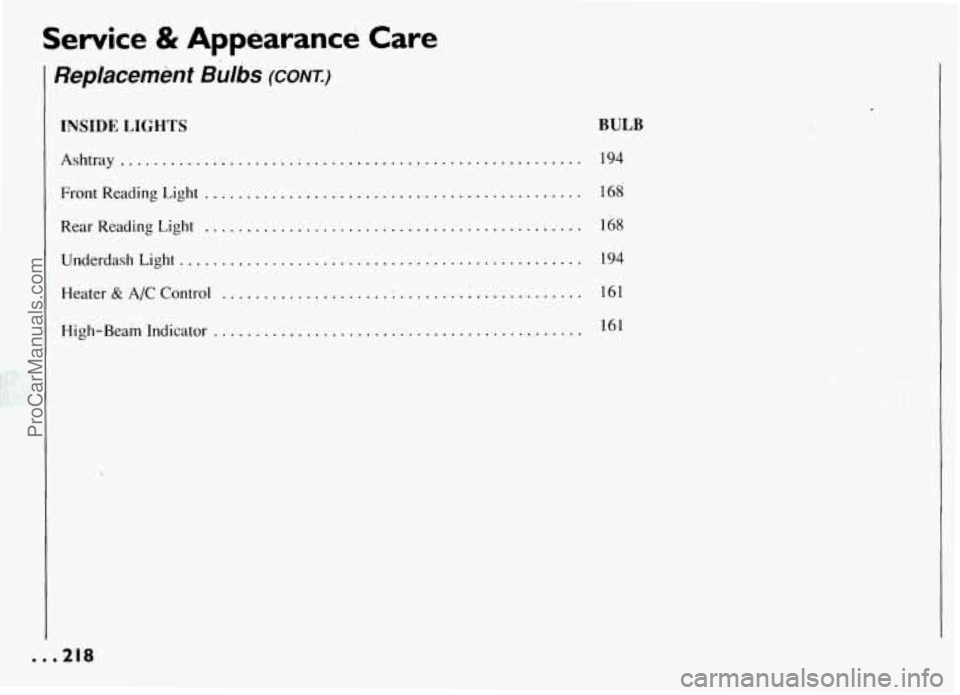
Service & Appearance Care
Replacement Bulbs (CONK)
INSIDE LIGHTS
Ashtray .......................................................
Front Reading Light .............................................
Rear Reading Light .............................................
UnderdashLight ................................................
Heater & A/C Control .................... : ......................
High-Beam Indicator ............................................
BULB
194
168
168
194
161 161
. . -218
ProCarManuals.com