1994 PONTIAC GRAND-AM flat tire
[x] Cancel search: flat tirePage 4 of 274

How to Use This Manual
It
Using Your 1994 Pontiac
Owner’s Manual
I‘
Many people read their owner’s manual
from beginning
to end when they first
receive their new vehicle. This will help
you learn about the features and controls
for your vehicle. In this manual, you’ll
find that pictures and words work
together to explain things quickly.
There are nine parts with black-tabbed
pages
in this manual. Each part begins
with a brief list of contents, so you can
usually tell at a glance
if that part
contains the information you want.
You can bend the manual slightly to reveal
the black tabs that help you find a part.
I
Part 1: Seats & Restraint Systems
This part tells you how to use your seats
and safety belts properly. It also explains
the
“SRS” (Air Bag) System.
Part 2: Features & Controls
This part,explains how to start and
operate your Pontiac.
Part 3: Comfort Controls & Audio
Systems
This part tells you how to adjust the
ventilation and comfort controls and how
to operate your sound system.
Part 4: Your Driving and the Road
Here you’ll find helpful information and
tips about
the road and how to drive
under different conditions.
Part 5: Problems on the Road
This part tells you what to do if you have
a problem while driving, such as a flat tire
or engine overheating, etc.
Part 6: Service & Appearance Care
Here the manual tells you how to keep
your Pontiac running properly and
looking good.
Part 7: Maintenance Schedule
This part tells you when to perform
vehicle maintenance and what fluids and
lubricants to use.
Part 8: Customer Assistance
Information
This part tells you how to contact Pontiac
for assistance and how to get service
publications. It
also gives you information
on “Reporting Safety Defects’’ on
page 247.
Part 9: Index
Here’s an alphabetical listing of almost
?very subject
in this manual. You can use it
to quickly find something you want to read.
Service Station Information
This is a quick reference of service
information.
You can find it on the last
page of this manual.
3.. .
ProCarManuals.com
Page 134 of 274

At the entrance there is usually a ramp
that leads to the freeway. If you have a
clear view of the freeway as you drive
along
the entrance ramp, you should
begin to check traffic. Try to determine
where you expect
to blend with the flow.
Try to merge into the gap at close
to the
prevailing speed. Switch on your turn signal, check your mirrors and glance
over your shoulder as often as necessary.
Try to blend smoothly with the traffic
flow.
Once you are on the freeway, adjust your
speed to the posted limit or to the
prevailing rate if it’s slower. Stay in the
right lane unless you want to pass.
Before changing lanes, check your
mirrors. Then use your turn signal.
Just before you leave the lane, glance
quickly over your shoulder to make sure
there isn’t another vehicle in your “blind”
spot.
Once you are moving on the freeway,
make certain you allow a reasonable following distance. Expect to move
slightly slower at night.
When you want to leave the freeway,
move to the proper lane well
in advance.
If you-miss your exit do not; under any
circumstances, stop and back
up. Drive on
to the next exit.
The exit ramp can be curved, sometimes
quite sharply.
The exit speed is usually posted.
Reduce your speed according to your
speedometer, not to your sense of motion.
After driving for any distance at higher
speeds, you may tend to think you are
going slower than you actually are.
Before Leaving on a
Long Trip
Make sure you’re ready. Try to be well
rested. If
you must start when you’re not
fresh
-- such as after a day’s work --
don’t plan to make too many miles that
first part of the journey. Wear comfortable
clothing and shoes you can easily drive
in.
Is your vehicle ready for a long trip? If
you keep it serviced and maintained, it’s
ready to go. If it needs service, have it
done before starting out. .Of course, you’ll
find experienced and able service experts
in Pontiac dealerships all across North
America. They’ll be ready and willing to
help if you need it.
Here are some things you can check
before a trip:
0
0
0
0
0
0
0
Windshield Washer Fluid: Is the
reservoir full? Are all windows clean
inside and outside?
Wiper Blades: Are they in good
shape?
Fuel, Engine Oil. Other Fluids: Have
you checked all levels?
Lights:’
Are they all working? Are the
lenses clean?
Tires: They are vitally important to a
safe, trouble-free trip. Is the tread
good enough for long-distance
driving?
Are the tires all inflated to
the recommended pressure?
Weather Forecasts: What’s the
weather outlook along your route?
Should you delay your trip a short
time to avoid a major storm system?
Maps: Do you have up-to-date maps?
133...
ProCarManuals.com
Page 135 of 274

Your Driving and the Road
Highway Hypnosis
Is there actually such a condition as
“highway hypnosis”? Or is it just plain
falling asleep at the wheel? Call it
highway hypnosis, lack of awareness, or
whatever.’
There is something about an easy stretch
of road with the same scenery, along with
the hum of the tires on the road, the drone
of the engine, and the rush of the wind
against the vehicle that can make you
sleepy. Don’t let it happen to you! If it
does, your vehicle can leave the road in
less than a second, and you could crash
and
be injured.
What can you do about highway
hypnosis? First, be aware that it can
happen.
Second, here are some tips:
Make sure your vehicle is well
ventilated, with a comfortably cool
interior.
Keep your eyes moving. Scan the road
ahead and to the sides. Check your
rearview mirrors and your instruments
frequently.
If you get sleepy, pull off the road into
a rest, service, or parking area and
take a nap, get some exercise, or both.
For safety, treat drowsiness on the
highway as an emergency.
Hill and Mountain
Roads
Driving on steep hills or mountains is
different from driving in flat or rolling
terrain.
If you drive regularly in steep country, or
if you’re planning
to visit there, here are
some tips that can make your trips safer
and more enjoyable.
0 Keep your vehicle in good shape. Check all fluid levels and also the
brakes, tires, cooling system and
transaxle. These parts can work hard
on mountain roads.
ProCarManuals.com
Page 144 of 274
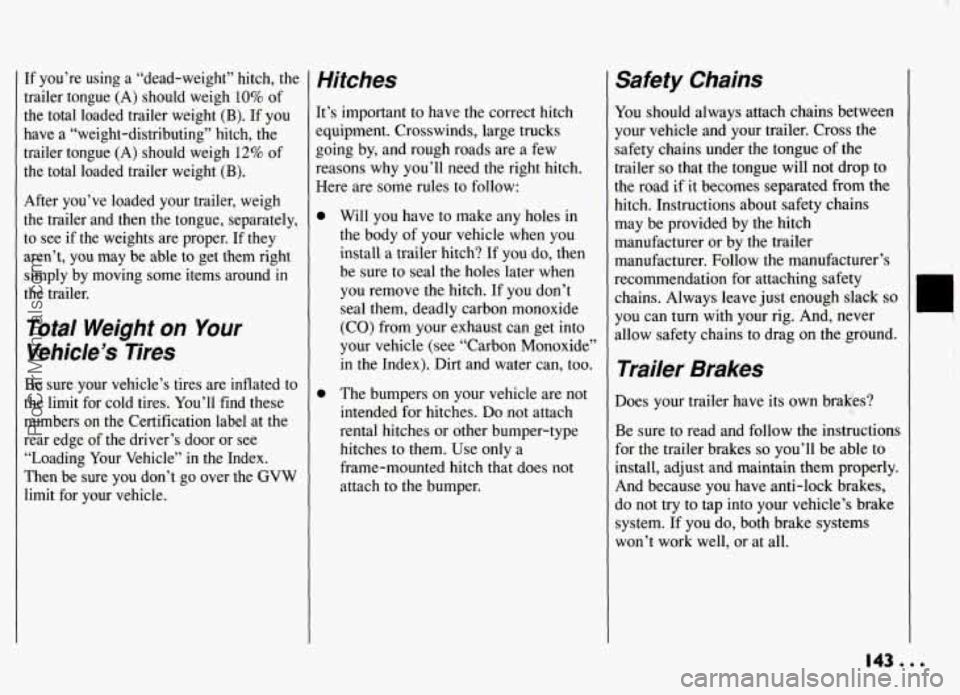
If you’re using a “dead-weight” hitch, the
trailer tongue
(A) should weigh 10% of
the total loaded trailer weight (B). If you
have
a “weight-distributing” hitch, the
trailer tongue
(A) should weigh 12% of
the total loaded trailer weight
(B).
After you’ve loaded your trailer, weigh
the trailer and then the tongue, separately, to see if the weights are proper. If they
aren’t, you may
be able to get them right
simply by moving some items around in
the trailer.
Total Weight on Your
Vehicle’s Tires
Be sure your vehicle’s tires are inflated to
the limit for cold tires. You’ll find these
numbers on the Certification label at the
rear edge of the driver’s door or see
“Loading Your Vehicle”
in the Index.
Then be sure you don’t go over the GVW
limit for your vehicle.
Hitches
It’s important to have the correct hitch
equipment. Crosswinds, large trucks
going by, and rough roads are a few
reasons
why you’ll need the right hitch.
Here are some rules to follow:
Will you have to make any holes in
the body
of your vehicle when you
install a trailer hitch? If
you do, then
be sure to seal the holes later when
you remove the hitch. If you don’t
seal them, deadly carbon monoxide
(CO) from your exhaust can get into
your vehicle (see “Carbon Monoxide”
in the Index). Dirt and water can, too.
The bumpers on your vehicle are
not
intended for hitches. Do not attach
rental hitches or other bumper-type hitches to them. Use only a
frame-mounted hitch that does not
attach to the bumper.
Sa#ety Chains
You should always attach chains between
your vehicle
and your trailer. Cross the
safety chains under the tongue of the
trailer
so that the tongue will not drop to
the road if it becomes separated from the
hitch. Instructions about safety chains may be provided by the hitch
manufacturer or by the trailer
manufacturer. Follow the manufacturer’s
recommendation for attaching safety chains. Always leave just enough slack
so
you can turn with your rig. And, never
allow safety chains to drag on the .ground.
Trailer Brakes
Does your trailer have its own brakes?
Be sure to read and follow the instructions
for the trailer brakes
so you’ll be able to
install, adjust and maintain them properly.
And because you have anti-lock brakes,
do not try to tap into your vehicle’s brake
system. If you do, both brake systems
won’t work well, or at all.
0
!
1
I I
!
143...
ProCarManuals.com
Page 148 of 274
Here you’ll find what to do about
some problems that can occur on the
road .
Problems on the
Part 5
Road
Hazard Warning Flashers ............................................
Jumpstarting .....................................................
TowingYourPontiac ...............................................
Engine Overheating ................................................
If Steam is Coming From Your Engine .................................
If a Tire Goes Flat .................................................
ChangingaFlatTire ................................................
Compactspare ....................................................
If You’re Stuck: In Sand, Mud, Ice or Snow .............................
148
148
152
156
156
161
162
167
167
147 ...
ProCarManuals.com
Page 162 of 274
7
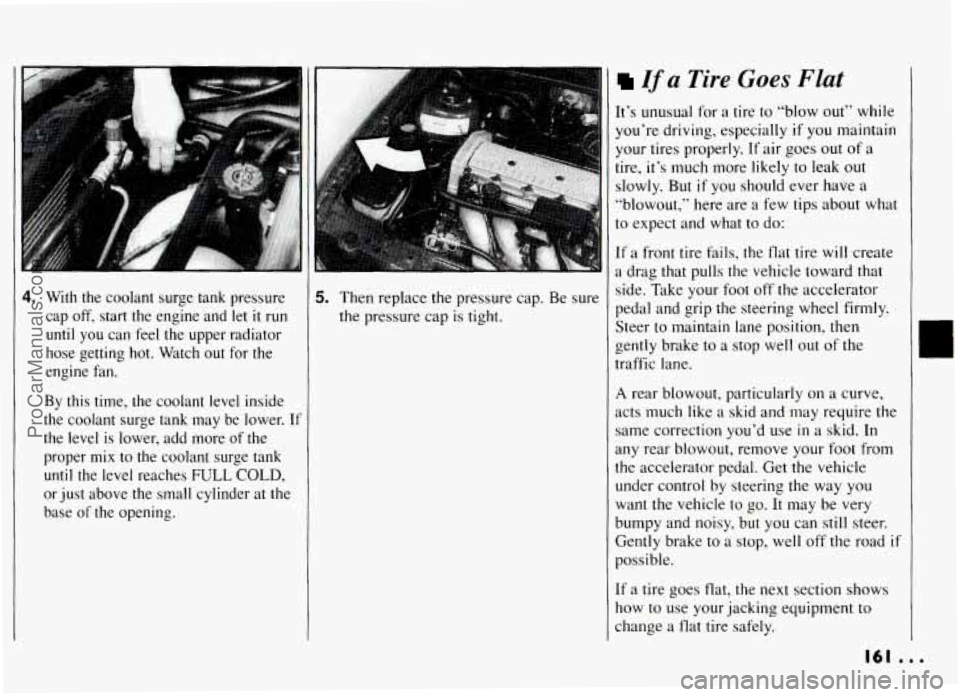
4. With the coolant surge tank pressure
cap off, start the engine and let
it run
until you can feel the upper radiator
hose getting hot. Watch out for the
engine fan.
By this time, the coolant level inside
the coolant surge tank may be lower. If
the level is lower, add more
of the
proper
mix to the coolant surge tank
until the level reaches FULL COLD,
or just above the small cylinder at the
base
of the opening.
I
5. Then replace the pressure cap. Be sure
the pressure cap is tight.
If a Tire Goes Flat
It’s unusual for a tire to “blow out” while
you’re driving, especially
if you maintain
your tires properly. If air goes out
of a
tire, it’s much more likely to leak out
slowly. But if you should ever have a
“blowout,” here are
a few tips about what
to expect and what to do:
If a front tire fails, the flat tire will create
a drag that pulls the vehicle toward that
side. Take your foot off the accelerator
pedal and grip
the steering wheel firmly.
Steer to maintain lane position, then
gently brake to
a stop well out of the
traffic lane.
A rear blowout, particularly on a curve,
acts much like a skid and may require
the
same correction you’d use in a skid. In
my rear blowout, remove your foot from
the accelerator pedal. Get the vehicle
under control by steering the way you
want the vehicle to go. It may be very
wmpy and noisy, but you can still steer.
Sently brake to a stop, well off the road if
Jossible.
[fa tire goes flat, the next section shows
low to use your jacking equipment to
:hange a
flat tire safely.
161 ...
ProCarManuals.com
Page 163 of 274
Problems on the Road
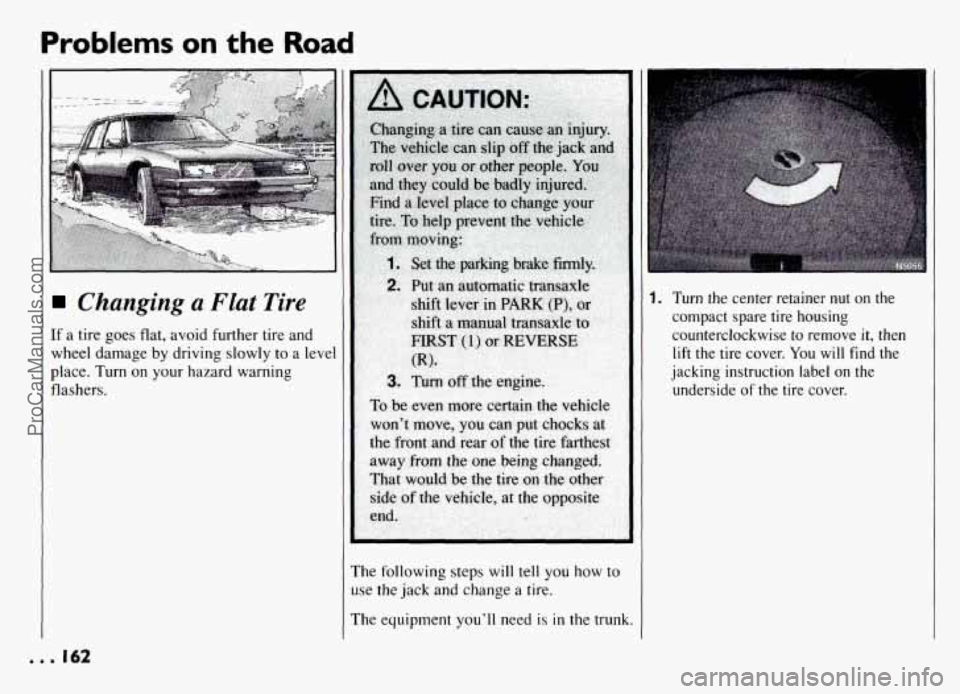
Changing a Flat Tire
If a tire goes flat, avoid further tire and
wheel damage
by driving slowly to a level
place. Turn on your hazard warning
flashers.
The following steps will tell you how to
use the jack and change a tire.
The equipment you’ll need is in the trunk.
1. Turn the center retainer nut on the
compact spare tire housing
counterclockwise
to remove it, then
lift the tire cover. You
will find the
jacking instruction label on the
underside
of the tire cover.
... 162
ProCarManuals.com
Page 165 of 274
Problems on the Road
18 (46cm) 18" (46cm)
Changing a Flat Tire
(CONT.)
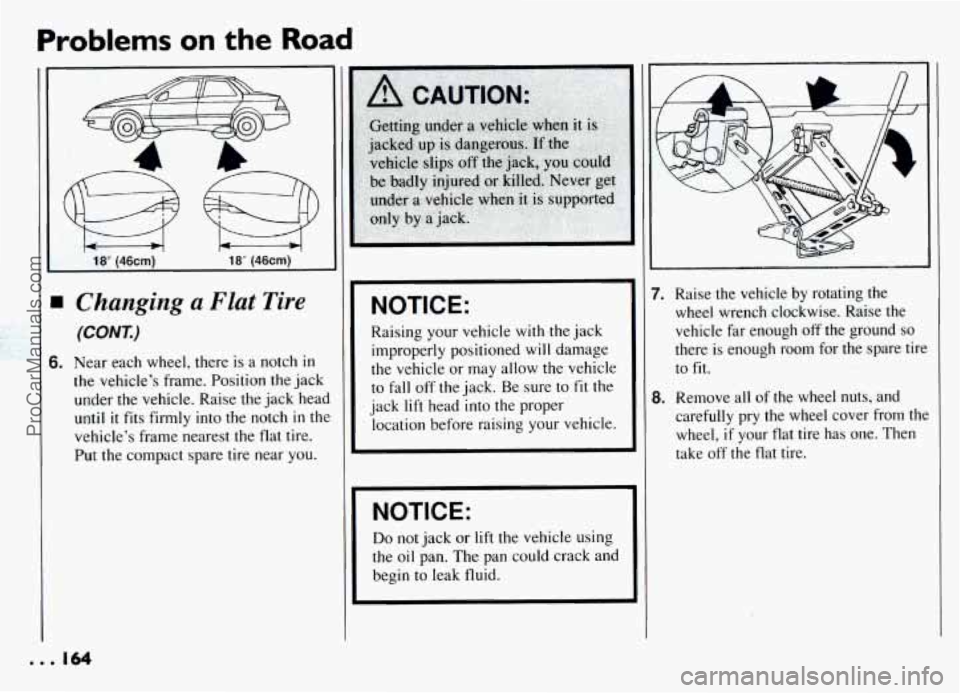
i. Near each wheel, there is a notch in
the vehicle's frame. Position the jack
under the vehicle. Raise the jack head
until it fits firmly into the notch
in the
vehicle's frame nearest the flat tire.
Put the compact spare tire near you.
NOTICE:
Raising your vehicle with the jack
improperly positioned
will damage
the vehicle or may allow the vehicle
to fall off the jack. Be sure to
fit the
jack lift head into the proper
location before raising your vehicle.
NOTICE:
Do not jack or lift the vehicle using
the oil pan. The pan could crack and
begin to leak fluid.
7. Raise the vehicle by rotating the
wheel wrench clockwise. Raise the
vehicle far enough
off the ground so
there is enough room for the spare tire
to
fit.
3. Remove all of the wheel nuts, and
carefully pry the wheel cover from the
wheel,
if your flat tire has one. Then
take off the flat tire.
... 164
ProCarManuals.com