1994 PONTIAC GRAND-AM clutch
[x] Cancel search: clutchPage 57 of 274

Features & Controls
Key Release Button
(MANUAL TRANSAXLE) (CONT.)
NOTICE:
If your key seems stuck in LOCK
and you can’t turn it, be sure it is all
the.way in. If
it is, then turn the
steering wheel left and right while
you
turn the key hard. But turn the
key only
with your hand. Using a
tool to force
it could break the key
or the ignition switch.
If none of this
works, then your vehicle needs
service.
Starting Your Engine
Engines start differently. The 8th digit of
your Vehicle Identification Number (VIN)
shows
the code letter or number for your
engine. You
will find the VIN at the top
left
of your instrument panel. (See
”Vehicle Identification Number”
in the
Index.) Follow the proper steps to start
the engine.
Automatic transaxle
Move your shift lever to PARK (P) or
NEUTRAL (N). Your engine won’t start
in any other position -- that’s a safety
feature. To restart when you’re already
.EUTRAL (N) only.
Don’t try to shift to PARK (P) if
your Pontiac is moving. If you do,
you could damage the transaxle.
Shift to PARK (P) only when your
vehicle
is stopped.
Manual transaxle
Hold the clutch pedal to the floor, then
shift your gear selector to neutral while
starting the engine. Your vehicle won’t
start
if the clutch pedal is not all the way
down
-- that’s a safety feature.
Both Transaxles
To Start Your 2.3 Liter EnEine
(Codes
3. D or A):
1. Without pushing the accelerator pedal,
turn your ignition key to START.
When the engine starts, let
go of the
key. The idle speed
will go down as
your engine gets warm.
NOTICE:
Holding your key in START for
longer than
15 seconds at a time will
cause your battery to be drained
much sooner. And the excessive
heat can damage your starter motor.
ProCarManuals.com
Page 66 of 274

1 3 5
2 4 R
C
E
il
F
4
h
II
t'
C
4
I1
C
F
'his is your shift pattern. Here's how to
bperate your transaxle:
rIRST (1): Press the clutch pedal and shi
nto FIRST. Then, slowly let up on the clutc
kedal as you press the accelerator pedal.
lou can shift into FIRST when you're
;oing less than
20 mph (32 km/h). If
fou've come to a complete stop and it's
lard to
shift into FIRST, put the shift
ever
in NEUTRAL (N) and let up on the
Iutch. Press the clutch pedal back down
hen shift into FIRST.
iECOND (2): Press the clutch pedal as
'ou let up on the accelerator pedal and shij
nto
SECOND. Then, slowly let up on the
:lutch pedal as
you press the accelerator
Iedal.
HIRD (3), FOURTH (4) AND FIFTH
;): Shift into THIRD, FOURTH and
IFTH the same way you do for
ECOND. Slowly let up on the clutch
:dal as you press the accelerator pedal.
o Stop: Let up on the accelerator pedal
Id press the brake pedal. Just before the
:hicle stops, press
the clutch pedal and
le brake pedal, and shift into NEUTRAL
9.
'EUTRAL (N): Use this position when
3u start or idle your engine.
.EVERSE (R): To back up, press down
Le clutch pedal and shift into REVERSE.
et
up on the clutch pedal slowly while
ressing the accelerator pedal. ~
NOTICE:
Shift
to REVERSE (R) only after
your vehicle is stopped. Shifting to
REVERSE (R) while your vehicle is
moving could damage your
transaxle.
ho, use REVERSE (R), along with the
arking brake, for parking your vehicle.
Shift Light
If you have a manual transaxle, you have
a SHIFT light. This light will show you
when to shift to the next higher gear for
best fuel economy.
When this light comes on, you can shift to
the next higher gear if weather, road and
traffic conditions let you. For the best fuel
economy, accelerate slowly and shift
when the light comes on.
While you accelerate, it is normal for the
light to go on and off if you quickly
change the position of the accelerator.
Ignore the SHIFT light when you
downshift.
ProCarManuals.com
Page 67 of 274
Features & Controls
Shift Speeds
(Manual Transaxle)
This chart shows when to shift to the next
higher gear for best fuel economy.
Acceleration Shift Speeds for 2.3L
OHC and 2.3L High Output Quad 4
Engines (Codes 3 and A):
FIRST to SECOND 15 mph (24 km/h)
SECOND to THIRD
25 mph (40 km/h)
THIRD to FOURTH 40 mph
(64 km/h)
FOURTH to FIFTH 45 mph (72 km/h)
If your speed drops below 20 mph
(32 km/h), or if the engine is not running
smoothly, you should downshift to the
next lower gear.
You may have to
downshift two or more gears to keep the
engine running smoothly or for good
performance.
NOTICE:
If you skip more than one gear
when you downshift, or if you race
the engine when you downshift, you
can damage the clutch or transaxle.
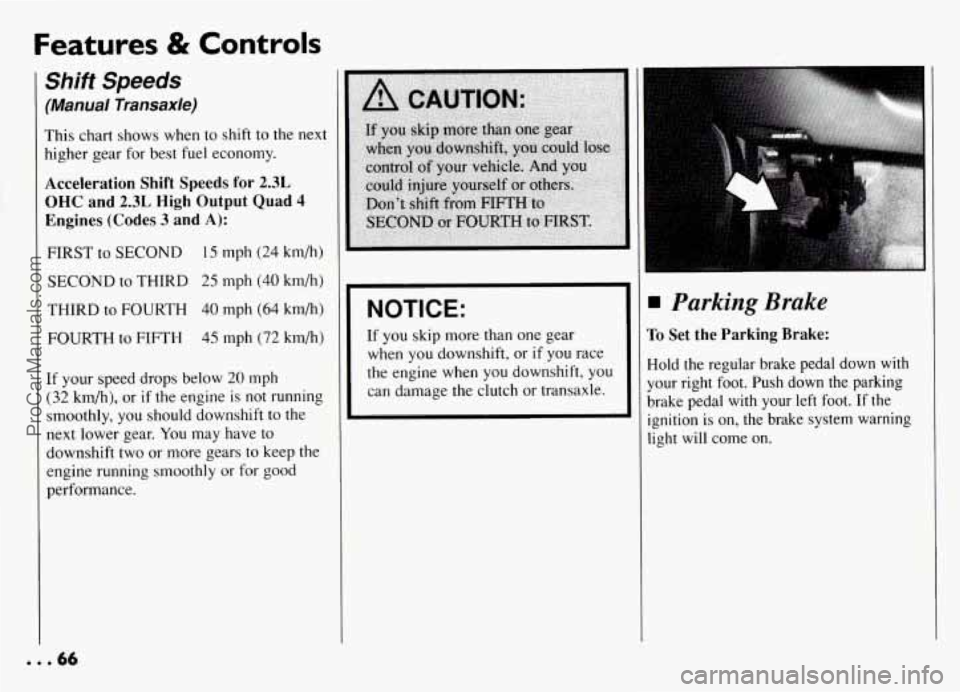
Parking Brake
To Set the Parking Brake:
Hold the regular brake pedal down with
your right foot. Push down the parking
brake pedal with your left foot. If the
ignition is on, the brake system warning
light will come on.
... 66
ProCarManuals.com
Page 77 of 274
Features & Controls
To Reduce Speed While
Using Cruise Control
There are two ways to reduce your speed
while using cruise control:
0 Push in the button at the end of the
lever until you reach the lower speed
you want, then release
it.
0 To slow down in very small amounts,
push the button for less than half a
second. Each
time you do this, you’ll
go
1 mph (1.6 km/h) slower.
Passing Another Vehicle
While Using Cruise
Control
Use the accelerator pedal to increase your
speed. When you take your foot off the
pedal, your vehicle
will slow down to the
Cruise Control speed you set earlier.
Using Cruise Control on
Hills
How well your Cruise Control will work
on hills depends upon your speed, load,
and the steepness of the hills. When going
up steep hills, you may have to step on
the accelerator pedal to maintain your
speed. When going downhill, you may
have to brake or shift to
a lower gear to
keep your speed down. Of course,
applying the brake takes you out of
Cruise Control. Many drivers find this
to
be too much trouble and don’t use Cruise
Control on steep hills.
To Get Out of Cruise
Control
There are two ways to turn off the Cruise
Control:
0 Step lightly on the brake pedal or push
the clutch pedal,
if you have a manual
transaxle;
OR
Move the Cruise switch to OFF.
To Erase Cruise Speed
Memory
When you turn off the Cruise Control or
the ignition, your Cruise Control set speed
memory
is erased.
ProCarManuals.com
Page 178 of 274
2.3L Quad OHC and Quad
4 Engines (CODES 3,
D AND A)
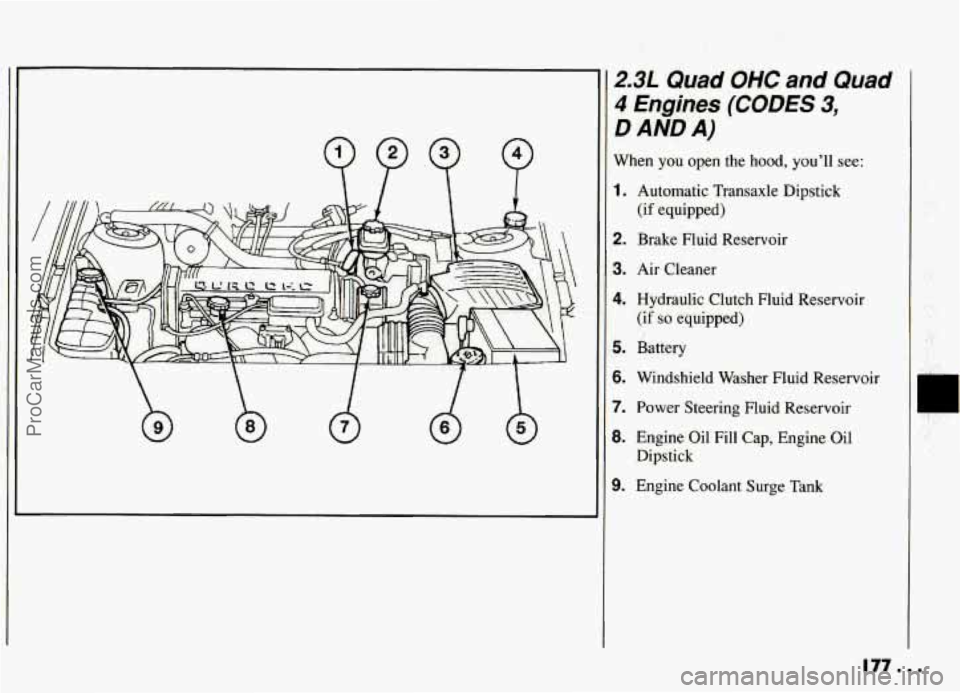
When you open the hood, you'll see:
1. Automatic Transaxle Dipstick
(if'equipped)
2. Brake Fluid Reservoir
3. Air Cleaner
4. Hydraulic Clutch Fluid Reservoir
(if so equipped)
5. Battery
6. Windshield Washer Fluid Reservoir
7. Power Steering Fluid Reservoir
B. Engine Oil Fill Cap, Engine Oil
Dipstick
3. Engine Coolant Surge Tank
ProCarManuals.com
Page 188 of 274
How to Add Fluid
Here’s how to add fluid. Refer to the
Maintenance Schedule to determine what
kind of fluid
to use. See “Recommended
Fluids and Lubricants”
in the Index.
1. Remove the dipstick by flipping the
handle up and then pulling the
dipstick out.
2. Add fluid at the dipstick hole.
Add only enough fluid to bring the
fluid level up to the
FULL mark on the
dipstick.
3. Push the dipstick back in all the way;
then flip the handle down to lock the
dipstick
in place.
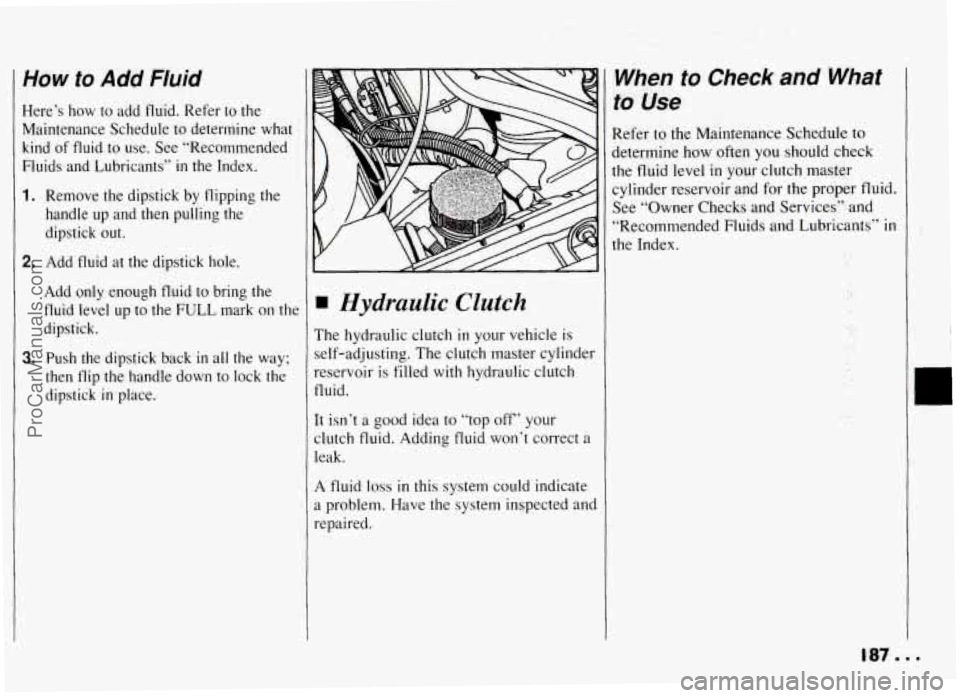
Hydraulic Clutch
The hydraulic clutch in your vehicle is
self-adjusting. The clutch master cylinder
reservoir is filled with hydraulic clutch
fluid.
It isn’t a good idea to “top off’ your
clutch fluid. Adding fluid won’t correct a
leak.
A fluid loss in this system could indicate
a problem. Have the system inspected and
repaired.
When to Check and What
to Use
Refer to the Maintenance Schedule to
determine how often you should check
the fluid level
in your clutch master
cylinder reservoir and for the proper fluid.
See “Owner Checks and Services” and
“Recommended Fluids and Lubricants”
in
the Index.
187...
ProCarManuals.com
Page 234 of 274
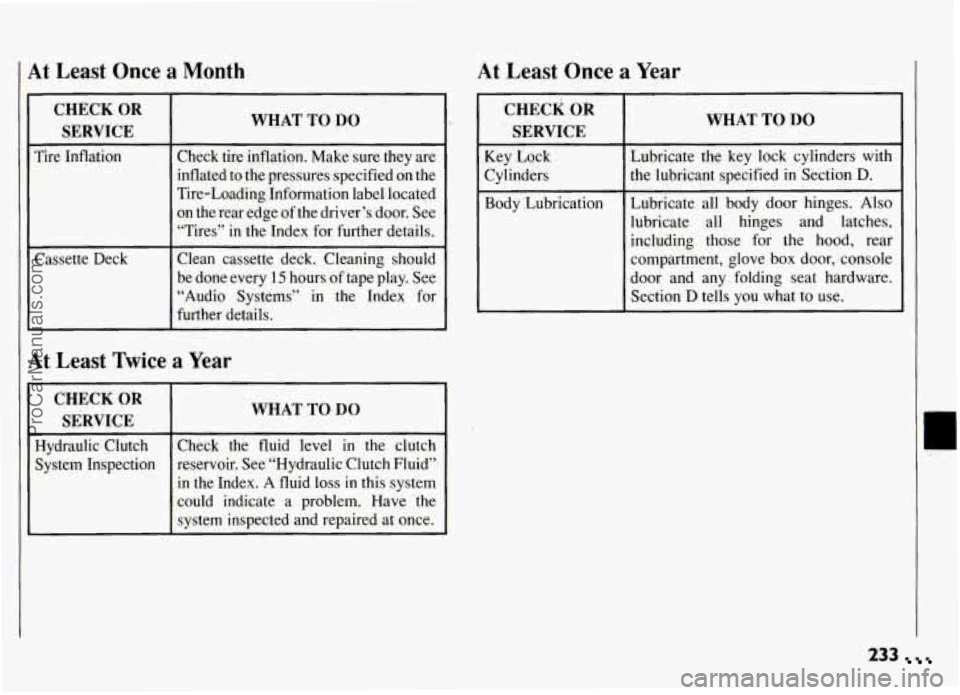
At Least Once a Month At Least Once a Year
WHAT TO DO I’
Tire Inflation Check tire inflation. Make sure they are
inflated to the pressures specified on the
Tire-Loading Information label located
on the rear edge of the driver’s door. See
“Tires” in the Index for further details.
Cassette Deck Clean cassette deck. Cleaning should
be done every
15 hours of tape play. See
“Audio Systems” in the Index for
further details.
I I
Lt Least Twice a Year
SERVICE I
WHAT TO DO
Hydraulic Clutch Check the fluid level in the clutch-
System Inspection reservoir. See “Hydraulic Clutch Fluid”
in the Index.
A fluid loss in this system
could indicate a problem. Have ‘the
system inspected and repaired at once.
CHECK OR
SERVICE
Key Lock
Cylinders
Body ‘Lubrication
WHAT TO DO
Lubricate the key lock cylinders with
the lubricant specified in Section
D.
Lubricate all body door hinges. Also
lubricate all hinges and latches,
including those for the hood, rear
compartment, glove box door, console
door and any folding seat hardware.
Section
D tells you what to use.
I
233
ProCarManuals.com
Page 235 of 274
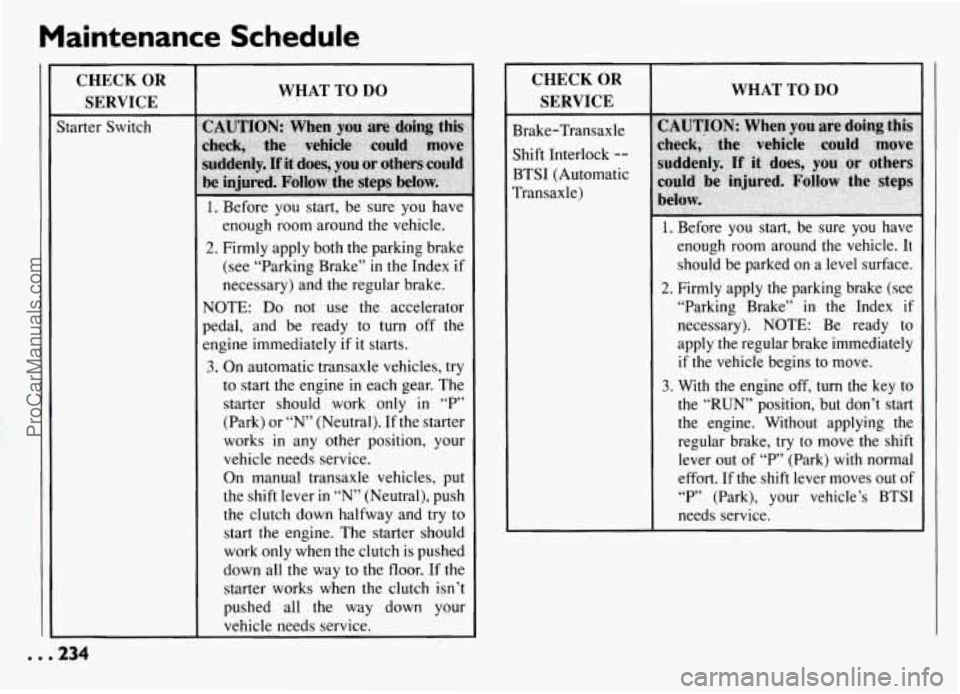
Maintenance Schedule
CHECK OR
SERVICE
Starter Switch
WHAT TO DO
1. Before you start, be sure’ you have
enough room around the vehicle.
2. Firmly apply both the parking brake
(see “Parking Brake” in the Index if
necessary) and the regular brake.
NOTE: Do not use the accelerator
pedal, and be ready to turn off the
engine immediately if it starts.
3. On automatic transaxle vehicles, try
to start the engine in each gear. The
starter should work only
in “F’”
(Park) or “N” (Neutral). If the starter
works
in any other position, your
vehicle needs service.
On manual transaxle vehicles, put
the shift lever in “N” (Neutral), push
the clutch down halfway and
try to
start the engine. The starter should
work only when the clutch is pushed
down all the way to ‘the floor. If the
starter works when the clutch isn’t
pushed all the way down your
vehicle needs service.
CHECK OR
SERVICE
Brake-Transaxle
Shift Interlock
--
BTSI (Automatic
I‘ransaxle)
WHAT TO DO
1. Before you start, be sure you have
enough room around the vehicle. It
should be parked on a level surface.
2. Firmly apply the parking brake (see
“Parking Brake”
in the Index if
necessary). NOTE: Be ready to
apply the regular brake immediately
if the vehicle begins to move.
3. With the engine off, turn the key to
the “RUN” position, but don’t start the engine. Without applying the
regular brake, try to move the shift
lever out of
“P” (Park) with normal
effort. If the shift lever moves out of
“P’ (Park), your vehicle’s BTSI
needs service.
. . .234
ProCarManuals.com