Page 212 of 290
2. Unscrew the clamp on the air intake
hose where the hose attaches to the
throttle body near the top
of the
engine. Detach the hose from the
throttle body, then pull back the rear
of the housing cover.
3. Remove the air filter,
4. Be sure to install the air filter and
replace the cover tightly.
5. Reattach the air intake hose and
tighten the clamp.
Automatic Transaxle
Fluid
When to Check and
Change
A good time to check your automatic
transaxle fluid level is when the engine oil
is changed..Refer to the Maintenance
Schedule to determine when to. change
your fluid. See “Scheduled Maintenance
Services”
in the Index.
How to Check
,- , .. : : j! ? !i
Because this operation can be a little
difficult,
you may choose to have this
done at a Pontiac Dealership Service
Department.
211 b..
ProCarManuals.com
Page 213 of 290

Service & Appearance Care
How to Check (cow.)
If you do it yourself, be sure to follow all
the instructions here, or
you could get a
false reading on the dipstick.
NOTICE:
Too much or too little fluid can
damage your transaxle. Too much
can mean that some of
the fluid
could come out and fall on hot
engine parts or exhaust system
parts, starting a fire. Be sure to get
an accurate reading
if you check
your transaxle
fluid.
Wait at least 30 minutes before checking
the transaxle fluid
level if you have been
driving:
0 When outside temperatures are above
90°F (32°C).
0 At high speed for quite a while.
0 In heavy traffic -- especially in hot
weather.
I
To get the right reading, the fluid should
be at normal operating temperature,
which is 180°F to 200°F (82°C to 93°C).
Get the vehicle warmed up by driving
about 15 miles (24 km) when outside
temperatures are above 50°F (10°C). If
it's colder than 50°F ( 10°C), you may
have
to drive longer.
To Check the Fluid Level
Park your vehicle on a level place.
Keep the engine running.
With the parking brake applied, place
the shift lever
in "P" (Park).
With your
foot on the brake pedal,
move the shift lever through each gear
range, pausing for about three seconds
in each range. Then, position the shift
lever
in "P" (Park).
Let the engine run at idle for three
to
five minutes. Then. Without Shutting
Off the Engine,
Follow These Steps:
1. Pull out the dipstick and wipe it with a
clean rag or paper towel.
2. Push it back in all the way, wait three
seconds and then pull it back
out
again.
ProCarManuals.com
Page 214 of 290
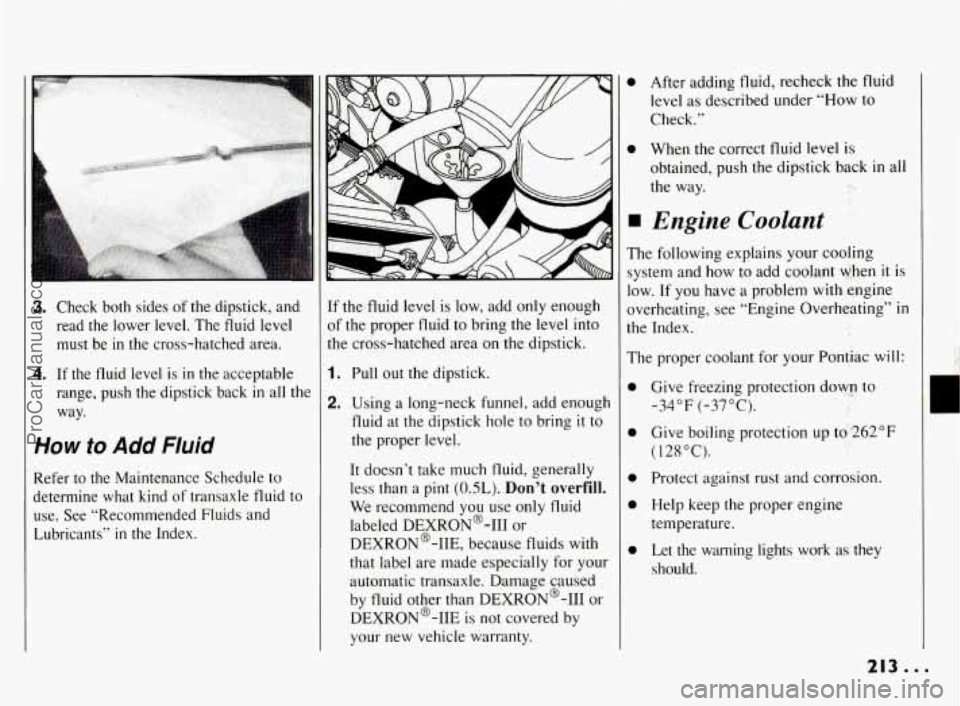
3. Check both sides of the dipstick, and
read the lower level. The fluid level must be in the cross-hatched area.
4. If the fluid level is in the acceptable
range, push the dipstick back in all the
way.
How to Add Fluid
Refer to the Maintenance Schedule to
determine what kind of transaxle fluid to
use. See “Recommended Fluids and
Lubricants’’
in the Index. If
the fluid level is low, add only enough
of the proper fluid to bring the level into
the cross-hatched area on the dipstick.
1. Pull out the dipstick.
2. Using a long-neck funnel, add enough
fluid at the dipstick hole to bring
it to
the proper level.
It doesn’t take much fluid, generally
less than a pint
(OSL). Don’t overfill.
We recommend you use only fluid
labeled DEXR0N’-I11
or
DEXRON@-IIE, because fluids with
that label are made especially for your
automatic transaxle. Damage caused
by fluid other than DEXRON@-I11 or
DEXR0N’-IIE is not covered by your new vehicle warranty.
0 After adding fluid, recheck the fluid
level as described under “How to
Check.”
0 When the correct fluid level is
obtained, push the dipstick back in all
the way. ..
Engine Coolant
The following explains your cooling
system and how to add coolant when
it is
1.0~. If
you have a problem with engine
overheating, see “Engine Overheating” in
the Index.
The proper coolant for your Pontiac will:
0
0
0
0
0
Give freezing protection down to
-34°F (-37°C).
Give boiling protection up to
,262”F
( 128 “C).
Protect against rust and corrosion.
Help keep the proper engine
temperature.
Let the warning lights work as they should.
r
213...
ProCarManuals.com
Page 215 of 290
Service & Appearance Care
Engine Coolant (CONT.)
What to Use
Use a mixture of one-half clean water
(preferably distilled) and one-half
antifreeze that meets
“GM Specification
1825-M,” which won’t damage aluminum
parts.
You can also use a recycled coolant
conforming to
GM Specification 1825-M
with a complete coolant flush and refill. If
you use this mixture, you don’t need to
add anything else.
NOTICE:
If you use an improper coolant mix,
your engine could overheat and be
badly damaged. The repair cost
wouldn’t be covered by your
warranty.
Too much water in the
mix can freeze and crack the engine,
radiator, heater core and other parts.
Adding Coolant
To Check Coolant
When your engine is cold, the coolant
level should be at
“FULL COLD” or a
little higher. When your engine is warm,
‘.he level should be up to “FULL HOT” or
1 little higher.
. . .214
ProCarManuals.com
Page 216 of 290
If this light comes on, it means you're lo
on coolant.
L
LOW COOLANT
I'o Add C,oolant
[f you need more coolant, add the proper
mix at the coolant recovery tank.
Add coolant
mix at the recovery tank, but
be careful not to spill
it.
Radiator Pressure Cap
I NOTICE:
Your radiator cap is a 15 psi
( 105 kPa) pressure-type cap and
must be tightly installed to prevent
coolant loss and possible engine
damage from overheating. Be sure
the arrows on the cap line up with
the overflow tube on the radiator
filler neck.
When you replace your radiator pressure
cap, an AC@ cap
is recommended.
215...
ProCarManuals.com
Page 217 of 290
Service & Appearance Care
Thermostat
Engine coolant temperature is controlled
by a thermostat
in the engine coolant
system. The thermostat stops the flow
of
coolant through the radiator until the
coolant reaches a preset temperature.
When you replace your thermostat, an
AC@ thermostat is recommended.
Power Steering Fluid
How To Check Power
Steering
Fluid
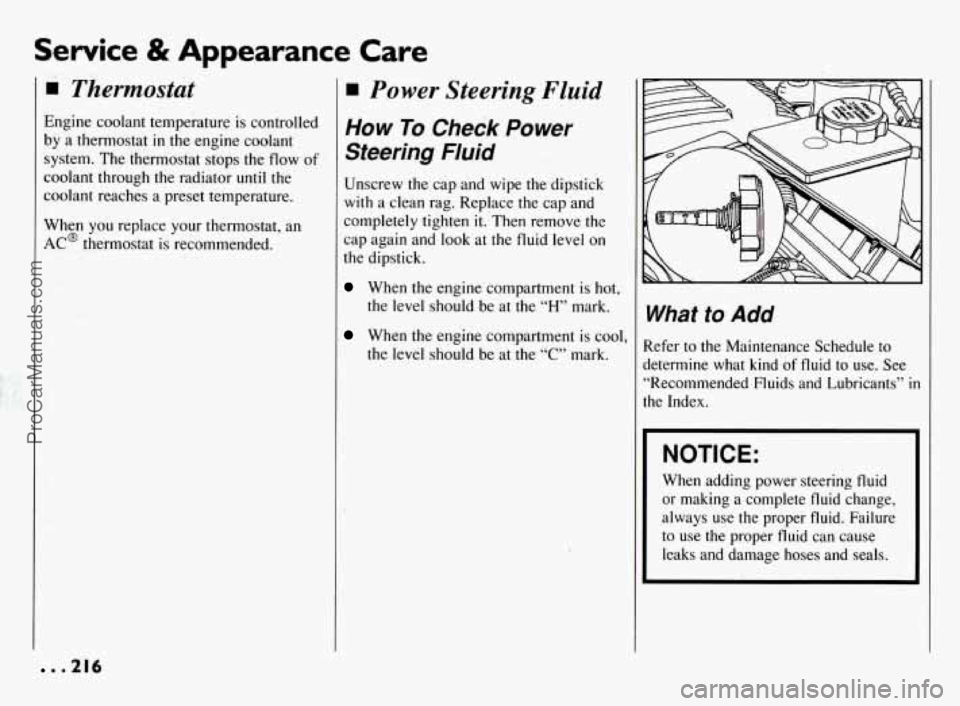
Unscrew the cap and wipe the dipstick
with a clean rag. Replace the cap and
completely tighten
it. Then remove the
cap again and look at the fluid level on
the dipstick.
When the engine compartment is hot,
the level should be at the
“H” mark.
When the engine compartment is cool,
the level should be at the “C” mark.
What to Add
Refer to the Maintenance Schedule to
determine what kind
of fluid to use. See
“Recommended Fluids and Lubricants”
in
the Index.
NOTICE:
When adding power steering fluid
or making a complete fluid change,
always
use the proper fluid. Failure
to use the proper fluid can cause
leaks and damage hoses and seals.
. .216
ProCarManuals.com
Page 219 of 290

Service & Appearance Care
Brake Master Cylinder
(CONK)
work at all. So, it isn’t a good idea to “top
off’ your brake fluid. Adding brake fluid.
won’t correct a leak. If you add fluid
when your linings are worn, then you’ll
have too much fluid when you get new
brake linings.
You should add (or remove)
brake fluid, as necessary, only when work
is done on the brake hydraulic system.
When your brake fluid falls to a low level,
your brake warning light will come on. A
chime will sound
if you try to drive with
this warning light on. See “Brake System
Warning Light” in the Index.
. . .218
What to Add
When you do need brake fluid, use only
DOT-3 brake fluid
-- such as Delco
Supreme 11
@ (GM Part No. 1052535).
Use new brake fluid from a sealed
container only, and always clean the brake
fluid reservoir cap before removing
it.
NOTICE:
e Don’t let someone put in the
wrong kind of fluid. For
example, just a few drops of
mineral-based oil, such as
engine oil, in your brake
system can damage brake
system parts
so badly that
they’ll have to be replaced.
Brake fluid can damage
paint,
so be careful not to
spill brake fluid on your
vehicle. If you do, wash it
off
immediately. See
“Appearance Care”
in the
Index.
Brake Wear
Your Pontiac has front disc brakes and
rear drum brakes.
Disc brake pads have built-in wear
indicators that make a high-pitched
warning sound when the brake pads are
worn and new pads are needed. The
sound may come and
go or be heard all
the time your vehicle is moving (except when you are pushing on the brake pedal
firmly).
ProCarManuals.com
Page 238 of 290

I
A ’ ASSEMBLY
CODE
MODEL
YEAR 1994 PLANT
Vehicle Identification
Number (VZN)
This is the legal identifier for your
Pontiac. It appears
on a plate in the front
corner of the instrument panel, on the
driver’s side.
You can see it if you look
through the windshield from outside your
vehicle. The VIN also appears on the
Vehicle Certification and Service Parts
labels and the certificates of title and
registration.
Engine Identification
The eighth character in your VIN is the
engine code. This code will help
you
identify your engine, specifications, and
replacement parts.
Service Parts
Identification Label
You’ll find this label on your spare tire
cover.
It’s very helpful if
you ever need to order
parts. On this label is:
0 your VIN,
0 the model designation,
0 paint information, and
0 a list of all production options and
special equipment.
Be sure that this label
is not removed
from the vehicle.
Add-on Electrical
Equipment
NOTICE:
Don’t add anything electrical to
your Pontiac unless
you check with
your dealer first. Some electrical
equipment can damage your vehicle
and the damage wouldn’t be
covered by your warranty. Some
add-on electrical equipment can
keep other components from
working as they should.
Your vehicle has an air bag system.
Before attempting to add anything
electrical to your Pontiac, see “Servicing
Your Air Bag-Equipped Pontiac” in the
Index.
c
237.. .
ProCarManuals.com


