Page 87 of 404

NOTICE:
Driving with the parking brake on can cause your rear brakes to
overheat. You may have
to replace them, and you could also
damage other parts of your vehicle.
If you are towing a trailer and are parking on any hill: See “Towing a
Trailer” in the Index. That section shows what to do first to keep the trailer
from moving.
Propshaft Brake Burnish Procedure
If you have a 3500 HD model, it is recommended that the propshaft
mounted parking brake be burnished
as part of the new vehicle break in.
The parking brake will work best after it has been burnished following these
instructions.
Make
10 (ten) stops, using the parking brake foot pedal, from 20 mph
(32 kdh) about
2 1/2 miles (4 km) apart. In between stops, drive the
vehicle at
20 mph (32 km/h).
Torque Lock
The parking brake should be set first whenever you leave the driver’s seat.
If you are parked on
a hill and the transmission is placed in “P” (Park)
before
the parking brake is set, the weight of the vehicle may put too much
force
on the parking pawl in the transmission. It may be difficult to pull the
selector lever out
of “P’ (Park). This is called “torque lock.” To prevent this,
the parking brake should be set
BEFORE moving the gear selector to “P’
(Park).
When preparing to move
a vehicle parked on a hill, the selector lever should
be moved out of
“P’ (Park) BEFORE releasing the parking brake. Even
when
on level surfaces, its a good idea to set the parking brake first before
shifting
the transmission from “P” (Park).
If torque lock does occur, you may have to have another vehicle nudge your
vehicle uphill a little to take some
of the pressure off the transmission while
you pull the selector lever out of “P” (Park).
2-29
ProCarManuals.com
Page 88 of 404
Shifting Into “P” (Park) (Automatic
Transmission Models Only)
Steering Column Shift Lever
1. Hold the brake
pedal down
with
your right foot
and set the
parking brake.
2. Move the shift lever into “P” (Park) position like this:
0 Pull the lever toward you.
0 Move the lever up as far as it will go.
3. If you have four-wheel drive, be sure the transfer case is in a drive gear
- not in “N” (Neutral)
4. Move the ignition key to LOCK.
2-30
ProCarManuals.com
Page 89 of 404

5. Remove the key and take it with you. If you can walk away from your
vehicle with
the ignition key in your hand, your vehicle is in “P”
(Park).
Leaving Your Vehic/e With the Engine Running
(Automatic Transmission Models Only)
If you have to leave your vehicle with the engine running, be sure your
vehicle is
in “P” (Park) and your parking brake is firmly set before you
leave it. If you have four-wheel drive with a manual transfer case shift
lever, be sure that the transfer case
is in a drive gear - not in “N” (Neutral).
After you’ve moved the
shift lever into the “P’ (Park) position, hold the
regular brake pedal down. Then, see if
you can move the shift lever away
from “P” (Park) without first pulling it toward
you. If you can, it means that
the shift lever wasn’t
fully locked into “P” (Park).
Torque Lock (Automatic Transmission)
If you are parking on a hill and you don’t shift your transmission into “P”
(Park) properly,
the weight of the vehicle may put too much force on the
parking pawl
in the transmission. You may find it difficult to pull the shift
lever out of
“P’ (Park). This is called “torque lock.” To prevent torque lock,
set the parking brake and then shift into “P’ (Park) properly before you
leave
the driver’s seat. To find out how, see “Shifting Into ‘P’ (Park)” in the
Index.
When you are ready to drive, move the
shift lever out of “P” (Park)
BEFORE you release the parking brake.
If “torque
lock” does occur, you may need to have another vehicle push
yours
a little uphill to take some of the pressure from the transmission, so
you can pull the shift lever out of “P’ (Park).
2-31
ProCarManuals.com
Page 90 of 404
Parking Your Vehicle
(Manual Transmission Models
Only)
Before you get out of your vehicle, put your manual transmission in “R”
(Reverse), turn off the engine, and firmly apply the parking brake.
If you have four-wheel drive, be sure your transfer case is in a drive gear.
Your vehicle could roll
if it isn’t.
If
you are parking on a hill, or if your pulling a trailer, see “Parking on
Hills” or “Towing a Trailer” in the Index.
Parking Over Things That Burn
2-32
ProCarManuals.com
Page 92 of 404
If you have four-wheel drive and your transfer case is in “N” (Neutral),
your vehicle will be free to roll, even
if your shift lever is in “P” (Park). So,
be sure the transfer case is in a drive gear - not in “N” (Neutral). Follow
the proper steps to be sure your vehicle won’t move. See “Shifting Into
‘P’
(Park)’’ in the Index.
If you’re pulling a trailer, see “Towing a Trailer” in the Index.
Four- Wheel Drive
If your vehicle has four-wheel drive, you can send your engine’s driving
power to all four wheels for extra traction.
To get the most satisfixtion out
of four-wheel drive, you must be familiar with it’s operation. Read
the part
that follows before using four-wheel drive.
You should use 2H for most
normal driving conditions.
Rear-wheel antilock brakes
do not work when you shift into four-wheel
drive. Your regular brakes
will still work. When you shift back into
two-wheel drive, your rear-wheel antilock brakes will take over again.
2-34
ProCarManuals.com
Page 94 of 404

When your headlights or parking lights are on, rotate the dial to the right of
your headlight switch up
to brighten, or down to dim, your transfer case
indicator light.
2H (2-Wheel High): This setting is for driving in most street and highway
situations. Your front axle is not engaged
in two-wheel drive.
4H (4-Wheel High): This setting engages your front axle to help drive your
vehicle. Use
4H when you need extra traction, such as on wet or icy roads,
or in most off-road situations.
N (Neutral): Shift to this setting only when your vehicle needs to be towed
or when using a power take-off.
4L (4-Wheel Low): This setting also engages your front axle to give you
extra power, but should be used only for off-road driving.
You can shift from
2H to 4H or from 4H to 2H while the vehicle is moving.
Your front axle will engage faster if you take your foot off of the accelerator
for a few seconds after you shift.
In extremely cold weather it may be
necessary to stop or slow the vehicle to shift
out of 2H.
To shift into or out of 4L or “N” (Neutral):
Slow the vehicle to a roll, about 1-3 mph (2-5 kdh) and shift your
transmission into neutral.
0 Shift the transfer case shift lever in one continuous motion.
Don’t pause
in “N” (Neutral) as you shift the transfer case into 4L, or your
gears could clash.
Remember that driving
in 4H or 4L may reduce fuel economy. Also, driving
in four-wheel drive on dry pavement could cause your tires to wear fdster
and make your transfer case harder to shift.
Front Axle Locking Feature
The front axle locks and unlocks automatically when you shift the transfer
case. Some delay
for the axle to lock or unlock is normal. If the outside
temperature is very hot, or the vehicle has been used under hard driving
conditions, there may be
a slight delay for the axle to unlock.
Whenever you are
in four wheel drive, the rear wheel anti-lock brake
system does not operate. The regular brake system operates normally. When
you shift back into two-wheel drive, the anti-lock brake system will
operate.
2-36
ProCarManuals.com
Page 102 of 404
NOTICE:
0 When using concentrated washer fluid, follow the
manufacturer’s instructions for adding water.
Don’t mix water with ready-to-use washer fluid. Water can
cause the solution to freeze and damage your washer fluid
tank and other parts of the washer system.
Also, water
doesn’t clean as well as washer fluid.
Fill your washer fluid tank only 314 full when it’s very cold.
This allows for expansion, which could damage the tank if it is
completely full.
0 Don’t use radiator antifreeze in your windshield washer. It
can damage your washer system and paint.
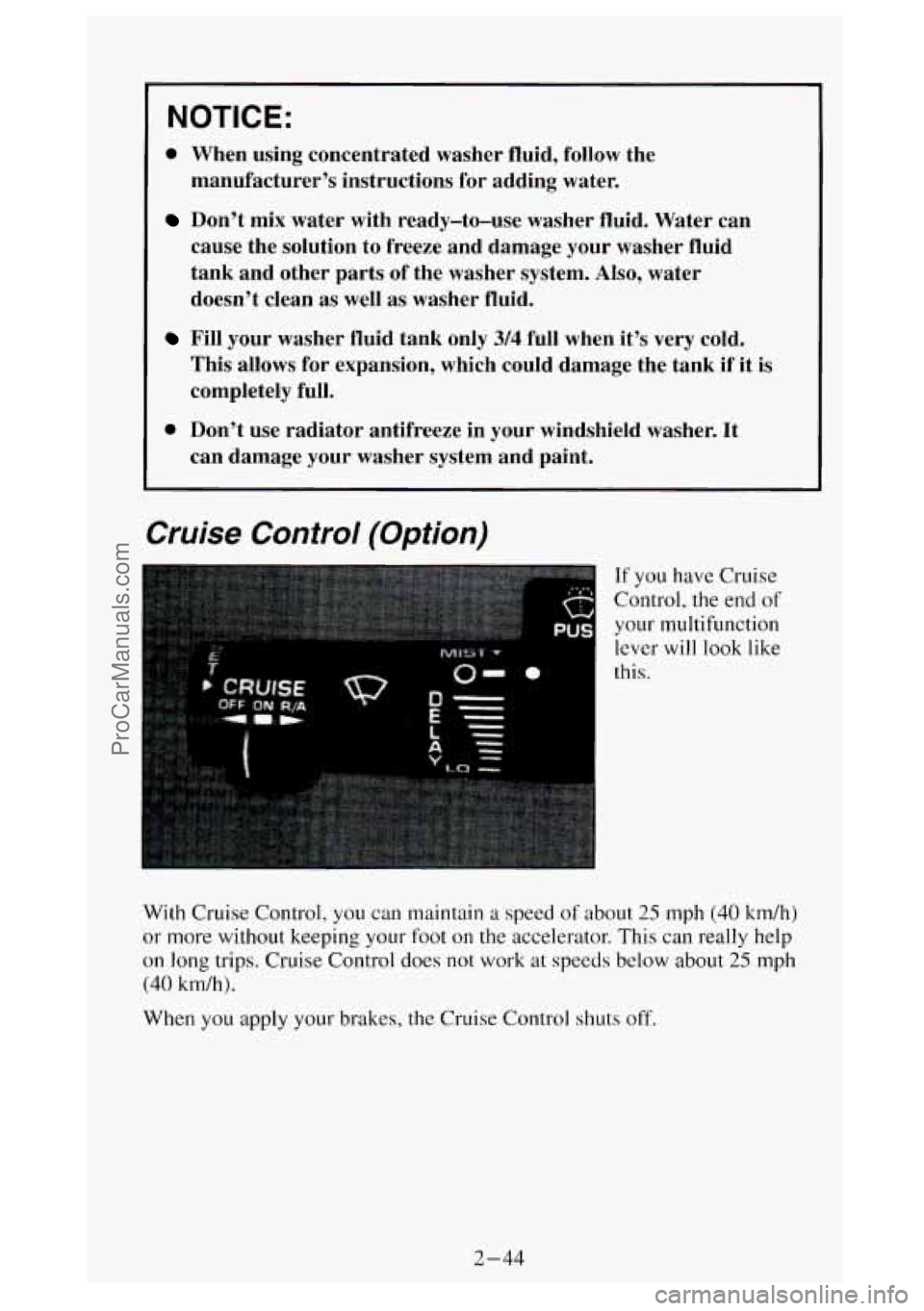
Cruise Control (Option)
If you have Cruise
Control,
the end of
your multifunction
lever
will look like
this.
With Cruise Control, you can maintain a speed
of about 25 mph (40 km/h)
or more without keeping your foot
on the accelerator. This can really help
on long trips. Cruise Control does not work at speeds below about 25 mph
(40 km/h).
When
you apply your brakes, the Cruise Control shuts off.
2-44
ProCarManuals.com
Page 104 of 404
To Resume a Set Speed
Suppose you set your Cruise Control at a desired speed and then you apply
the brake. This, of course, shuts off the Cruise Control. But you don't need
to reset it.
Once you're going
. .A- about 23 mpn
(40 km/h) or more,
you can move the
Cruise Control switch
from
ON to R/A
(Resume/Accelerate)
for about half a
second.
You'll go right back up to your chosen speed and stay there.
Remember, if you hold the switch at
WA longer than half a second, the
vehicle will keep going faster until you release the switch or apply the
brake. You could be startled and even lose control.
So unless you want to go
faster, don't hold the switch at
WA.
To Increase Speed While Using Cruise Control
There are two ways to go to a higher speed. Here's the first:
Use the accelerator pedal to get to the higher speed.
Push the button at
the end of the
lever, then release
the button and the accelerator pedal.
You'll now cruise
at the higher
speed.
2-46
J ProCarManuals.com