Page 173 of 385
Controlling your vehicle is the key to successful off-road driving. One of
the best ways to control your vehicle is to control your speed. Here are some
things to keep in mind. At higher speeds:
you approach things faster and you have less time to scan the terrain for
you have less time to react.
obstacles.
0 you
have more vehicle bounce when you drive over obstacles.
0 you'll need more distance for braking, especially since you're on an
unpaved surface.
Scanning the Terrain
Off-road driving can take you over many different kinds of terrain. You
need
to be familiar with the terrain and its many different features. Here are
some things
to consider.
Surface Conditions. Off-roading can take you over hard-packed dirt,
gravel, rocks, grass, sand, mud,
snow or ice. Each of these surfaces affects
the steering, acceleration, and braking
of your vehicle in different ways.
Depending upon the kind of surface you are on, you may experience
slipping, sliding, wheel spinning, delayed acceleration, poor traction, and
longer braking distances.
Surface Obstacles. Unseen or hidden obstacles can be hazardous. A rock,
log, hole,
rut, or bump can startle you if you're not prepared for them. Often
these obstacles are hidden by grass, bushes, snow or even the rise and fall of
the terrain itself. Here are some things to consider:
Is the path ahead clear?
0 Will the surface texture change abruptly up ahead?
0 Does the travel take you uphill or downhill? (There's more discussion
Will you have to stop suddenly or change direction quickly?
of these subjects later.)
When you drive over obstacles
or rough terrain, keep a firm grip on the
steering wheel. Ruts, troughs, or other surface features can jerk the wheel
out of your hands
if you're not prepared.
4- 14
ProCarManuals.com
Page 205 of 385
Hazard Warning Flashers
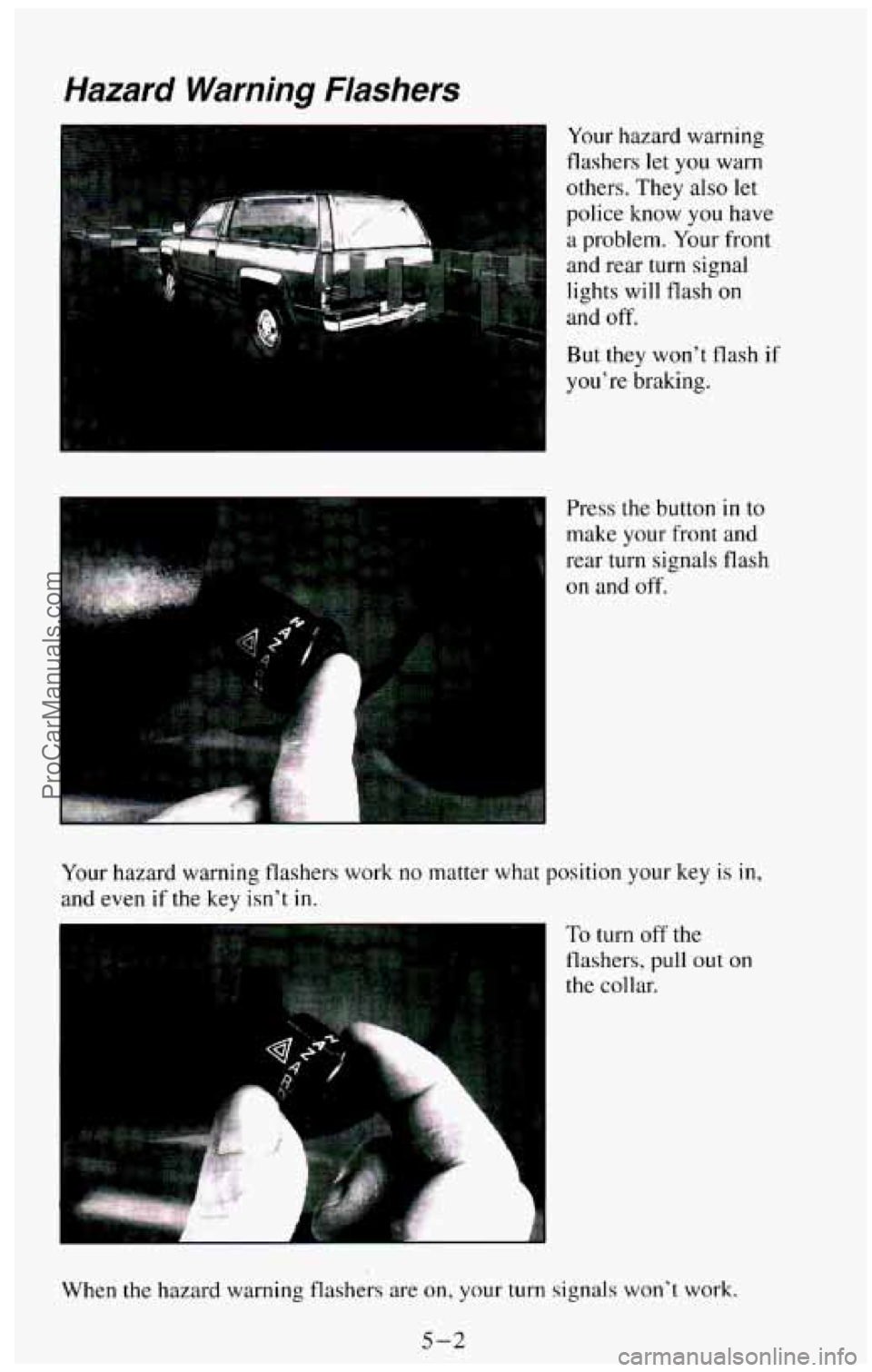
Your hazard warning
flashers let you warn
1
others. They also let
police know you have
a problem. Your front
and rear turn signal
lights will flash
on
and off.
But they won’t flash if
you’re braking.
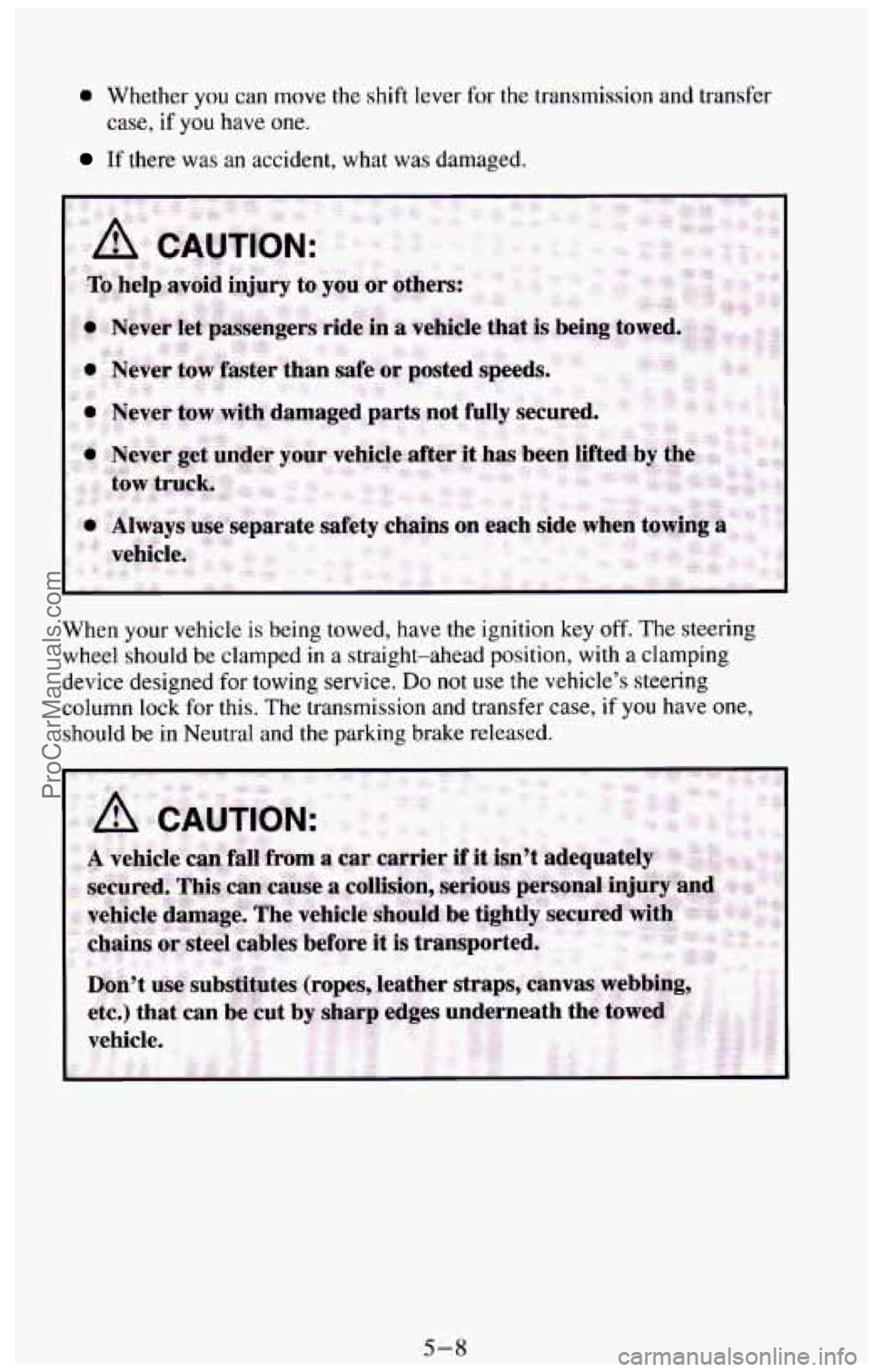
Press the button
in to
make your front and
rear turn signals flash
on and
off.
Your hazard warning flashers work no matter what position your key is in,
and even if the key isn’t in.
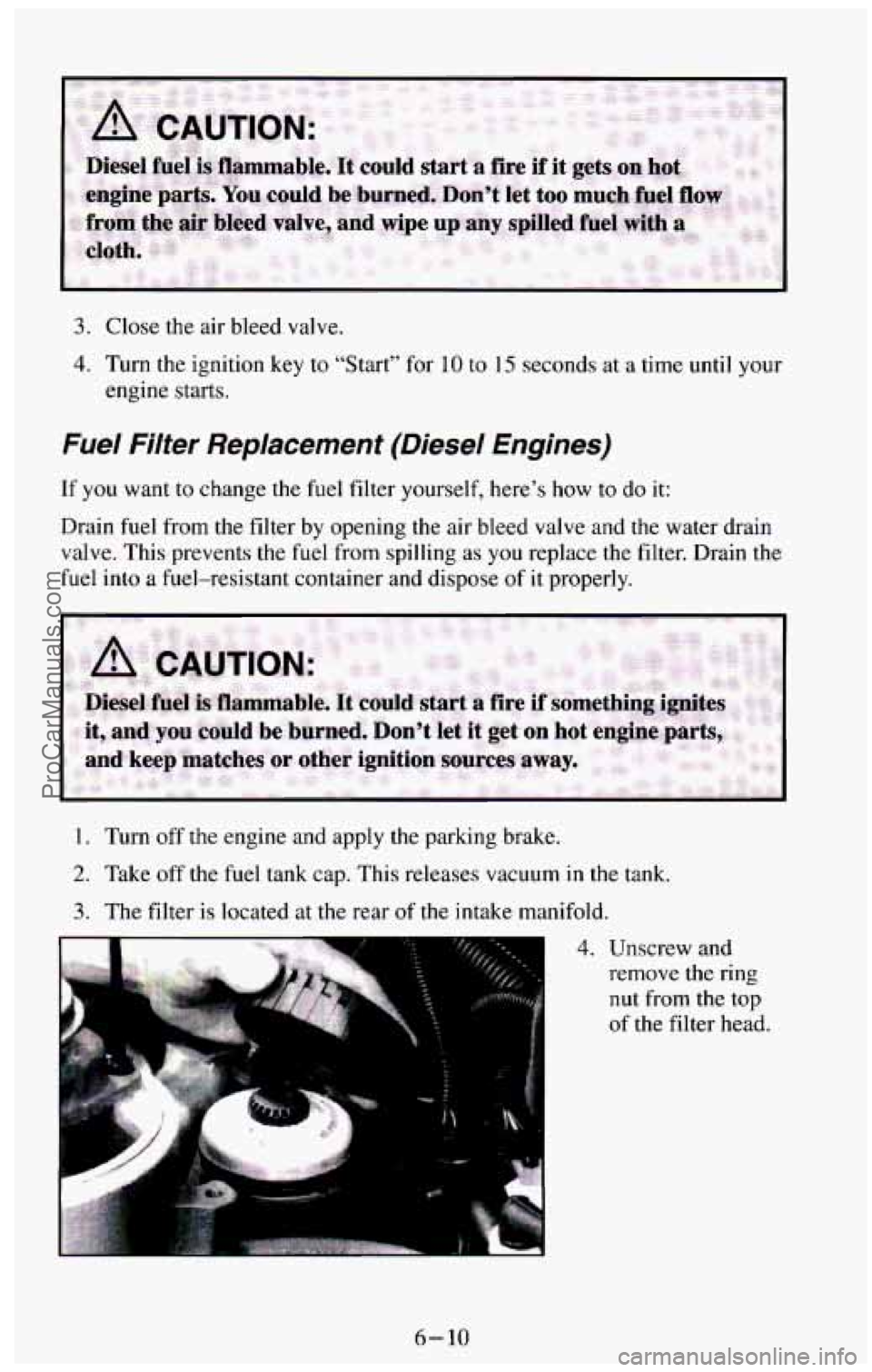
PP . . lo turn orr me
flashers, pull out on
the collar.
When the
hazard warning flashers are on, your turn signals won’t work.
5-2
ProCarManuals.com
Page 211 of 385
0 Whether you can move the shift lever for the transmission and transfer
case,
if you have one.
If there was an accident, what was damaged.
When your vehicle is being towed, have the ignition key off. The steering
wheel should be clamped
in a straight-ahead position, with a clamping
device designed for towing service,
Do not use the vehicle’s steering
column lock for this.
The transmission and transfer case, if you have one,
should be in Neutral and the parking brake released.
5-8 ProCarManuals.com
Page 254 of 385
NOTICE:
If there is water in your diesel fuel and the weather is warm or
humid, fungus and bacteria can grow in the fuel. They can
damage your fuel system. You’ll need a diesel fuel biocide
to
sterilize your fuel system. Your dealer can advise you if you ever
need this.
If your fuel tank needs to be purged to remove water, see your
dealer or
a qualified technician. Improper purging can damage
your fuel system.
Running Out of Fuel (Diesel Engines)
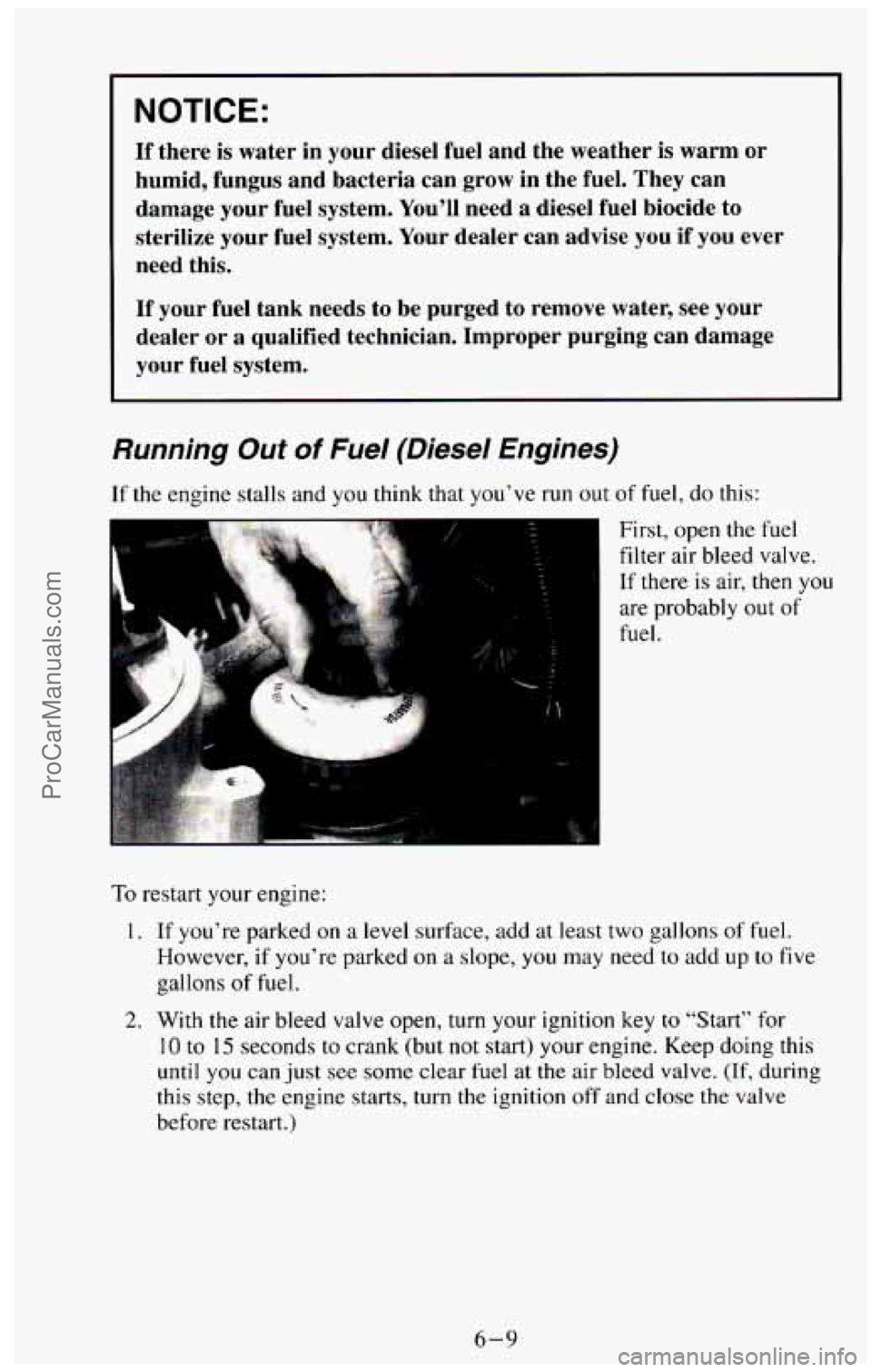
If the engine stalls and you think that you’ve run out of fuel, do this:
First, open the fuel
filter air bleed valve.
If there is air, then
you
are probably out of
fuel.
To restart your engine:
1. If you’re parked on a level surface, add at least two gallons of fuel.
However, if you’re parked
on a slope, you may need to add up to five
gallons
of fuel.
10 to 15 seconds to crank (but not start) your engine. Keep doing this
until
you can just see some clear fuel at the air bleed valve. (If, during
this step, the engine starts, turn the ignition off and close the valve
before restart.)
2. With the air bleed valve open, turn your ignition key to “Start” for
6-9
ProCarManuals.com
Page 255 of 385
3. Close the air bleed valve.
4. Turn the ignition key to “Start” for 10 to 15 seconas at a time until your
engine starts.
Fuel Filter Replacement (Diesel Engines)
If you want to change the fuel filter yourself, here’s how to do it:
Drain fuel from the filter by opening the air bleed valve and the water drain
valve. This prevents the
fuel from spilling as you replace the filter. Drain the
fuel into a fuel-resistant container and dispose
of it properly.
1. Turn off the engine and apply the parking brake.
2. Take off the fuel tank cap. This releases vacuum in the tank.
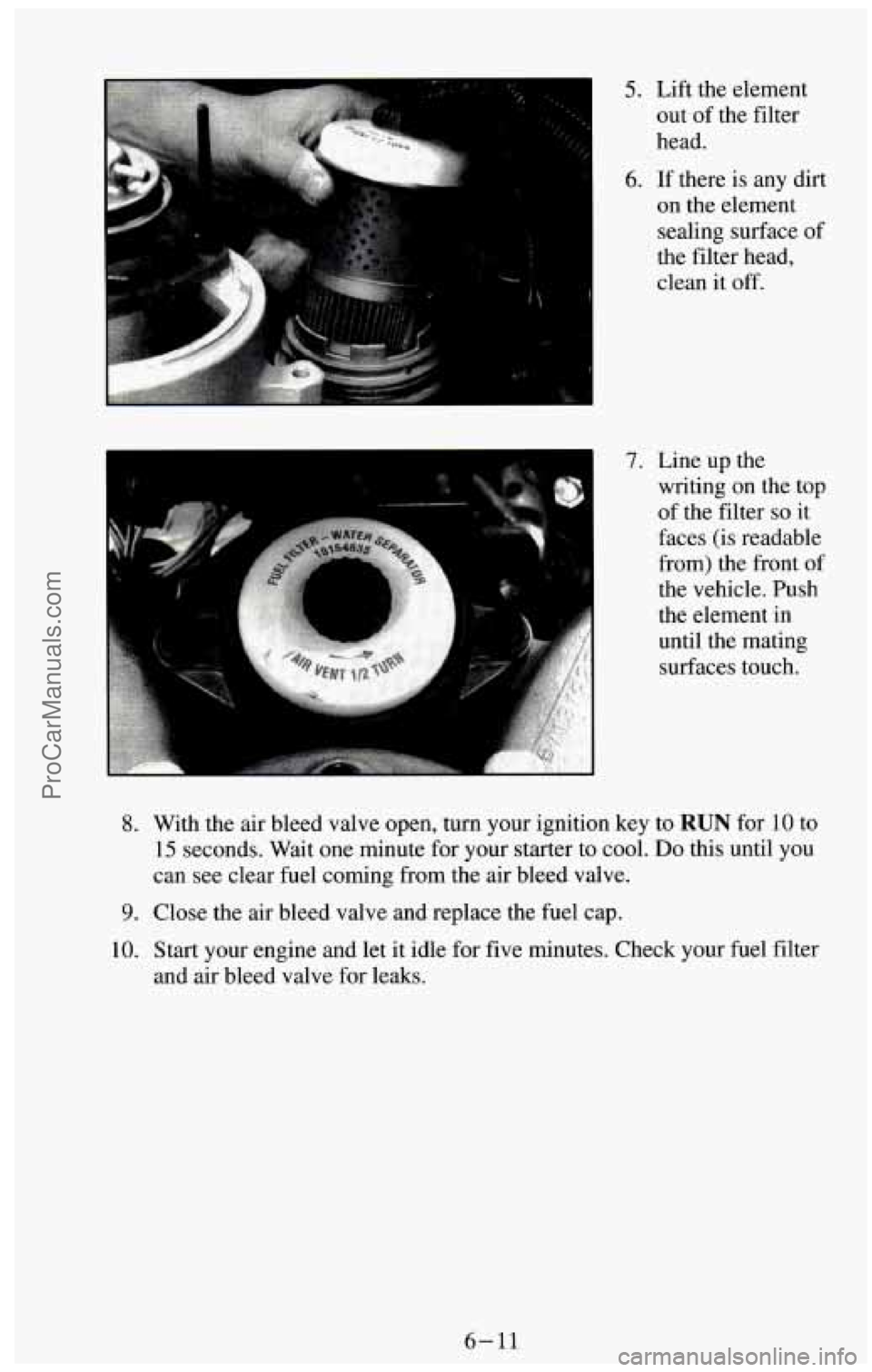
3. The filter is located at the rear of the intake manifold.
4;: .
4. Unscrew and
remove the ring
nut from the top
of the filter head.
6- 10
ProCarManuals.com
Page 256 of 385
8.
9.
10.
5. Lift the element out of the filter
head.
6. If there is any dirt
on the element
sealing surface of
the filter head,
clean it off.
7. Line up the
writing
on the top
of the filter
so it
faces (is readable
from) the front of
the vehicle.
Push
the element in
until the mating
surfaces touch.
With the air bleed valve open, turn your ignition key to
RUN for 10 to
15 seconds. Wait one minute for your starter to cool.
Do this until you
can see clear fuel coming from the air bleed valve.
Close the air bleed valve and replace the fuel cap.
Start your engine and let it idle for five minutes. Check your fuel filter
and air bleed valve for leaks.
6-11
ProCarManuals.com
Page 355 of 385
25. BRAKE SYSTEM INSPECTION? - When the engine oil is
changed, inspect the
lines and hoses for proper hookup, binding, leaks,
cracks, chafing, etc. Check
the parking brake adjust, and the fluid level
in the master cylinder.
A low fluid level can indicate worn disc brake
pads which may need to be serviced.
When the wheels are removed for rotation, inspect disc brake pads for
wear and rotors for surface condition. Also inspect drum brake linings
for wear and cracks. Inspect other brake parts, including drums, wheel
cylinders, parking brake, etc., at
the same time. Remove any rust or dirt
from the wheel and mounting surfaces before mounting
the wheel.
Inspect brakes more often if driving habits or conditions resul\
t in
frequent braking.
Owner Checks and Services
Listed below are owner checks and services which should be made at the
time period specified to help ensure proper safety, emission performance,
and dependability of your vehicle.
Be
sure any necessary repairs are completed at once. Whenever any fluids
or lubricants
are added to your vehicle, make sure they are the proper ones,
as shown in this Section.
At Least Once a Month
Tire inflation pressure check - Check the tires for proper inflation. If
they are low, inflate them to the level specified on the Certificatiomire
label or on the tire inflation charts. See “Loading Your Vehicle” or
“Inflation-Tire Pressure”
in the Index.
At Least Once a Year
Key lock cylinder lubrication - Lubricate key lock cylinders with engine
oil. See the “Recommended Fluid and Lubricants” chart
in this section.
Transmission neutral or clutch start switch operation -
?A fluid loss in these systems may indicate a problem. Have them inspected
and repaired at once.
7-22
ProCarManuals.com
Page 356 of 385
I. Before you start, be sure you have enough room around the vehicle.
2. Firmly apply both the manual parking brake and the Ye‘@lar brake. See
“Brakes” and “Parking Brake” in the Index.
Do not use the accelerator
pedal.
3. Be ready to turn off the engine immediately if it starts.
4. On automatic transmission vehicles, try to start the engine in each gear.
The starter should work only in
“P’ (Park) or “N” (Neutral).
On manual transmission vehicles, put the shift lever
in “N” (Neutral), push
the clutch down halfway, and try to start the engine. The starter should work
only when the clutch is pushed down all the way to the floor.
Steering column lock operation - While parked, try to turn the key to
LOCK in each gear shift position.
With an automatic transmission, the key should turn to
LOCK only when
the gear shift is in
“P” (Park).
On vehicles with a key release lever, try to turn the key to LOCK without
pressing the lever. The key should turn to
LOCK only with the key lever
depressed.
On all vehicles, the key should come out only in
LOCK.
Parking brake and transmission
“P’ (PARK) mechanism operation -
Park on a fairly steep hill, with the vehicle facing downhill. Keeping your
foot
on the regular brake, set the manual parking brake.
To check the parking brake: With the engine running and the
transmission in
“N” (Neutral), slowly remove foot pressure from the
regular brake pedal.
Do this until the vehicle is held by the parking
brake
only.
To check the “P” (Park) mechanism’s holding ability: Apply the regular
brake and shift to
“P’ (Park). Release the manual parking brake, then
slowly release the regular brake.
7-23 ProCarManuals.com