1994 CHEVROLET SUBURBAN towing
[x] Cancel search: towingPage 212 of 385
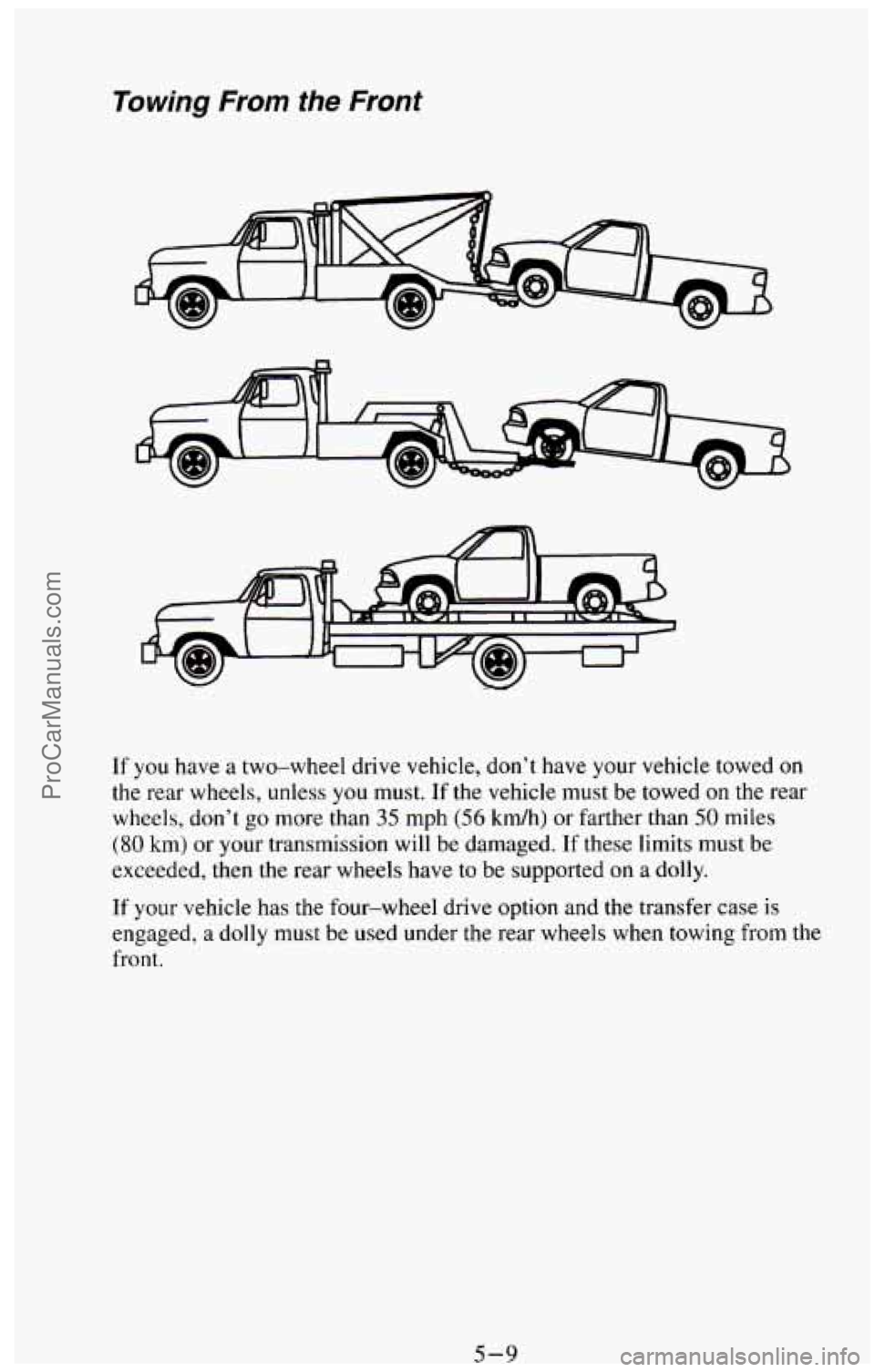
Towing From the Front
If you have a two-wheel drive vehicle, don’t have your vehicle towed on
the rear wheels, unless you must. If the vehicle must be towed on the rear
wheels, don’t
go more than 35 mph (56 km/h) or farther than 50 miles
(80 km) or your transmission will be damaged. If these limits must be
exceeded, then the rear wheels have to be supported on a dolly.
If your vehicle has
the four-wheel drive option and the transfer case is
engaged, a dolly must be used under the rear wheels when towing from the
front.
5-9 ProCarManuals.com
Page 213 of 385
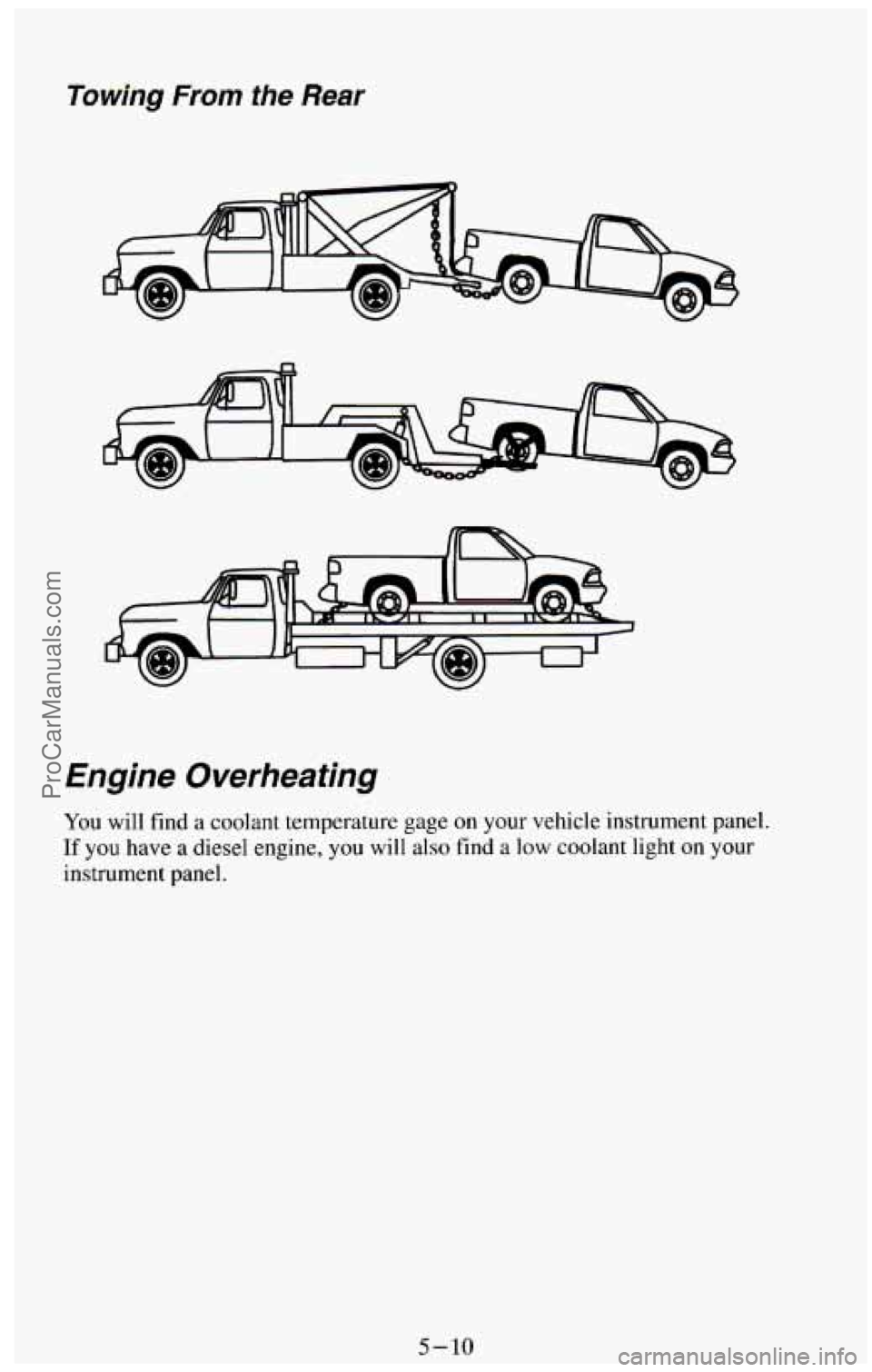
Towing From the Rear
Engine Overheating
You will find a coolant temperature gage on your vehicle instrument panel.
If you have a diesel engine, you will also find a low coolant light on your
instrument panel.
5-10 ProCarManuals.com
Page 227 of 385
Engine Fan Noise
Your vehicle has a clutched engine cooling fan. When the clutch is engaged,
the fan spins faster to provide more air to cool
the engine. In most every day
driving conditions the fan
is spinning slower and clutch is not fully engaged.
This improves
fuel economy and reduces fan noise. Under heavy vehicle
loading, trailer towing and/or high outside temperatures, the fan speed
increases as the clutch more fully engages.
So you may hear an increase in
fan noise. This is normal and should not be mistaken as the transmission
slipping or making extra shifts.
It is merely the cooling system functioning
properly. The
fan will slow down when additional cooling is not required
and the clutch partially disengages.
You may also hear this fan noise when you start the engine. It will go away
as the fan clutch partially disengages.
If a Tire Goes Flat
It’s unusual for a tire to “blow out” while you’re driving, especially if you
maintain your tires properly. If air goes out of a tire, it’s much more likely to
leak out slowly. But if you should ever have
a “blowout,” here are a few tips
about what to expect and what
to do:
If a front tire fails, the flat tire will create a drag that pulls the vehicle
toward that side. Take your foot off the accelerator pedal and grip the
steering wheel firmly. Steer to maintain lane position, then gently brake to a
stop well out of the traffic lane.
A rear blowout, particularly on a curve, acts much like a skid and may
require the same correction you’d use in a skid. In any rear blowout, remove
your foot from the accelerator pedal. Get the vehicle under control
by
steering the way you want the vehicle to go. It may be very bumpy and
noisy, but you can still steer. Gently brake to a stop, well off the road if
possible.
If a
tire goes flat, the next section shows how to use your jacking equipment
to change a flat tire safely.
5-24
ProCarManuals.com
Page 243 of 385
If You’re Stuck: In Sand, Mud, Ice or Snow
What you don’t want to do when your vehicle is stuck is to spin your
wheels. The method known
as “rocking” can help you get out when you’re
stuck, but you must use caution.
NOTICE:
Spinning your wheels can destroy parts of your vehicle as well as
the tires. If you spin the wheels too fast while shifting your
transmission back and forth, you can destroy
your transmission.
Rocking your vehicle to get it out:
First, turn your steering wheel left and right. That will clear the area around
your front wheels. Then shift back and forth between
“R” (Reverse) and a
forward gear (or with a manual transmission, between First or Second gear
and Reverse), spinning the wheels
as little as possible. Release the
accelerator pedal while you shift, and press lightly on the accelerator pedal
when the transmission is in gear. If that doesn’t get you out after a few tries,
you may need to be towed out. Or,
you can use your recovery hooks, if your
vehicle has them.
If you do need to be towed out, see “Towing Your
Vehicle” in the Index.
5-40
ProCarManuals.com
Page 306 of 385

Trailering Package
If your vehicle comes with the Trailering Package, there is also a load rating
which includes the weight
of the vehicle and the trailer it tows. This rating
is called the Gross Combination Weight Rating (GCWR).
When you weigh your trailer, be sure to include the weight
of everything
you put in it. And, remember
to figure the weight of the people inside as
part of your
load.
Your dealer can help you determine your GCWR.
Trailer Recommendations
You must subtract your hitch loads from the CWR for your vehicle. Weigh
your vehicle with the trailer hitch attached,
so that you won’t go over the
GVWR
or the GAWR.
You’ll get the best performance
if you spread out the weight of your load
the right way, and if you choose the correct hitch and trailer brakes.
For more information, see “Trailer Towing’’
in the Index.
Add-on Equipment
When you carry removable items, like snow plow blades, you may need to
put a limit on how many people you carry inside your vehicle. Be sure to
weigh your vehicle before you buy and install the new equipment.
~
NOTICE:
Your warranty doesn’t cover parts or components that fail
because
of overloading.
6-61 ProCarManuals.com
Page 354 of 385
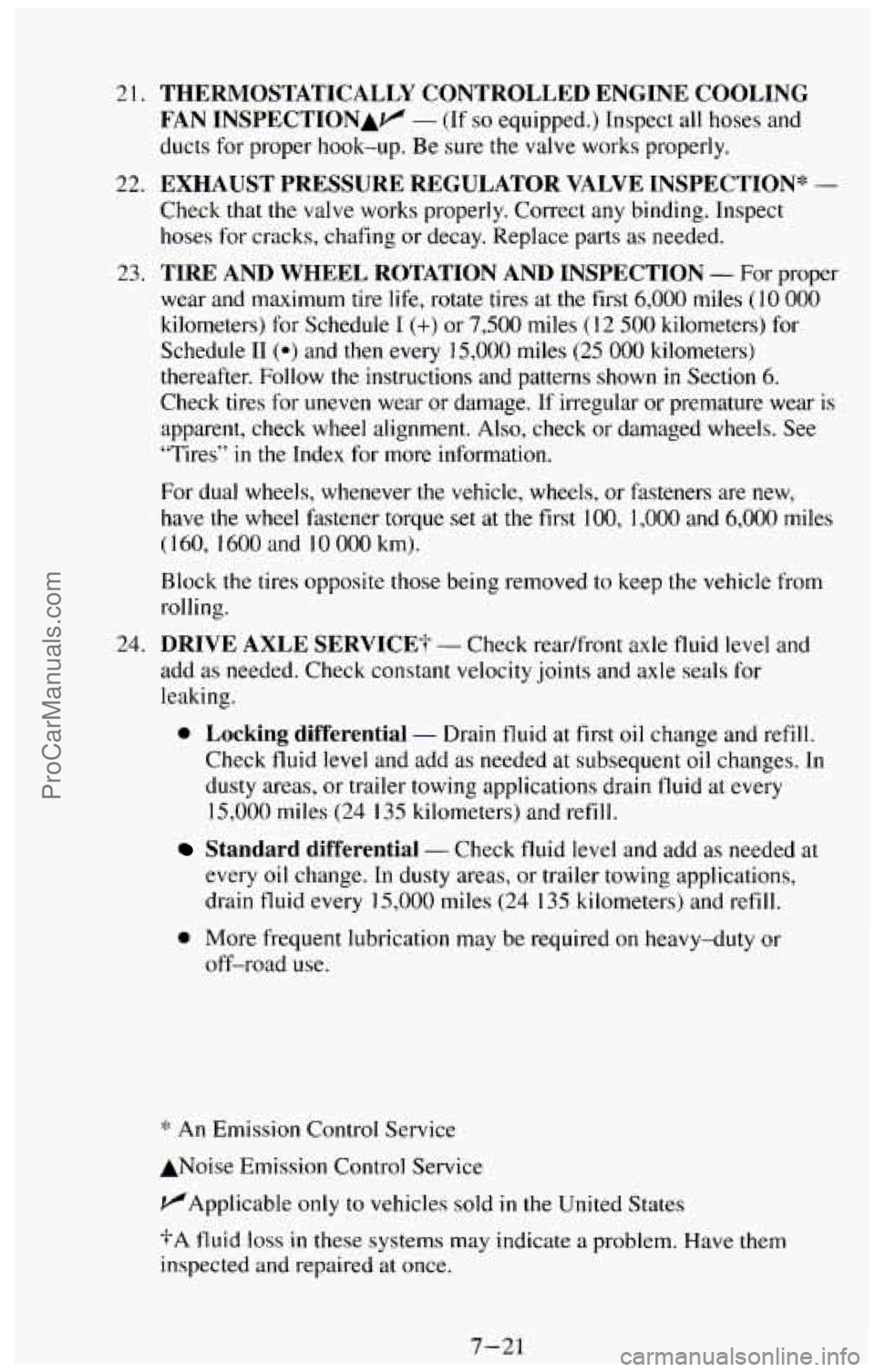
2 I. THERMOSTATICALLY CONTROLLED ENGINE COOLING FAN INSPECTIONAI/
- (If so equipped.) Inspect all hoses and
ducts for proper hook-up. Be sure the valve works properly.
22. EXHAUST PRESSURE REGULATOR VALVE INSPECTION” -
Check that the valve works properly, Correct any binding. Inspect
hoses for cracks, chafing or decay. Replace parts as needed.
23. TIRE AND WHEEL ROTATION AND INSPECTION - For proper
wear and maximum tire life, rotate tires at the first 6,000 miles
(10 000
kilometers) for Schedule
I (+) or 7,500 miles (12 500 kilometers) for
Schedule
I1 (0) and then every 15,000 miles (25 000 kilometers)
thereafter. Follow the instructions and patterns shown
in Section 6.
Check tires for uneven wear or damage. If irregular or premature wear is
apparent, check wheel alignment. Also, check or damaged wheels. See
“Tires”
in the Index for more information.
For dual wheels, whenever the vehicle, wheels, or fasteners are new,
have the wheel fastener torque
set at the first 100, 1,000 and 6,000 miles
( 160, 1600 and 10 000 km).
Block the tires opposite
those being removed to keep the vehicle from
rolling.
24.
DRIVE AXLE SERVICE? - Check readfront axle fluid level and
add
as needed. Check constant velocity joints and axle seals for
leaking.
0 Locking differential - Drain fluid at first oil change and refill.
Check fluid
level and add as needed at subsequent oil changes. In
dusty areas, or trailer towing applications drain fluid at every
15,000 miles (24 135 kilometers) and refill.
Standard differential - Check fluid level and add as needed at
every oil change. In dusty areas, or trailer towing applications,
drain fluid every
15,000 miles (24 135 kilometers) and refill.
0 More frequent lubrication may be required on heavy-duty or
off-road
use.
:i: An Emission Control Service
ANoise Emission Control Service
VApplicable
only to vehicles sold in the United States
+A fluid
loss in these systems may indicate a problem. Have them
inspected and repaired
at once.
7-21 ProCarManuals.com
Page 369 of 385

Chevrolet Roadside Assistance Program
To enhance Chevrolet’s strong commitment to customer satisfaction,
Chevrolet is excited
to provide the services of the ChevroletlGeo Roadside
Assistance Center.
24-Hour Roadside Assistance Number
Roadside Assistance is available 24 hours a day, 365 days a year, by calling
I-800-CHEV USA (1-800-243-8872). This toll-free number will provide
you over-the-phone roadside assistance with minor mechanical problems.
If your problem cannot be resolved over the phone, our advisors have access
to a nationwide network of dealer recommended service providers. The
following services are available:
Towing
Locksmith
Tire repair
Rental car or taxi
Additional services as necessary
The Roadside Assistance Center uses companies that will provide you with
quality and priority service. When roadside services are required, our
advisors will explain any payment obligations that may be incurred for
utilizing outside services.
For prompt assistance when calling, please have the following available
to
give to the advisor:
Vehicle Identification Number
License plate number
Vehicle color
Vehicle location
0 Telephone number where you can be reached
Vehicle mileage
Description of problem
Canadian Roadside Assistance
Vehicles purchased in Canada have an extensive Roadside Assistance
program accessible from anywhere
in Canada or the U.S.A. Please refer to
the separate brochure provided by the dealer or call 1-800-268-6800 for
emergency services.
8-6 ProCarManuals.com
Page 380 of 385
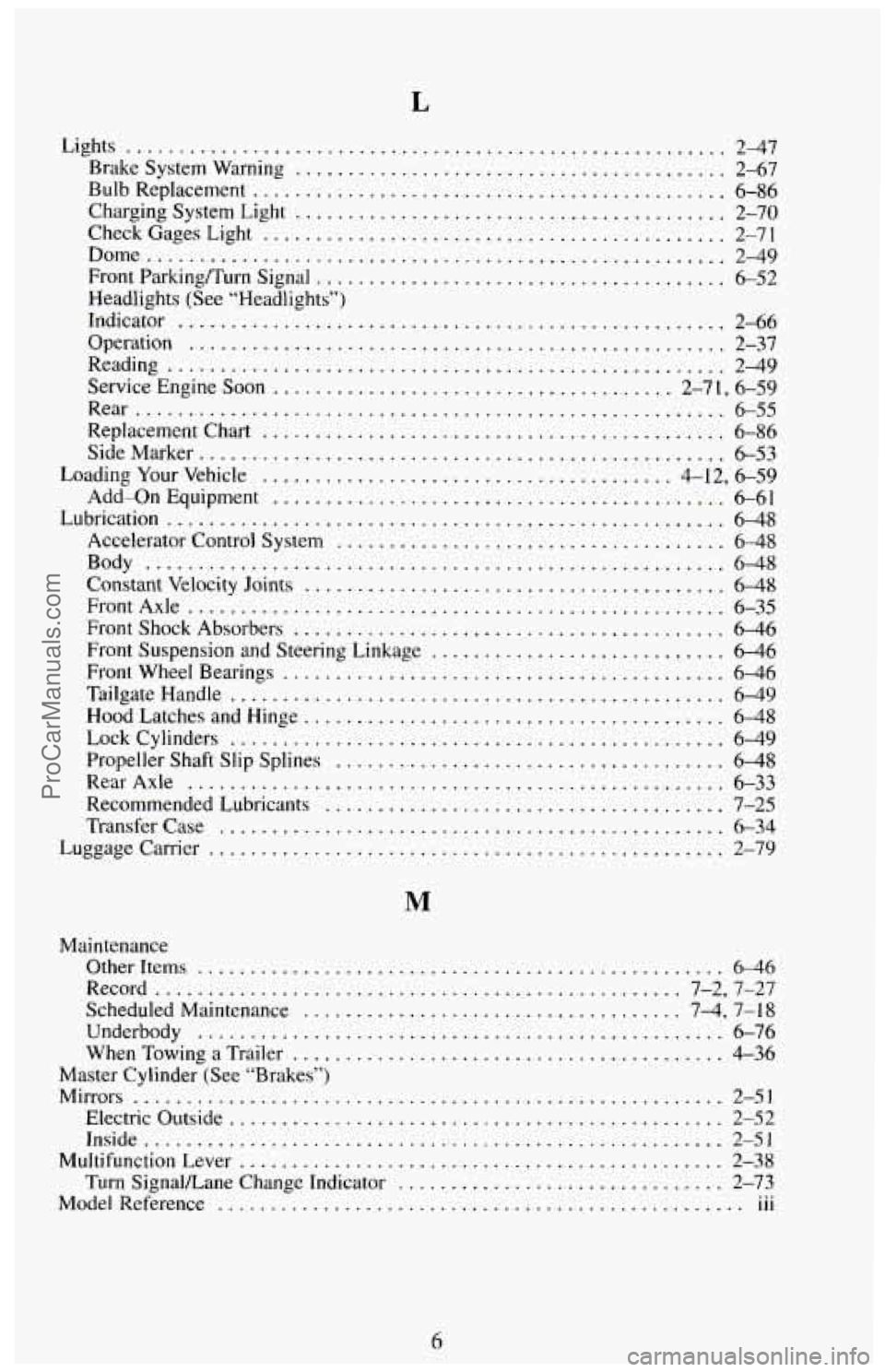
L
Lights ..................................................... 2-47
Brake System Warning ......................................... 2-67
Bulb Replacement
............................................. 6-86
Charging System Light
......................................... 2-70
Front Parking/Turn Signal
....................................... 6-52
CheckGagesLight
............................................ 2-71
Dome
....................................................... 2-49
Headlights (See “Headlights”)
Indicator
.................................................... 2-66
Operation
................................................... 2-37
Reading ..................................................... 2-49
Service Engine
Soon ...................................... 2-7 1. 6-59
Rear
........................................................ 6-55
Replacement Chart
............................................ 6-86
SideMarker .................................................. 6-53
Loading Your Vehicle ....................................... 4-12, 6-59
Add-on Equipment
........................................... 6-61
Accelerator Control System
..................................... 6-48
Constant Velocity Joints
........................................ 6-48
Front Shock Absorbers
......................................... 6-46
Front Suspension and Steering Linkage
............................ 6-46
Front Wheel Bearings .......................................... 6-46
TailgateHandle
............................................... 6-49
HoodLatchesandHinge ........................................ 6-48
Lockcylinders ............................................... 6-49
Propeller Shaft Slip Splines
..................................... 6-48
RearAxle ................................................... 6-33
Recommended Lubricants ...................................... 7-25
Transfercase ................................................ 6-34
Luggagecarrier ................................................. 2-79
Lubrication
..................................................... 6-48
Body
....................................................... 6-48
FrontAxle
................................................... 6-35
Maintenance Otherltems
.................................................. 6-46
Record .................................................. 7.2. 7.27
Scheduled Maintenance .................................... 747-1 8
When Towing
a Trailer ......................................... 4-36
Master Cylinder (See “Brakes”)
Mirrors
........................................................ 2-51
Electric Outside ............................................... 2-52
Inside ....................................................... 2-51
Multifunction Lever .............................................. 2-38
Turn SignalLane Change Indicator
............................... 2-73
Underbody
.................................................. 6-76
... ModelReference .................................................. 111
6
ProCarManuals.com