1994 CHEVROLET SUBURBAN lights
[x] Cancel search: lightsPage 143 of 385
When you first turn on your vehicle’s air conditioning, open the windows to
clear the vehicle
of hot air. Using the MAX button can also help. See
“MAX Button” in this section for more information.
.‘
s
...... Lj”. . ..-. .....
‘I ,OFF
..... .. ... : .
Function Display
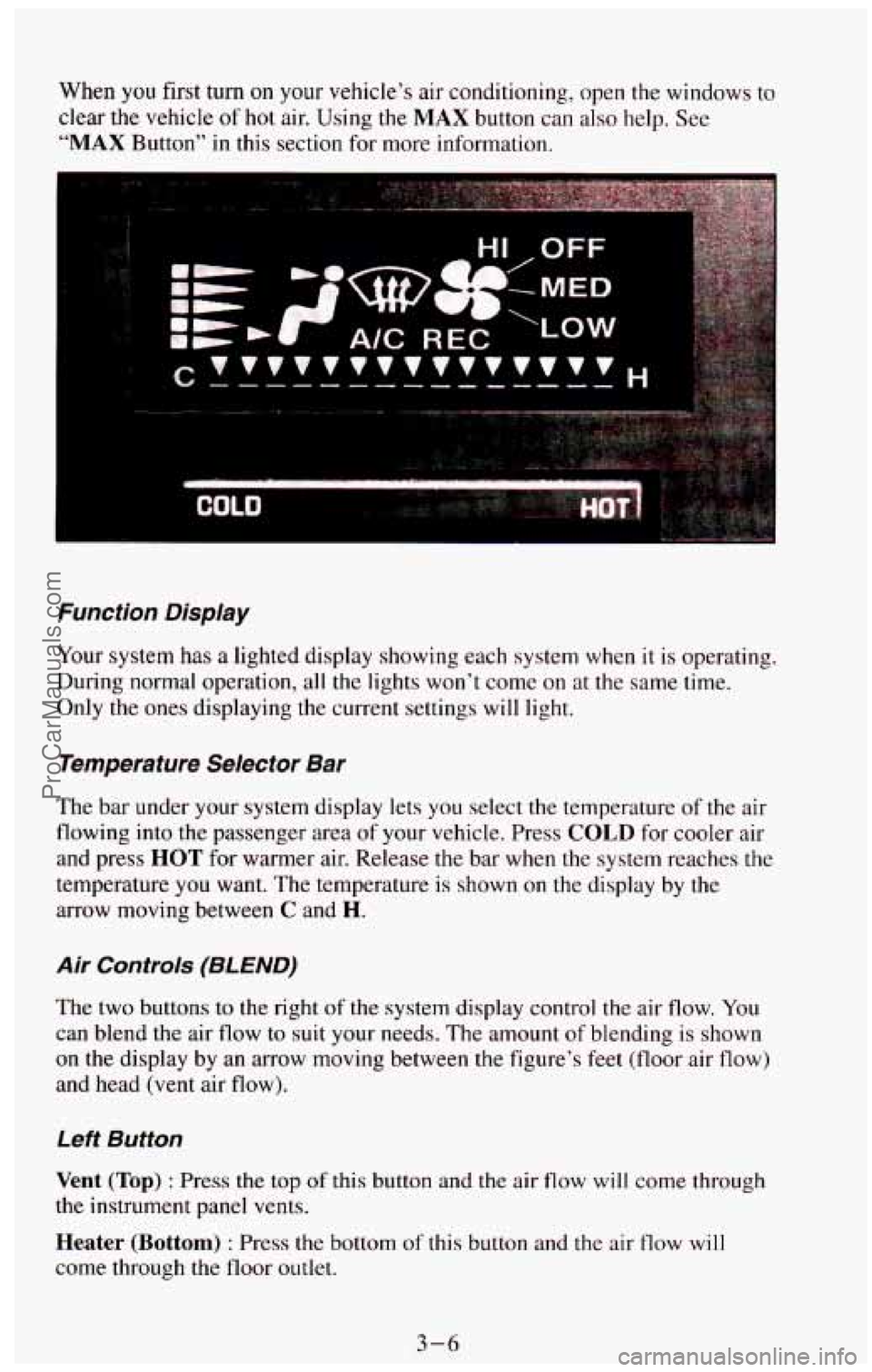
Your system has a lighted display showing each system when it is operating.
During normal operation, all the lights won’t come on
at the same time.
Only the ones displaying the current settings will light.
Temperature Selector Bar
The bar under your system display lets you select the temperature of the air
flowing into the passenger area
of your vehicle. Press COLD for cooler air
and press HOT for warmer air. Release the bar when the system reaches the
temperature you want. The temperature is shown on the display by the
arrow moving between
C and H.
Air Controls (8L END)
The two buttons to the right of the system display control the air flow. You
can blend
the air flow to suit your needs. The amount of blending is shown
on the display by an arrow moving between the figure’s feet (floor air flow)
and head (vent air flow).
Left Button
Vent (Top) : Press the top of this button and the air flow will come through
the instrument panel vents.
Heater (Bottom) : Press the bottom of this button and the air flow will
come through the floor outlet.
3-6
ProCarManuals.com
Page 169 of 385
0
0
0
0
0
a
a
0
Watch for traffic signs, pavement markings, and lines. If you can see a
sign
up ahead that might indicate a turn or an intersection, delay your
pass. A broken center line usually indicates it’s all right to pass
(providing the road ahead is clear). Never cross a solid line on your
side of the lane or a double solid line, even if the road seems empty of
approaching traffic.
Do not get too close to the vehicle you want to pass while you’re
awaiting
an opportunity. For one thing, following too closely reduces
your area
of vision, especially if you’re following a larger vehicle.
Also, you won’t have adequate space if the vehicle ahead suddenly
slows or stops. Keep back a reasonable distance.
When it looks like
a chance to pass is coming up, start to accelerate but
stay in the right
lane and don’t get too close. Time your move so you
will be increasing speed as the time comes to move into the other lane.
If the way is clear to pass, you will have a “running start” that more
than makes up for the distance you would lose by dropping back. And
if something happens to cause
you to cancel your pass, you need only
slow down and drop back again and wait for another opportunity.
If other cars are lined up to pass a slow vehicle, wait your turn. But
take care that someone isn’t trying
to pass you as you pull out to pass
the slow vehicle. Remember
to glance over your shoulder and check
the blind spot.
Check your mirrors
, glance over your shoulder, and start your left lane
change signal before moving out of the right lane to pass. When
you
are far enough ahead of the passed vehicle to see its front in your inside
mirror, activate your right lane change signal and move back into the
right lane. (Remember that
if your right outside mirror is convex, the
vehicle you just passed may seem to be farther away from
you than it
really is.)
Try not
to pass more than one vehicle at a time on two-lane roads.
Reconsider before passing the next vehicle.
Don’t overtake a slowly moving
vehicle too rapidly. Even though the
brake lights are not flashing, it may be slowing down or starting to turn.
If you’re being passed, make it easy for the following driver to get
ahead
of you. Perhaps you can ease a little to the right.
Loss of Control
Let’s review what driving experts say about what happens when the three
control systems (brakes, steering and acceleration) don’t have enough
friction where the tires meet
the road to do what the driver has asked.
In any emergency, don’t give up. Keep trying to steer and constantly seek
an
escape route or area of less danger.
4-10
ProCarManuals.com
Page 174 of 385
When you drive over bumps, rocks, or other obstacles, your wheels can
leave the ground. If this happens, even with one or two wheels, you can’t
control the vehicle as well or at all.
Because you
will be on an unpaved surface, it’s especially important to
avoid sudden acceleration, sudden turns, or sudden braking.
In a way, off-road driving requires a different kind of alertness from driving
on paved roads and highways. There
are no road signs, posted speed limits
or signal lights. You have to use your own good judgment about what is safe
and what isn’t.
Drinking and driving can be very dangerous on any road. And this is
certainly true for off-road driving. At the very time you need special
alertness and driving skills, your reflexes, perceptions and judgment can be
affected by even a small amount of alcohol. You could have a serious
- or
even fatal
- accident if you drink and drive or ride with a driver who has
been drinking. (See “Drunken Driving” in the Index.)
Driving On Off-Road Hills
Off-road driving often takes you up, down, or across a hill. Driving safely
on hills requires good judgment and an understanding of what your vehicle
can and can’t do. There are some hills that simply can’t be driven, no matter
how well built the vehicle.
Approaching a Hill
When you approach a hill, you need to decide if it’s one of those hills that’s
just too steep
to climb, descend, or cross. Steepness can be hard to judge.
On a very small hill, for example, there may be a smooth, constant incline
with only a small change in elevation where you can easily see all the way
to the top. On a large hill, the incline may get steeper as you near the top,
but you may not see this because the crest
of the hill is hidden by bushes,
grass, or shrubs.
4-15
ProCarManuals.com
Page 176 of 385
0 Sound the horn as you approach the top of the hill to let opposing
Use your headlights even during the day. They make you more visible
traffic know you’re there.
to
oncoming traffic.
Q: What should I do if my vehicle stalls, or is about to stall, and I
can’t make it up the hill?
A: If this happens, there are some things you should do, and there are
some things you must not do. First, here’s what you
should do:
Push the brake pedal to stop the vehicle and keep it from rolling
backwards. Also, apply the parking brake.
If your engine is still running, shift the transmission into reverse,
release the parking brake, and slowly back down the hill in reverse.
If your engine has stopped running, you’ll need to restart it. With the
brake pedal depressed and the parking brake still applied, shift the
transmission to
“P” (Park) (or, shift to “N’ (Neutral) if your vehicle has
a manual transmission) and restart the engine. Then, shift to reverse,
release the parking brake, and slowly back down the
hill as straight as
possible in reverse.
wheel at the
12 o’clock position. This way, you’ll be able to tell if your
wheels are straight and maneuver as you back down. It’s best that you
back down the hill with your wheels straight rather than in the left or
right direction. Turning the wheel too far to the left or right will
increase the possibility of a rollover.
As you are backing down the hill, put your left hand on the steering
Here are some things you
must not do if you stall, or are about to stall,
when going
up a hill.
0 Never attempt to prevent a stall by shifting into “N” (Neutral) (or
depressing the clutch, if you have a manual transmission) to “rev-up”
the engine and regain forward momentum. This won’t work.
Your
4- 17
ProCarManuals.com
Page 182 of 385
After Off-Road Driving
Remove any brush or debris that has collected on the underbody, chassis or
under the hood. These accumulations can be a fire hazard.
After operation in mud or sand, have the brake linings cleaned and checked.
These substances can
cause glazing and uneven braking. Check the body
structure, steering, suspension, wheels, tires, and exhaust system for
damage. Also, check the fuel lines and cooling system for any leakage.
Your vehicle will require more frequent service due to off-road use. Refer
to the Maintenance Schedule for additional information.
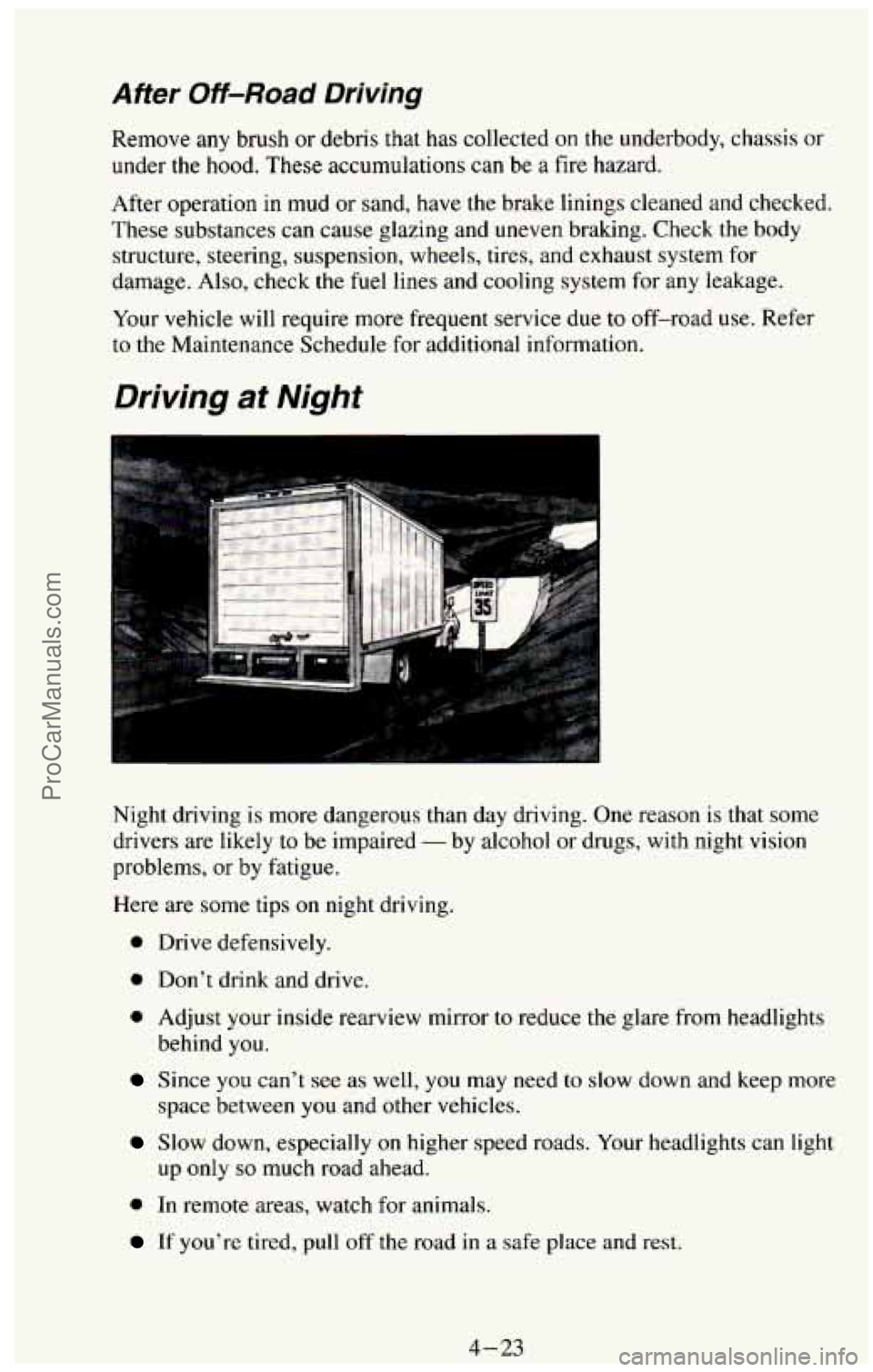
Driving at Night
Night driving is more dangerous than day driving. One reason is that some
drivers are likely
to be impaired - by alcohol or drugs, with night vision
problems, or by fatigue.
Here are some tips
on night driving.
0 Drive defensively.
0 Don't drink and drive.
0 Adjust your inside rearview mirror to reduce the glare from headlights
behind
you.
Since you can't see as well, you may need to slow down and keep more
space between you and other vehicles.
up
only so much road ahead.
Slow down, especially on higher speed roads. Your headlights can light
0 In remote areas, watch for animals.
If you're tired, pull off the road in a safe place and rest.
4-23 ProCarManuals.com
Page 183 of 385
Night Vision
No one can see as well at night as in the daytime. But as we get older these
differences increase.
A 50-year-old driver may require at least twice as
much light
to see the same thing at night as a 20-year-old.
What you do in the daytime can
also affect your night vision. For example,
if
you spend the day in bright sunshine you are wise to wear sunglasses.
Your eyes will have less trouble adjusting to night. But if
you’re driving,
don’t wear sunglasses at night. They may cut down
on glare from
headlights, but they also make a lot of things invisible.
You can be temporarily blinded by approaching lights. It
can take a second
or two, or
even several seconds, for your eyes to readjust to the dark. When
you are faced with severe glare (as from a driver who doesn’t lower the high
beams, or a vehicle with misaimed headlights), slow down a little. Avoid
staring directly into the approaching lights.
Keep your windshield and all the
glass on your vehicle clean - inside and
out. Glare at night is made much worse by dirt
on the glass. Even the inside
of the glass
can build up a film caused by dust. Dirty glass makes lights
dazzle and flash more than clean glass would, making the pupils of your
eyes contract repeatedly.
Remember that your headlights light up far less of a roadway when
you are
in a turn or curve. Keep your
eyes moving; that way, it’s easier to pick out
dimly lighted objects. Just as your headlights should be checked regularly
for proper aim,
so should your eyes be examined regularly. Some drivers
suffer from night blindness
- the inability to see in dim light - and aren’t
even aware
of it.
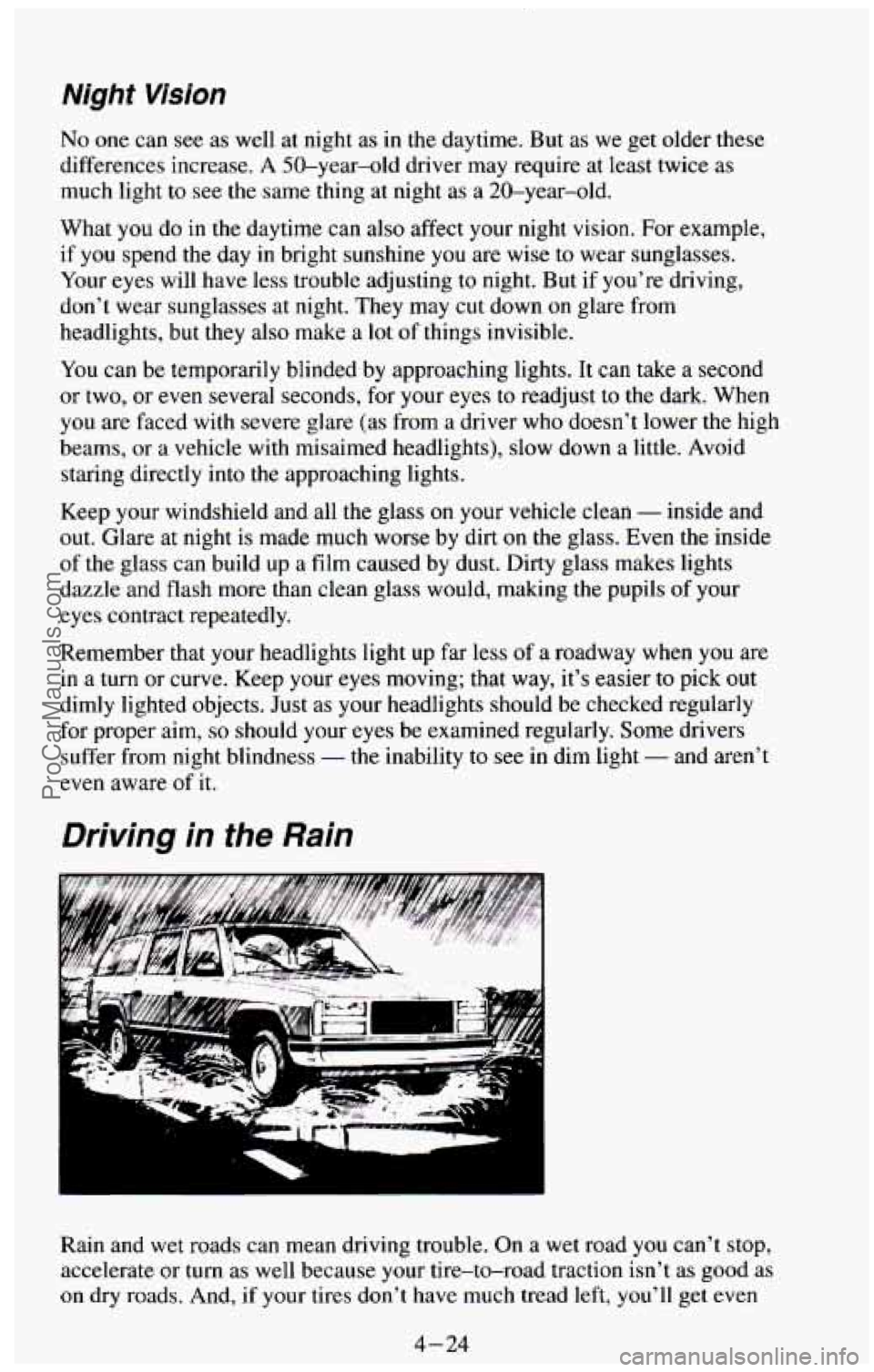
Driving in the Rain
Rain and wet roads can mean driving trouble. On a wet road you can’t stop,
accelerate
or turn as well because your tire-to-road traction isn’t as good as
on dry roads. And, if your tires don’t have much tread left, you’ll get even
4-24
ProCarManuals.com
Page 185 of 385
Hydroplaning is dangerous. So much water can build up under your tires
that they can actually ride on the water. This can happen if the road
is wet
enough and you’re going fast enough. When your vehicle is hydroplaning, it
has little or no contact with the road.
Hydroplaning doesn’t happen often. But it can if your tires haven’t much
tread or if the pressure in one or more is
low. It can happen if a lot of water
is standing
on the road. If you can see reflections from trees, telephone
poles,
or other vehicles, and raindrops “dimple” the water’s surface, there
could be hydroplaning.
Hydroplaning usually happens at higher speeds. There just isn’t a hard and
fast rule about hydroplaning. The best advice
is to slow down when it is
raining.
Some Other Rainy Weather Tips
Turn on ybur low-beam headlights - not just your parKing lights - to
help make
you more visible to others.
Besides slowing down, allow some extra following distance. And be
especially careful when you pass another vehicle. Allow yourself more
clear room ahead, and be prepared to have your view restricted by road
spray.
Have good tires with proper tread depth. (See “Tires” in the Index.)
City Driving
One of the biggest problems with city streets is the amount of traffic on
them. You’ll want to watch out for what the other drivers are doing and pay
attention to traffic signals.
Here are ways
to increase your safety in city driving:
4-26
ProCarManuals.com
Page 187 of 385
Once you are moving on the freeway, make certain you allow a reasonable
following distance. Expect to move slightly slower
at night.
When you want to leave the freeway, move to the proper lane well
in
advance. If you miss your exit do not, under any circumstances, stop and
back up. Drive on to the next exit.
The exit ramp can be curved, sometimes quite sharply.
The exit speed is usually posted.
Reduce your speed according to your speedometer, not to your sense of
motion. After driving for
any distance at higher speeds, you may tend to
think you
are going slower than you actually are.
Before Leaving on a Long Trip
Make sure you’re ready. Try to be well rested. If you must start when you’re
not fresh
- such as after a day’s work - don’t plan to make too many
miles that first part of the journey. Wear comfortable clothing and shoes you
can easily drive
in.
Is your vehicle ready for a long trip? If you keep it serviced and maintained,
it’s ready
to go. If it needs service, have it done before starting out. Of
course, you’ll find experienced and able service experts in vehicle
dealerships all across North America. They’ll be ready and willing
to help if
you need
it.
Here are some things you can check before a trip:
0
0
0
0
0
0
Windshield Washer Fluid: Is the reservoir full? Are all windows clean
inside and outside?
Wiper Blades: Are they in good shape?
Fuel, Engine OiZ, Other Fluids: Have you checked all levels?
Lights: Are they all working? Are the lenses clean?
Tires: They are vitally important to a safe, trouble-free trip. Is the tread
good enough for long-distance driving? Are the tires all inflated to the
recommended pressure?
Weather Forecasts: What’s the weather outlook along your route?
Should you delay your trip a short time to avoid a major storm system?
Maps: Do you have up-to-date maps?
4-28
ProCarManuals.com