1994 CHEVROLET SUBURBAN air condition
[x] Cancel search: air conditionPage 290 of 385
Brake Wear
Your vehicle has front disc brakes and rear drum brakes.
Disc brake pads have built-in wear indicators that make
a high-pitched
warning sound when the brake pads are worn and new pads are needed. The
sound
may come and go or be heard all the time your vehicle is moving
(except when you
are pushing on the brake pedal firmly).
NOTICE:
Continuing to drive with worn-out brake pads could result in
costly brake repair.
Some driving conditions or climates may cause a brake squeal when the
brakes are first applied or lightly applied. This does not mean something is
wrong with your brakes.
Rear drum brakes don’t have wear indicators, but if you ever hear a rear
brake rubbing noise,
have the rear brake linings inspected. Also, the rear
brake drums should be removed and inspected each time the tires are
removed for rotation or changing. When you have the front brakes replaced,
have the rear brakes inspected, too.
Brake linings should always be replaced as complete axle sets.
Brake Pedal Trave/
See your dealer if the brake pedal does not return to normal height, or if
there
is a rapid increase in pedal travel. This could be a sign of brake
trouble.
Brake Adjustment
Every time you make a brake stop, your disc brakes adjust for wear.
Tf your brake pedal goes down farther than normal, your rear drum brakes
may need adjustment. Adjust them by backing up and firmly applying the
brakes a few times.
6-45
ProCarManuals.com
Page 292 of 385
Wheel Nut Torque
For vehicles with dual wheels, when the vehicle, wheel or fasteners are new,
have the torque set at
the first 100, 1,000 and 6,000 miles (160, 1600 and
9600 km). Use the torque specified in the appropriate Specification Chart
later
in this section.
Single Belt Accessory Drive
If your new vehicle uses a serpentine belt, it is lighter, and more durable
than systems with several belts.
The belt
ruIl 'li'vkf br iir6und the pulleys or^ the engine. A tensione'r'n'iay be
used to keep the belt tight at all times. The tensioner also makes replacing
the belt easier
if you need to replace the belt, be sure to get the correct
replacement belt. Your dealership
or parts supplier can help you with this.
The Accessory Drive Belt Routing label on your vehicle will show you how
to route the belt your vehicle uses.
Windshield Wiper Blade lnserts
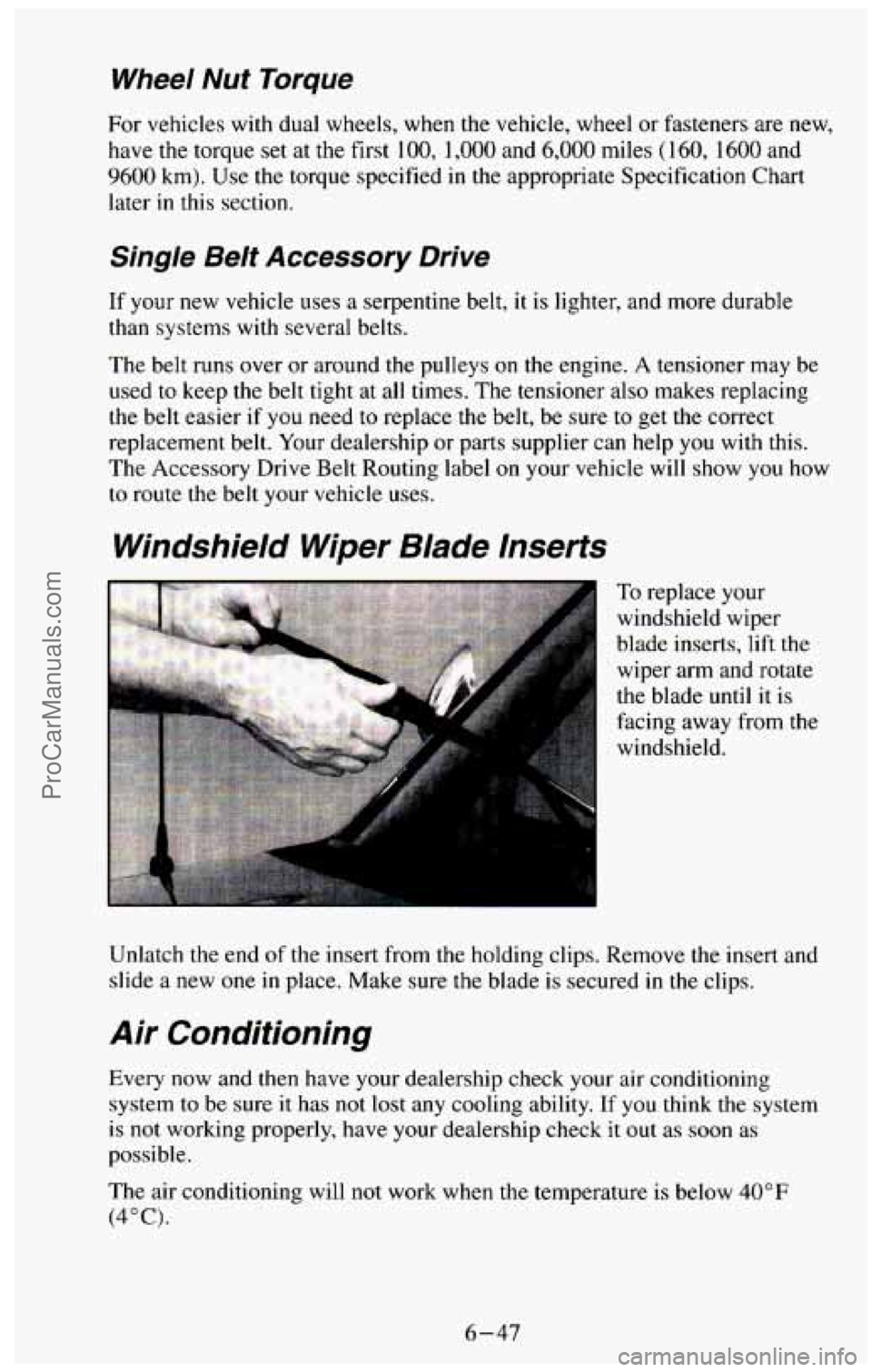
To replace your
windshield wiper
blade inserts, lift the
wiper arm and rotate
the blade until
it is
facing
away from the
windshield.
Unlatch the end
of the insert from the holding clips. Remove the insert and
slide
a new one in place. Make sure the blade is secured in the clips.
Air Conditioning
Every now and then have your dealership check your air conditioning
system to be sure
it has not lost any cooling ability. If you think the system
is not working properly, have your dealership check it out as soon as
possible.
The air conditioning will not work when the temperature
is below 40°F
(4°C).
6-47
ProCarManuals.com
Page 293 of 385
Fluid Leak Check
After the vehicle has been parked for a while, inspect the surface under the
vehicle for water, oil, fuel or other fluids. Water dripping from the air
conditioning system after it has been used is normal. If you notice fuel leaks
or fumes, the causes should be found and corrected at once.
Lubrication
Accelerator Control System
Your maintenance schedule will tell you how often the accelerator linkage
pivot points must be lubricated. See “Recommended Fluids and Lubricants”
in
the Index for the proper lubricant to use.
Accelerator cables and cruise control cables should not be lubricated. Any
cables that are worn or
are hard to pull should be replaced.
Hood Latches and Hood Hinge
Your maintenance schedule will tell you how often to lubricate the hood
latch and hood hinge assembly. See the Index under “Recommended Fluids
and Lubricants” for the proper lubricant to use.
Propeller Shaft Slip Splines
See your maintenance schedule to find out how often the slip splines must
be lubricated. See “Recommended Fluids and Lubricants” in the Index for
the proper lubricant to use.
Constant Velocity Joints
See your maintenance schedule to find out how often the constant velocity
joints must be lubricated. See “Recommended Fluids and Lubricants” in the
Index for the proper lubricant to use.
Normal
use of your vehicle will cause metal to metal wear at some points on
the cab and body if they are not lubricated.
For exposed surfaces, such
as door checks, door lock bolts, lock striker plates,
dovetail bumper wedges, etc., a thin
film of engine oil should be applied.
The seat adjusters and seat track should be lubricated
with chassis grease.
Door weather strips and rubber hood bumpers should be lightly coated with
a rubber lubricant.
Never use too much of any lubricant and be sure to wipe up any extra
lubricant when you are finished.
6-48
ProCarManuals.com
Page 303 of 385
some feature of your vehicle that you can get along without-like the radio
or cigarette lighter-and use its fuse, if it is of the value you need. Replace
it as soon as you can. See “Fuses and Circuit Breakers’’ in the Index
for
more information.
Exhaust System
To help prevent damage to your exhaust system, do not continue to drive
your vehicle if you notice:
Engine misfiring
Loss of performance
Other unusual operating conditions
Have your engine and exhaust system serviced regularly.
Three- Way Catalytic Converter (gas engines)
Your vehicle’s three-way catalytic converter is designed to reduce the
pollutants in your vehicle’s exhaust. Use only unleaded fuel in your vehicle.
If you use leaded fuel, you could damage your three-way catalytic converter
and other engine components.
Three- Way Catalytic Converter (diesel engines)
Your vehicle’s three-way catalytic converter is designed to reduce the
particulates in your vehicle’s exhaust. If your vehicle’s three-way catalytic
converter ever needs to be replaced, it must be replaced with a three-way
catalytic converter intended for use with diesel engines only.
Engine Contro/ Module System (All T61 equipped
vehicles and diesel engine vehicles below
8,500 lbs. GVWR)
Gasoline Engines
This system has an oxygen sensor (02) that helps keep your engine’s
air-fuel mixture at a proper level. Use only unleaded fuel in your vehicle. If
you use leaded fuel, you could damage your oxygen sensor
(02) and
three-way catalytic converter.
Diesel Vehicles Below S,5UU LBS. GVWR
This system monitors engine speed and throttle position. It adjusts exhaust
gas recirculation to limit emissions.
ProCarManuals.com
Page 313 of 385
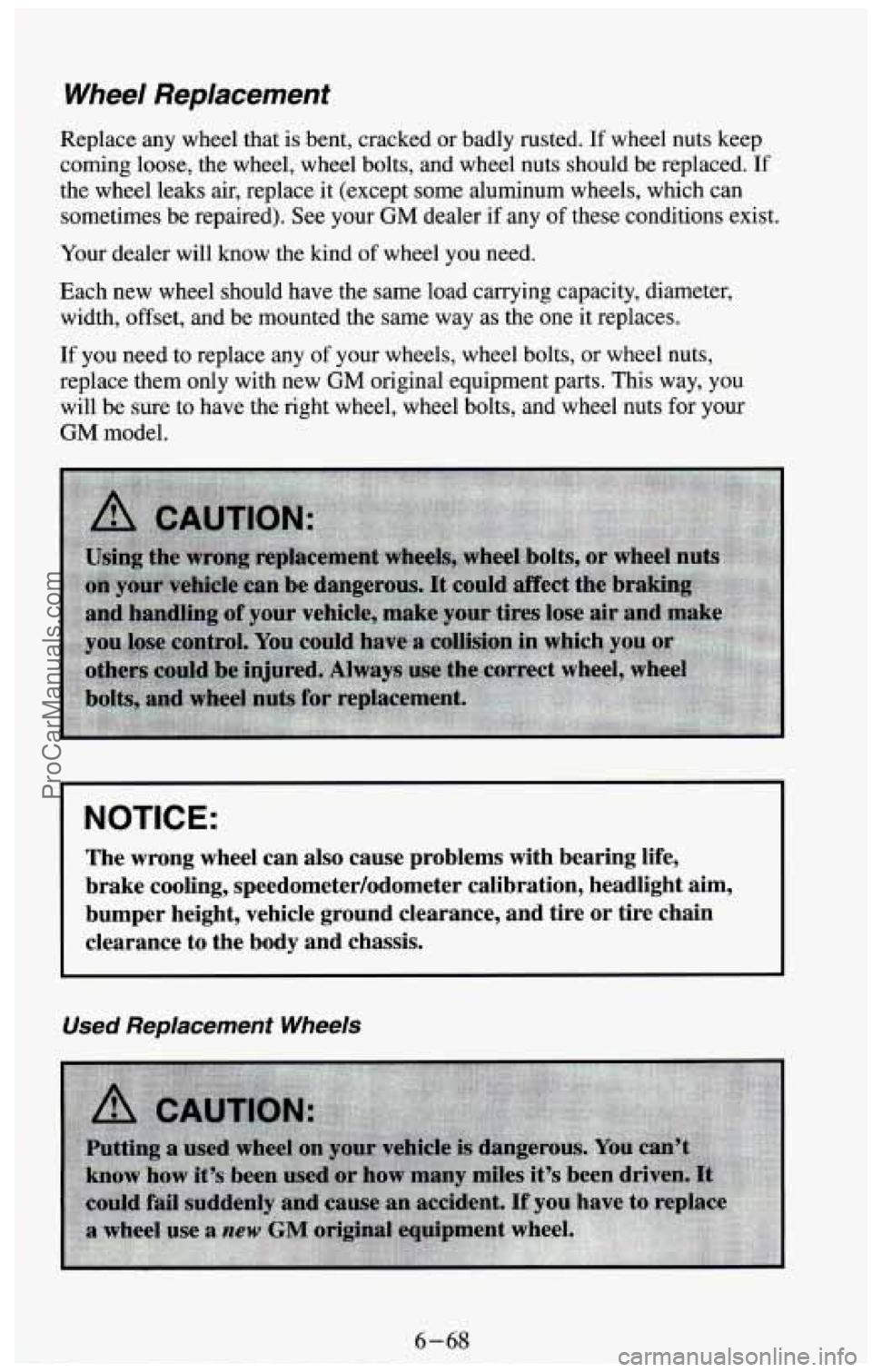
Wheel Replacement
Replace any wheel that is bent, cracked or badly rusted. If wheel nuts keep
coming loose, the wheel, wheel bolts, and wheel nuts should be replaced.
If
the wheel leaks air, replace it (except some aluminum wheels, which can
sometimes be repaired). See your GM dealer if any
of these conditions exist.
Your dealer will know the kind
of wheel you need.
Each new wheel should have the same load carrying capacity, diameter,
width, offset, and be mounted the same way as the one it replaces.
If you need to replace any of your wheels, wheel bolts, or wheel nuts,
replace them only with new GM original equipment parts. This way, you
will be sure to have the right wheel, wheel bolts, and wheel nuts
for your
GM model.
NOTICE:
The wrong wheel can also cause problems with bearing life,
brake cooling, speedometer/odometer calibration, headlight aim, bumper height, vehicle ground clearance, and tire or tire chain\
clearance to the body and chassis.
Used Replacement Wheels
ProCarManuals.com
Page 321 of 385
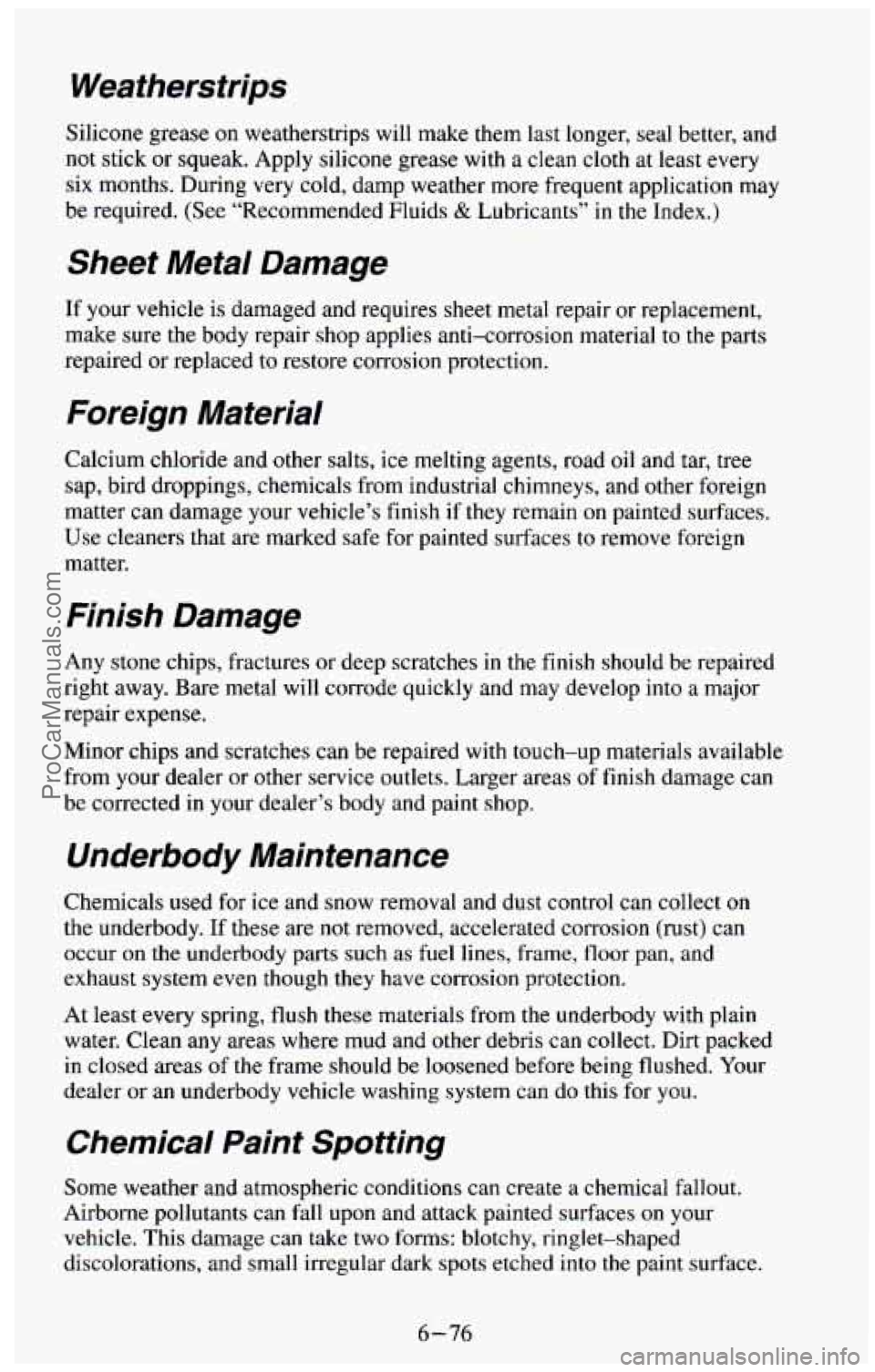
Weatherstrips
Silicone grease on weatherstrips will make them last longer, seal better, and
not stick or squeak. Apply silicone grease with a clean cloth at least every
six months. During very cold, damp weather more frequent application may
be required. (See “Recommended Fluids
& Lubricants’’ in the Index.)
Sheet Metal Damage
If your vehicle is damaged and requires sheet metal repair or replacement,
make sure the body repair shop applies anti-corrosion material to the parts
repaired or replaced to
restore corrosion protection.
Foreign Material
Calcium chloride and other salts, ice melting agents, road oil and tar, tree
sap, bird droppings, chemicals from industrial chimneys, and other foreign
matter can damage your vehicle’s finish if they remain on painted surfaces.
Use cleaners that are marked safe for painted surfaces to remove foreign
matter.
Finish Damage
Any stone chips, fractures or deep scratches in the finish should be repaired
right away. Bare metal will corrode quickly and may develop into a major
repair expense.
Minor chips and scratches can be repaired with touch-up materials available
from your dealer or other service outlets. Larger areas of finish damage can
be corrected
in your dealer’s body and paint shop.
Underbody Maintenance
Chemicals used for ice and snow removal and dust control can collect on
the underbody. If these are not removed, accelerated corrosion (rust) can
occur
on the underbody parts such as fuel lines, frame, floor pan, and
exhaust system even though they have corrosion protection.
At least every spring,
flush these materials from the underbody with plain
water. Clean
any areas where mud and other debris can collect. Dirt packed
in closed areas of the frame should be loosened before being flushed. Your
dealer or an underbody vehicle washing system can do this for you.
Chemical Paint Spotting
Some weather and atmospheric conditions can create a chemical fallout.
Airborne pollutants can fall upon and attack painted surfaces on your
vehicle. This damage can take two
forms: blotchy, ringlet-shaped
discolorations, and small irregular dark
spots etched into the paint surface.
6-76
ProCarManuals.com
Page 322 of 385
Although no defect in the paint job causes this, GM will repair, at no charge
to the owner, the surfaces of new vehicles damaged
by this fallout condition
within 12 months or 12,000 miles (20 000 km) of purchase, whichever
comes first.
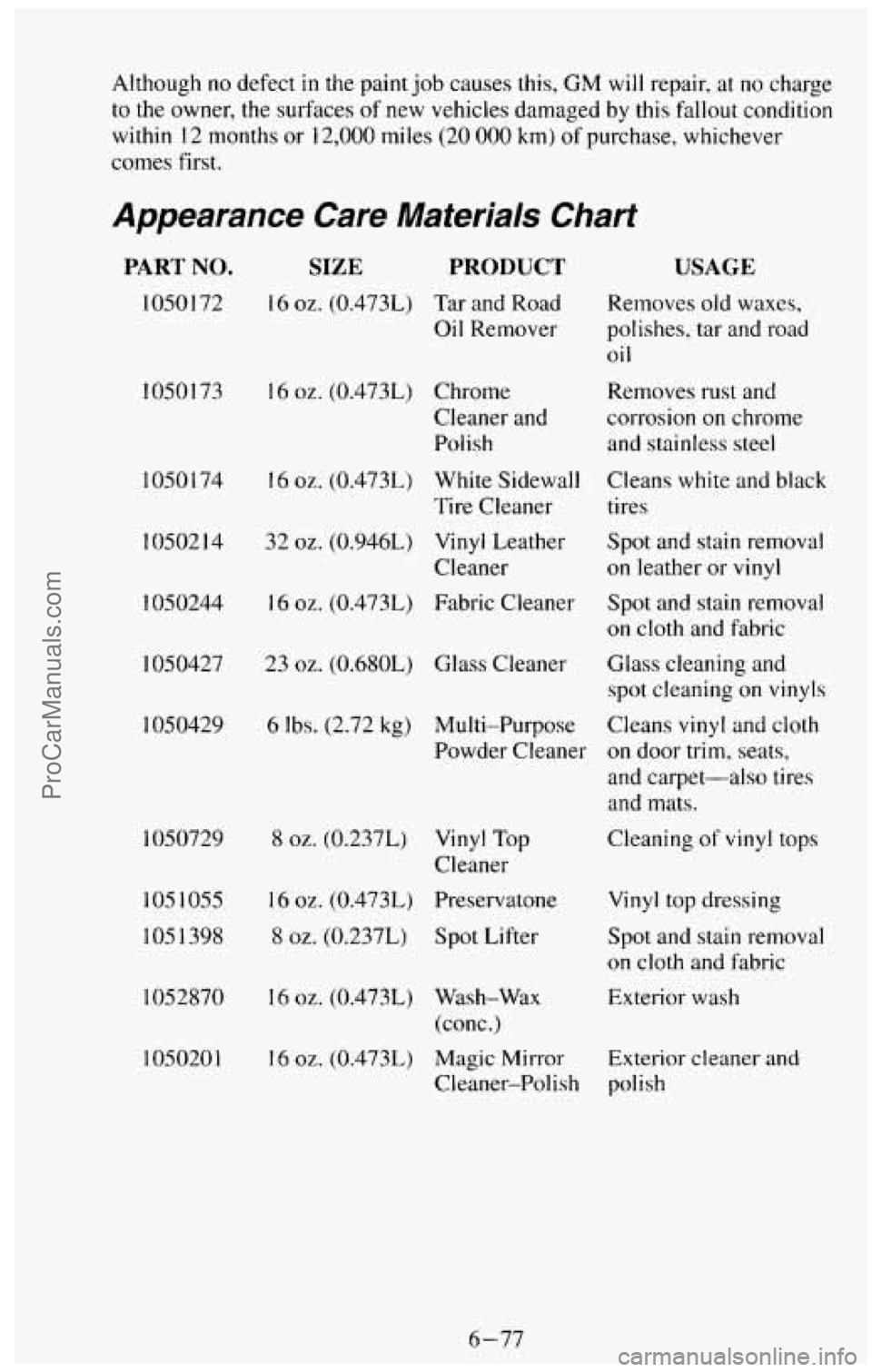
Appearance Care Materials Chart
PART NO.
1050172
1050173
1050 174
1050214
1050244 1050427
I050429
1050729
1051055 1051398
1052870
105020
1
SIZE PRODUCT
16 oz. (0.473L) Tar and Road
Oil Remover
16 02. (0.473L) Chrome
Cleaner and
Polish
I6 oz. (0.473L) White Sidewall
32
02. (0.946L) Vinyl Leather
Tire Cleaner
Cleaner
16 02. (0.473L) Fabric Cleaner
23
oz. (0.680L) Glass Cleaner
6 Ibs. (2.72 kg) Multi-Purpose
Powder Cleaner
8 oz. (0.237L) Vinyl Top
16
oz. (0.4731) Preservatone
8
02. (0.237L) Spot Lifter
Cleaner
USAGE
Removes
old waxes,
polishes, tar and road
oil
Removes rust and
corrosion on chrome
and stainless steel
Cleans white and black
tires
Spot and stain removal
on leather or
vinyl
Spot and stain removal
on cloth and fabric
Glass cleaning and
spot cleaning on vinyls
Cleans
vinyl and cloth
on door
trim, seats,
and carpet-also tires
and mats.
Cleaning
of vinyl tops
Vinyl top dressing
Spot and stain removal
on cloth and fabric
Exterior wash
16 oz. (0.473L) Wash-Wax
I6 oz. (0.473L) Magic Mirror Exterior cleaner and
(conc.)
Cleaner-Polish polish
6-77
ProCarManuals.com
Page 328 of 385

Service Replacement Part and Filter
Recommendations -Gas Engines
Engine
VIN
Oil Filter
Air Cleaner Filter
PCV Valve
Spark Plugs‘%
Fuel Filter
Radiator Cap
5.7L
K
PF353‘
A348C
cv774c
.CR43TS
GF48 1
RC36
$Four Wheel Drive Vehicle -use a
PFS 1 oil filter
*Use AC copper-cored resister type spark plugs
Service Replacement Part and Filter
Recommendations -Diesel Engines
Engine
VIN
Oil Filter
Air Cleaner
Fuel Filter
Surge Tank Cap 6.5L
S”
PF3S
A917C
TP
I 006
RC33
7.4L
N
PF35
A348C
cv774c
.CR43TS
GF48
I
RC36
6.5L
F”
PF35
A9 17C
TP
1006
RC33
*Heavy Duty Emission Engine
Air Conditioning Refrigerants
Not all air conditioning refrigerants are the same. If the air conditioning
system
in your vehicle needs refrigerant, be sure the proper refrigerant is
used. If you’re not sure, ask your GM dealer. For additional information, see
your “Warranty and Owner Assistance Information” booklet.
Air Conditioning Refrigerant Capacity
TYPE
Refrigerant R 134A
Refrigerant
R 134A
QTY
Front A/C 3.0 lbs. (1.360 kg)
Front and Rear A/C
4.25 Ibs. (I .927 kg)
6-83
ProCarManuals.com