1994 CHEVROLET SUBURBAN Electrical
[x] Cancel search: ElectricalPage 199 of 385
Trailer Brakes
If your trailer weighs more than 1,000 pounds (450 kg) loaded, then it needs
its own brakes
- and they must be adequate. Be sure to read and follow the
instructions for the trailer brakes
so you’ll be able to install, adjust and
maintain them properly.
Your trailer brake system can tap into your vehicle’s hydraulic brake system,
but consider the following:
Will the trailer brake system use more than 0.02 cubic inch (0.3 cc) of
fluid from your vehicle’s master cylinder? If it will, don’t tap into your
vehicle’s brake system. Both braking systems
won’t work well, and you
could even lose your brakes altogether.
not, the trailer brake system must not be used with your vehicle.
If everything checks
out this far, make the brake tap at the port on the
master cylinder that sends the fluid to the rear brakes. But don’t use copper
tubing for this. if you do, it will bend and finally break
off. Use steel brake
tubing.
Will the trailer brake parts take 3,000 psi (20 650 kPa) of pressure? If
Driving with a Trailer
Towing a trailer requires a certain amount of experience. Before setting out
for the open road,
you’ll want to get to know your rig. Acquaint yourself
with the feel
of handling and braking with the added weight of the trailer.
And always keep
in mind that the vehicle you are driving is now a good
deal longer and not nearly so responsive as your vehicle is by itself.
Before
you start, check the trailer hitch and platform, safety chains,
electrical connector, lights, tires and mirror adjustment. If the trailer has
electric brakes, start your vehicle and trailer moving and then apply the
trailer brake controller by hand to be sure the brakes are working. This lets
you check your electrical connection at the same time.
4-40
ProCarManuals.com
Page 207 of 385
Tu Jump Start Your Vehicle;
1. Check the other vehicle. It must have a 12-volt battery with a negative
ground system.
I NOTICE:
I
If the other system isn’t a 12-volt system with a negative
ground, both vehicles can be damaged.
If you have a diesel engine vehicle with two batteries (or more), you
should know before you begin that, especially in cold weather, you may
not be able to get enough power from a single battery in another
vehicle to start your diesel engine.
If your vehicle has more than one battery, use the battery that’s on the
passenger side
of the vehicle - this will reduce electrical resistance.
2. Get the vehicles close enough so the jumper cables can reach, but be
sure the vehicle’s aren’t touching each other.
If they are, it could cause
a ground connection
you don’t want. You wouldn’t be able to start your
vehicle, and the bad grounding could damage the electrical systems.
You could be injured if
the vehicles roll. Set the parking brake firmly
on each vehicle. Put an automatic transmission in “P’ (Park) or a
manual transmission in “N’ (Neutral). If you have a four-wheel-drive
vehicle, be sure the transfer case is not in “N” (Neutral).
3. Turn off the ignition on both vehicles. Turn off all lights that aren’t
needed, and radios. This will avoid sparks and help save both batteries.
And it could save your radio!
NOTICE:
If you leave your radio on, it could be badly damaged. The
repairs wouldn’t
be covered by your warranty.
4. Open the hoods and locate the batteries. Find the positive (+) and
negative
(-) terminals on each battery.
5-4
ProCarManuals.com
Page 210 of 385
9. Attach the cable at least 18 inches (45 cm) away from the dead battery,
but not near engine parts that move. The electrical connection
is just as
good there, but the chance of sparks getting back to the battery is much
less.
10. Now start the vehicle with the good battery and run the engine for
awhile.
1 1. Try to start the vehicle with the dead battery.
If it won't start after a few tries, it probably needs service.
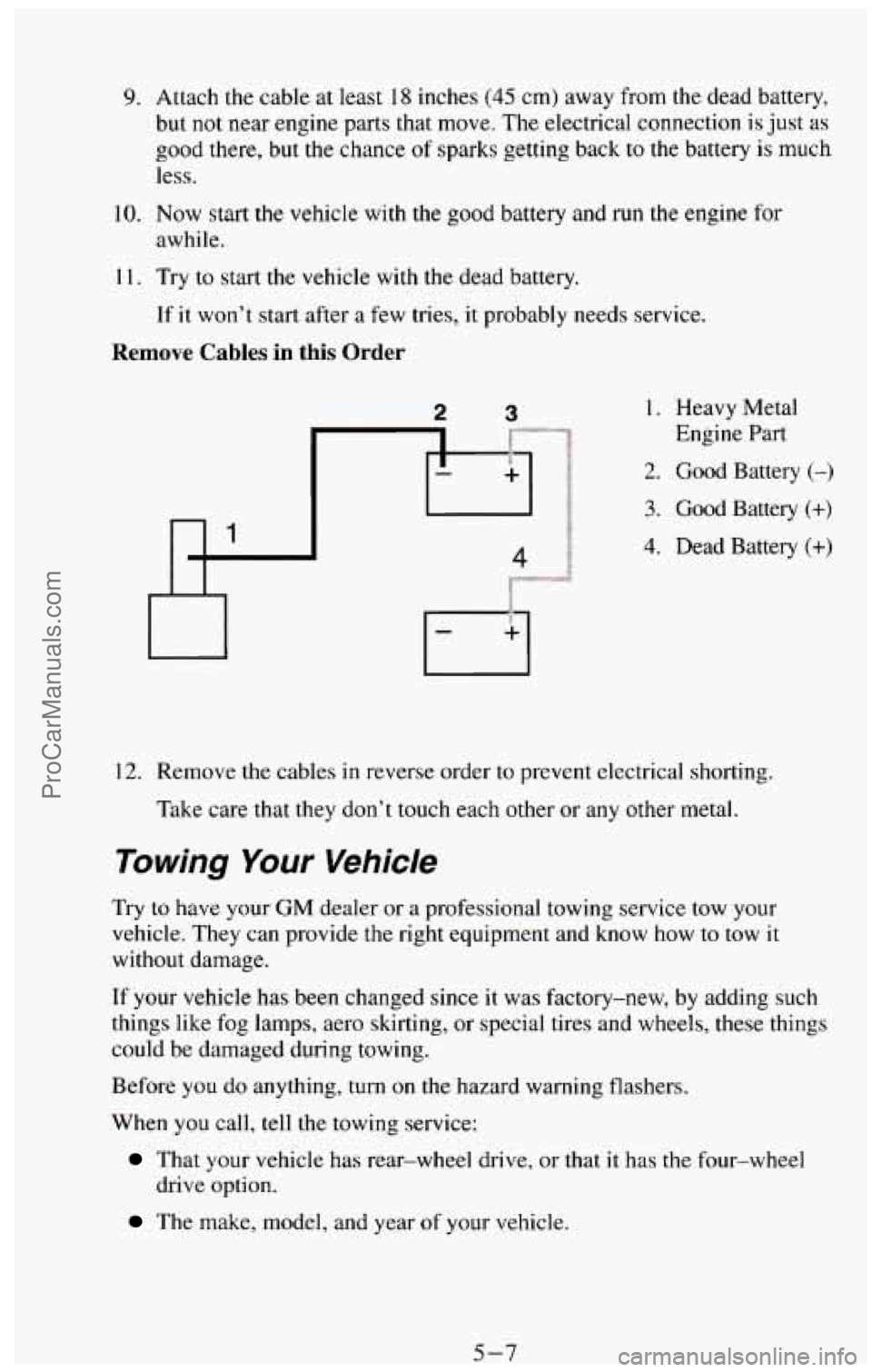
Remove Cables in this Order
1. Heavy Metal
Engine Part
2. Good Battery (-)
3. Good Battery (+)
4. Dead Battery (+)
12. Remove the cables in reverse order to prevent electrical shorting.
Take care that they don't touch each other
or any other metal.
Towing Your Vehicle
Try to have your GM dealer or a professional towing service tow your
vehicle. They can provide the right equipment and know how
to tow it
without damage.
If your vehicle has been changed since
it was factory-new, by adding such
things like fog lamps, aero skirting, or special tires and wheels, these things
could
be damaged during towing.
Before
you do anything, turn on the hazard warning flashers.
When you call,
tell the towing service:
That your vehicle has rear-wheel drive, or that it has the four-wheel
drive option.
The make, model, and year of your vehicle.
5-7 ProCarManuals.com
Page 296 of 385
NOTICE:
Avoid touching the bulb or letting it come in contact with
anything damp. Oil from
your skin or moisture on the bulb can
cause the bulb to explode when it is turned on. If either comes in
contact with the bulb, clean
it with alcohol or a suitable
degreaser and wipe the bulb dry.
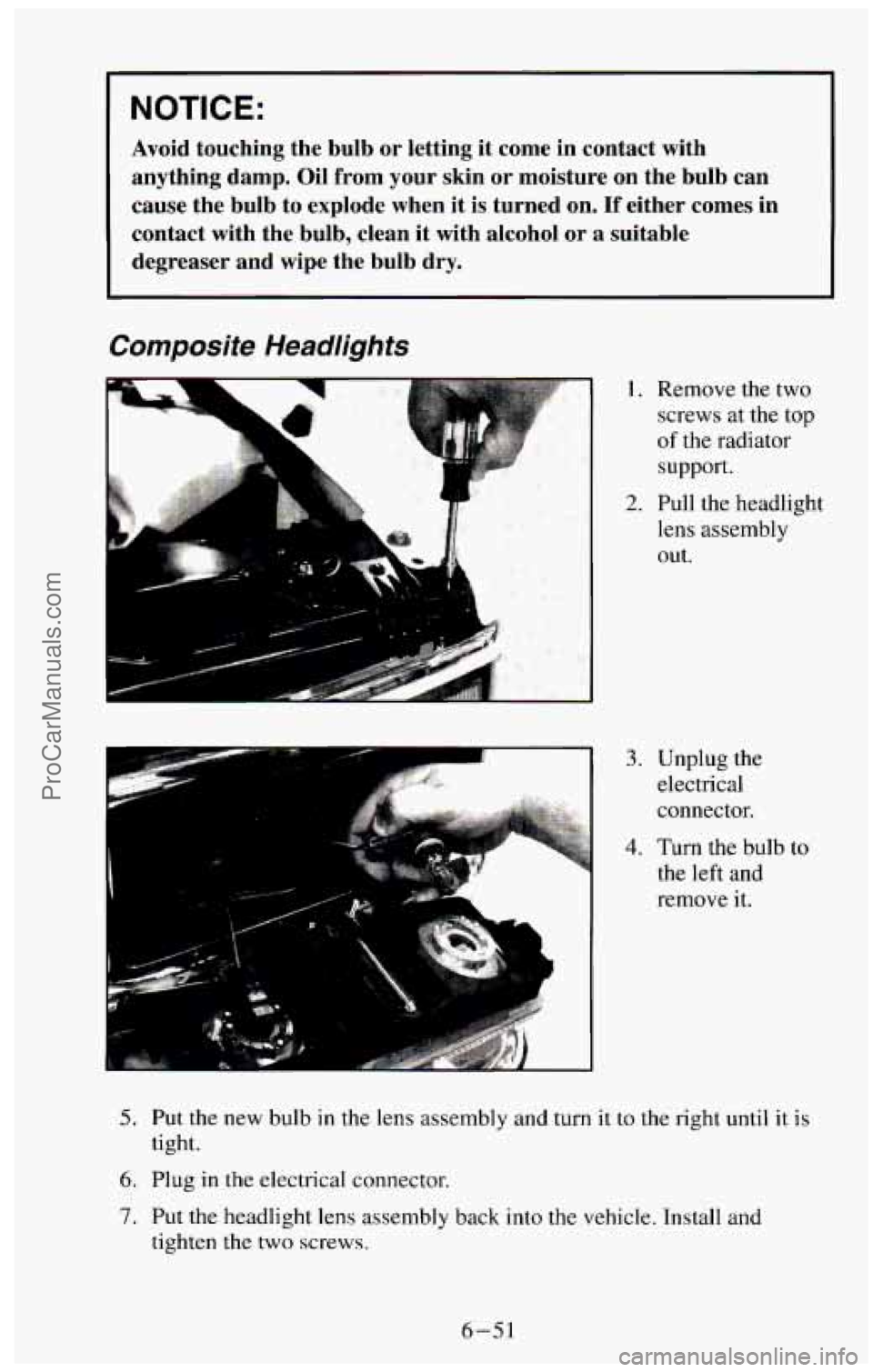
Composite Headlights
.' --6n k
'I
i 1. Remove the two
screws at the top
of the radiator
support.
2. Pull the headlight
lens assembly
out.
3. Unplug the
electrical
connector.
4. Turn the bulb to
the left and
remove it.
5. Put the new bulb in the lens assembly and turn it to the right until it is
6. Plug in the electrical connector.
7. Put the headlight lens assembly back into the vehicle. Install and
tight.
tighten the two screws.
6-51
ProCarManuals.com
Page 301 of 385
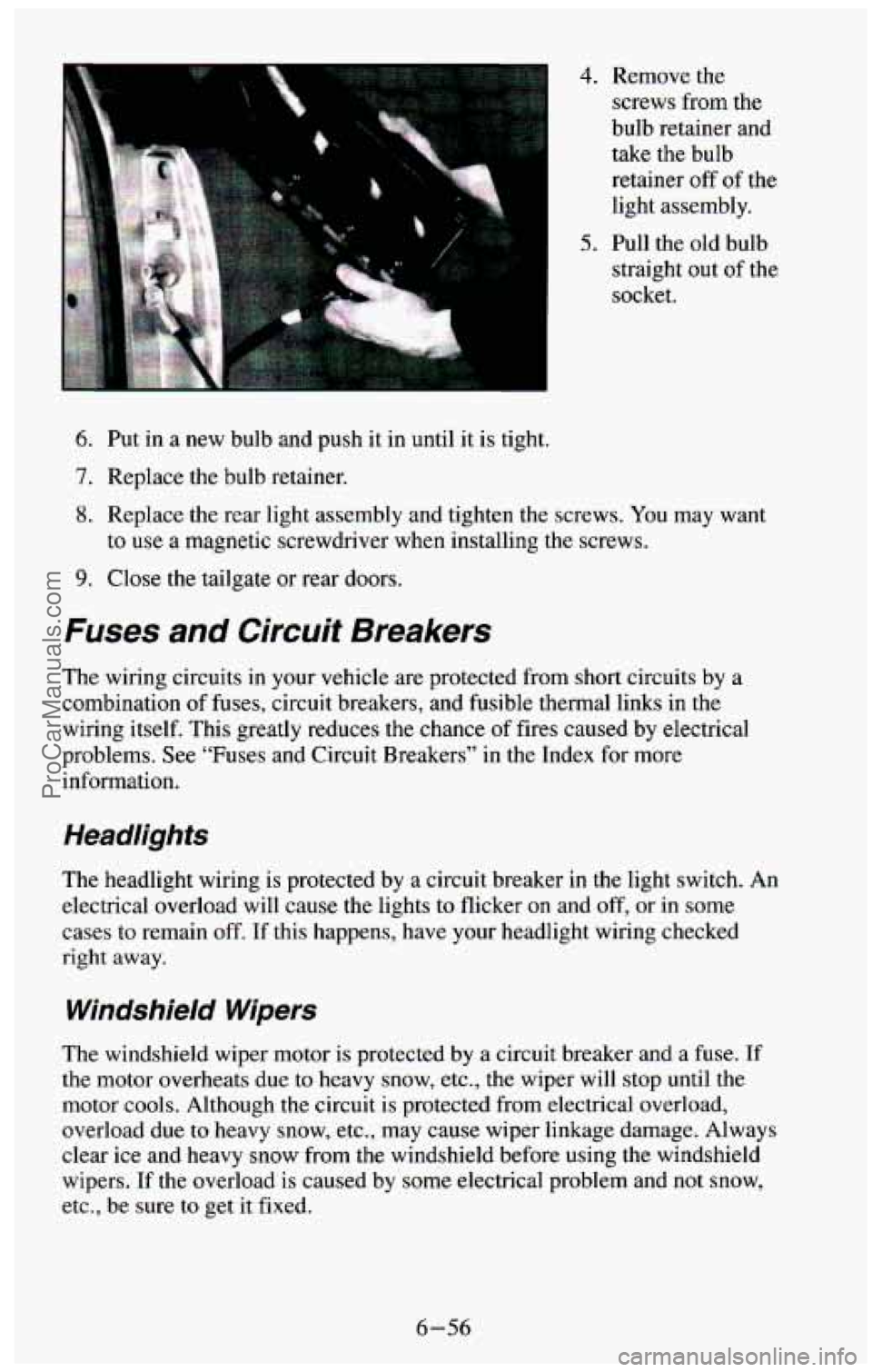
4. Remove the
screws from the
bulb retainer and
take the bulb
retainer
off of the
light assembly.
5. Pull the old bulb
straight out
of the
socket.
6. Put in a new bulb and push it in until it is tight.
7. Replace the bulb retainer.
8. Replace the rear light assembly and tighten the screws. You may want
to use
a magnetic screwdriver when installing the screws.
9. Close the tailgate or rear doors.
Fuses and Circuit Breakers
The wiring circuits in your vehicle are protected from short circuits by a
combination
of fuses, circuit breakers, and fusible thermal links in the
wiring itself. This greatly reduces the chance of fires caused by electrical
problems. See “Fuses and Circuit Breakers” in the Index for more
information.
The headlight wiring is protected by
a circuit breaker in the light switch. An
electrical overload
will cause the lights to flicker on and off, or in some
cases to remain off.
If this happens, have your headlight wiring checked
right away.
Windshield Wipers
The windshield wiper motor is protected by a circuit breaker and a fuse. If
the motor overheats due to heavy snow, etc., the wiper will stop until the
motor cools. Although
the circuit is protected from electrical overload,
overload due to heavy snow, etc., may cause wiper linkage damage. Always
clear ice and heavy snow from the windshield before using the windshield
wipers.
If the overload is caused by some electrical problem and not snow,
etc., be sure to get it fixed.
6-56
ProCarManuals.com
Page 325 of 385
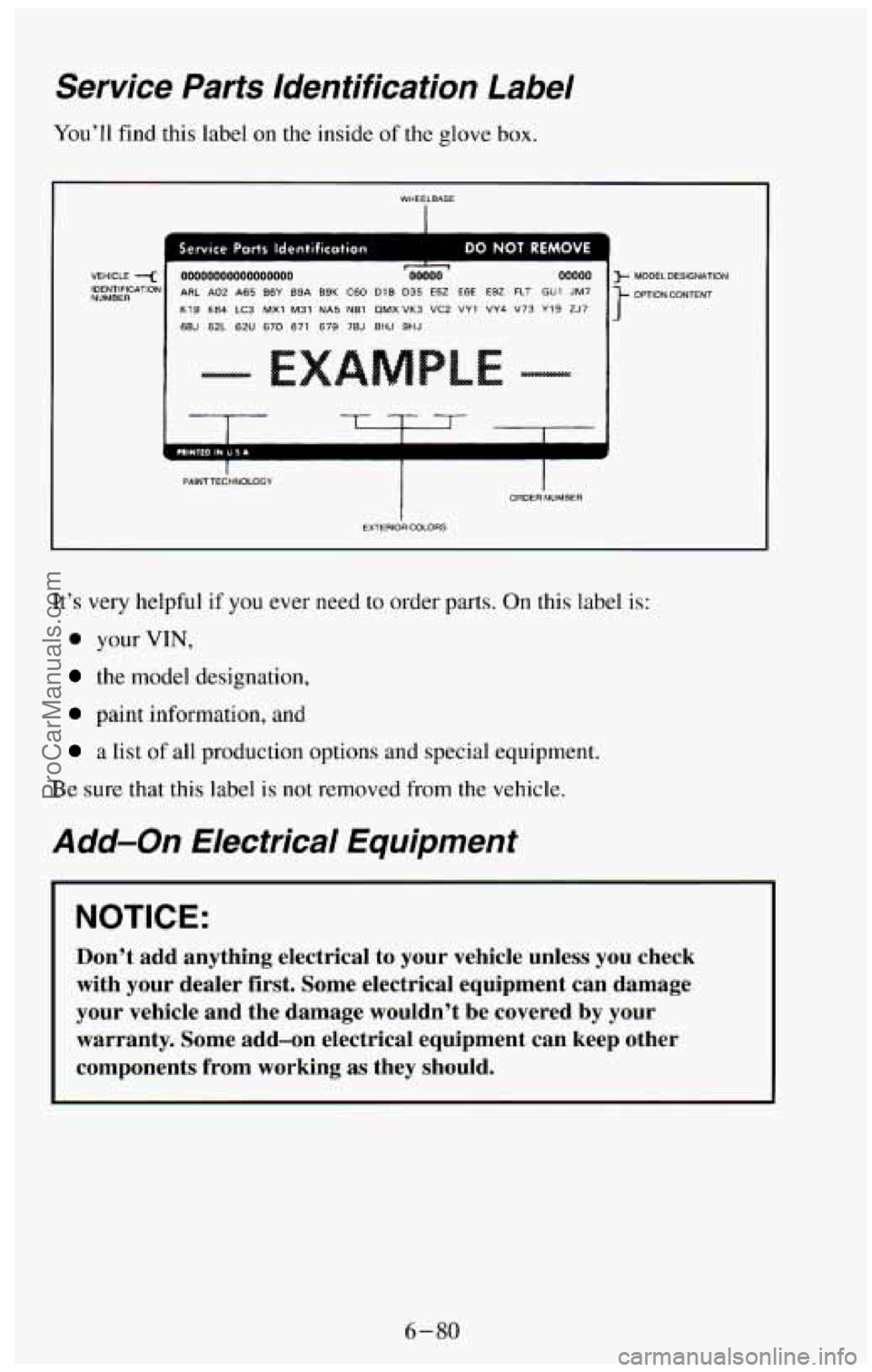
Service Parts Identification Label
You’ll find this label on the inside of the glove box.
WHEELBASE
I
MODEL DESIGNATION
OPTION CONTENT K19 K64 LC3 MXl M31 NA5 NB1 QMXVK3 VC2 VYl VY4 V73 Y19 ZJ7
6BJ 62L 62U 67D 671
679 7BJ 8HJ BHJ
I PAINT TECHNOLOGY I ORDER NUMBER
EXTERIOR COLORS
It’s very helpful if you ever need to order parts. On this label is:
0 your VIN,
the model designation,
paint information, and
a list of all production options and special equipment.
Be sure that this label is not removed from the vehicle.
Add-on E/ectrical Equipment
NOTICE:
Don’t add anything electrical to your vehicle unless you che\
ck
with
your dealer first. Some electrical equipment can damage
your vehicle and the damage wouldn’t be covered by your
warranty. Some add-on electrical equipment can keep other
components
from working as they should.
6-80
ProCarManuals.com
Page 377 of 385
Driving (continued)
Braking
...................................................... 4-5
Control
of A Vehicle ............................................ 4-4
Defensive
.................................................... 4-2
Downhill
.................................................... 4-18
Guidelines
................................................... 4-11
Highway Hypnosis
............................................ 4-29
Hydroplaning
................................................ 4-26
In Blizzard ................................................... 4-33
InCity
...................................................... 4-26
InRain
...................................................... 4-24
In Sand, Mud, Ice, Or Snow ................................ 4-21, 5-40
InWater ..................................................... 4-22
LongDistance
................................................ 4-28
LossofControl
............................................... 4-10
Nightvision
................................................. 4-24
Off-Roading
................................................. 4-12
OnCurves
.................................................... 4-7
OnGrades
................................................... 4-42
On Hill and Mountain Roads .................................... 4-29
On Off-Road
Hills ............................................ 4-15
OnSnoworIce
............................................... 4-31
Passing
...................................................... 4-9
Skidding
.................................................... 4-11
Stuck in Deep
Snow ...................................... 4-33, 5-40
Throughwater .......................................... 2-15, 4-22
Uphill
...................................................... 4-16
Winter
...................................................... 4-30
WithaTrailer ................................................ 4-36
DrunkenDriving
................................................. 4-2
Freeway
..................................................... 4-27
E
Electrical System
Engine Add-on
Equipment
...........................................
Adding Coolant ..................................... 5-14,5-20.
Aircleaner
..................................................
Block Heater ........................................ 2-1 9,3-5,
Computer Command Control System
..............................
Coolant ...................
Coolant Temperature Gage ....
Cooling System .............
Crankcase .................
Exhaust ...................
Fan Noise .................
Identification ...............
Leaving Vehicle While Running
Oil (See “Oil”)
Overheating
................
Running While Parked .......
Starting ...................
Equipment. Add-on .........
Exhaust System .............
..................................
..................................
..................................
..................................
..................................
..................................
............................. 6-79,
..................................
..................................
..................................
............................. 2-13,
..................................
..................................
6-80
6-37
6-27
6-21
6-58
6-35
2-75
5-12
6-82
5-24 2-31
6-81
2-31
5-10
2-31
2-16
6-61
6-58
3 ProCarManuals.com