1994 CHEVROLET SUBURBAN ECO mode
[x] Cancel search: ECO modePage 198 of 385
After you’ve loaded your trailer, weigh the trailer and then the tongue,
separately, to
see if the weights are proper. If they aren’t, you may be able to
get them right simply by moving some items around in the trailer.
Total Weight on Your Vehicle’s Tires
Be sure your vehicle’s tires are inflated to the limit for cold tires. You’ll find
these numbers
on the Certification label at the rear edge of the driver’s door
or see “Tire Loading” in the Index. Then be sure you don’t go over the
GVW limit for your vehicle.
Hitches
It’s important to have the correct hitch equipment. Crosswinds, large trucKs
going by, and rough roads are a few reasons why you’ll need the right hitch.
Here are some rules
to follow:
If you use a step bumper hitch, and your trailer tongue has a V-shaped
foot, your bumper could be damaged
in sharp turns. Check the distance
from the front edge of
the foot to the middle of the hitch ball socket. If
the distance is less than 12 inches, take the foot off the trailer tongue.
If you’ll be pulling a trailer with a utility model that, when loaded, will
weigh more than
3,000 pounds (1 361 kg); or with a wagon model that,
when loaded, will weigh more than
4000 pounds (1 800 kg), be sure to
use
a properly mounted, weight-distributing hitch and sway control of
the proper size. This equipment is very important for proper vehicle
loading and good handling when you’re driving.
0 Will you have to make any holes in the body of your vehicle when you
install a trailer hitch? If
you do, then be sure to seal the holes later
when
you remove the hitch. If you don’t seal them, deadly carbon
monoxide
(CO) from your exhaust can get into your vehicle (see
“Carbon Monoxide”
in the Index). Dirt and water can, too.
Safety Chains
You should always attach chains between your vehicle and your trailer.
Cross the safety chains under
the tongue of the trailer so that the tongue will
not drop to the road if it becomes separated from the hitch. Instructions
about safety chains may be provided by
the hitch manufacturer or by the
trailer manufacturer. Follow the manufacturer’s recommendation for
attaching safety chains. Always leave
just enough slack so you can turn with
your rig. And, never allow safety chains to drag on the ground.
4-39
ProCarManuals.com
Page 291 of 385
Replacing Brake System Parts
The braking system on a modern vehicle is complex. Its many parts have to
be of top quality and work well together if the vehicle is to have really good
braking. Vehicles we design and test have top-quality
GM brake parts in
them, as your vehicle does when it is new. When you replace parts of your
braking system
- for example, when your brake linings wear down and
you have to have new ones put
in - be sure you get new genuine GM
replacement parts. If you don’t, your brakes may no longer work properly.
For example, if someone puts
in brake linings that are wrong for your
vehicle, the balance between your front and rear brakes can change, for the
worse. The braking performance you’ve come to expect can change
in many
other ways
if someone puts in the wrong replacement brake parts.
Other Maintenance Items
Front Suspension and Steering Linkage
Your maintenance schedule will tell you how often to lubricate the fittings.
See “Recommended Fluids and Lubricants” in the Index for the proper
lubricant to use.
Front Wheel Bearing
Your vehicle has front wheel bearings that must be cleaned and repacked.
Your maintenance schedule will tell you how often this must be done.
Front Shock Absorbers
The front shock absorbers of your vehicle do many things. They help the
vehicle ride smoothly and also control the travel of the suspension system.
When the shock absorbers are serviced, any replacement shock absorbers
must be the same as the original equipment shock absorbers
in both
extended length
and strength.
I NOTICE:
If you use shock absorbers that are not the same as the original
shock absorbers, the shock absorbers or suspension system
could be damaged.
6-46
ProCarManuals.com
Page 304 of 385
Malfunction Indicator
(SERVICE ENGINE SOON) Lamp
The Malfunction Indicator (SERVICE ENGINE SOON) Lamp on your
instrument panel lets you know when your emission system needs service.
The light
will come on briefly when you start your engine to let you know
that the system is working.
If it does not come on when you start your
engine,
or if it comes on and stays on while you're driving, your system
may need service. Your vehicle should still be driveable, but
you should
have your system serviced right away.
Secondary Air Injection Reaction (AIR) System
You may have this system. It has a control valve that will direct air to where
it is needed. If the AIR system needs service, your Malfunction Indicator
(SERVICE ENGINE SOON) Lamp on your instrument panel will come
on.
Loading Your Vehicle
MFD BY GENERAL MOT0 RSCORP
i IN EFFECT -
I
- MODEL [ISPEED w
u TIRE SIZE RTG FilM PSllKPA (COLD)
q----p nri
SEE OWNERS MANUAL FOR ADDITIONAL INFORMATION
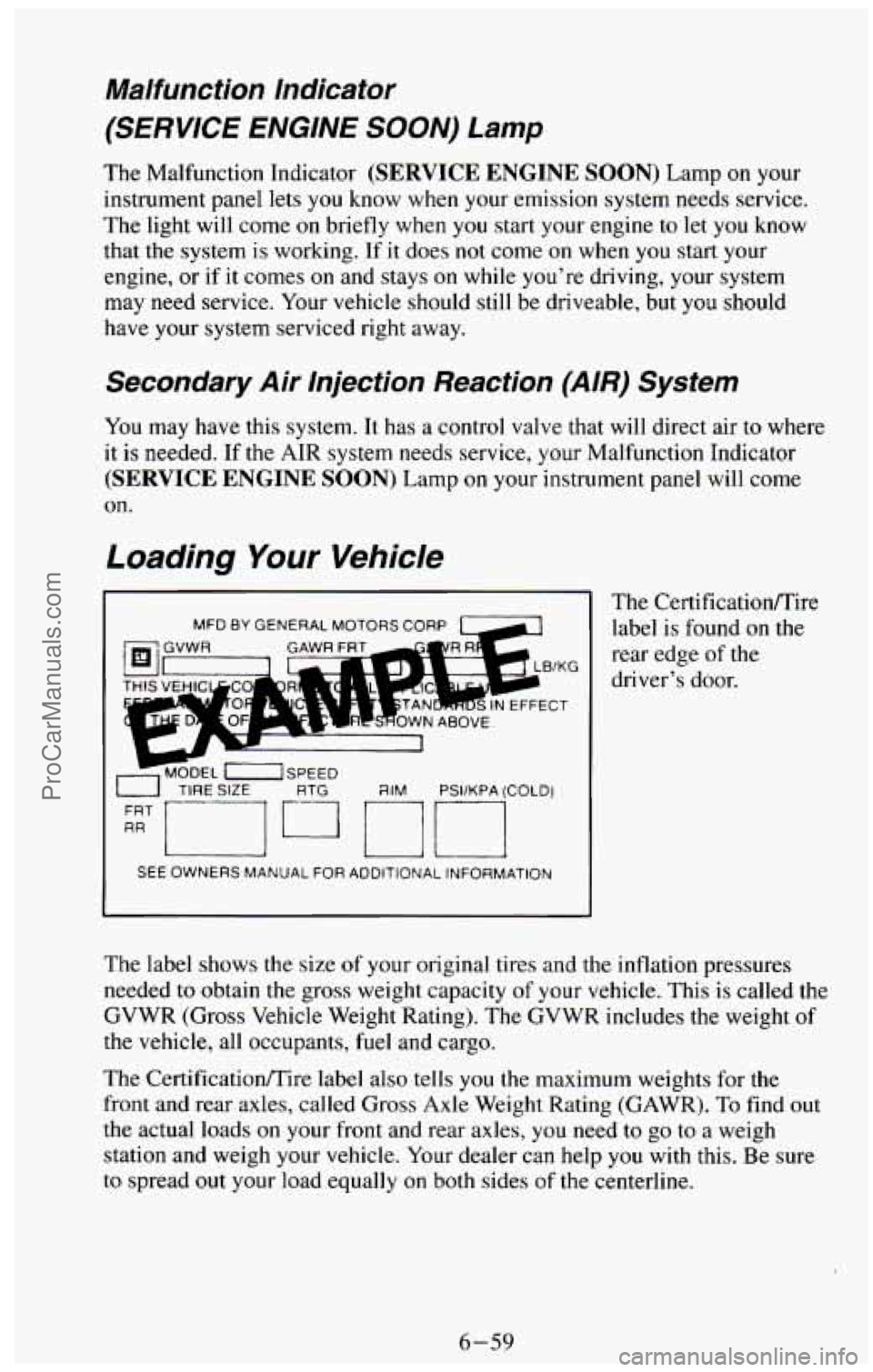
The CertificatiodTire
label is found
on the
rear edge
of the
driver's door.
The label shows the size
of your original tires and the inflation pressures
needed to obtain the gross weight capacity
of your vehicle. This is called the.
GVWR (Gross Vehicle Weight Rating). The GVWR includes the weight
of
the vehicle, all occupants, fuel and cargo.
The Certificatioflire label also tells you the maximum weights for the
front and rear axles, called Gross Axle Weight Rating (GAWR).
To find out
the actual loads on your front and rear axles,
you need to go to a weigh
station and weigh your vehicle. Your dealer can help you with this.
Be sure
to spread out your load equally on both sides of the centerline.
6-59
ProCarManuals.com
Page 327 of 385
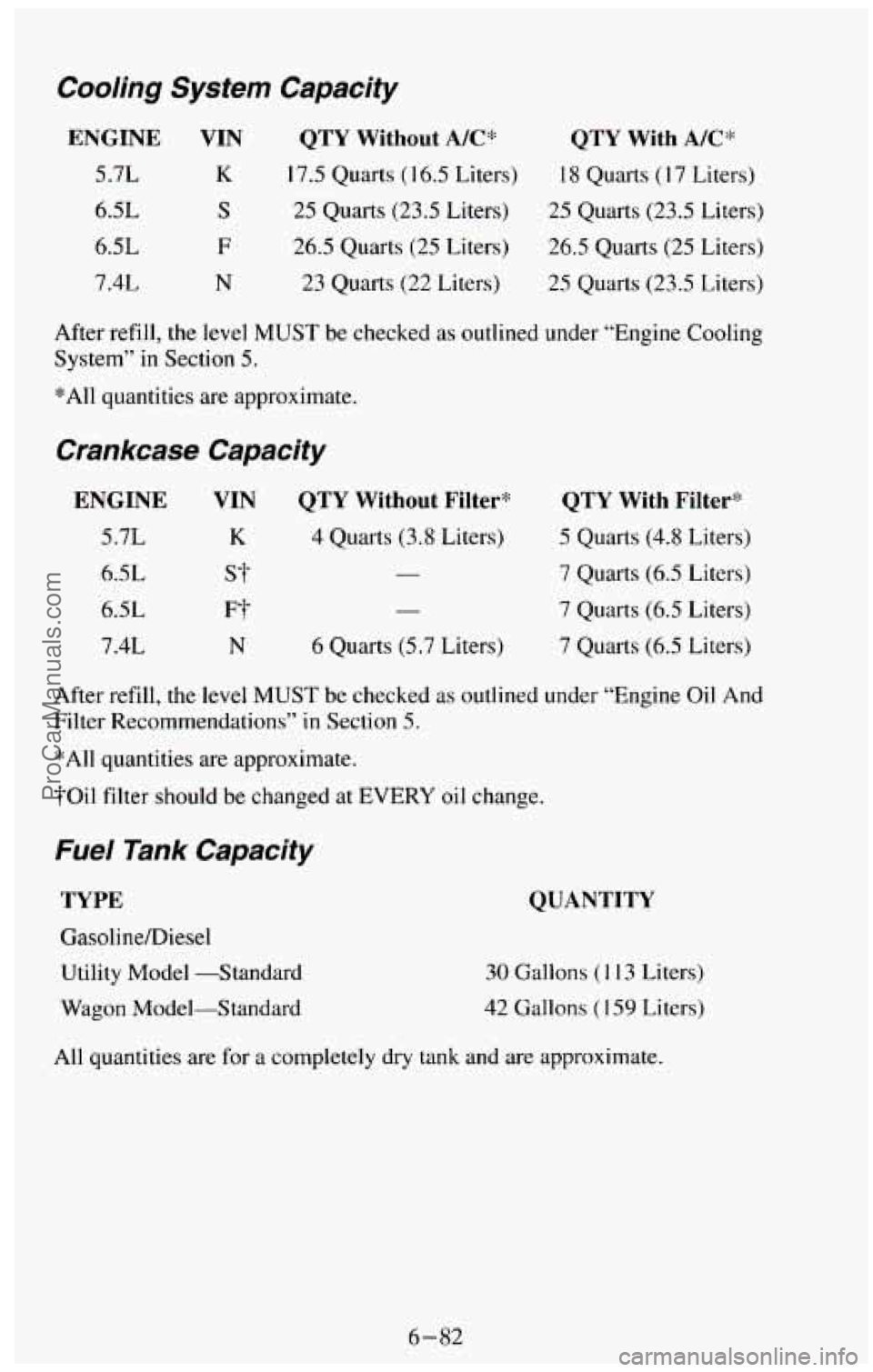
Cooling System Capacity
ENGINE VIN
5.7L K
6.5L S
6.5L F
7.4L N
QTY Without AfC* QTY With A/C*
17.5 Quarts (1 6.5 Liters)
18 Quarts ( I7 Liters)
25 Quarts
(23.5 Liters) 25 Quarts (23.5 Liters)
26.5 Quarts (25 Liters)
26.5 Quarts (25 Liters)
23 Quarts (22 Liters)
25 Quarts (23.5 Liters)
After refill, the level MUST be checked as outlined under “Engine Cooling
System”
in Section 5.
*All quantities are approximate.
Crankcase Capacity
ENGINE
5.7L
6.5L
6.5L
7.4L
VIN
K
ST
F?
N
QTY Without Filter“
4 Quarts (3.8 Liters)
6 Quarts (5.7 Liters)
QTY With Filter:$
5 Quarts (4.8 Liters)
7 Quarts (6.5 Liters)
7 Quarts
(6.5 Liters)
7 Quarts (6.5 Liters)
After refill, the level MUST be checked
as outlined under “Engine Oil And
Filter Recommendations”
in Section 5.
*All quantities are approximate.
?Oil filter should be changed at
EVERY oil change.
Fuel Tank Capacity
TYPE
Gasoline/Diesel
Utility Model -Standard
Wagon Model-S tandard
QUANTITY
30 Gallons (I 13 Liters)
42 Gallons (I 59 Liters)
All quantities are for a completely dry tank and are approximate.
6-82
ProCarManuals.com
Page 353 of 385
12.
13.
14.
15.
16.
17.
18.
19.
20.
EGR SYSTEM INSPECTION* - Conduct EGR SYSTEM CHECK
as described in the Service Manual.
ELECTRONIC VACUUM REGULATOR VALVE (EVRV)
INSPECTION*
- Inspect filter for excessive contamination or
plugging. If required, clean element with a solution of biodegradable
soap and water, let dry and reinstall element.
ENGINE TIMING CHECK AND DISTRIBUTOR CHECK (SOME
MODELS)*$
- Adjust timing to underhood label specifications.
Inspect
the inside and outside of the distributor cap and rotor for cracks,
carbon tracking and corrosion. Clean
or replace as needed,
FUEL TANK, CAP AND LINES INSPECTION*$ - Inspect the
fuel tank, cap and lines for damage or leaks. Remove fuel cap, inspect
gasket for an even filler neck imprint, and any damage. Replace parts
as needed.
THERMOSTATICALLY CONTROLLED AIR CLEANER
INSPECTION*A
- (If so equipped.) Inspect all hoses and ducts for
proper hook-up.
Be sure the valve works properly.
SINGLE ENGINE ACCESSORY DRIVE (SERPENTINE) BELT
INSPECTION*
- Inspect belt. Look for cracks, fraying, wear, and
proper tension. Adjust or replace
as needed.
Check all
fuel and vapor lines and hoses for proper hookup, routing,
and condition. Check that the purge valve works properly,
if equipped.
Replace as needed.
SHIELDS AND UNDERHOOD INSULATION INSPECTIONAV
- Inspect shields and underhood insulation for damage or looseness.
Adjust or replace
as required.
AIR INTAKE SYSTEM INSPECTIONAV - Check the air intake
system installation to see that gaskets are sealed properly and all hose
connections, fasteners, and other components are tight. Also check to
be sure that
the air cleaner housing is properly seated, that the cover fits
tightly, and the wing nuts are tight. Tighten connections and fasteners
or replace damaged parts
as required.
'% An Emission Control Service
ANoise Emission Control Service
P'Applicable only to vehicles sold
in the United States
$The California Air Resources Board
has determined that the failure to
perform this maintenance item will not nullify
the emission warranty or
limit recall liability prior to the completion of the vehicle \
useful life.
General Motors, however, urges that
all recommended maintenance
services be performed at the indicated intervals and the maintenance be \
recorded.
EVAPORATIVE CONTROL SYSTEM (ECS) INSPECTION* -
7-20
ProCarManuals.com
Page 371 of 385
Bulletins cover various subjects. Some pertain to the proper use and care of
your vehicle. Some describe costly repairs. Others describe inexpensive
repairs which, if done on time with the latest parts, may avoid future costly
repairs. Some bulletins tell
a technician how to repair a new or unexpected
condition. Others describe
a quicker way to fix your vehicle. They can help
a technician service your vehicle better.
Most bulletins apply to conditions affecting
a small number of cars or
trucks. Your Chevrolet dealer or a qualified technician may have to
determine if
a specific bulletin applies to your vehicle.
You can subscribe to all Chevrolet’s bulletins by calling Helm, Inc. at
1-800-7824356. This way
you’ll get them as they become available.
Individual PSP’s
If you don’t want to buy all the PSP’s issued by Chevrolet for all car or
truck models
in the model year, you can buy individual PSP’s, such as those
which may pertain to
a particular model. To do this, you will first need to
see our index of PSP’s. It provides a variety of information. Here’s what
you’ll find
in the index and how you can get one:
What You’ll Find in the Index:
A list of PSP’s published by Chevrolet in a model year (1990 or later).
PSP’s covering all models
of Chevrolet cars or light trucks (less than
10,000 pounds
(4 536 kg) GVWR) are listed in the same index.
0 Ordering information so you can buy the specific PSP’s you may want.
0 Price information for the PSP’s you may want to buy.
How You Can Get an Index:
Indexes are published periodically. Most of the PSP’s which could
potentially apply to the most recent Chevrolet models will be listed in the
most recent publication for that model year. This means you may want to
wait
until the end of the model year before ordering an index, if you are
interested
in buying PSP’s pertaining to a current model year car or truck.
Some PSP’s pertaining
to a particular model year vehicle may be published
in later years, and these would be listed in the later year’s index. When you
order an index for a model year that is not over yet, we’ll send you the most
recently published issue. Check the ordering form for indexes for earlier
model years.
Lut out the ordering form, fill it out, and mail it in. We will then see to it
that an index
is mailed to you. There is no charge for indexes for the
1989-1994 model years.
8-8 ProCarManuals.com
Page 380 of 385
L
Lights ..................................................... 2-47
Brake System Warning ......................................... 2-67
Bulb Replacement
............................................. 6-86
Charging System Light
......................................... 2-70
Front Parking/Turn Signal
....................................... 6-52
CheckGagesLight
............................................ 2-71
Dome
....................................................... 2-49
Headlights (See “Headlights”)
Indicator
.................................................... 2-66
Operation
................................................... 2-37
Reading ..................................................... 2-49
Service Engine
Soon ...................................... 2-7 1. 6-59
Rear
........................................................ 6-55
Replacement Chart
............................................ 6-86
SideMarker .................................................. 6-53
Loading Your Vehicle ....................................... 4-12, 6-59
Add-on Equipment
........................................... 6-61
Accelerator Control System
..................................... 6-48
Constant Velocity Joints
........................................ 6-48
Front Shock Absorbers
......................................... 6-46
Front Suspension and Steering Linkage
............................ 6-46
Front Wheel Bearings .......................................... 6-46
TailgateHandle
............................................... 6-49
HoodLatchesandHinge ........................................ 6-48
Lockcylinders ............................................... 6-49
Propeller Shaft Slip Splines
..................................... 6-48
RearAxle ................................................... 6-33
Recommended Lubricants ...................................... 7-25
Transfercase ................................................ 6-34
Luggagecarrier ................................................. 2-79
Lubrication
..................................................... 6-48
Body
....................................................... 6-48
FrontAxle
................................................... 6-35
Maintenance Otherltems
.................................................. 6-46
Record .................................................. 7.2. 7.27
Scheduled Maintenance .................................... 747-1 8
When Towing
a Trailer ......................................... 4-36
Master Cylinder (See “Brakes”)
Mirrors
........................................................ 2-51
Electric Outside ............................................... 2-52
Inside ....................................................... 2-51
Multifunction Lever .............................................. 2-38
Turn SignalLane Change Indicator
............................... 2-73
Underbody
.................................................. 6-76
... ModelReference .................................................. 111
6
ProCarManuals.com