Page 183 of 340
Downloaded from www.Manualslib.com manuals search engine Problems on the Road
Section
.
Here you’ll find what to do about some problems that can occur on the road .
Hazard Warning Flashers ..................................... 5-2
Other Warning Devices
...................................... 5-3
Jump Starting .............................................. 5-3
Towing Your Vehicle ........................................ 5-8
Engine Overheating
........................................ 5-12
If a Tire Goes Flat ......................................... 5-20
Changing a Flat Tire ....................................... 5-20
If You’re Stuck: In Sand. Mud. Ice or Snow ..................... 5-34
5-1
Page 190 of 340
Downloaded from www.Manualslib.com manuals search engine Towing Your Vehicle
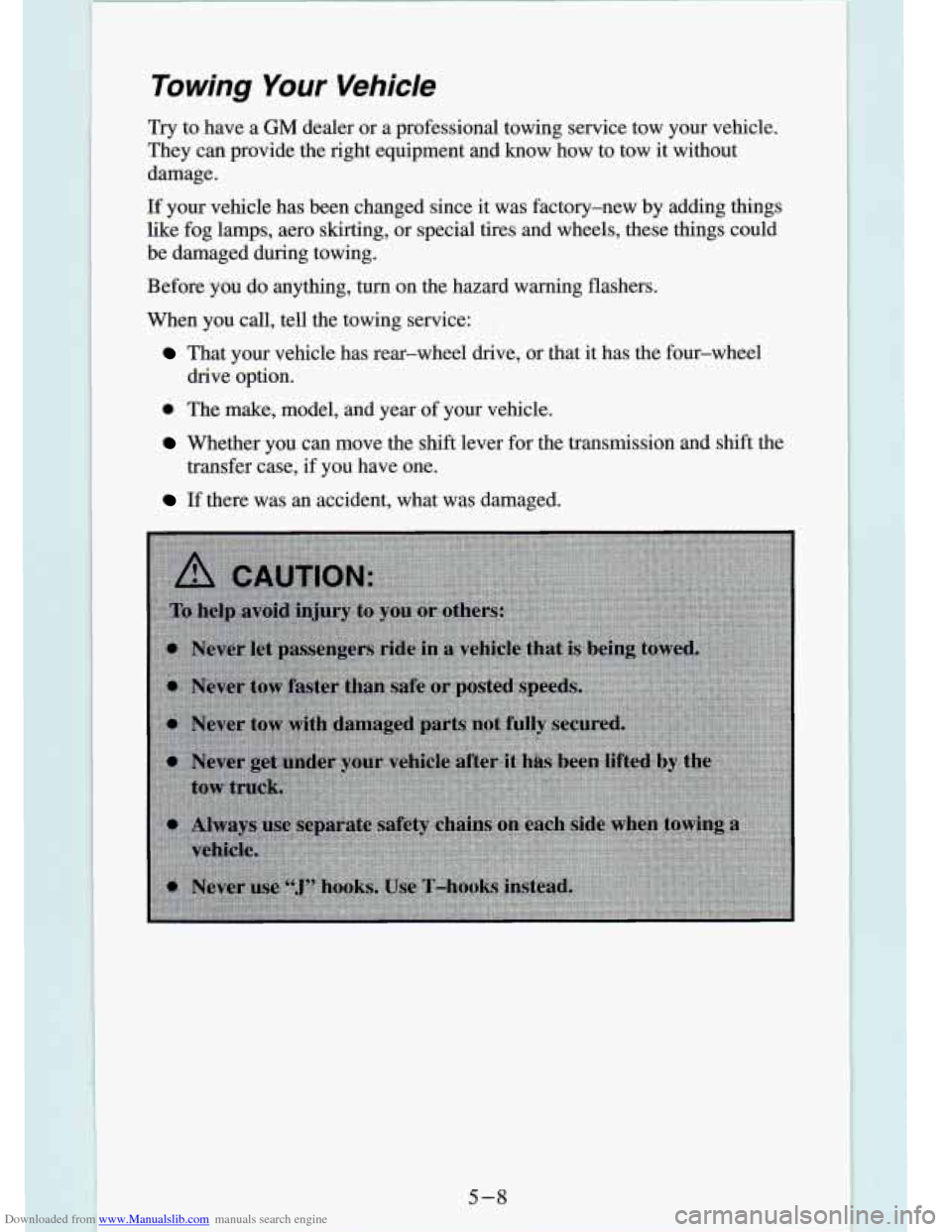
Try to have a GM dealer or a professional towing service tow your vehicle.
They can provide the right equipment and know how to tow it without
damage.
If your vehicle has been changed since
it was factory-new by adding things
like fog lamps, aero skirting, or special tires and wheels, these things\
could
be damaged during towing.
Before you do anything, turn on the hazard warning flashers.
When you call, tell the towing service:
That your vehicle has rear-wheel drive, or that it has the four-wheel
0 The make, model, and year of your vehicle.
Whether you can move the shift lever for the transmission and shift the
drive option.
transfer case, if you have one.
If there was an accident, what was damaged.
5-8
Page 191 of 340
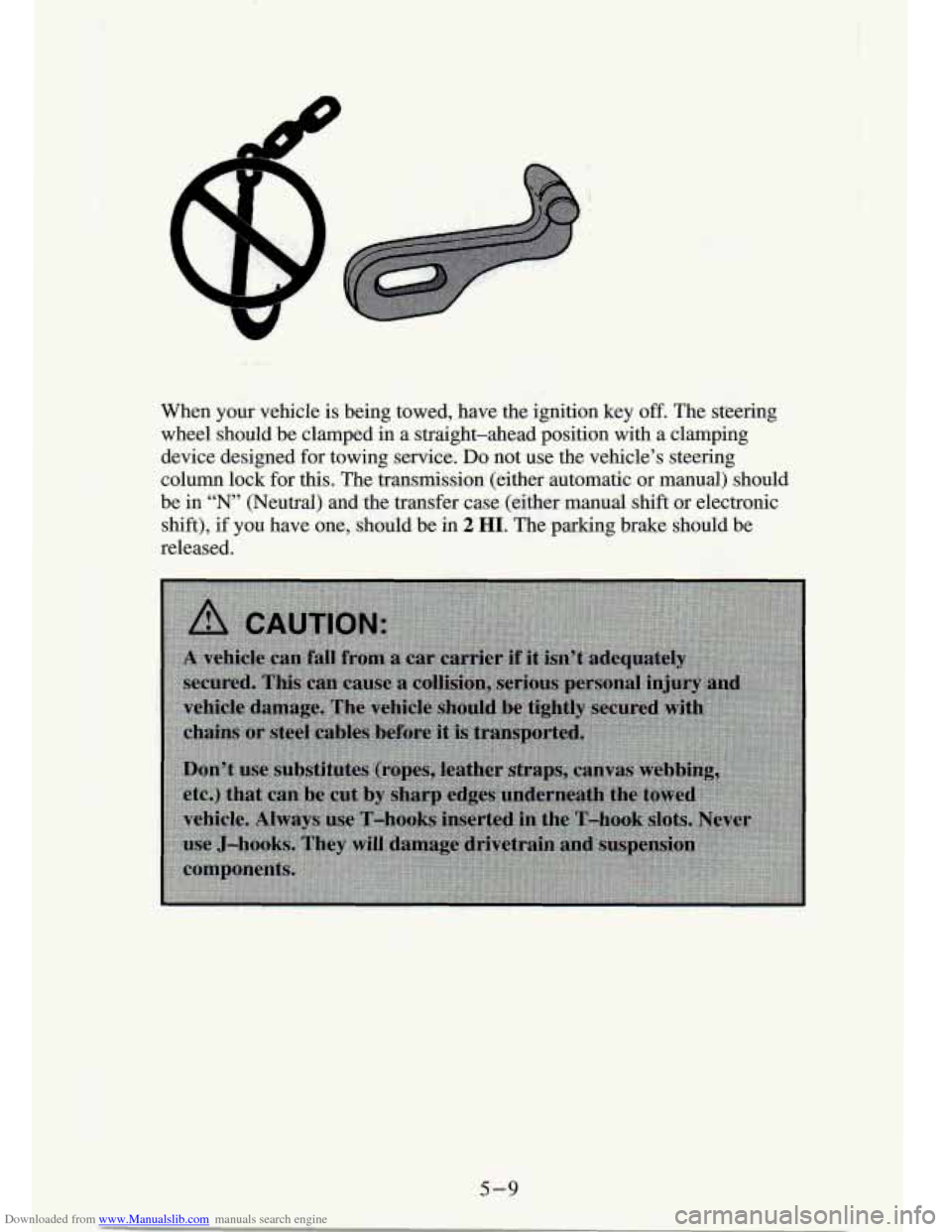
Downloaded from www.Manualslib.com manuals search engine When your vehicle is being towed, have the ignition key off. The steering
wheel should be clamped in a straight-ahead position
with a clamping
device designed for towing service.
Do not use the vehicle’s steering
column lock for this. The transmissi,on (either automatic or manual) should
be
in “N’ (Neutral) and the transfer case (either manual shift or electronic
shift),
if you have one, should be in 2 HI. The paking brake should be
released.
5-9
Page 192 of 340
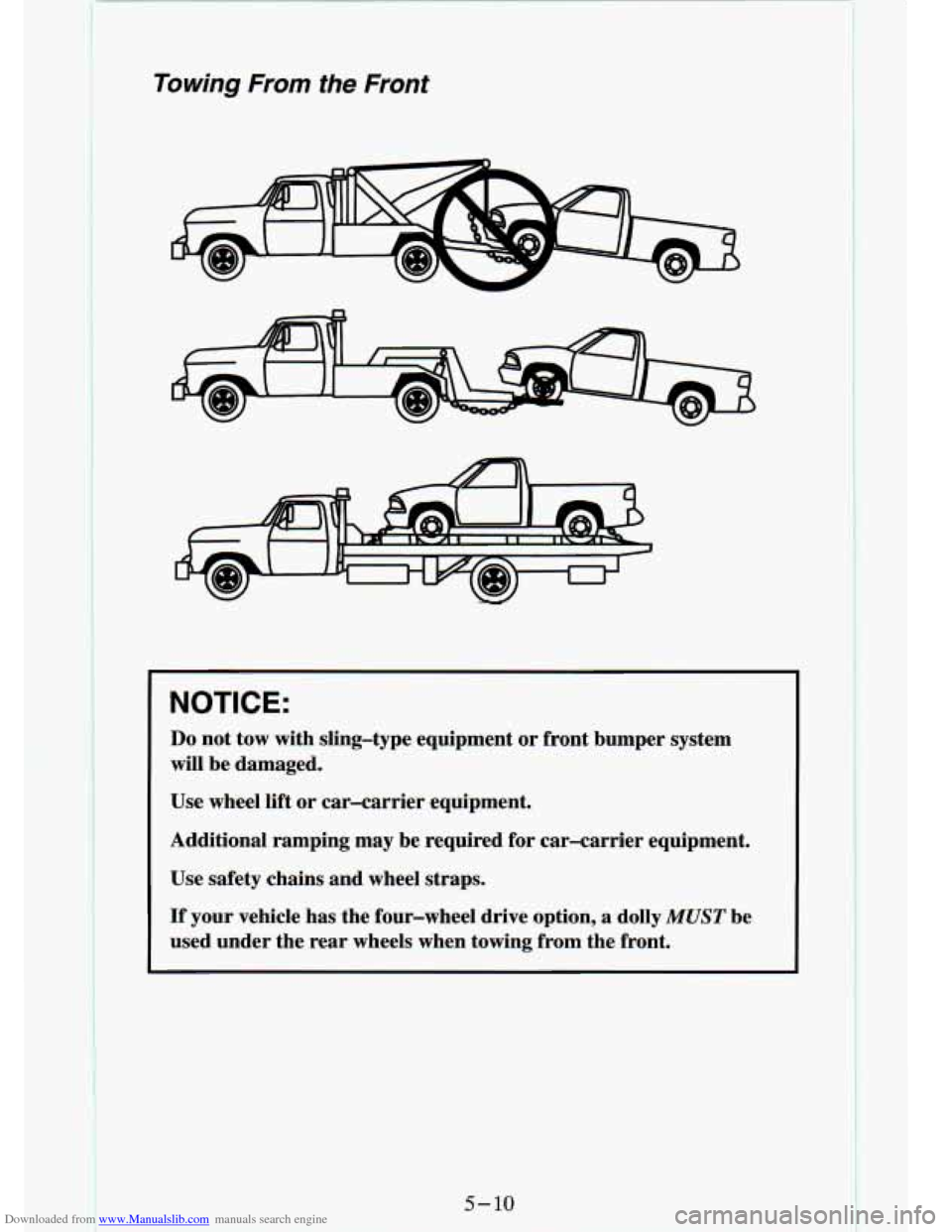
Downloaded from www.Manualslib.com manuals search engine Towing From fhe Front
NOTICE:
Do not tow with sling-type equipment or front bumper system
will be damaged.
Use wheel lift or car-carrier equipment.
Additional ramping may be required for car-carrier equipment.
Use safety chains and wheel straps.
If your vehicle has the four-wheel drive option, a dolly MUST be
used under the rear wheels when towing from the front.
5-19
Page 193 of 340
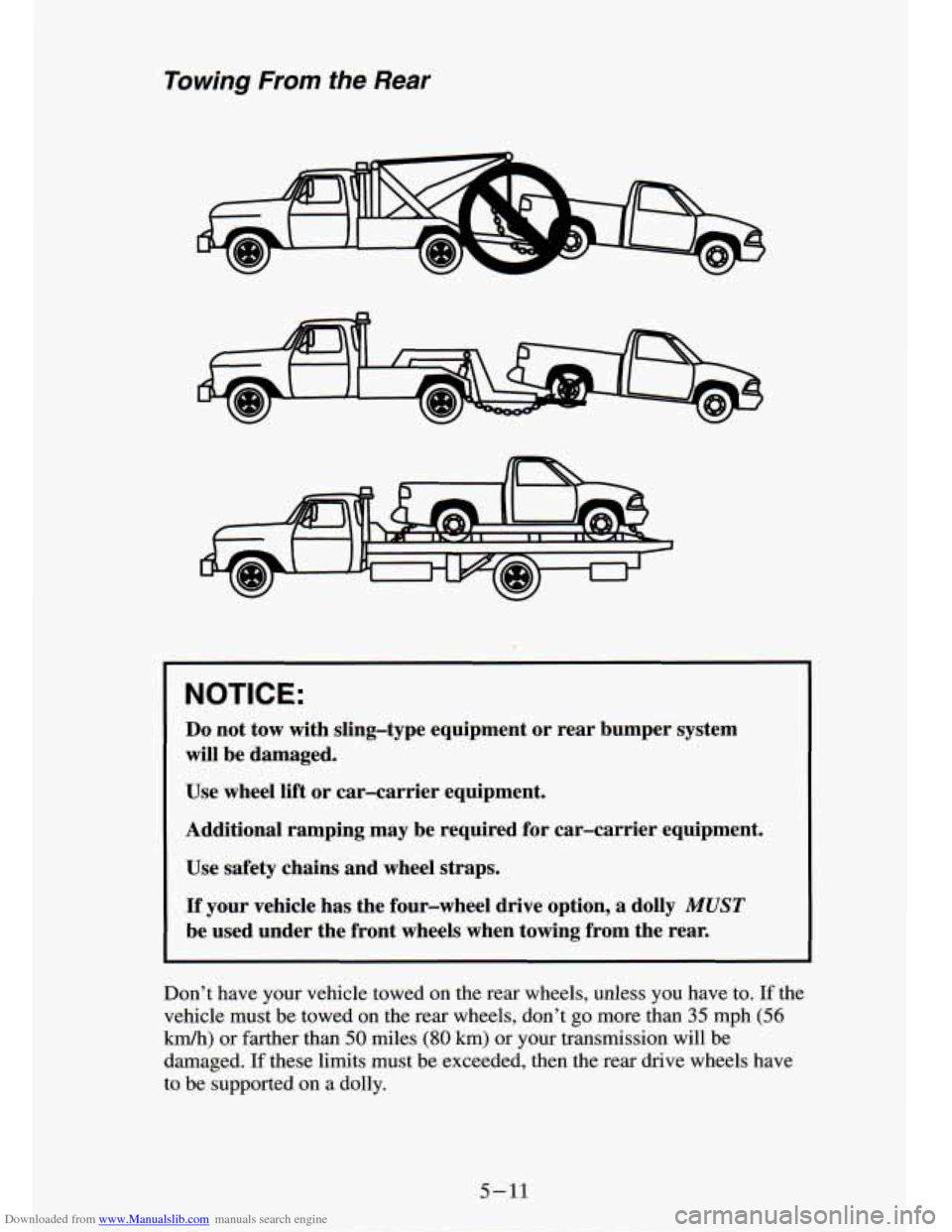
Downloaded from www.Manualslib.com manuals search engine Towing From the Rear
NOTICE:
Do not tow with sling-type equipment or rear bumper system
will be damaged.
Use wheel lift or car-carrier equipment.
Additional ramping may be required for car-carrier equipment.
: . .A. :i.-.
Use safety chains and wheel straps.
If your vehicle has the four-wheel drive option, a dolly MUST
be used under the front wheels when towing from the rear.
Don’t have your vehicle towed on the rear wheels, unless you have to. If the
vehicle must be towed on the rear wheels, don’t go more th\
an
35 mph (56
km/h) or farther than 50 miles (80 km) or your transmission will be
damaged.
If these limits must be exceeded, then the rear drive wheels have
to be supported on a dolly.
5-11
Page 201 of 340
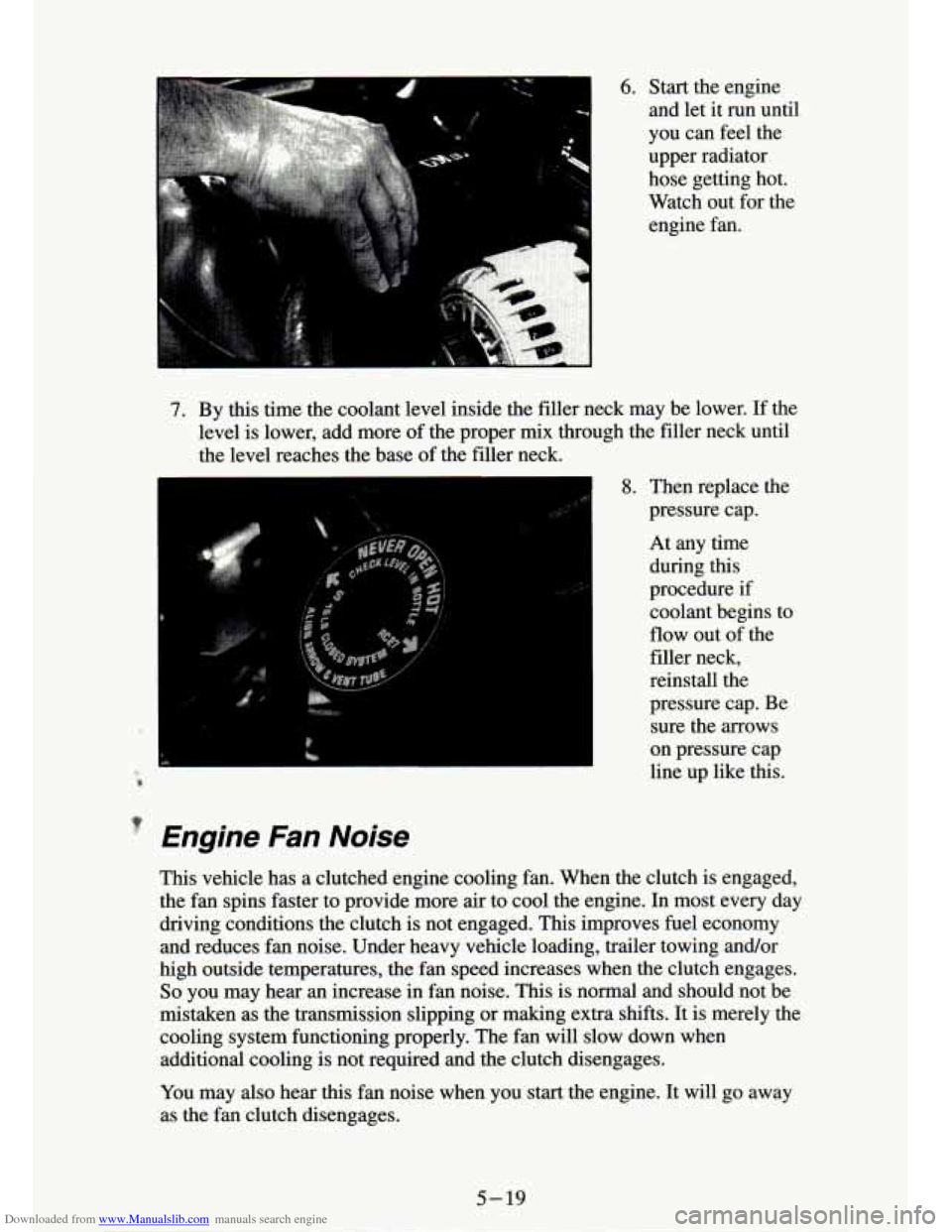
Downloaded from www.Manualslib.com manuals search engine 7. By this time the coolant level inside the filler neck may be lower. If the
level is lower, add more of the proper
mix through the filler neck until
the level reaches the base of the filler neck.
8. Then replace the
pressure cap.
At any time during
this
procedure if coolant begins to
flow out of the
filler neck,
reinstall the
pressure cap. Be sure the arrows
on pressure cap
line up like this.
P
' Engine Fan Noise
This vehicle has a clutched engine cooling fan. When the clutch is engaged,
the fan spins faster to provide more air
to cool the engine. In most every day
driving conditions the clutch is not engaged. This improves fuel economy
and reduces fan noise. Under heavy vehicle loading, trailer towing and/or
high outside temperatures, the fan speed increases when the clutch engages.
So you may hear an increase in fan noise. This is normal and should not be
mistaken as the transmission slipping or making extra shifts. It is merely the
cooling system functioning properly. The fan will slow down when
additional cooling is not required and the clutch disengages.
You may also hear this fan noise when you
start the engine. It will go away
as the
fan clutch disengages.
5-19
Page 206 of 340
Downloaded from www.Manualslib.com manuals search engine Underbody Carrier
NOTICE:
Never remove or restow a tire from/to a stowage position under
the vehicle while the vehicle is supported
by a jack. Always
tighten the tire fully against the underside
of the vehicle when
restowing.
I
5
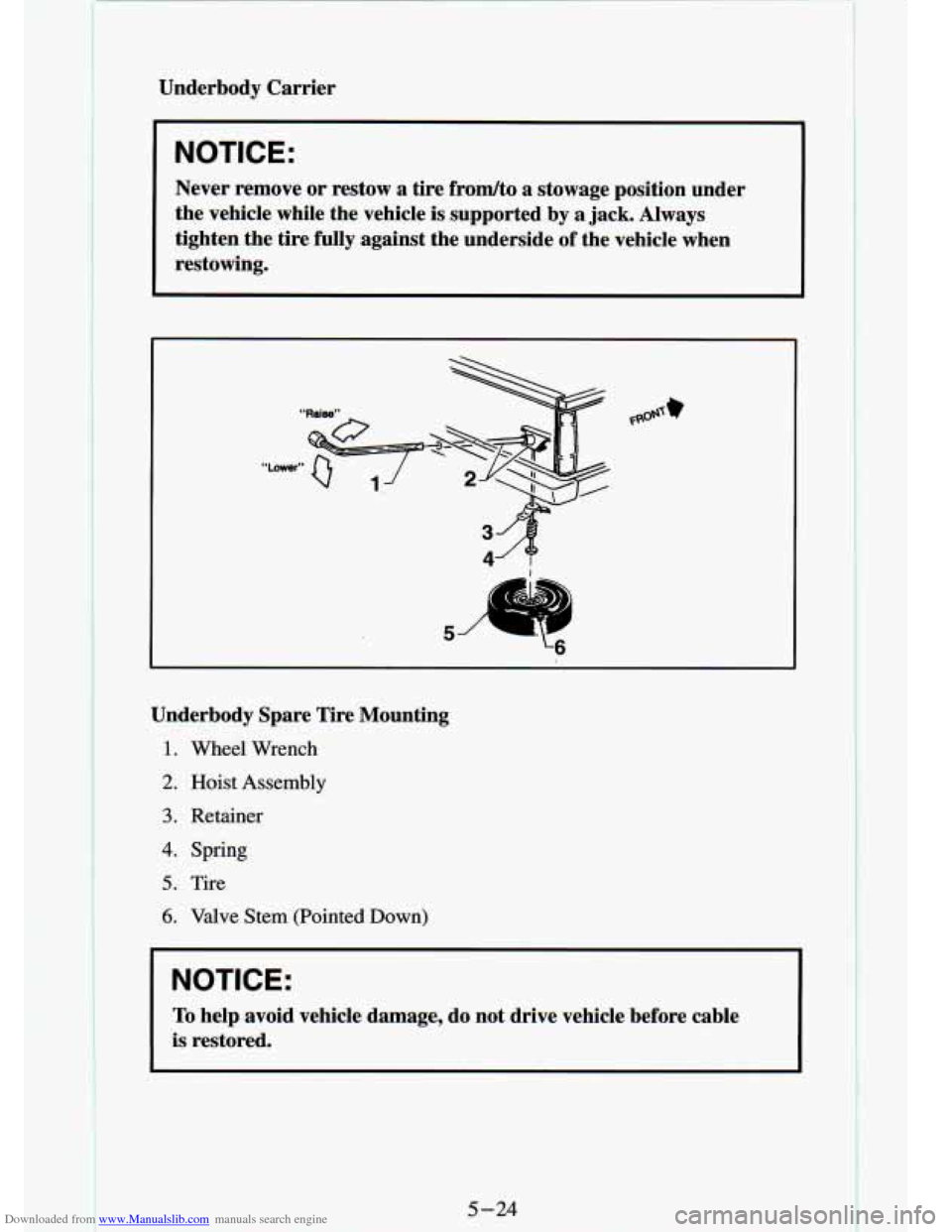
Underbody Spare Tire Mounting
1. Wheel Wrench
2. Hoist Assembly
3. Retainer
4. Spring
5. Tire
6. Valve Stem (Pointed Down)
NOTICE:
To help avoid vehicle damage, do not drive vehicle before cable
is restored.
5-24
I
Page 217 of 340
Downloaded from www.Manualslib.com manuals search engine Rocking your vehicle to get it out:
First, turn your steering wheel left and right. That will clear the area around
your front wheels. Then shift back and forth between
“R’ (Reverse) and a
forward gear (or with a manual transmission, between First or \
Second gear and Reverse), spinning the wheels as little as possible. Release the
accelerator pedal while you shift, and press lightly on the accelerator pedal
when the transmission is
in gear. If that doesn’t get you out after a few .tries,
you may need to be towed out. Or, you can use your recovery hooks, if your
vehicle has them.
If you do need to be towed out, see “Towing Your
Vehicle” in the Index.
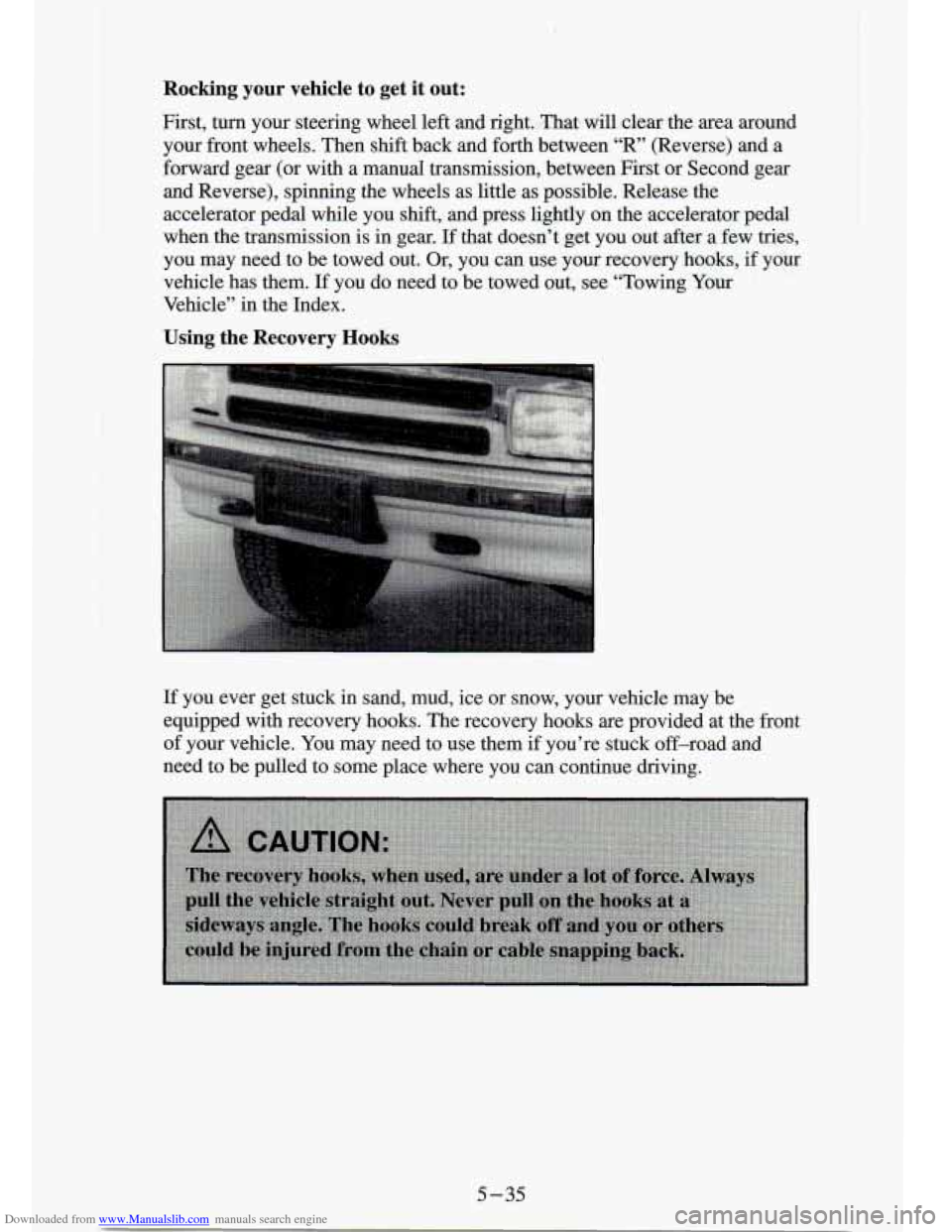
Using the Recovery Hooks
If you ever get stuck in sand, mud, ice or snow, your vehicle may be
equipped with recovery hooks. The recovery hooks are provided at the front
of your vehicle. You may need to use them if you’re stuck off-road and
need to be pulled to some place where you can continue driving.
5-35