1994 CHEVROLET S10 heater
[x] Cancel search: heaterPage 172 of 340
Downloaded from www.Manualslib.com manuals search engine Run your engine only as long as you must. This saves fuel. When you run
the engine, make it go a little faster than just idle. That is, push the
accelerator slightly. This uses less fuel for the heat that you get and it keeps
the battery charged. You will need a well-charged battery to restart the
vehicle, and possibly for signaling later on with your headlights. Let the
heater run for awhile.
Then, shut the engine off and close the window almost all the way to
preserve the heat. Start the engine again and repeat this only\
when you feel
really uncomfortable from the cold. But do it as little as possible. Preserve
the fuel as long as you can. To help keep warm, you can get out of the
vehicle and do some fairly vigorous exercises every half hour \
or
so until
help comes.
Recreational Vehicle Towing
(Four- Wheel Drive Only)
If your vehicle has &wheel drive, you may tow it behind another vehicle
providing it does not have the optional electronic shift transfer case.
NOTICE:
Recreational vehicle towing is not recommended for vehicles
with the optional electronic shift transfer case because the
electronic shift has no neutral position.
4-36
Page 195 of 340
Downloaded from www.Manualslib.com manuals search engine /f No Steam Is Coming From Your Engine
If you get the overheat warning but see or hear no steam, the problem may
not be too serious. Sometimes the engine can get a little too hot when you:
0 Climb a long hill on a hot day.
0 Stop after high speed driving.
0 Idle for long periods in traffic.
0 Tow a trailer.
If you get the overheat warning with no sign of steam, try this for a minute
or
so:
1. If you have an air conditioner, turn it off.
2. Turn on your heater to full hot at the highest fan speed and open the
window as necessary.
3.
If you’re in a traffic jam, shift to “N” (Neutral).
If you no longer have the overheat warning, you can drive. Just to be safe,
drive slower for about ten minutes. If the warning doesn’t come back on,
you can drive normally.
If the warning continues, pull over, stop, and park your vehicle \
right away.
If there’s still no sign
of steam, push the accelerator until the engine speed is
about twice as fast as normal idle speed. Bring the engine speed back to
normal idle speed after two or three minutes. Now see
if the warning stops.
But then,
if you still have the warning, TURN OFF THE ENGINE AND
GET EVERYONE
OUT OF THE VEHICLE until it cools down.
You may decide not to lift the hood but to get service help right away.
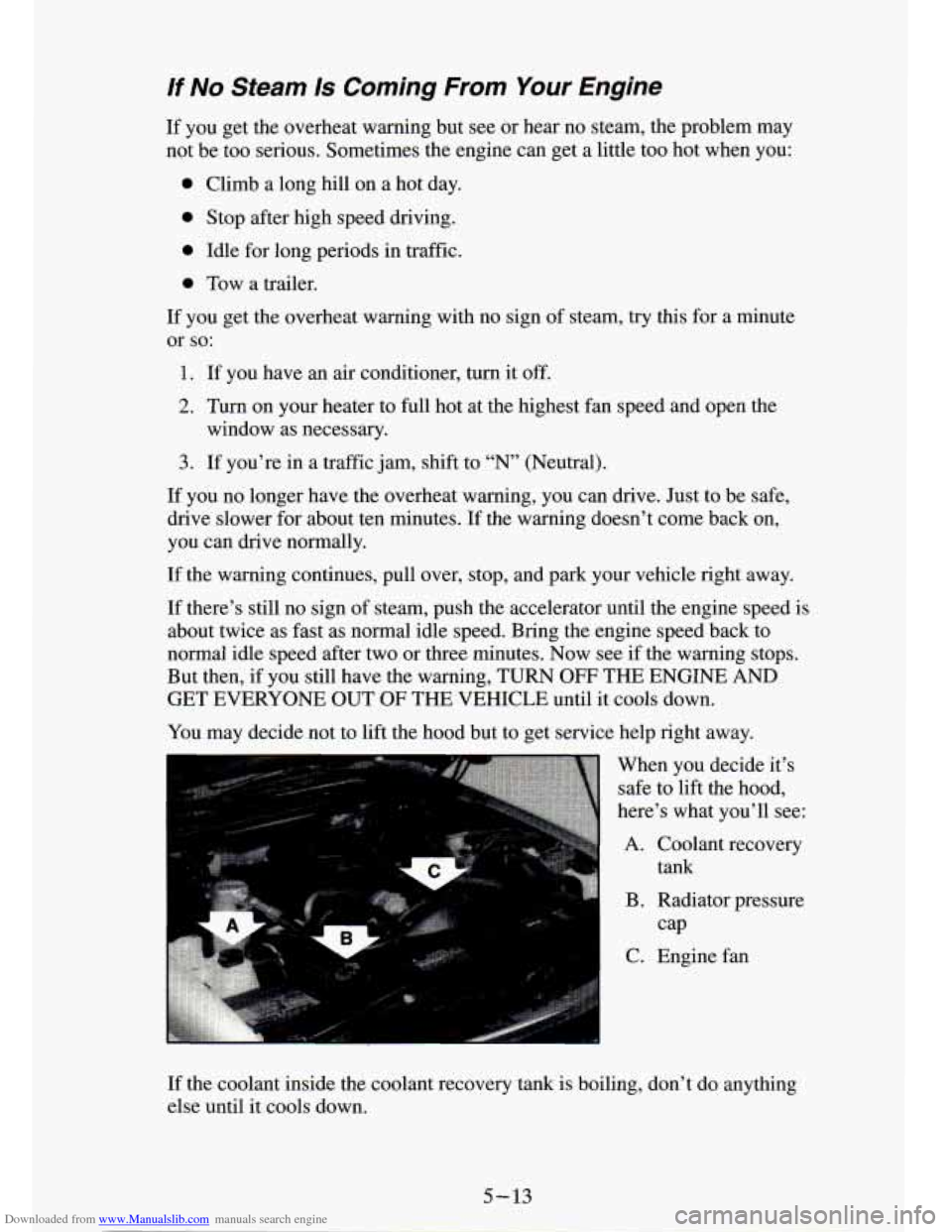
When you decide it’s safe to lift the hood,
here’s what you’ll see:
A. Coolant recovery tank
B. Radiator pressure
C. Engine fan
cap
If the coolant inside the coolant recovery tank is boiling, don’t do anything
else until it cools down.
5-13
Page 196 of 340
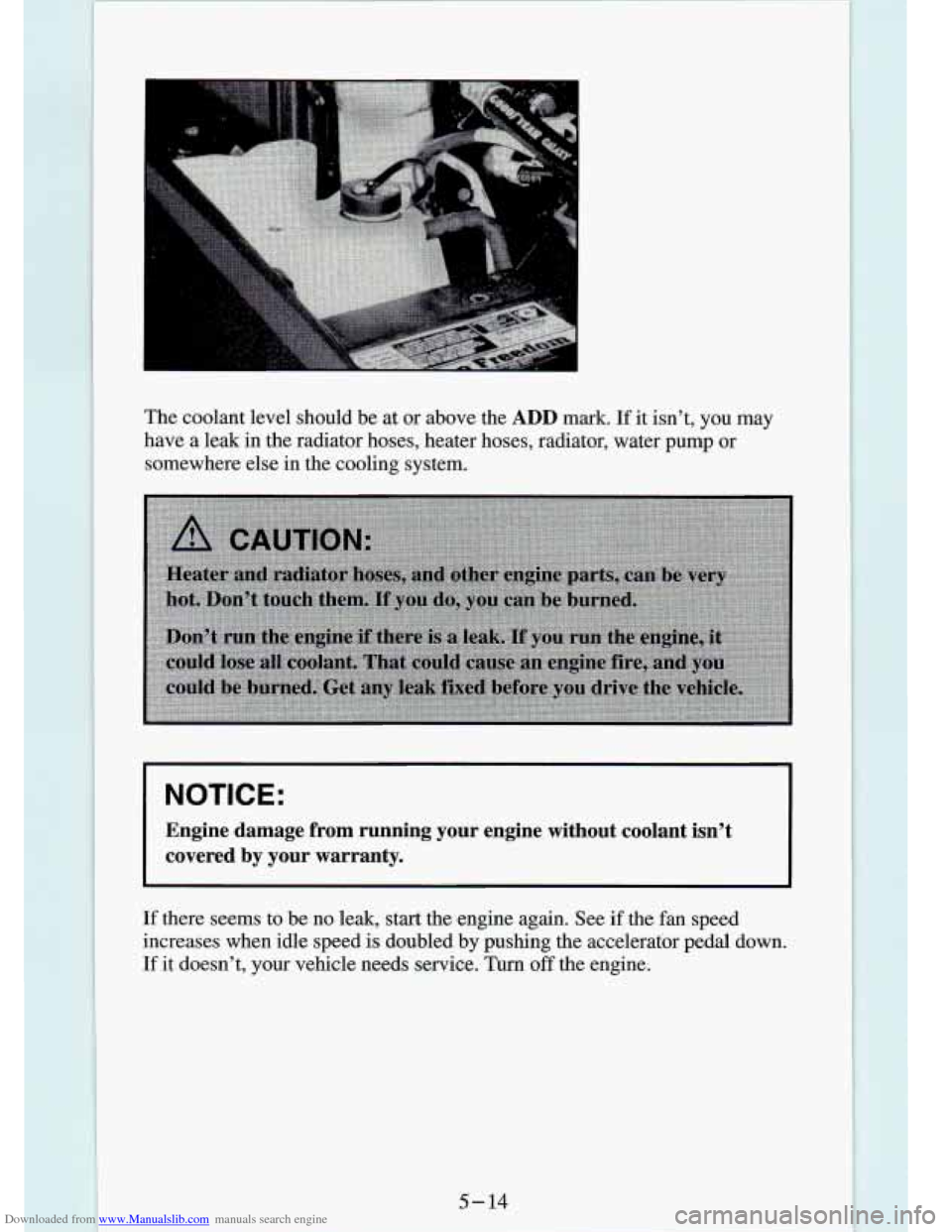
Downloaded from www.Manualslib.com manuals search engine The coolant level should be at or above the ADD mark. If it isn’t, you may
have a leak in the radiator hoses, heater hoses, radiator, wat\
er pump or
somewhere else in the cooling system.
I NOTICE:
Engine damage from running your engine without coolant isn’t \
covered
by your warranty.
If there seems to be no leak, start the engine again. See if the fan speed
increases when idle speed is doubled by pushing the accelerator\
pedal down.
If it doesn’t, your vehicle needs service. Turn off the engine.
Page 197 of 340
Downloaded from www.Manualslib.com manuals search engine How to Add Coolant to the Coolant Recovery Tank
If you haven’t found a problem yet, but the coolant level isn’t at or above
the
ADD mark, add a 50/50 mixture of clean water (preferably distilled) and
a proper antifreeze at the coolant recovery tank. (See “Engine Coolant” in
the Index for more information about the proper coolant mix.)
I NOTICE:
In cold weather, water can freeqe and crack the engine, radiator, \
heater core and other parts. Use the recommended coolant.
When the coolant in the coolant recovery tank is at or above the ADD mark,
start your vehicle.
If the overheat warning continues, there’s one more thing you can t\
ry. You
can add the proper coolant mix directly
to the radiator, but be sure the
cooling system is cool before you do it.
5-15
Page 231 of 340
Downloaded from www.Manualslib.com manuals search engine Engine Oil Additives
Don’t add anything to your oil. Your GM dealer is ready to advise if you
think something should be added.
When to Change Engine Oil
See if any one of these is true for you:
Most trips are less than 4 miles (6 km).
0 It’s below freezing outside and most trips are less than 10 miles (16
km).
The engine is at low speed most of the time (as in door-to-door
delivery, or in stop-and-go traffic).
You tow a trailer often.
Most trips are through dusty places.
0 The vehicle is frequently operated off-road.
If any one of these is true for your vehicle, then you need to change your oil
andfilter every 3,000 miles (5 000 km) or 3 months - whichever comes
first.
If none of them is true, change the oil every
7,500 miles (12 500 km) or 12
months - whichever comes first. Change the filter at the first oil change
and at every other oil change after that.
Four-wheel Drive Remote Oil Filter
If your vehicle has four-wheel drive, you will have a remote oil filter
located under the radiator support. There is a special access \
door in the
vehicle body skirt shield.
Engine Coolant Heater (Engine Block Heater)
An engine coolant heater can be a big help if you have to park outside in
very cold weather,
0 “F (-1 8 O C) or colder. If your vehicle has this option,
see “Engine Coolant Heater
” in the Index.
What to Do with Used Oil
Did you know that used engine oil contains certain elements that may be
unhealthy for your skin and could even cause cancer? Don’t let used oil stay
on your skin for very long. Clean your skin and nails with soap and water,
or a good hand cleaner. Wash or properly throw away clothing or rags
containing wed engine oil. (See the manufacturer’s warnings about the use
and disposal of oil products.)
6-13
Page 242 of 340
Downloaded from www.Manualslib.com manuals search engine I NOTICE:
If you use an improper coolant mix, your engine could overheat
and be badly damaged. The repair cost wouldn’t be covered by
your warranty. Too much water in the
mix can freeze and crack
the engine, radiator, heater core and other parts.
Some conditions, such as air trapped in the cooling system, ca\
n affect the
coolant level in the radiator. Check the coolant level when th\
e engine
is cold
and foilow the steps under “Adding Coolant” for the proper way to add
coolant.
If you have to add coolant more than four times a year, have your dealer
check your cooling system.
I NOTICE:
If you use the proper coolant, you don’t have to add extra
inhibitors or additives which claim to improve the system. These
can be harmful.
Adding Coolant
To Check Coolant
When your engine is cold, the coolant level should be at “ADD,” or a little
higher. When your engine is warm, the level should be up to
“FULL HOT,”
or a little higher.
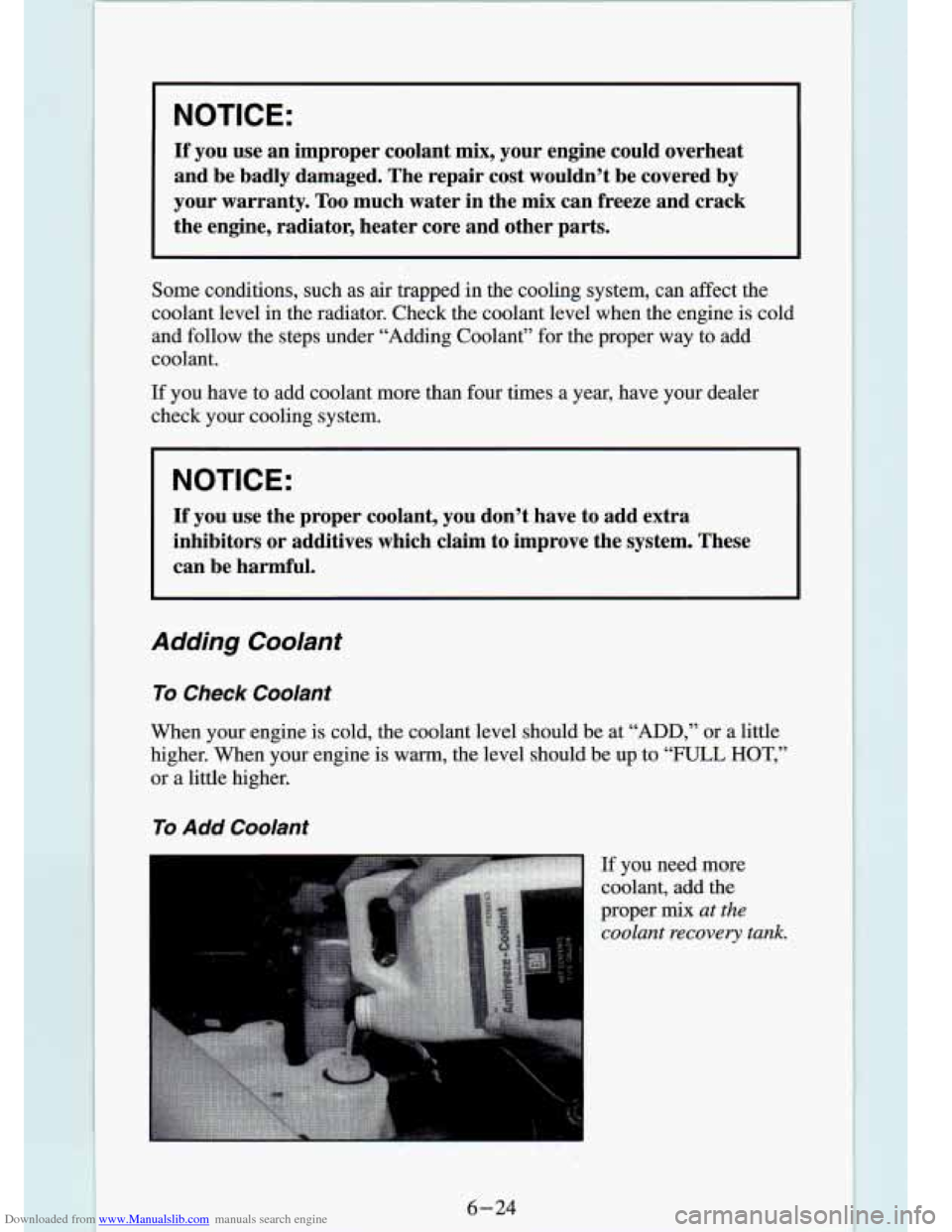
To Add Coolant
I
If you need more
coolant, add the
proper
mix at the
coolant recovery tank.
6-24
Page 295 of 340

Downloaded from www.Manualslib.com manuals search engine FUSEKIRCUIT BREAKER
6
10
11
12
13
14
15
16
17
18
19
20
21
22
23
24
NAME
HTR NC
CIRCUITS PROTECTED
Blower Motor, Temperature Door
Motor
PWR AUX Pwr Auxiliary Outlets
(NOT USED) ECM BATT Engine Computer (Battery), ABS
Battery, Fuel Pump
ECM IGN Engine Computer (Ignition), Injectors, Engine Sensors
RADIO
(NOT USED) RDO/BATT ILLUM
DRL
TURN B/U
WIPER
BRAKE
4 WD
(NOT USED) FOG
(NOT USED)
(NOT USED)
(NOT USED) Radio,
Inside Rearview
Mirror Map
Lamps
Clock, Radio Battery, CD Player
Cluster Illumination, Ash Tray Lamp,
Radio Illumination, Heater Lamp,
Four-wheel Drive Illumination, Chime Module, Fog Lamp Switch
Illumination, Daytime Running
Lamps
Daytime Running Lamps (Canada
Turn Signals, Backup Lamps
Windshield Washer, Windshield
Wiper Motor Only)
Speedometer, Anti-lock Braking
System, Cruise Control
Four-wheel Drive
Fog Lamps
Page 329 of 340
Downloaded from www.Manualslib.com manuals search engine Daytime Running Lights (Canada Only) ......................... 247. 2-64
Indicator Light
..................................... 2-47.2-62. 2-64
DomeLight
.................................................... 2-48
Doors
.......................................................... 2-5
Driving Locks
........................................................ 2-6
Across an Incline
............................................. 4-22
After Off-Road Driving
........................................ 4-25
AtNight
.................................................... 4-25
Backingup
.................................................. 4-42
Defensive
.................................................... 4-2
Downhill ...................................................... 4-20
Freeway
..................................................... 4-29
Highway Hypnosis
............................................ 4-31
Hydroplaning
................................................ 4-27
InBlizzard
................................................... 4-33
InCity
...................................................... 4-28
In Mud. Sand. Snow. Or Ice ................................ 4-23. 5-35
InRain
...................................................... 4-26
InWater
..................................................... 4-24
LossofControl
............................................... 4-12
Nightvision
................................................. 4-26
Off-Roading
................................................. 4-13
OnCurves
................................................... 4-18
OnGrades
................................................... 4-43
On Hill and Mountain Roads
.................................... 4-31
On Off-Road Hills
............................................ 4-17
OnSnoworIce
............................................... 4-33
Passing
..................................................... 4-11
Skidding
.................................................... 4-12
Stuck in Deep Snow
........................................... 5-35
Throughwater
.......................................... 2-14. 4-24
Uphill
...................................................... 4-18
Winter ...................................................... 4-33
WithaTrailer
................................................ 4-38
DrunkenDriving
................................................. 4-2
E
Electrical System Accessory Power Outlets
....................................... 2-51
Add-on Equipment
........................................... 6-70
Adding Coolant
.......................................... 5-15, 6-25
Aircleaner
.................................................. 6-14
Coolant (Block) Heater
................................ 2.14.3-5. 6.13
Coolant
................................................ 6.23. 6.73
Coolant Temperature Gage
...................................... 2-60
Crankcase
................................................... 6-74
Exhaust
..................................................... 2-25
FanNoise
................................................... 5-19
Identification
............................................ 6-69, 6-73
Oil (See “Oil”)
Engine
3