Page 162 of 274
Downloaded from www.Manualslib.com manuals search engine I -
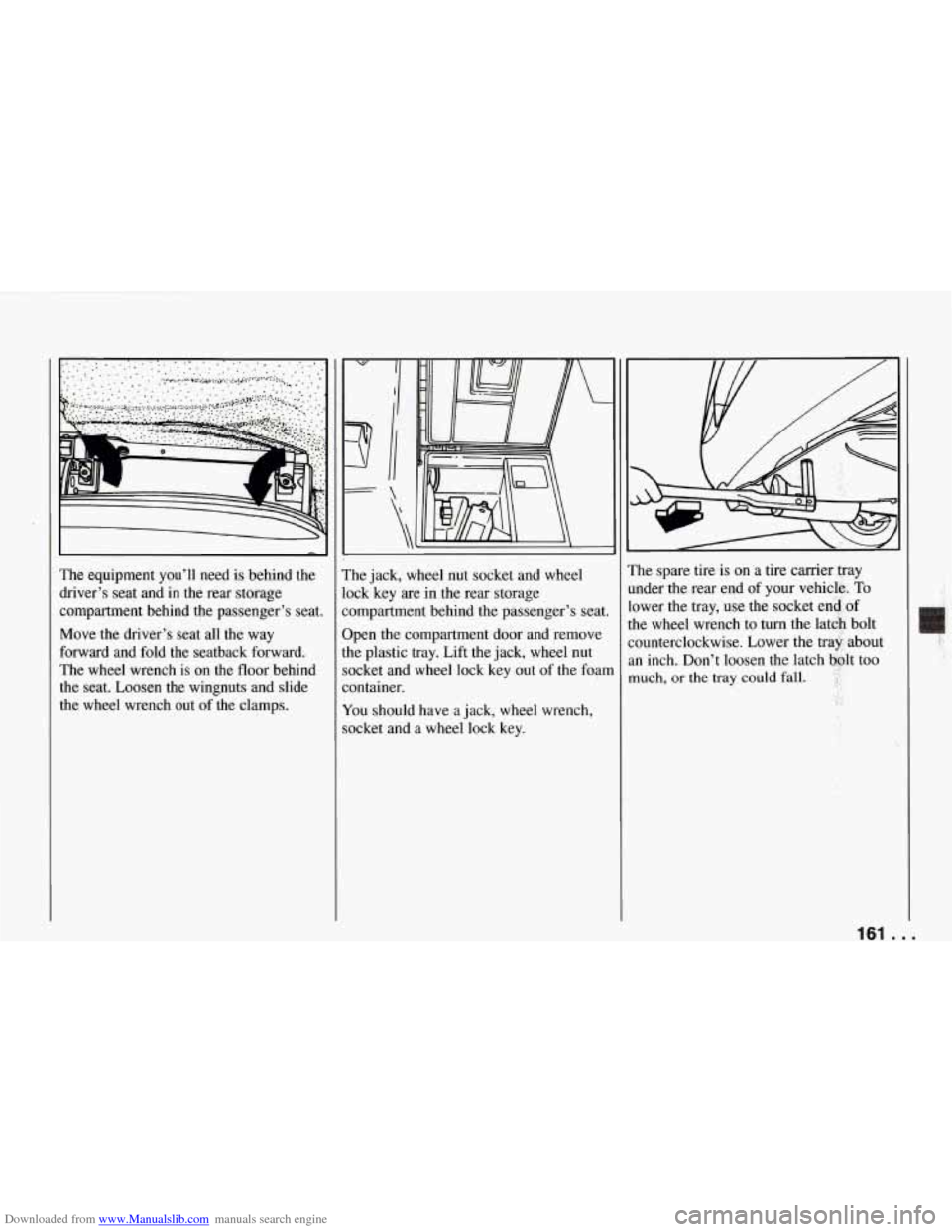
The equipment you’ll need is behind the
driver’s seat and in the rear storage
compartment behind the passenger’s seat.
Move the driver’s seat all the way
forward and fold the seatback forward.
The wheel wrench is on the floor behind
the seat. Loosen the wingnuts and slide
the wheel wrench out of the clamps. The
jack, wheel nut socket and wheel
ock key are in the rear storage
:ompartment behind the passenger’s seat.
]pen the compartment door and remove
,he plastic tray. Lift the jack, wheel nut
socket and wheel lock key out
of the foan
container.
You should have a jack, wheel wrench,
socket and
a wheel lock key. The
spare tire is on a tire carrier Q-ay
mder the rear end of your vehicle,.
To
lower the tray, use the socket end of
:he wheel wrench to turn the latch bolt
:ounterclockwise. Lower the trag- about
an inch. Don’t loosen the latch bplt too
much, or the tray could fall.
,i
161 ...
Page 163 of 274
Downloaded from www.Manualslib.com manuals search engine Problems on the Road
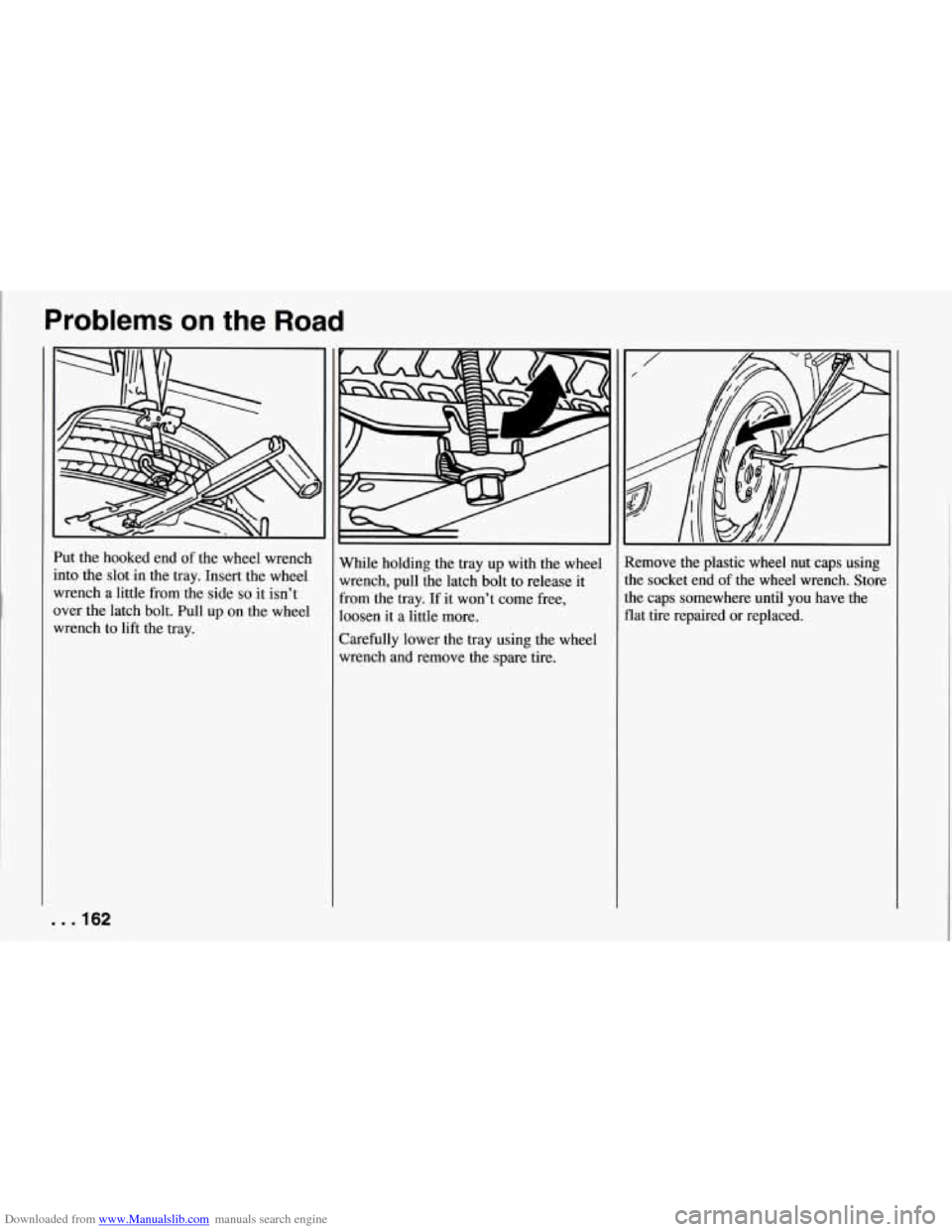
Put the hooked end of the wheel wrench
into the slot in the tray. Insert the wheel
wrench a little from the side
so it isn't
over the latch bolt. Pull up on the wheel
wrench to lift the tray. While holding the tray up with
the wheel
wrench, pull the latch bolt to release it
from the tray. If it won't come free,
loosen it a little more.
Carefully lower the tray using the wheel wrench and remove the spare tire. Zemove
the plastic wheel nut caps using
he socket end
of the wheel wrench. Store
he caps somewhere until you have the
Iat tire repaired or replaced.
. . .I62
Page 165 of 274
Downloaded from www.Manualslib.com manuals search engine Problems on the Road
~~~ ~~~~
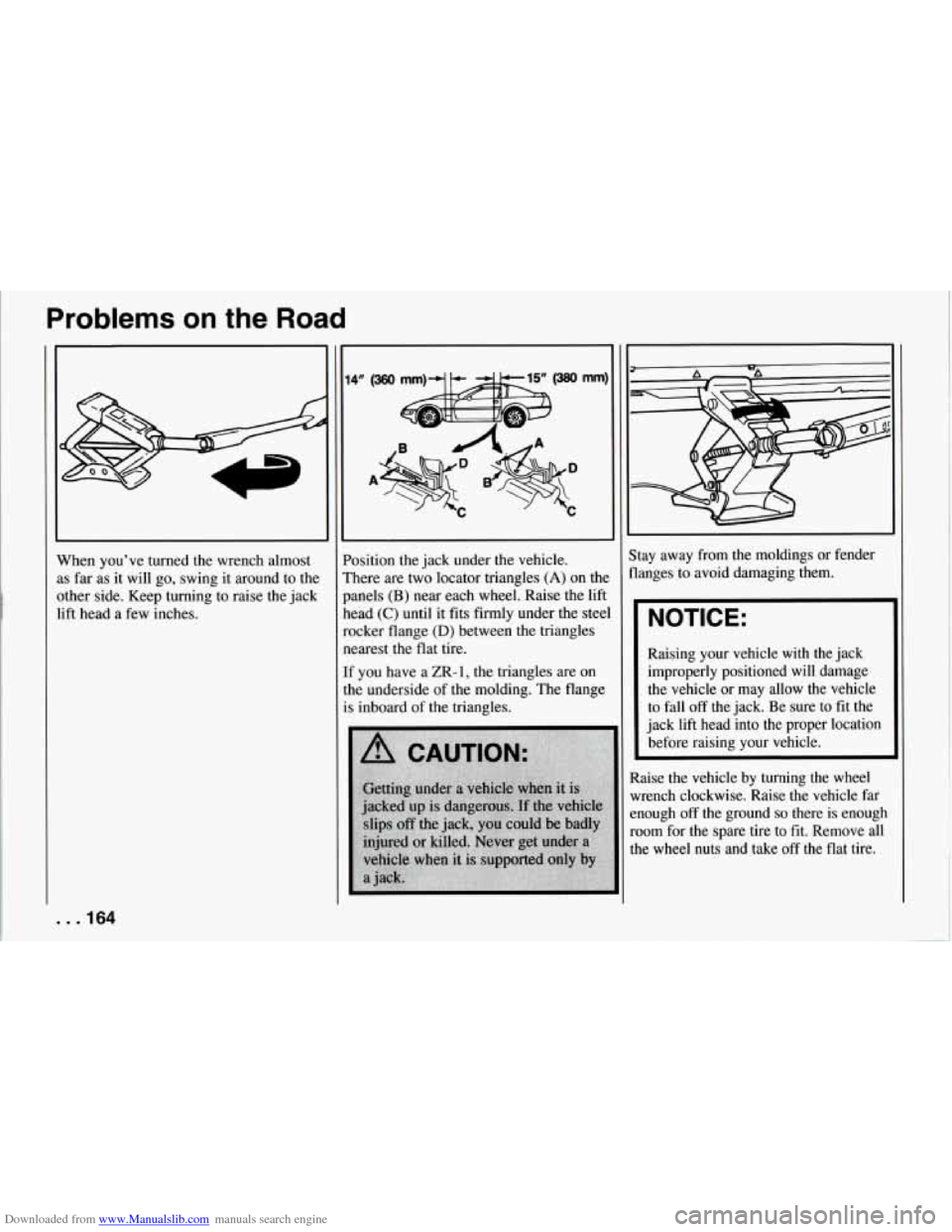
When you've turned the wrench almost
LS far as it will go, swing it around to the
)ther side. Keep turning to raise the jack
ift head a few inches.
. .I64
A
'osition the jack under the vehicle.
rhere are two locator triangles
(A) on the
,anels (B) near each wheel. Raise the lift
lead (C) until it fits firmly under the steel
ocker flange
(D) between the triangles
learest the flat tire.
f you have a ZR-
1 the triangles are on
he underside of the molding. The flange
s inboard of the triangles.
I
Stay away from the moldings or fender
flanges to avoid damaging them.
NOTICE:
Raising your vehicle with the jack
improperly positioned will damage
the vehicle or may allow the vehicle
to fall
off the jack. Be sure to fit the
jack lift head into the proper location
before raising your vehicle.
Raise the vehicle by turning the wheel
wrench clockwise. Raise the vehicle far
enough
off the ground so there is enough
room for the spare tire to fit. Remove all
the wheel nuts and take
off the flat tire.
Page 166 of 274
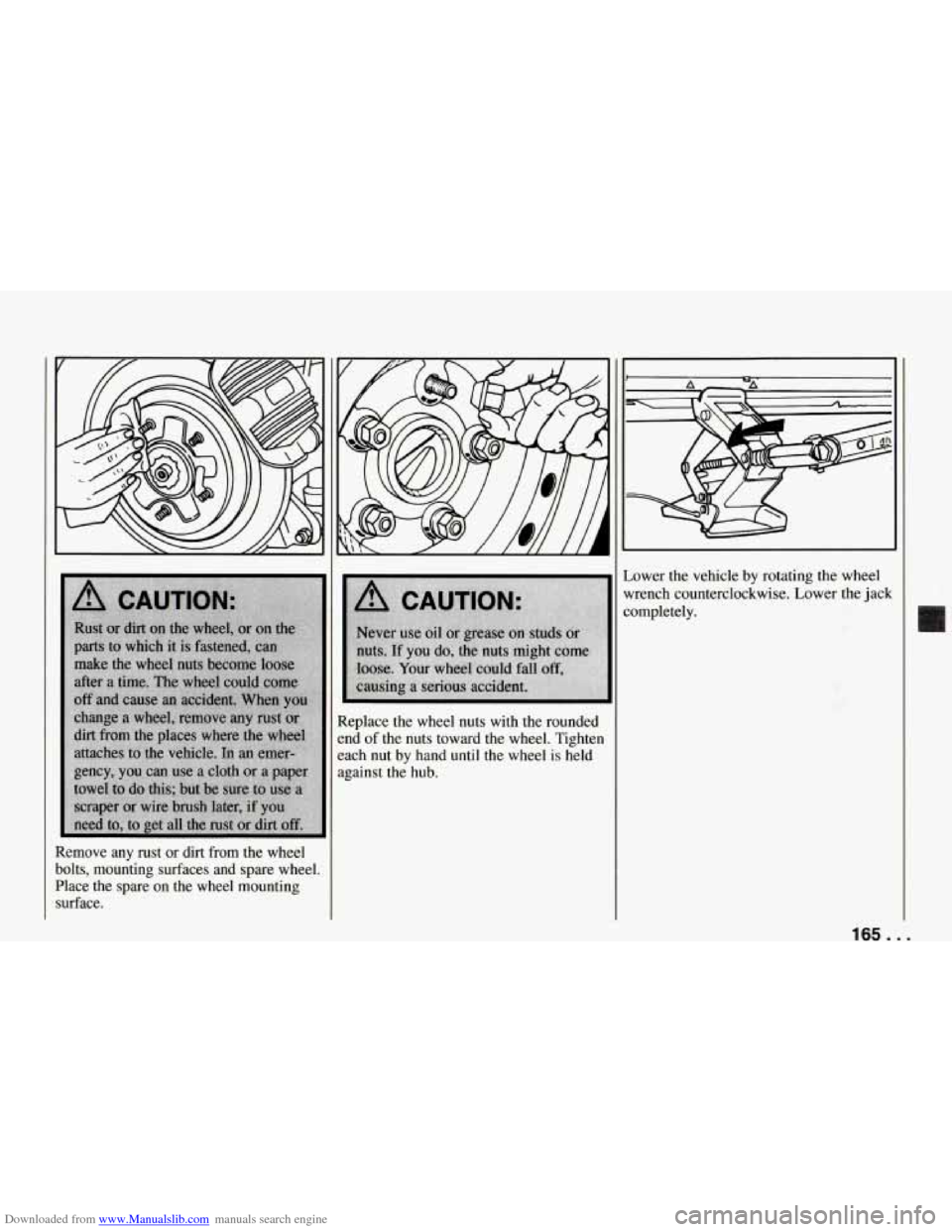
Downloaded from www.Manualslib.com manuals search engine Remove any rust or dirt from the wheel
bolts, mounting surfaces and spare wheel.
Place the spare on the wheel mounting surface. Replace the wheel nuts with
the rounded
end
of the nuts toward the wheel. Tighten
each nut by hand until the wheel is held
against the hub.
I =k'
W
Lower the vehicle by rotating the wheel
wrench counterclockwise. Lower the jack
completely.
.. ,..,e.
,,2.' Ts '*I ; ..
,i$
165 ...
Page 167 of 274
Downloaded from www.Manualslib.com manuals search engine Problems on the Road
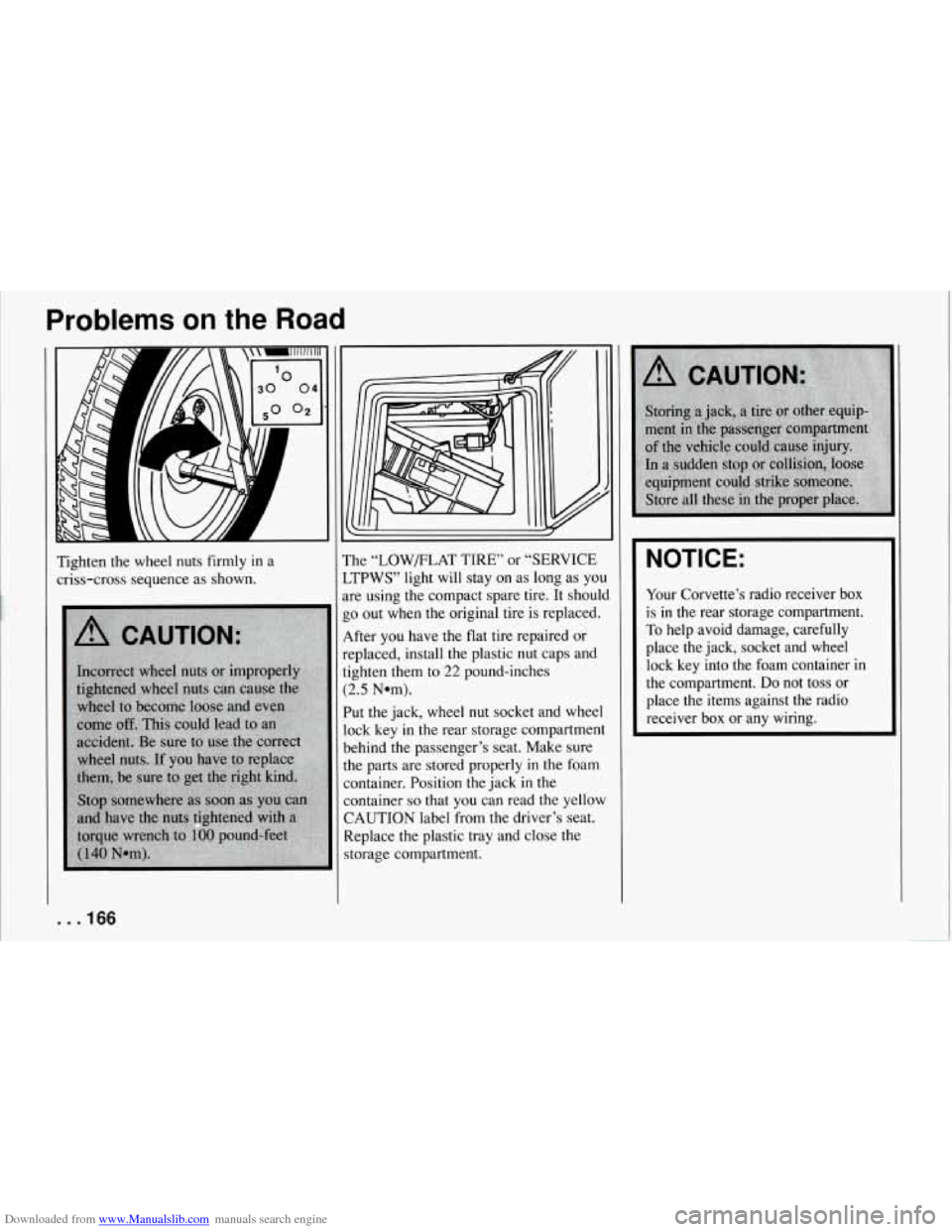
Tighten the wheel nuts firmly in a
criss-cross sequence as shown. The
“LOWELAT TIRE” or “SERVICE
LTPWS” light will stay on as long as you
ire using the compact spare tire. It should
50 out when the original tire is replaced.
9fter you have the flat tire repaired or
eeplaced, install the plastic
nut caps and
lighten them to
22 pound-inches
:2.5 Nom).
Put the jack, wheel nut socket and wheel
.ock
key in the rear storage compartment
3ehind the passenger’s seat. Make sure
:he parts are stored properly
in the foam
Zontainer. Position the jack in the
Zontainer
so that you can read the yellow
CAUTION label from
the driver’s seat.
Replace the plastic tray
and close the
storage compartment.
NOTICE:
Your Corvette’s radio receiver box
is in the rear storage compartment.
To help avoid damage, carefully
place the jack, socket and wheel
lock key into the foam container
in
the compartment. Do not toss or
place the items against the radio
receiver
box or any wiring.
. . .I66
Page 168 of 274
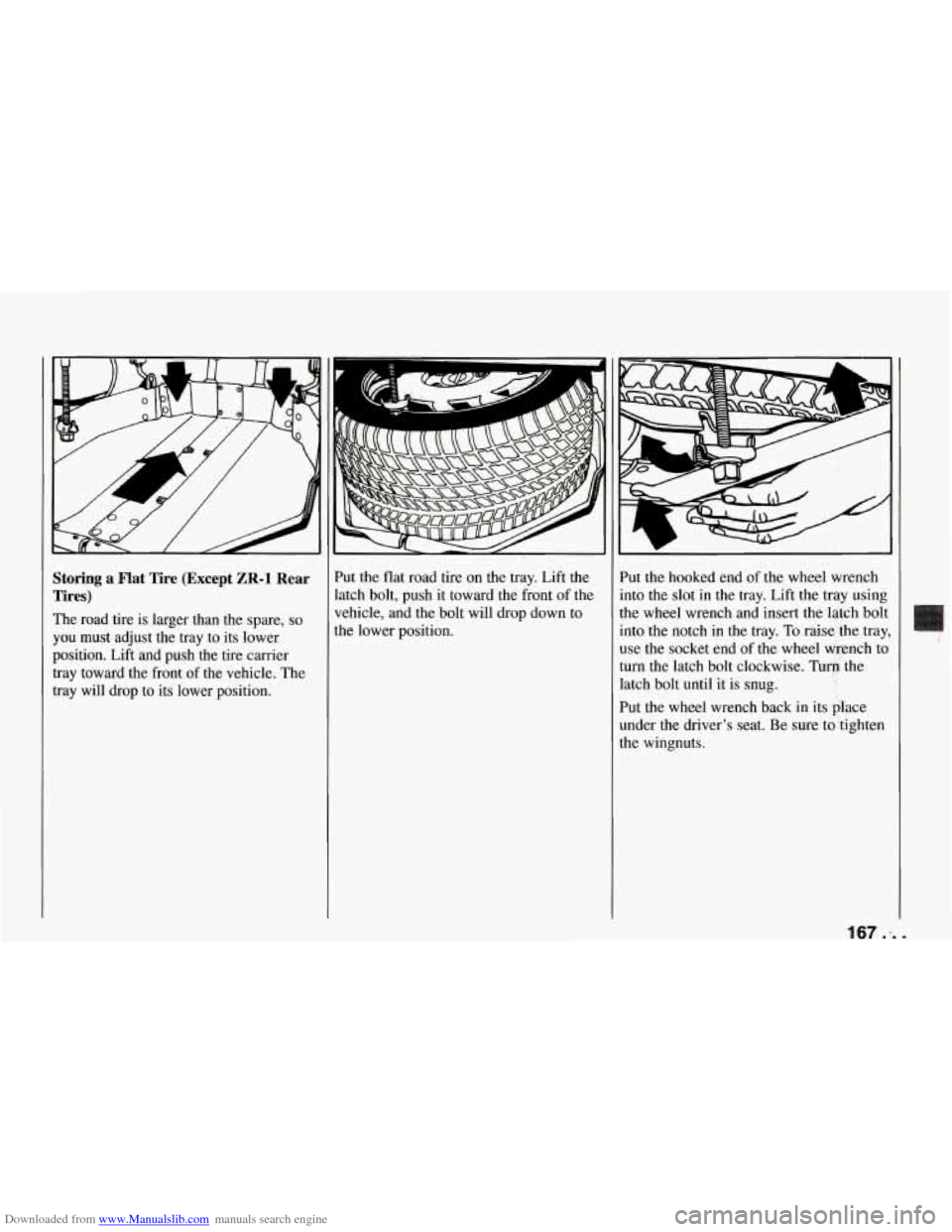
Downloaded from www.Manualslib.com manuals search engine Storing a Flat Tire (Except ZR-1 Rear
Tires)
The road tire is larger than the spare, so
you must adjust the tray to its lower
position. Lift and push the tire carrier
tray toward the front of the vehicle. The
tray will drop to its lower position. Put
the flat road tire
on the tray. Lift the
latch bolt, push it toward the front
of the
vehicle, and the bolt will drop down to
the lower position. Put the
hooked end of the wheel wrench
into the slot in the tray. Lift the tray using
the wheel wrench and insert the latch bolt
into the notch
in the tray. To raise the tray,
use the socket end of the wheel wrench to
turn the latch bolt clockwise. Turn the
latch bolt until it is snug.
Put the wheel wrench back in its place
under the driver's seat. Be sure to tighten
the wingnuts.
167 :. .
Page 170 of 274
Downloaded from www.Manualslib.com manuals search engine Compact Spare Tire
Although the compact spare was fully
inflated when your vehicle was new, it
can lose air after a time. Check the
inflation pressure regularly. It should be
60 psi (420 kPa). After installing the
compact spare on your vehicle, you
should stop as soon as possible and make
sure your spare tire is correctly inflated.
The compact spare is made to perform
well at posted speed limits for distances
up to
3,000 miles (5 000 km), so you can
finish your trip and have your full-size
tire repaired or replaced where you want.
Of course, it’s best to replace your spare
with a full-size tire as soon as you can.
Your spare will last longer and be in
good shape in case you need it again.
-
NOTICE:
Don’t take your compact spare
through an automatic car wash with
guide rails. The compact spare can
get caught on the rails. That can
damage the tire and wheel, and
maybe other parts
of your vehicle.
Don’t use your compact spare on some
other vehicle.
And don’t
mix your compact spare or
wheel with other wheels
or tires. They
won’t
fit. Keep your spare and its wheel
together.
NOTICE:
Tire chains won’t fit your compact
spare. Using them will damage
your vehicle and destroy the chains
too. Don’t use tire chains on your
compact spare.
If You’re Stuck: In
Sand, Mud, Ice or
Snow
What you don’t want to do when your
vehicle is stuck is to spin your wheels.
The method known as “rocking” can help
you get out when you’re stuck, but .you
must use caution.
169 ...
Page 207 of 274
Downloaded from www.Manualslib.com manuals search engine Service and Appearance Care
Inflation - Tire Pressure
The Tire-Loading Information label which is on the driver’s door shows the correct
inflation pressures for your tires, when they’re cold. “Cold” means your vehicle has
been sitting for at least three hours or driven no more than a mile.
For competitive driving or high-speed driving (over
150 mph or 240 krn/h), make
sure your tires are inflated to
35 psi (240 kPa). When you end this type of driving,
reduce the “cold” inflation pressures (if necessary) to those listed
on the
Tire-Loading Information label.
NOTICE:
Don’t let anyone tell you that underinflation or overinflation is all right. It’s not.
If your tires don’t have enough air (underinflation) you can get:
0 Too much flexing
0 Too much heat
0 Tire overloading
0 Bad wear
0 Bad handling
Bad fuel economy.
If your tires have too much air (overinflation), you can get:
Unusual wear
Bad handling
0 Rough ride
Needless damage from road hazards.
When to Check: Check your tires
mce
a month or more. Don’t forget
your compact spare tire. It should be at
50 psi (420 Wa).
How to Check: Use a good quality
pocket-type gauge to check tire
pressure. Simply looking at the tires
will not tell you the pressure,
=specially if you have radial tires
-
which may look properly inflated even
if they’re underinflated.
Lf your tires have valve caps, be sure to
put them back on. They help prevent
leaks by keeping out dirt and moisture.
Tire Rotation
I’he tires on your Corvette are
lirectional, asymmetrical, and are
different sizes front to rear. Due to this,
your tires should not be rotated. Each
tire and wheel should be used only in
the position it is in.
. . .206