1994 CHEVROLET CORVETTE fuel type
[x] Cancel search: fuel typePage 93 of 274
Downloaded from www.Manualslib.com manuals search engine Features and Controls
I NOTICE:
I
Damage to your engine from
neglected oil problems can be costly
and is not covered by your warranty.
... 92
TEMP OIL
OF TEMP OIL
‘F
280
T1 Engine LT5 Enginl
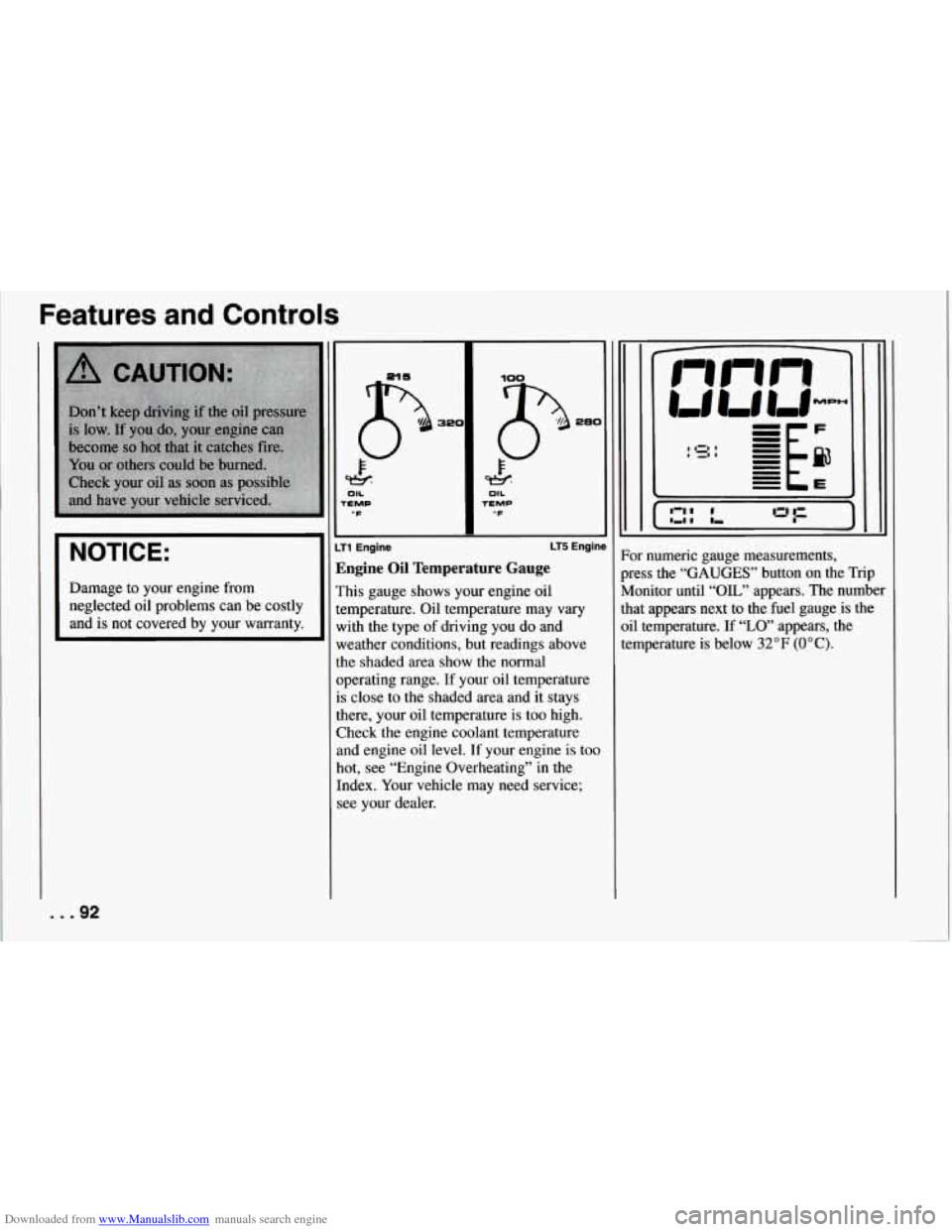
Zngine Oil Temperature Gauge
rhis gauge shows your engine oil
emperature. Oil temperature may
vary
vith the type of driving you do and
weather conditions, but readings above
the shaded area show the normal
operating range. If your oil temperature
is close to the shaded area and it stays
there, your oil temperature is too high.
Check the engine coolant temperature
and engine oil level. If your engine
is too
hot, see “Engine Overheating” in the
Index. Your vehicle may need service;
see your dealer.
1 IZI I
I ,I I
)r numeric gauge measurements,
ness the
“GAUGES” button on the Trip
[onitor until
“OIL” appears. The number
at appears next to the fuel gauge is the
1 temperature. If “LO’ appears, the
mperature
is below 32°F (OOC).
Page 176 of 274
Downloaded from www.Manualslib.com manuals search engine Be careful not to spill gasoline. Clean
5asoline from painted suirfaces
as soon
1s possible. See “Cleaning the Outside
If Your Corvette’’ in the Index.
When you put the cap back on, turn it to
:he right until you hear at least three
:licks.
NOTICE:
If you need a new cap, be sure to
get the right type. Your dealer can
get one for you.
If you get the wrong
type, it may not fit or have proper
venting, and your fuel tank and
emissions system might be damaged.
I Checking Things under
the Hood
Hood Release
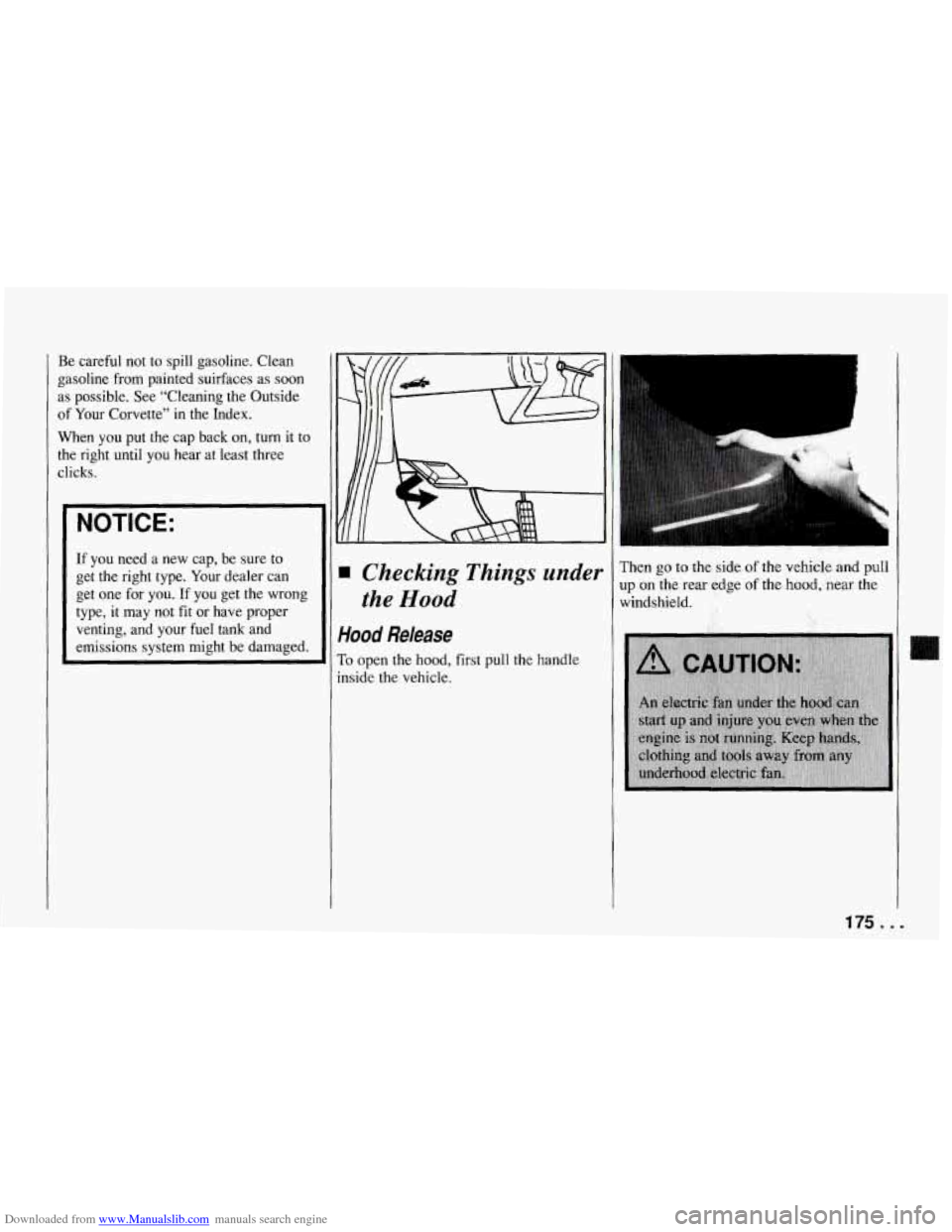
ro open the hood, first pull the handle
inside the vehicle.
L
Fhen go to the side of the vehicle and pull
~p on the rear edge of the hood, near the
windshield.
175 ...
Page 207 of 274
Downloaded from www.Manualslib.com manuals search engine Service and Appearance Care
Inflation - Tire Pressure
The Tire-Loading Information label which is on the driver’s door shows the correct
inflation pressures for your tires, when they’re cold. “Cold” means your vehicle has
been sitting for at least three hours or driven no more than a mile.
For competitive driving or high-speed driving (over
150 mph or 240 krn/h), make
sure your tires are inflated to
35 psi (240 kPa). When you end this type of driving,
reduce the “cold” inflation pressures (if necessary) to those listed
on the
Tire-Loading Information label.
NOTICE:
Don’t let anyone tell you that underinflation or overinflation is all right. It’s not.
If your tires don’t have enough air (underinflation) you can get:
0 Too much flexing
0 Too much heat
0 Tire overloading
0 Bad wear
0 Bad handling
Bad fuel economy.
If your tires have too much air (overinflation), you can get:
Unusual wear
Bad handling
0 Rough ride
Needless damage from road hazards.
When to Check: Check your tires
mce
a month or more. Don’t forget
your compact spare tire. It should be at
50 psi (420 Wa).
How to Check: Use a good quality
pocket-type gauge to check tire
pressure. Simply looking at the tires
will not tell you the pressure,
=specially if you have radial tires
-
which may look properly inflated even
if they’re underinflated.
Lf your tires have valve caps, be sure to
put them back on. They help prevent
leaks by keeping out dirt and moisture.
Tire Rotation
I’he tires on your Corvette are
lirectional, asymmetrical, and are
different sizes front to rear. Due to this,
your tires should not be rotated. Each
tire and wheel should be used only in
the position it is in.
. . .206
Page 225 of 274
Downloaded from www.Manualslib.com manuals search engine Service and Appearance Care
Capacities and Specifications
Engine
Type ............................................................. V8
Fuel Delivery
....................... Sequential Multiport Fuel Injection (SFI)
Valve Arrangement VIN Engine Code
J ................................. Dual Overhead Cam
VIN Engine Code
P .................................... Overhead Valve
Piston Displacement ....................................... 350 CID (5.7L)
Bore
VIN Engine Code
J ..................................... 3.90" (99 mm)
VIN Engine Code P .................................. .4.00" (101.6 mm)
VIN Engine Code
J ..................................... 3.66" (93 mm)
VIN Engine Code
P .................................. .3.48" (88.39 mm)
VIN Engine Code
J ............................................ 11 .O: 1
VIN Engine Code
P ............................................ 10.5: 1
Firingorder .......................................... 1-843-6-5-7-2
Stroke
Compression Ratio
.. .224
Page 238 of 274
Downloaded from www.Manualslib.com manuals search engine ITEM
NO. SERVICE
Index. This provides proper
freeze and boil protection,
corrosion inhibitor level and
maintains proper engine
operating temperature.
Inspect hoses and replace if
they are cracked, swollen or
deteriorated. Tighten screw-type
hose clamps. Clean the outside of
the radiator and air conditioning
condenser. Wash the pressure cap
and neck.
To help ensure proper operation,
we recommend a pressure test of
both the cooling system and the
pressure cap.
5 Transmission Service - For
manual transmissions, fluid
doesn’t require changing. See
“Periodic Maintenance
Inspection.”
For automatic transmissions,
change both the fluid and filter
every
15,000 miles (25 000 km)
ITEM
NO. SERVICE
if the vehicle is mainly driven
under one or more of these
conditions:
In heavy city traffic where the
outside temperature regularly
reaches
90 OF (32 O C) or
higher.
In hilly or mountainous
terrain.
Uses such as found in taxi,
police car or delivery service.
If you do not use your vehicle
under any of these conditions,
change both
the fluid and
filter every
100,000 miles
(1 66 000 km).
Replace spark plugs with the
proper type. See “Replacement
Parts” in the Index.
6 Spark Plug Replacement* -
7 Spark Plug Wire Inspection*? -
Inspect for burns, cracks or other
damage. Check the boot fit at the
coils and at the spark plugs.
Replace wires as needed.
ITEM
NO. SERVICE
8 Air Cleaner Filter Replacement*-
Replace every
30,000 miles
(50 000 km) or more often under
dusty conditions. Ask your dealer
for the ’proper replacement inter-
vals for your driving conditions.
Inspection*?
- Inspect fuel tank,
cap and lines (including fuel rails
and injection assembly) for
damage or leaks. Inspect fuel cap
gasket for an even filler neck
imprint or any damage. Replace
parts as needed. Periodic replace-
ment of the fuel filter is not
required.
9 Fuel Tank. Cap and Lines
* An Emission Control Service.
t The U.S. Environmental Protection Agency
or the California Air Resources Board has
determined that the failure to perform this
maintenance item will not nullify the emission
warranty or limit recall liability prior to the
completion
of vehicle useful life. General
Motors, however, urges that all recommended
maintenance services be performed at the
indicated intervals and the maintenance be
recorded in “Section
E: Maintenance Record.”
I -I
237. . .