1994 CHEVROLET CORVETTE key
[x] Cancel search: keyPage 50 of 274

Downloaded from www.Manualslib.com manuals search engine I NOTICE:
Your engine is designed to work with
the electronics in your vehicle. If you
add electrical parts or accessories,
you could change the way the fuel
injection system operates. Before
adding electrical equipment, check
with your dealer. If you don’t, your
engine might not perform properly.
If you ever have to have your vehicle
towed, see the part
of this manual
that tells how to do it without
damaging your vehicle. See “Towing
Your Vehicle” in the Index.
Engine Power Switch (ZR-I)
The LT5 engine in your ZR-1 has two sets
of intake runners and fuel injectors. The
primary set can be run alone for normal
engine power, or both sets can be used
for
full engine power.
Full power gives you extra power for
highway touring and off-road sports use
and reserve power for passing. With
normal power, you’ll notice less engine
and exhaust noise. To
change the power setting, put your
engine power key into the switch. Turn
the key to the setting you want and let
go
The key will return to the center position.
Your ZR-1 is able to run at full power
under the following conditions:
The engine coolant and oil
temperatures are greater than
68 OF
(20°C) but less than 302°F (150°C).
e System voltage is greater than ten
e The “SERVICE ENGINE SOON’
volts.
light is not on.
You can switch the setting at engine
speeds up to
4,000 rpm. When you
select the
“FULL” setting, a light near
[he switch will come on. It should go
>ut when you change back to the
“NORMAL” setting. When you turn the
ignition
off, the setting will go back to
normal power.
Off-Road Track Use
See your Warranty Book before using
your Corvette for off-road track use.
NOTICE:
If you use your Corvette for off-road
track use, your engine may use more
oil than it would with normal use.
Low oil levels can damage the
engine. Be sure to check the oil level
often during off-road track use.
You
may need to add additional oil. See
“Engine Oil” in the Index.
49 ...
Page 52 of 274
Downloaded from www.Manualslib.com manuals search engine How long should you keep the coolant
heater plugged in? The answer depends
on the weather, the kind of
oil you have,
and some other things. Instead of trying
to list everything here, we ask that you
contact your Chevrolet dealer in the area
where you’ll be parking your vehicle. The
dealer can give you the best advice for
that particular area.
. i:,
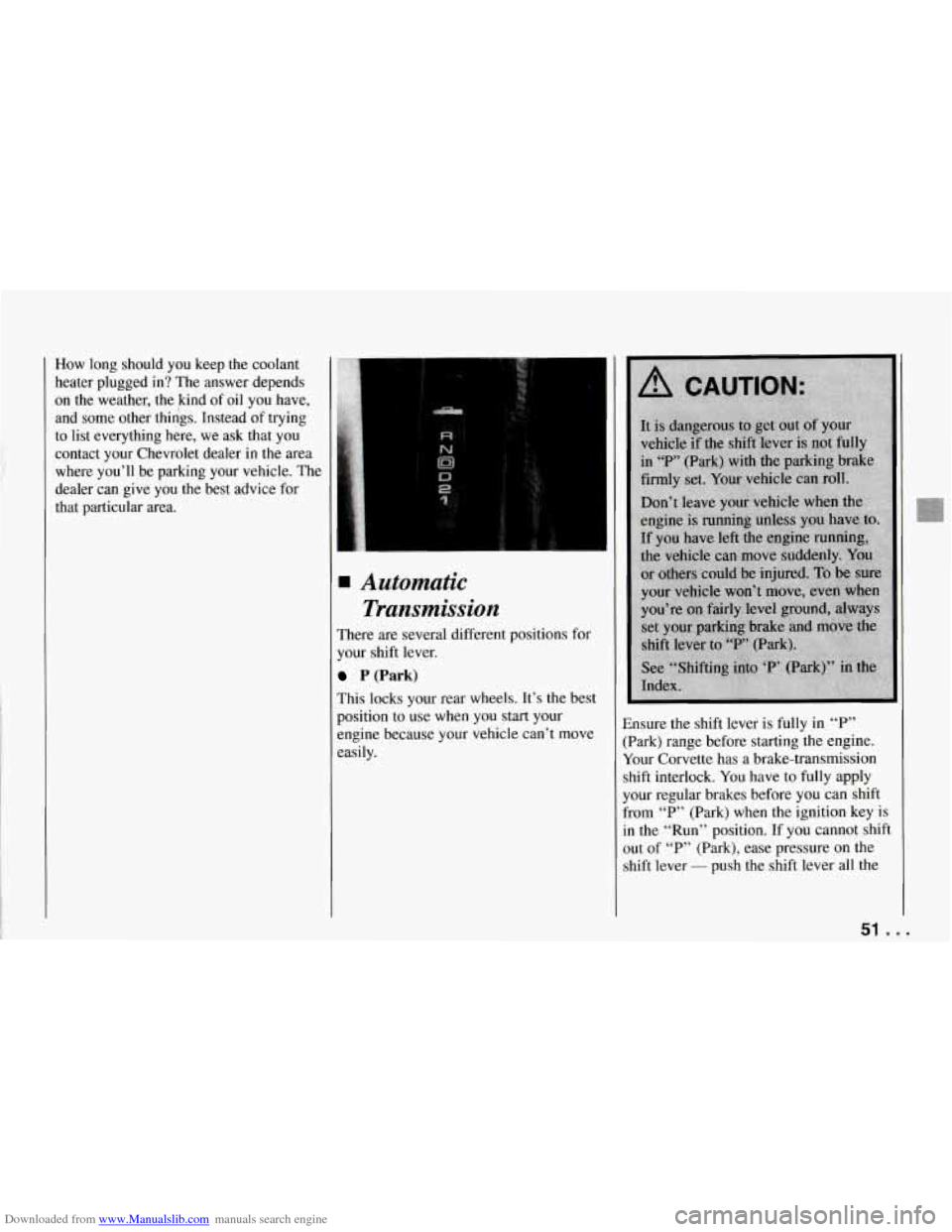
Automatic Transmission
There are several different positions for
your shift lever.
P (Park)
This locks your rear wheels. It’s the best
position to use when you start your
engine because your vehicle can’t move
easily. Ensure the shift
lever is fully in
“P”
(Park) range before starting the engine.
Your Corvette has a brake-transmission
shift interlock. You have to fully apply
your regular brakes before you can shift
from “P” (Park) when the ignition key is
in the “Run” position. If you cannot shift
out of
“P” (Park), ease pressure on the
shift lever
- push the shift lever all the
51 ...
Page 58 of 274
Downloaded from www.Manualslib.com manuals search engine I // /
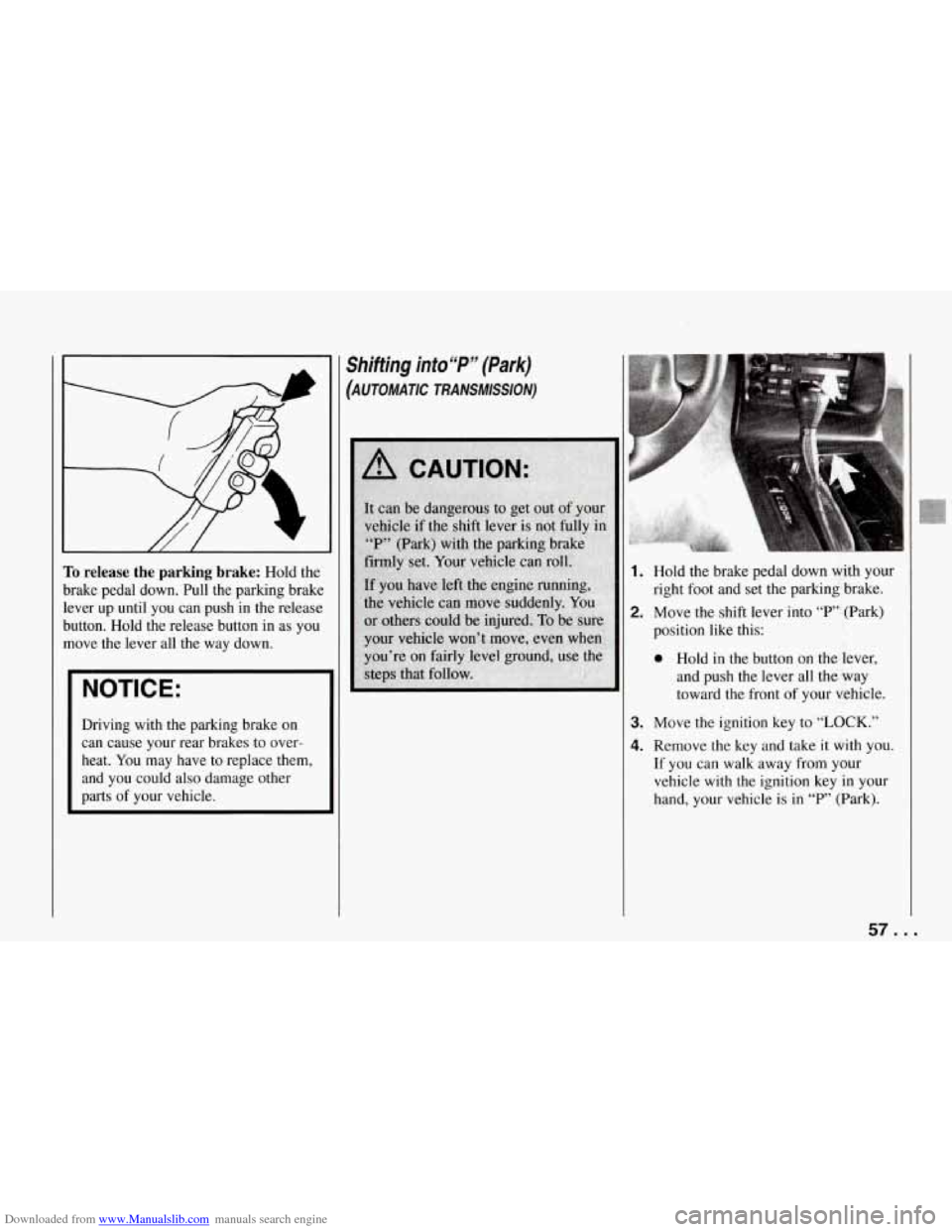
To release the parking brake: Hold the
brake pedal down. Pull the parking brake
lever up until you can push in the release
button. Hold the release button in as
you
move the lever all the way down.
NOTICE:
Driving with the parking brake on
can cause your rear brakes to over-
heat.
You may have to replace them,
and you could also damage other
parts
of your vehicle.
Shifting into“P” (Park)
(AUTOMATIC TRANSMISSION)
1. Hold the brake pedal down with your
right foot and set the parking brake.
2. Move the shift lever into “P’ (Park)
position like this:
0 Hold in the button on the lever,
and push the lever all the way
toward the front
of your vehicle.
I 3. Move the ignition key to “LOCK.”
4. Remove the key and take it with you.
If you can walk away from your
vehicle with the ignition key
in your
hand, your vehicle
is in “P” (Park).
57 ...
Page 59 of 274
Downloaded from www.Manualslib.com manuals search engine Features and Controls
Leaving Your Vehicle with the
Engine Running
(AUTOMATIC TRANSMISSION)
Torque Lock
(AUTOMATIC TRANSMISSION)
If you are parking on a hill and you don’t
shift your transmission into
“P” (Park)
properly, the weight of the vehicle may
put too much force on the parking pawl in
the transmission. You may find it difficult
to pull the shift lever out of
“P’ (Park).
This is called “torque lock.” To prevent torque lock,
set the parking brake and
then shift into
“F’” (Park) properly before
you leave the driver’s seat.
To find out
how, see “Shifting into ‘P’ (Park)” in the
Index.
When you are ready to drive, move the
shift lever out of
“P” (Park) BEFORE
you release the parking brake.
If “torque lock” does occur, you may
need to have another vehicle push yours a
little uphill to take some of the pressure
from the transmission,
so you can pull
the shift lever out of
“P” (Park).
Shifting out of P (Park)
(AUTOMATIC TRANSMISSION)
Your Corvette has a brake-transmission
shift interlock. You have to fully apply
your regular brake before you can shift
from
“P” (Park) when the ignition is in
the “Run” position. See “Automatic
Transmission” in the Index.
If you cannot shift out of “P” (Park),
ease pressure on the shift lever
- push
the shift lever all the way into
“P” (Park)
and release
the shift lever button as you
maintain brake application. Then press
the shift lever button and move the shift
lever into the gear you wish. If you
ever hold the brake pedal down but
still can’t shift out of
“P” (Park), try this:
1. Turn the key to “Off.”
2. Apply and hold the brake until the end
3. Shift to “N’ (Neutral).
4. Start the vehicle and then shift to the
drive gear you want.
can. of Step
4.
5. Have the vehicle fixed as soon as you
Parking Your Vehicle
(MANUAL TRANSMISSION)
Before you get out of your vehicle, put
your manual transmission
in “R”
(Reverse) and firmly apply the parking
brake.
... 58
Page 71 of 274
Downloaded from www.Manualslib.com manuals search engine Features and Controls
Roof Panel (COUPE)
Until you are sure you can remove the
panel alone, have someone help you.
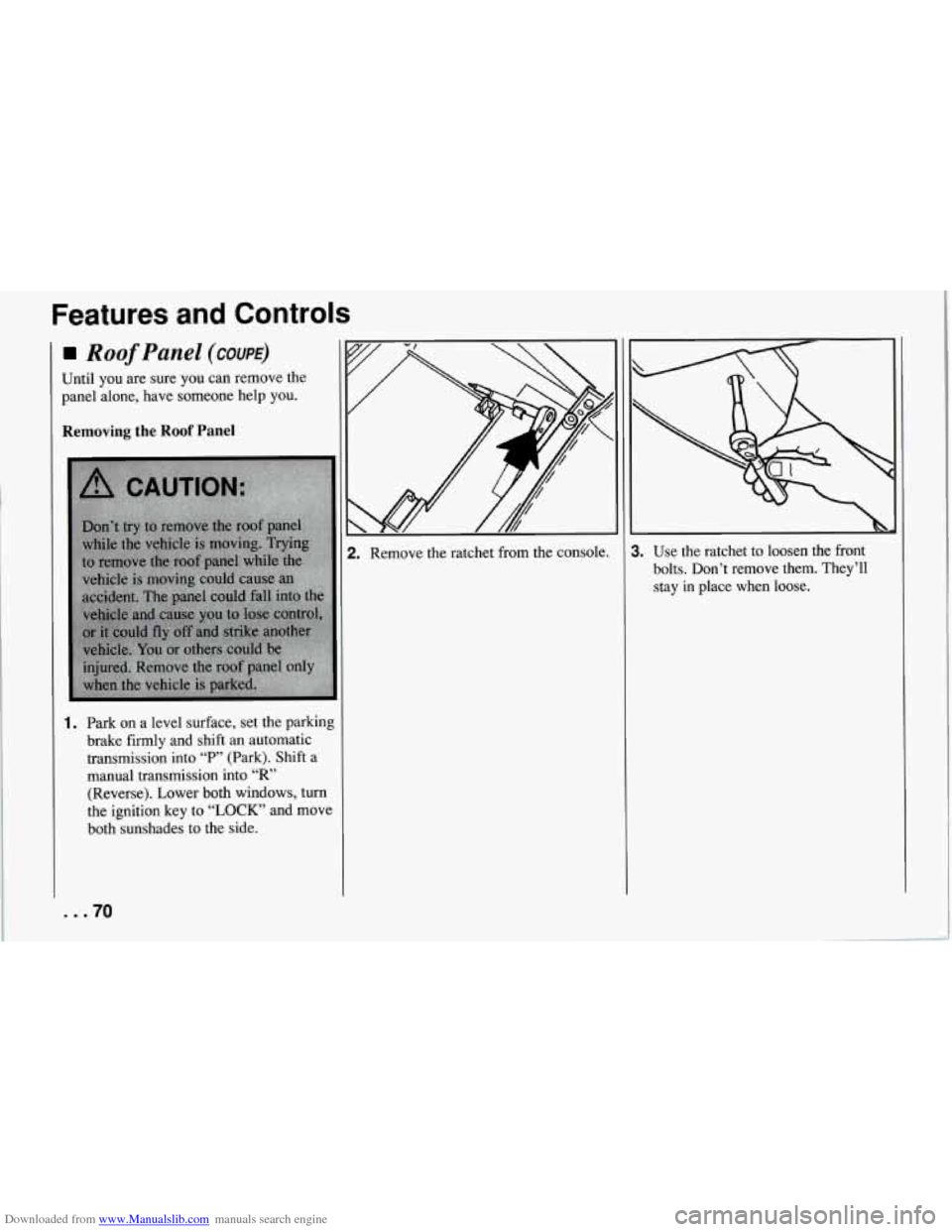
Removing the Roof Panel
1. Park on a level surface, set the parking
brake firmly and shift an automatic
transmission into
“P” (Park). Shift a
manual transmission into
“R’
(Reverse). Lower both windows, turn
the ignition key to
“LOCK” and move
both sunshades to the side.
... 70
2. Remove the ratchet from the console. 1. Use the ratchet to loosen the front
bolts. Don’t remove them. They’ll
stay
in place when loose.
Page 73 of 274
Downloaded from www.Manualslib.com manuals search engine Features and Controls
6. Gently lift up on the roof panel to be
sure
it is locked in place.
Installing the Roof Panel
1.
2.
Park on a level surface, set the parking
brake firmly and shift an automatic
transmission into “P” (Park). Shift a
manual transmission into
“R’
(Reverse).. Lower both windows, turn
the ignition key to “LOCK” and move
both sunshades to the side.
If the roof panel is stored in the rear
area, remove
it by reversing the steps
under “Storing the Roof Panel” above.
... 72
3. Lower the roof panel onto the vehicle,
rear edge first, and place the rear
guide pins into the holes in the roof
opening.
4. Lower the front of the roof panel, and
align the front guide pins.
5. Tighten the rear bolts part way.
NOTICE:
If you tighten bolts that are
improperly started,
the threads can
become stripped. Be sure all bolts are
properly started before you tighten
them.
6. Use the ratchet to start the front bolts.
If the bolts are hard to start, tighten
the rear bolts some more. Holding
down the panel on the outside will
also help.
front bolts.
7. Fully tighten the rear bolts, then the
If you hear a popping noise when you
drive,
the bolts may not be tight enough.
Be sure to tighten’them securely.
Storage and
Compartments
Center Console
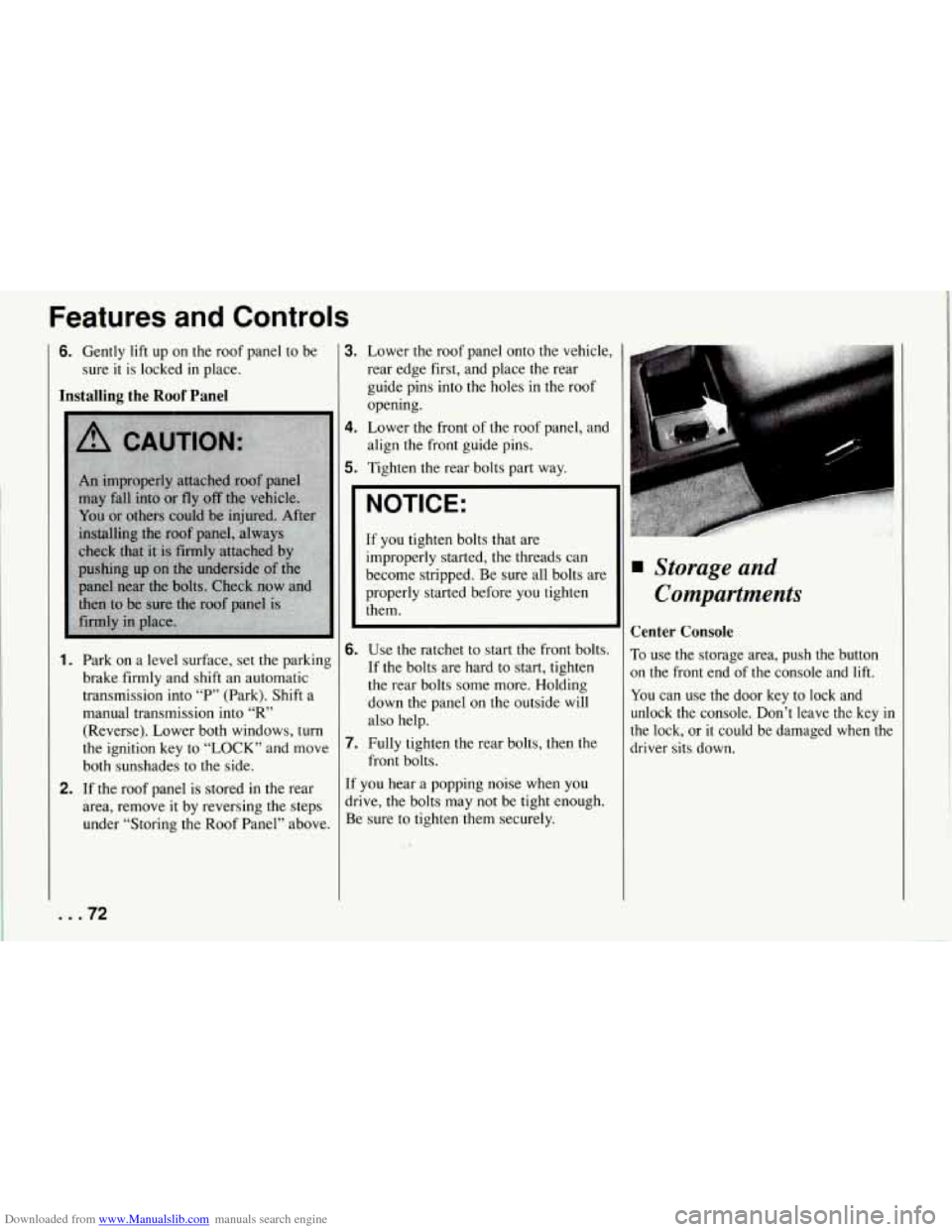
To use the storage area, push the button
on the front end of the console and lift.
You can use the door key to lock and
unlock the console. Don’t leave the key
in
the lock, or it could be damaged when the
driver sits down.
Page 74 of 274
Downloaded from www.Manualslib.com manuals search engine i
-l
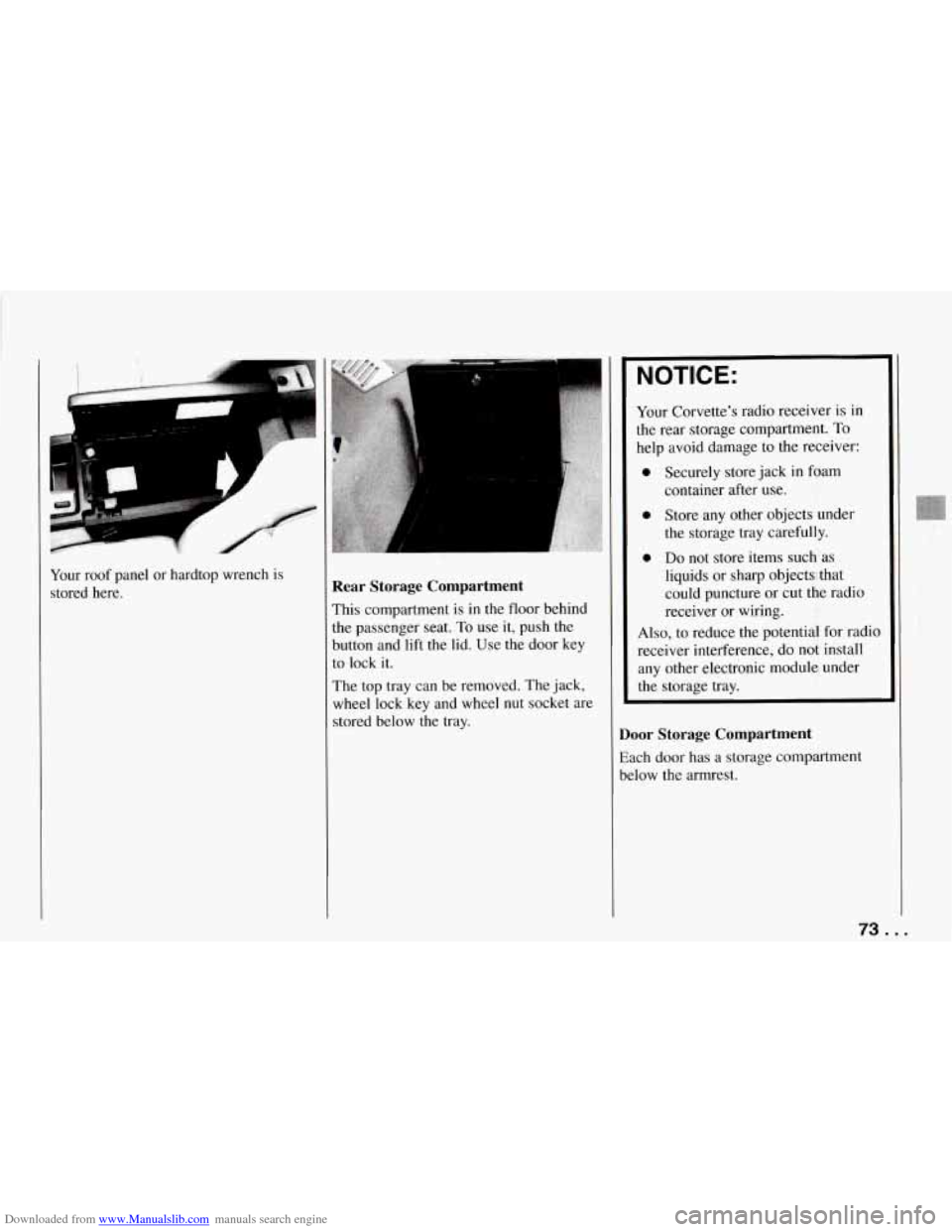
Your roof panel or hardtop wrench is
stored here. Rear Storage Compartment
This compartment is in the floor behind
the passenger seat.
To use it, push the
button and lift the lid. Use the door key
to lock it.
The top tray can be removed. The jack,
wheel lock key and wheel
nut socket are
stored below the tray.
NOTICE:
Your Corvette’s radio receiver is in
the rear storage compartment.
To
help avoid damage to the receiver:
0 Securely store jack in foam
0 Store any other objects under
the storage tray carefully.
0 Do not store items such as
liquids or sharp objects that
could puncture or cut the radio
receiver or wiring.
container
after use.
Also, to reduce the potential for radio
receiver interference, do not install
any other electronic module under
the storage tray.
Door Storage Compartment
Each door has a storage compartment
below the armrest.
73 ...
Page 83 of 274
Downloaded from www.Manualslib.com manuals search engine Features and Controls
Warning Lights, Gauges
and Indicators
This section describes the warning lights
and gauges that may be on your vehicle.
The pictures will help you locate them.
Warning lights and gauges can signal that
something is wrong before it becomes
serious enough to cause an expensive
repair or replacement. Paying attention
to your warning lights and gauges could
also save you or others from injury.
Warning lights go on when there may be
or
is a problem with one of your vehicle’s
functions.
As you will see in the details
on the
next few pages, some warning
lights come on briefly when you turn the
ignition key just to let you know they’re
working. If you are familiar with this
section, you should not be alarmed when
this happens.
Gauges can indicate when there may be
or is a problem with one of your vehicle’s
functions. Often gauges and warning
lights work together to
let you know
when there’s a problem with your vehicle.
... 82
When one of the warning lights comes on
and stays on when you are driving, or
when one of the gauges shows there may
be a problem, check the section that tells
you what to do about
it. Please follow the
manual’s advice. Waiting to
do repairs
can be costly
- and even dangerous. So
please get to know your warning lights
and gauges. They’re a big help.
Your vehicle also has a driver information
center that works along with the warning
lights and gauges. See “Driver Information Center’’
in the Index.
System Problems
If “SYS” flashes on the display near your
fuel gauge, there may be a problem with
your Corvette’s electrical system. If the
“SECURITY” light flashes at the same
time, there is a problem with your theft
deterrent system. Have your vehicle
checked by your dealer
if “SYS’ keeps
appearing.
Gauge Markings
The analog gauges provide a quick visual
reference to the actual measurement of
these gauges. However, you must keep in mind that the gauges aren’t linear. This means that the middle mark is not
a
temperature halfway between the top and
bottom temperatures on the gauge. For
example, the middle mark on the coolant
gauge represents 210°F,
not 180°F as you
might expect.