1994 CHEVROLET CORVETTE check engine light
[x] Cancel search: check engine lightPage 131 of 274
Downloaded from www.Manualslib.com manuals search engine Your Driving and the Road
0
0
..
If other cars are lined up to pass a
slow vehicle, wait your turn. But take
care that someone isn’t trying to pass
you as you pull out to pass the slow
vehicle. Remember to glance over
your shoulder and check the blind
spot.
Check your mirrors, glance over your
shoulder, and start your left lane
change signal before moving out of
the right lane to pass. When you are
far enough ahead
of the passed vehicle
to see its front
in your inside mirror,
activate your right lane change signal
and move back into the right lane.
(Remember that your right outside
mirror is convex. The vehicle you just
passed may seem to be farther away
from you than it really is.)
Try not to pass more than one vehicle
at a time on two-lane roads.
Reconsider before passing the next vehicle.
Don’t overtake a slowly moving
vehicle too rapidly. Even though the
brake lights are not flashing, it may be
slowing down or starting
to turn.
If you’re being passed, make it easy
for the following driver to get ahead
of you. Perhaps you can ease a little
to the right.
,130
Loss of Control
Let’s review what driving experts say
about what happens when the three
control systems (brakes, steering and
acceleration) don’t have enough friction
where the tires meet the road to do what
the driver has asked.
In any emergency, don’t give up. Keep
trying to steer and constantly seek an
escape route or area of less danger.
Skidding
In a skid, a driver can lose control of the
vehicle. Defensive drivers avoid most
skids by taking reasonable care suited to
existing conditions, and by not
“overdriving” those conditions. But skids
are always possible.
The three types of skids correspond to
your Corvette’s three control systems.
In the braking skid your wheels aren’t
rolling. In the steering or cornering skid,
too much speed or steering in a curve
causes tires to slip and lose cornering
force. And in the acceleration skid too
much throttle causes the driving wheels
to spin.
A cornering skid
is best handled by
easing your foot
off the accelerator pedal. Remember: Any
ASR system helps avoid
only the acceleration skid. If your ASR
system is
off, then an acceleration skid is
also best handled by easing your foot off
the accelerator pedal.
If your vehicle starts to slide, ease your
foot
off the accelerator pedal and quickly
steer the way you want the vehicle to go.
If you start steering quickly enough, your
vehicle may straighten out. Always be
ready for a second skid if it occurs.
Of course, traction is reduced when water,
snow, ice, gravel, or other material is on
the road. For safety, you’ll want to slow
down and adjust your driving to these
conditions. It is important to slow down
on slippery surfaces because stopping
distance will be longer and vehicle
control more limited.
Page 133 of 274
Downloaded from www.Manualslib.com manuals search engine Your Driving and the Road
vehicle with misaimed headlights), slow
down a little. Avoid staring directly into
the approaching lights.
Keep your windshield and all the glass
on your vehicle clean
- inside and out.
Glare at night is made much worse by dirt
on the glass. Even the inside of the glass
can build up a film caused by dust. Dirty
glass makes lights dazzle and flash more
than clean glass would, making the pupils
of your eyes contract repeatedly.
Remember that your headlights light up
far less of a roadway when you are in a
turn
or curve. Keep your eyes moving;
that way, it’s easier to pick out dimly
lighted objects. Just as your headlights
should be checked regularly for proper
aim,
so should your eyes be examined
regularly. Some drivers suffer from night
blindness
- the inability to see in dim
light
- and aren’t even aware of it.
. . .I32
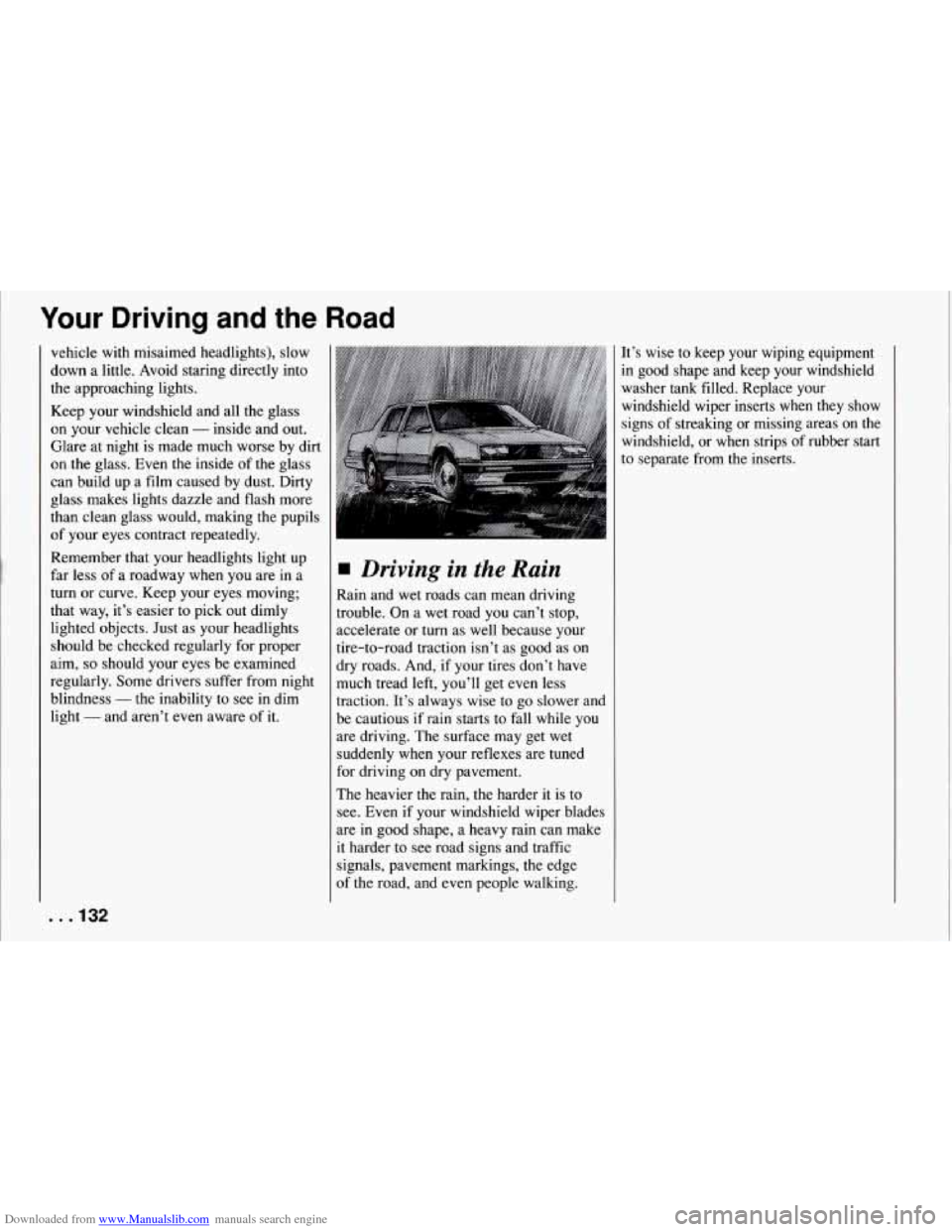
Driving in the Rain
Rain and wet roads can mean driving
trouble. On a wet road you can’t stop,
accelerate or turn as well because your
tire-to-road traction isn’t as good as on
dry roads. And, if your tires don’t have
much tread left, you’ll get even less
traction. It’s always wise to go slower and
be cautious
if rain starts to fall while you
are driving. The surface may get wet
suddenly when your reflexes are tuned
for driving on dry pavement.
The heavier the rain, the harder it is to
see. Even if your windshield wiper blades
are in good shape, a heavy rain can make
it harder to see road signs and traffic
signals, pavement markings, the edge
of the road, and even people walking. It’s wise
to keep your wiping equipment
in good shape and keep your windshield washer tank filled. Replace your
windshield wiper inserts
when they show
signs of streaking or missing areas on the
Windshield, or when strips of rubber start
to separate from the inserts.
Page 135 of 274
Downloaded from www.Manualslib.com manuals search engine Your Driving and the Road
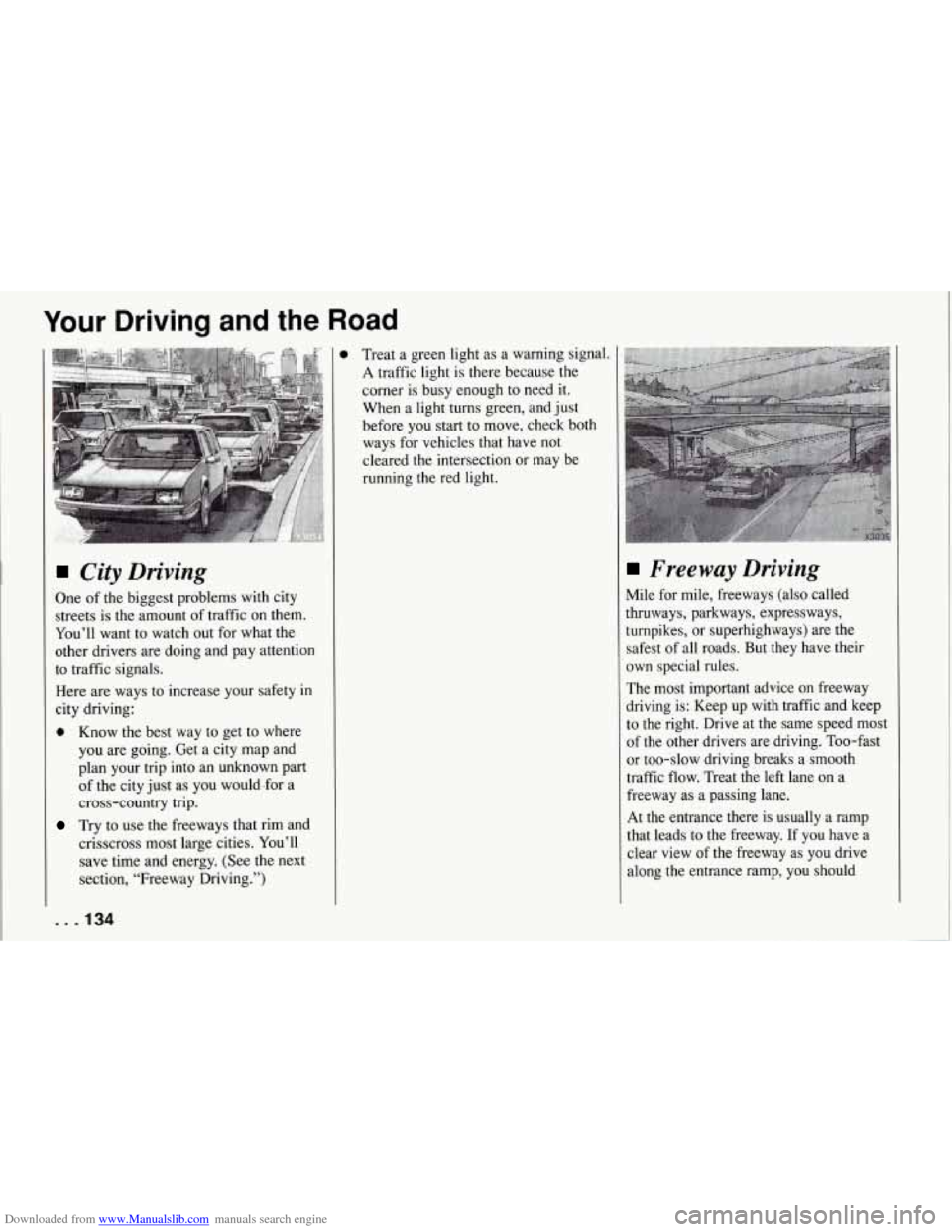
City Driving
One of the biggest problems with city
streets is the amount of traffic on them.
You’ll want to watch out for what the
other drivers are doing and pay attention
to trafflc signals.
Here are ways to increase your safety in
city driving:
0 Know the best way to get to where
you are going. Get a city map and
plan your trip into an unknown part
of the city just as you would-for a
cross-country trip.
Try to use the freeways that rim and
crisscross most large cities. You’ll
save time and energy. (See the next
section, “Freeway Driving.”)
. . .I34
Treat a green light as a warning signal.
A traffic light is there because the
corner is busy enough to need it.
When a light turns green, and just
before
you start to move, check both
ways for vehicles that have not
cleared the intersection or may be
running the red light.
Freeway Driving
Mile for mile, freeways (also called
thruways, parkways, expressways,
turnpikes, or superhighways) are the
safest of all roads.
But they have their
own special rules.
The most important advice on freeway driving is: Keep up with traffic and keep
to the right. Drive at the same speed most
of the other drivers are driving. Too-fast
or too-slow driving breaks
a smooth
traffic flow. Treat the left lane
on a
freeway as a passing lane.
At the entrance there is usually a ramp
that leads to the freeway. If you have a
clear view of the freeway as you drive
along the entrance ramp, you should
Page 136 of 274
Downloaded from www.Manualslib.com manuals search engine begin to check traffic. Try to determine
where you expect to blend with the flow.
Try to merge into the gap
at close to the
prevailing speed. Switch on your turn
signal, check your mirrors and glance
over your shoulder as often as necessary.
Try to blend smoothly with the traffic
flow.
Once you are on the freeway, adjust your
speed to the posted limit or to the
prevailing rate if it’s slower. Stay in the
right lane unless you want to pass.
Before changing lanes, check your
mirrors. Then use your turn signal. Just
before you leave the lane, glance quickly
over your shoulder to make sure there
isn’t another vehicle in your “blind” spot.
Once you are moving on the freeway,
make certain you allow a reasonable
following distance. Expect to move
slightly slower at night.
When you want to leave the freeway,
move to the proper lane well
in advance.
If you miss your exit do not, under any
circumstances, stop and back up. Drive on
to the next exit.
The exit ramp can be curved, sometimes
quite sharply. The exit speed is usually
posted. Reduce your speed according to your speedometer, not
to your sense of
motion. After driving for any distance at
higher speeds, you may tend to think you
are going slower than you actually are.
Before Leaving on a Long Trip
Make sure you’re ready. Try to be well
rested. If you must start when you’re not
fresh
- such as after a day’s work -
don’t plan to ,make too many miles that
first part
of the journey. Wear comfortable
clothing and shoes you can easily drive
in.
Is your vehicle ready for a long trip? If
you keep it serviced and maintained, it’s
ready to go. If it needs service, have it
done before starting out. Of course, you’ll
find experienced and able service experts
in Chevrolet dealerships all across North
America. They’ll be ready and willing to
help if you need
it.
Here are some things you can check
before a trip:
Windshield Washer Fluid: Is the
reservoir full? Are all windows clean
inside and outside?
0 Wiper Blades: Are they in good
shape?
0
0
Fuel, Engine Oil, Other Fluids:
Have you checked all levels?
Lights: Are they all working? Are the
lenses clean?
Tires: They are vitally important to a
safe, trouble-free trip.
Is the wead
good enough for long-distance
driving? Are the tires all inflated to
the recommended pressure?
Weather Forecasts: What’s the
weather outlook along your route?
Should you delay your trip
a short
time to avoid a major storm system?
Maps: Do you have up-to-date maps?
Highway Hypnosis
Is there actually such a condition as
“highway hypnosis”? Or is it jugt plain
falling asleep at the wheel? Call it
highway hypnosis, lack of awareness, or
whatever.
There is something about an easy stretch
of road with the same scenery, along with
the hum of the tires on the road, the drone
of the engine, and the rush of the wind
against the vehicle that can make you
sleepy. Don’t let it happen to you! If it
does, your vehicle can leave the road in
less than a second, and you could crash
and be injured.
135
Page 144 of 274
Downloaded from www.Manualslib.com manuals search engine 1 Jump Starting
If your battery has run down, you may
want to use another vehicle and some
jumper cables to start your Corvette.
But please follow the steps below to
do it safely.
NOTICE:
Ignoring these steps could result
in costly damage to your vehicle
that wouldn’t be covered by your
warranty.
Trying to start your Corvette by
pushing or pulling it could damage
your vehicle,
even if you have a
manual transmission. And if you
have an automatic transmission, it
won’t start that way.
Ib Jump Start Your Corvette:
1. Check the other vehicle. It must have
a 12-volt battery with a- negative
ground system.
NOTICE:
If the other system isn’t a 12-volt
system with a negative ground, both
vehicles can be damaged.
2. Get the vehicles close enough so the
jumper cables can reach, but be sure
the vehicles aren’t touching each
other. If they are, it could cause a ground connection you don’t
want.
You wouldn’t be able to start your
Corvette, and the bad grounding could
damage the electrical systems.
3. Turn off the ignition on both vehicles.
Turn
off all lights that aren’t needed,
and radios. This will avoid sparks and
help save both batteries. And it could
save your radio!
I NOTICE:
I
If you leave your radio on, it could be
badly damaged. The repairs wouldn’t
be covered by your warranty.
4. Open the hoods and locate the
batteries. Find the positive
(+) and
negative
(-) terminals on each.
143 ...
Page 189 of 274
Downloaded from www.Manualslib.com manuals search engine Service and Appearance Care
Remove the nut on the outboard side
of the unit. Then loosen the front and
inboard nuts. For the LT5 engine, loosen
the two inboard nuts. Move the ECM unit
to either side.
Fluid should be added if the fluid level
is at or below the “ADD” mark on the
reservoir. There are additional instructions
on the reservoir cap.
When returning the ECM to its proper
position, make sure the bolts are aligned
with the slots in the bracket. Then gently
push down on the unit. When replacing
the unit, be careful not to over-tighten the
nuts -just tighten them until they are
snug.
. . * 188
Rear Axle
When to Check Lubricant
Refer to the Maintenance Schedule
to determine how often to check the
lubricant. See “Periodic Maintenance
Inspections” in the Index.
How to Check Lubricant
If the level is below the bottom of the
filler plug hole, you’ll need to add some
lubricant. Add enough lubricant to raise
the level to the bottom of the filler plug
hole.
What to Use:
To add lubricant when the level is low, use
Axle Lubricant (GM Part
No. 12345977)
or
SAE 8OW-90 GL-5 gear lubricant.
To completely refill after draining,
add 4 ounces (1 18 ml) of Limited-Slip
Differential Lubricant Additive (GM Part
No. 1052358). Then fill to the bottom of
the filler plug hole with Axle Lubricant
(GM Part
No. 12345977) or SAE 8OW-90
GL-5 gear lubricant.
Engine Coolant
The following explains your cooling
system and how to add coolant when
it
is low. If you have a problem with
engine overheating or
if you need to add
coolant to your high fill reservoir, see
“Engine Overheating” in the Index.
The proper coolant for your Corvette will:
0
0
0
0
0
Give freezing protection down to -34°F (-37°C).
Give boiling protection up to 262°F
(128°C).
Protect against rust and corrosion.
Help keep the proper engine
temperature.
Let the warning lights work as they
should.
Page 206 of 274
Downloaded from www.Manualslib.com manuals search engine Extended Mobility Tires (omoiv)
If your Corvette has optional Goodyear
Extended Mobility Tires (EMT’s), the tires will have “EMT” molded on the
sidewalls. These tires perform
so well
without any air that a Low Tire Pressure
Warning System (LTPWS)
is used to
alert you if a tire has lost pressure.
A
“LOWELAT TIRE” light will appear on
your Driver Information Center if a tire’s
inflation pressure is less than
25 psi
(1 70 kPa). If the “LOWELAT TIRE”
light comes on, check your tire pressures
as soon as you can. See “Low Tire
Pressure Warning System” in
the Index
for additional information.
If a tire goes flat, you won’t need to stop
on the side of the road to change the tire.
You can just keep on driving. The shorter
the distance you drive and the slower the
speed, the greater the chance that the tire
will not have to be replaced. If you drive on
a deflated EMT for distances
of
50 miles (80 km) or less and at speeds of
55 mph (90 km/h) or less, there is a good
chance that the tire can be repaired. The
tire can operate effectively with no air
pressure for up to
200 miles (320 km) at
speeds up to
55 mph (90 km/h), but the
tire would then have to be replaced. Also
remember: When a tire is filled with air, it
provides a cushion between the road and
the wheel. Because you do not have this
cushion when driving on a deflated tire,
try to avoid potholes that could damage
your wheel and require replacement of it.
Some road hazards can damage a tire
beyond repair. This damage could occur
before you’ve driven on the tire in a
deflated condition. Whenever a tire has
been damaged, or if you’ve driven any
distance on a deflated EMT, check with
a Goodyear EMT Service Center to
determine whether the tire can be
repaired or should be replaced. To
maintain your vehicle’s extended
mobility feature, all replacement tires
must be Extended Mobility Tires.
See the Goodyear Extended Mobility Tire
Owner’s Manual and Limited Warranty
supplied with your Corvette for additional
information.
205. .
Page 214 of 274
Downloaded from www.Manualslib.com manuals search engine Glass
Glass should be cleaned often. GM Glass
Cleaner (GM Part
No. 1050427) or a
liquid household glass cleaner will
remove normal tobacco smoke and dust
films.
Don’t use abrasive cleaners on glass,
because they may cause scratches. Avoid
placing decals on the inside rear window,
since they may have to be scraped
off
later. If abrasive cleaners are used on the
inside of the rear window, an electric
defogger element may be damaged. Any
temporary license should not be attached
across the defogger grid.
Cleaning Dulso-Coated Moldings
These moldings are around the hatch
opening in your Corvette’s rear area.
When lightly soiled, wipe with a
sponge or
soft lint-free cloth
dampened with water.
water.
When heavily soiled, use warm soapy
You can remove scratches from a
Dulso-coated molding by wiping briskly
with the solvent-type cleaner described
earlier. If a ring forms, repeat the procedure
over a larger area, feathering
toward the center of the ring. If the ring
still remains, wipe the whole molding.
Cleaning the Outside of the Windshield
and Wiper Blades
If the windshield is not clear after using
the windshield washer, or if the wiper
blade chatters when running, wax or other
material may be on the blade or
windshield.
Clean the outside of the windshield with
GM Windshield Cleaner, Bon-Ami
Powder@
(GM Part No. 1050011). The
windshield is clean
if beads do not form
when you rinse it with water.
If you use a glass treatment or conditioner
containing ethyl alcohol or ethyl sulfate
on your glass, be sure to remove the
acrylic roof panel, if
so equipped. These
products may damage the panel.
Clean the blade by wiping vigorously
with a cloth soaked in full strength
windshield washer solvent. Then rinse the
blade with water.
Wiper blades should be checked on a
regular basis and replaced when worn.
Cleaning a Removable Roof Panel
Special care is necessary when cleaning,
removing and/or storing the roof panel.
Flush with water to remove dust and
dirt, then dry the panel.
Cleaner (GM Part
No. 1050427) or
a liquid household glass cleaner.
Leave the cleaner on the panel for
one minute, then wipe the panel with
a
soft, lint-free cloth.
Clean the panel with GM Glass
Don’t use abrasive cleaning materials.
If water drops are frequently allowed to
dry on the roof panel, impurities in the
water will adhere to the top, These
impurities may destroy the finish. When
the panel gets wet, you should dry it
off.
Do not use a glass treatment or
conditioner containing ethyl alcohol
or ethyl sulfate on the roof panel.
These products may damage the
panel.
213..