1994 CHEVROLET BLAZER steering
[x] Cancel search: steeringPage 235 of 348
Downloaded from www.Manualslib.com manuals search engine Rocking your vehicle to get it out:
First, turn your steering wheel left and right. That will clear the area around
your front wheels. Then shift back and forth between “R” (Reverse) and
a
forward gear (or with a manual transmission, between First or Second gear
and Reverse), spinning the wheels
as little as possible. Release the
accelerator pedal while
you shift, and press lightly on the accelerator pedal
when the transmission
is in gear. If that doesn’t get you out after a few tries,
you may need to be towed out. Or,
you can use your recovery hooks, if your
vehicle has them.
If you do need to be towed out, see “Towing Your
Vehicle”
in the Index.
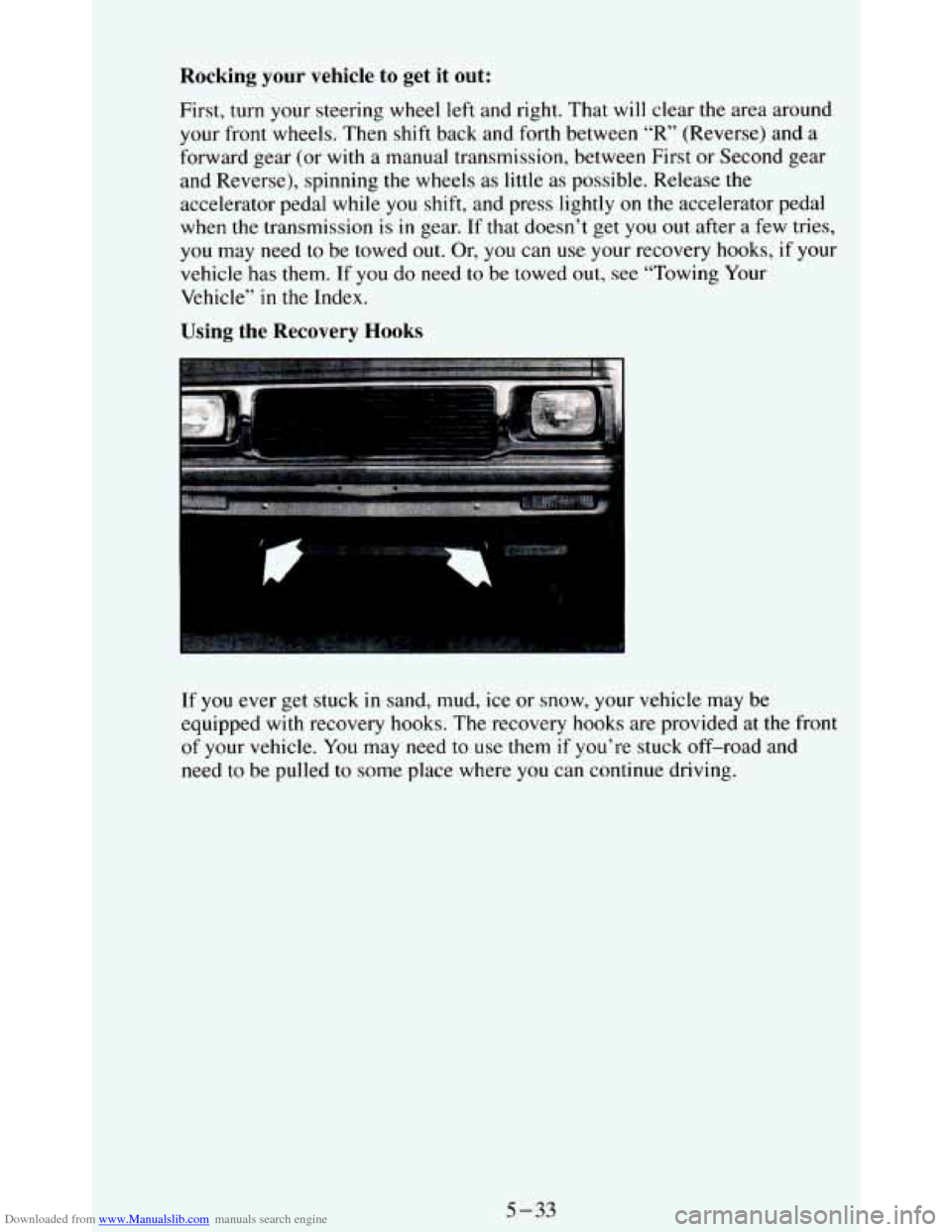
Using the Recovery Hooks
I
If you ever get stuck in sand, mud, ice or snow, your vehicle may be
equipped with recovery hooks.
The recovery hooks are provided at the front
of your vehicle. You may need to use them if you’re stuck off-road and
need to be pulled to some place where you can continue driving.
5-33
Page 237 of 348
Downloaded from www.Manualslib.com manuals search engine Service & Appearance Care
Section
Here you will find information about the care of your vehicle . This part
begins with service and fuel information. and then
it shows how to check
important fluid and lubricant levels
. There is also technical information
about your vehicle. and a section devoted to
its appearance care .
Service ................................................... 6-2
Fuel
..................................................... 6-3
Checking Things Under the Hood
.............................. 6-6
Engineoil
.............................................. 6-8
Aircleaner
............................................ 6-14
Automatic Transmission Fluid
............................. 6-15
Manual Transmission Fluid
............................... 6-18
Hydraulic Clutch ........................................ 6-20
RearAxle
............................................. 6-20
Transfer Case
.......................................... 6-21
FrontAxle
............................................. 6-22
Enginecoolant
......................................... 6-23
Power Steering Fluid
.................................... 6-26
Windshield Washer Fluid
................................. 6-28
Brake Master Cylinder
................................... 6-29
Replacing Brake System Parts
................................ 6-30
Battery
.................................................. 6-31
Vehiclestorage
......................................... 6-31
Bulb Replacement
......................................... 6-32
Other Maintenance Items
.................................... 6-35
Loading Your Vehicle
...................................... 6-39
Tires .................................................... 6-42
Appearance Care
.......................................... 6-49
Vehicle Identification Number (VIN)
.......................... 6-58
Service Parts Identification Label
............................. 6-60
Fuses and Circuit Breakers
.................................. 6-60
Capacities and Specifications Charts
........................... 6-62
6-1
Page 262 of 348
Downloaded from www.Manualslib.com manuals search engine Thermostat
Engine coolant temperature is controlled by a thermostat in the engine
coolant system. The thermostat stops the flow
of coolant through the
radiator until the coolant reaches
a preset temperature.
When you replace your thermostat, an
AC@ thermostat is recommended.
Power Steering Fluid
NOTICE:
Always turn the engine off before checking or adding power
steering fluid. The power steering cap is close to the fan and
other moving parts.
P
i
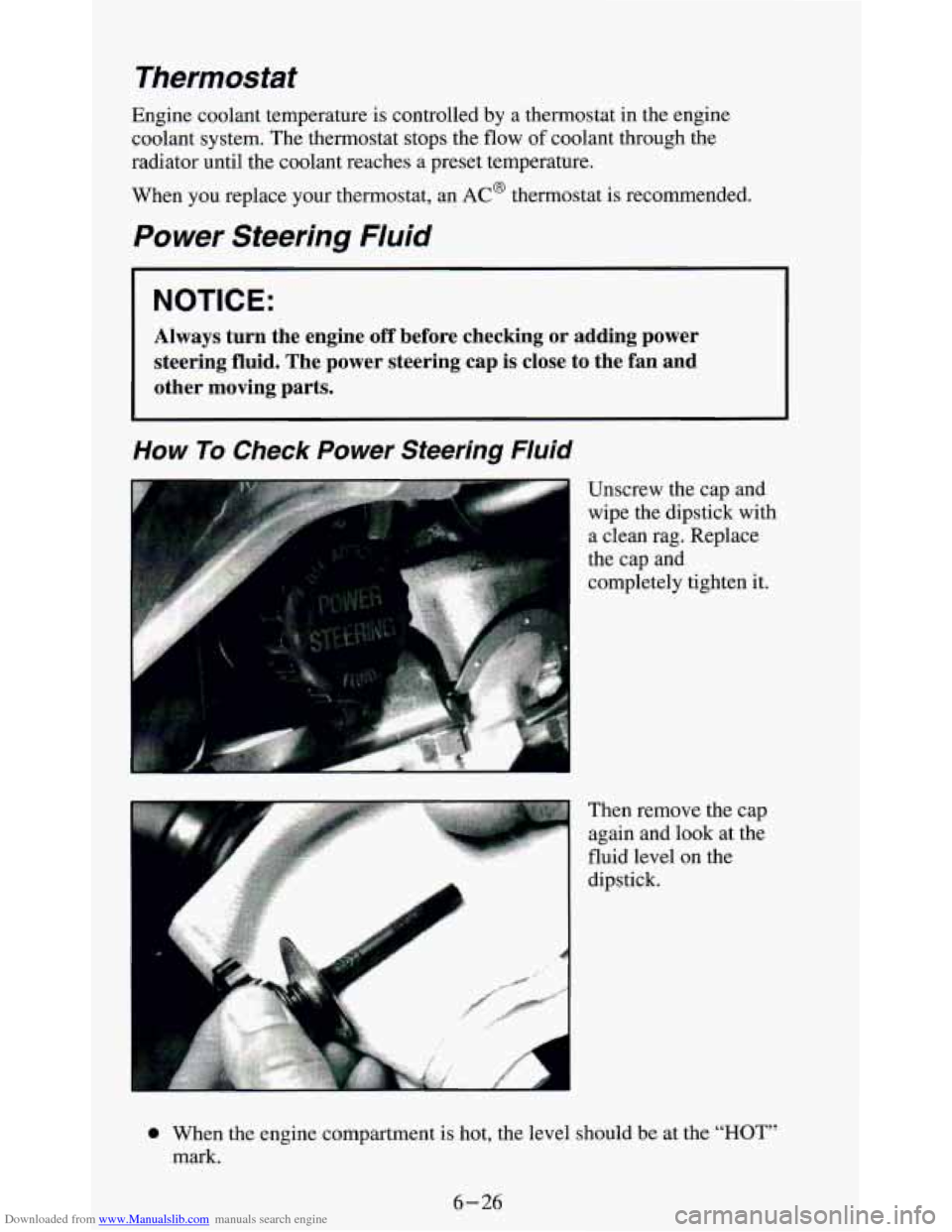
Unscrew the cap and
wipe the dipstick with
a clean rag. Replace
the cap and
completely tighten it.
Then remove the cap
again and look at the
fluid level on the
dipstick.
0 When the engine compartment is hot, the level should be at the “HOT”
mark.
6-26
Page 263 of 348
Downloaded from www.Manualslib.com manuals search engine 0 When the engine compartment is cool, the level should be at the
“FULL COLD” mark.
What to Add
Refer to the Maintenance Schedule to determine what kind of fluid to use.
See “Recommended Fluids and Lubricants”
in the Index.
NOTICE:
When adding power steering fluid or making a complete fluid
change, always use the proper fluid. Failure to use the proper
fluid can cause leaks and damage hoses and seals.
Windshield Washer Fluid
To Add
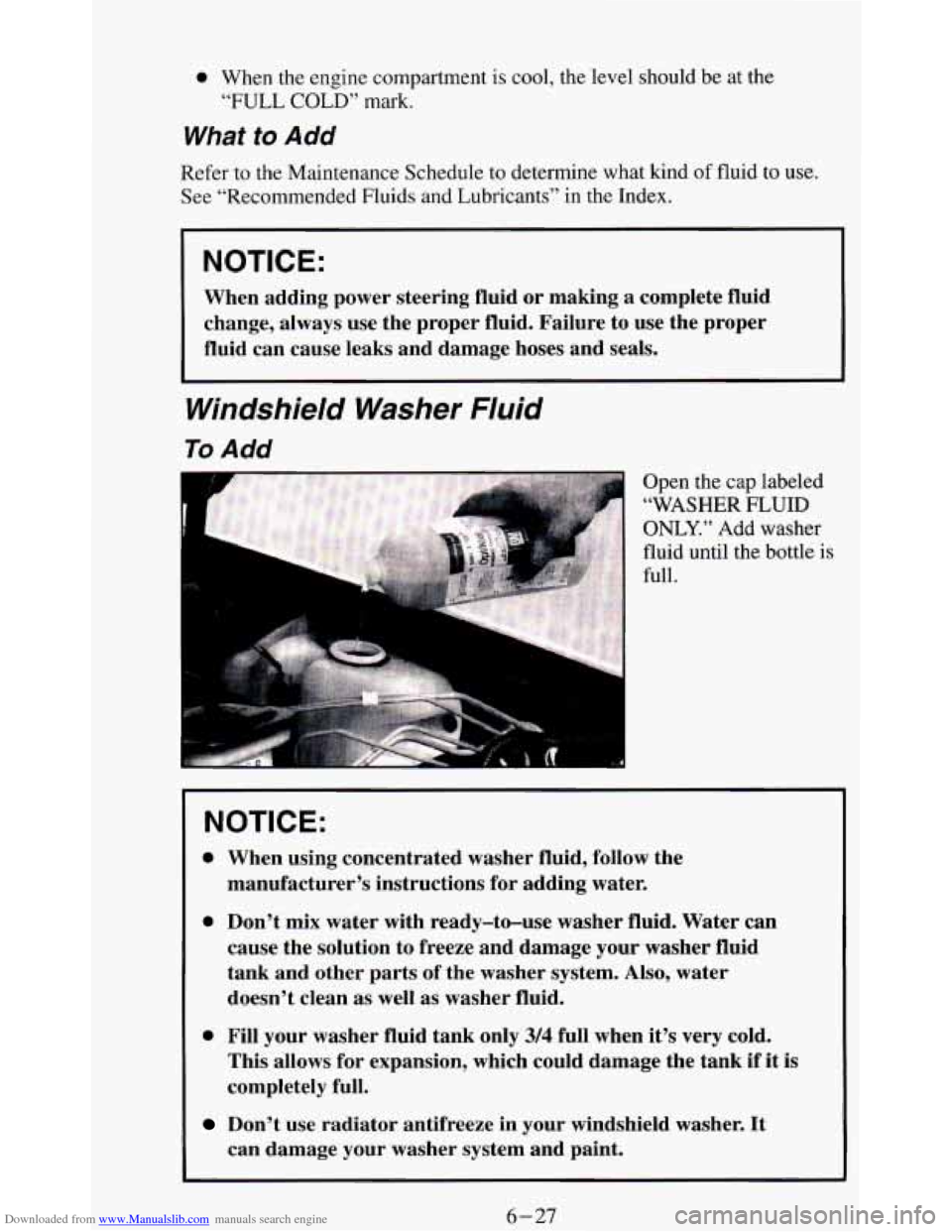
Open the cap labeled
“WASHER FLUID
ONLY.” Add washer
fluid until the
bottle is
full.
NOTICE:
0 When using concentrated washer fluid, follow the
manufacturer’s instructions for adding water.
0 Don’t mix water with ready-to-use washer fluid, Water can
cause the solution to freeze and damage your washer fluid
tank and other parts of the washer system.
Also, water
doesn’t clean as well as washer fluid.
0 Fill your washer fluid tank only 3/4 full when it’s very cold.
This allows for expansion, which could damage the tank if it
is
completely full.
Don’t use radiator antifreeze in your windshield washer. It
can damage your washer system and paint,
6-27
Page 271 of 348
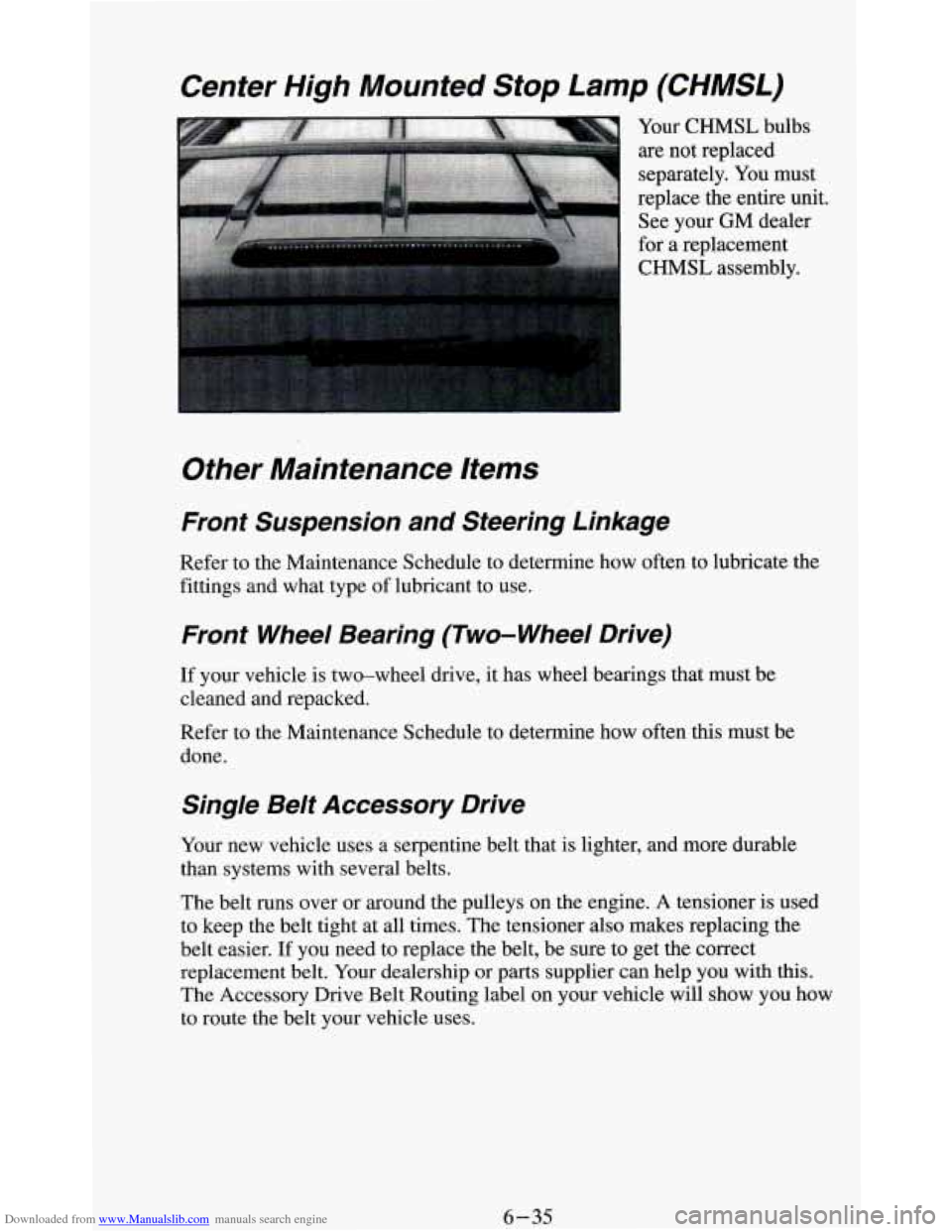
Downloaded from www.Manualslib.com manuals search engine Other Maintenance Items
Front Suspension and Steering Linkage
Refer to the Maintenance Schedule to determine how often to lubricate the
fittings and what type of lubricant to use.
Front Wheel Bearing (Two- Wheel Drive)
If your vehicle is two-wheel drive, it has wheel bearings that must be
cleaned and repacked.
Refer to the Maintenance Schedule to determine how often this must be
done.
Single Belt Accessory Drive
Your new vehicle uses a serpentine belt that is lighter, and more durable
than systems with several belts.
The belt runs over or around the pulleys on the engine. A tensioner is used
to keep the belt tight at all times. 'The tensioner also makes replacing the
belt easier. If you need to replace the belt, be sure to get the correct
replacement belt. Your dealership or parts supplier can help you with this.
The Accessory Drive Belt Routing label on your vehicle will show you how
to route the belt your vehicle uses.
6-35
Page 313 of 348

Downloaded from www.Manualslib.com manuals search engine Explanation Of Scheduled Maintenance Services
Below are explanations of the services listed in the maintenance charts.
The proper fluids and lubricants to use are listed in this section. Make sure
whoever services your vehicle
uses these. All parts should be replaced and
all necessary repairs done before you or anyone else drives the vehicle.
1.
2.
3.
4.
5.
ENGINE OIL AND OIL FILTER CHANGE* - ALWAYS USE
API SERVICE SH OR SG ENERGY CONSERVING I1 OILS OF THE
PROPER VISCOSITY. The “SH” or “SG” designation may be shown
alone or in combination with others, such as “SHKD”, or
“SH, SG,
CD,” or “SG/CD”, etc.
To determine the preferred viscosity oil for your
vehicle’s engine (e.g. SAE
5W-30), see “Engine Oil” in the Index.
CHASSIS LUBRICATION - Lubricate the front suspension, ball
joint, steering linkage, and transfer case shift linkage, parking brake
cable guides, propshaft splines, universal joints, brake pedal springs,
and clutch pedal springs at the intervals specified on the proper
maintenance schedule, or at every engine oil change, whichever comes
first.
Ball joints should
not be lubricated unless their temperature is 10°F
(-12°C) or higher. When the weather is cold, let them warm up before
lubricating them
or they could be damaged.
Also, be sure to check all the vehicle fluid levels at this time.
COOLING SYSTEM SERVICE* - Drain, flush and refill the
system with new or approved recycled coolant conforming to “GM
Specification
603%”’. See “Engine Coolant” in the Index for the
proper coolant and mixture to use in your vehicle.
Also inspect
the hoses and replace them if they are cracked, swollen, or
deteriorated. Clean the outside of the radiator and air conditioning
condenser. Wash the radiator neck. To ensure proper operation,
pressure test the radiator and cap.
AIR CLEANER FILTER REPLACEMENT” - Replace at
specified intervals. Ask your dealer for the proper replacement
intervals for your driving conditions.
FRONT WHEEL BEARING REPACK (2-WHEEL DRIVE
ONLY) - Clean and repack the front wheel bearings at each brake
relining,
or at the specified interval, whichever comes first.
*An Emission Control Service
7-7
Page 317 of 348
Downloaded from www.Manualslib.com manuals search engine Steering Column Lock Operation - While parked, try to turn the key to
LOCK in each gear shift position.
0 With an automatic transmission, the key should turn to LOCK only
0 With manual shift, the key should turn to LOCK only when you’re in
On vehicles with a key release lever, try to turn the key to
LOCK without
pressing the lever.
The key should turn to LOCK only with the key lever
depressed.
On all vehicles, the key should come out
only in LOCK.
Parking Brake and Transmission
“P’ (Park) Mechanism Operation -
when the gear shift is in “P’ (Park).
“R” (Reverse).
Park on a fairly steep hill, with the vehicle facing downhill. :eping your
foot on the regular brake, set the manual parking brake.
0 To check the parking brake: With the engine running and the
transmission in
“N’ (Neutral), slowly remove foot pressure from the
regular brake pedal.
Do this until the vehicle is held by the parking
brake only.
To check the “P” (Park) mechanism’s holding ability: Apply the regular
brake and shift to
“P” (Park). Release the manual parking brake, then
slowly release the regular brake.
Lap and Shoulder Belts Condition and Operation - Inspect belt system,
including: webbing, buckles, latch plates, retractors, guide loops and
anchors. Have a belt assembly replaced if the webbing has been cut or
otherwise damaged.
Body Lubrication Service - Lubricate all body door hinges including the
endgate, endgate handle pivot points, and endgate mounted spare tire carrier
(if equipped), lubricate the body hood,
fuel door and rear compartment
hinges, latches and locks including interior glove box and console doors,
and any moving seat hardware. Lubricate the hood safety lever pivot and
prop rod pivot. More frequent lubrication may be required when exposed
to
a corrosive environment.
7-11
Page 318 of 348
Downloaded from www.Manualslib.com manuals search engine Periodic Maintenance Inspections
Listed below are inspections and services which should be performed at
least twice a year (for instance, each spring and fall). You should let your
GM dealer’s service department or other qualified service center do these
jobs. Make sure any necessary repairs are completed at once.
Steering and Suspension Inspection? - Inspect front and rear suspension
and steering system for damaged,
loose or missing parts, signs of wear or
lack of lubrication. Inspect power steering lines and hoses for proper
hook-up, binding, leaks, cracks, chafing, etc. (On vehicles equipped with
manual steering gear, check for seal leakage). Lubricate the steering linkage.
Accelerator Control System - Lubricate all pivot points with engine oil,
except the
TBI throttle shaft. Do not lubricate the cam pulley. Remove all
external deposits from pulley.
Do not oil any accelerator or cruise control
cables. Replace any cables that have high effort or excessive wear.
Exhaust System Inspection - Inspect the complete system. Inspect the
body near the exhaust system. Look for broken, damaged, missing or
out-of-position parts,
as well as open seams, holes, loose connections or
other conditions which could cause a heat buildup in the floor pan or could
let exhaust fumes seep into the passenger compartments. See “Engine
Exhaust” in the Index.
Drive Axle Service - Check readfront axle fluid level and add as needed.
Check constant velocity joints and axle seals for leaking.
Transfer Case (four-wheel drive) Inspection? - Every 12 months or at
oil change intervals, check front axle and transfer case and add lubricant
when necessary. Check vent hose at transfer case for kinks and proper
installation. More frequent lubrication may be required
on off-road use.
?A fluid loss in these systems may indicate a problem. Have them inspected
and repaired at once.
7- 12