Page 18 of 398
These symbols are used on warning and indicator lights:
-I
I BRAKE I
I
ENGINE COOLANT
TEMPERATURE RADIATOR
COOLANT
CHARGING
1 FUEL 1 I
ENGINE OIL
PRESSURE 1 I
ENGINE OIL
TEMPERATURE I I I ANTILOCK BRAKE
.Here are some other symbols you may see:
-%r
FUSE I RADIO SELECTOR I
RADIO VOLUME AIR
CONDITIONING I
TRUNK HATCHBACK RELEASE SPEAKER
I
Page 107 of 398
TMLER TOWING PACMGE (OPTION)
If your Fleetwood is equipped with either V92 or V4P package, you can
increase your vehicle's trailer towing capability to
5,000 pounds (2270 kg)
or 7000 lbs. (3178 kg). To determine which package you have, see the
Service Parts Label located on the underside
of the trunk lid. These
packages include a trailering harness located
in the trunk, heavy-duty
engine and transmission cooling.
Also included are heavy-duty front and
rear springs, 2.93:l rear axle ratio and Eagle
GA P235/70R15 tires.
3
a,
I
I
P-NG BRAKE
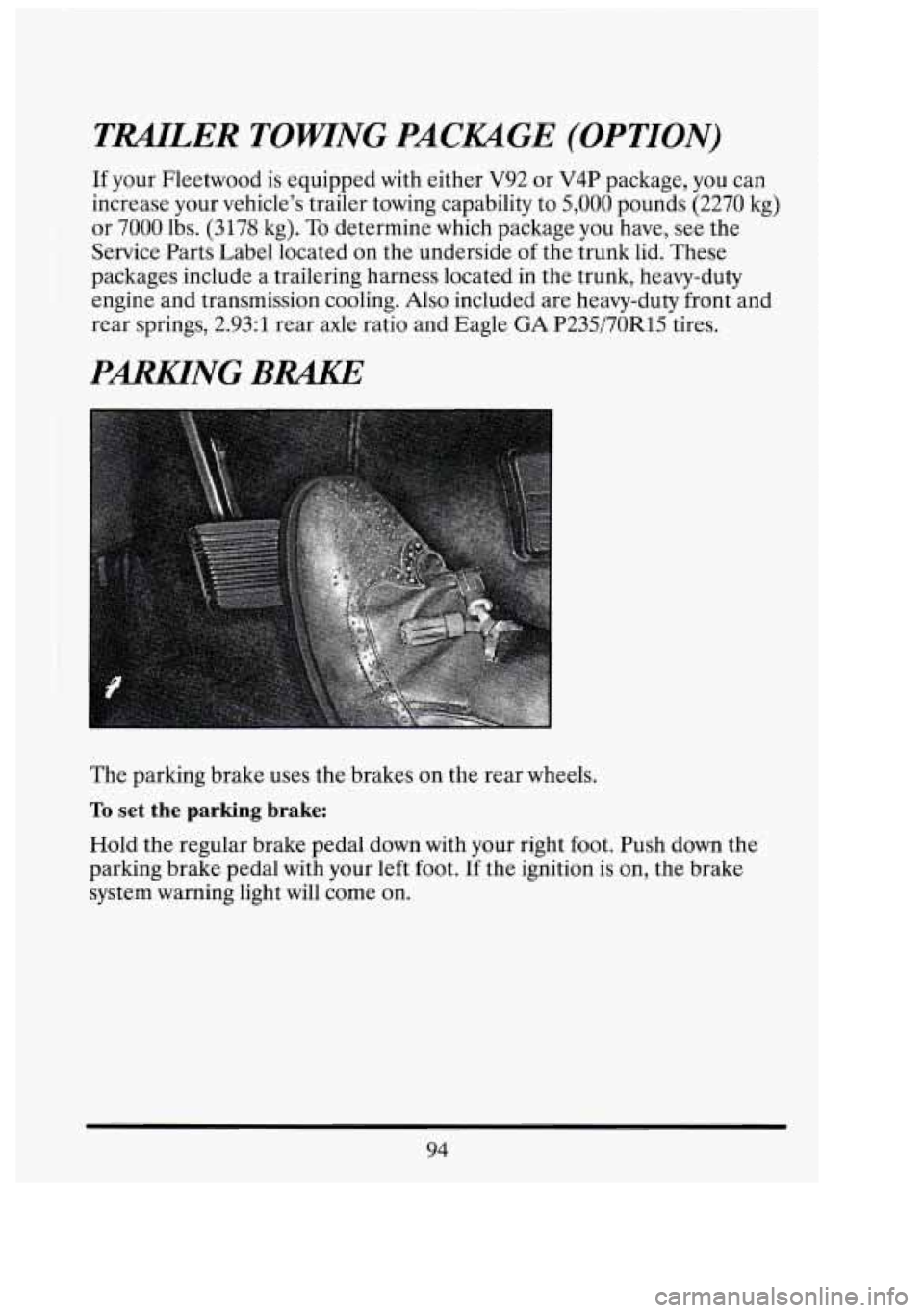
The parking brake uses the brakes on the rear wheels.
To set the parking brake:
Hold the regular brake pedal down with your right foot. Push down the
parking brake pedal with your left foot.
If the ignition is on, the brake
system warning light will come
on.
I
94
Page 127 of 398
Using Cruise Control on Hills
How well your Cruise Control will work on hills depends upon your
speed, load, and the steepness of the hills. When going up steep hills, you
may have to step
on the accelerator pedal to maintain your speed. When
going downhill, you may have to brake or shift to a lower gear to keep
your speed down.
Of course, applying the brake takes you out of Cruise
Control. Many drivers find this
to be too much trouble and don’t use
Cruise Control on steep hills.
To Get Out of Cruise Control
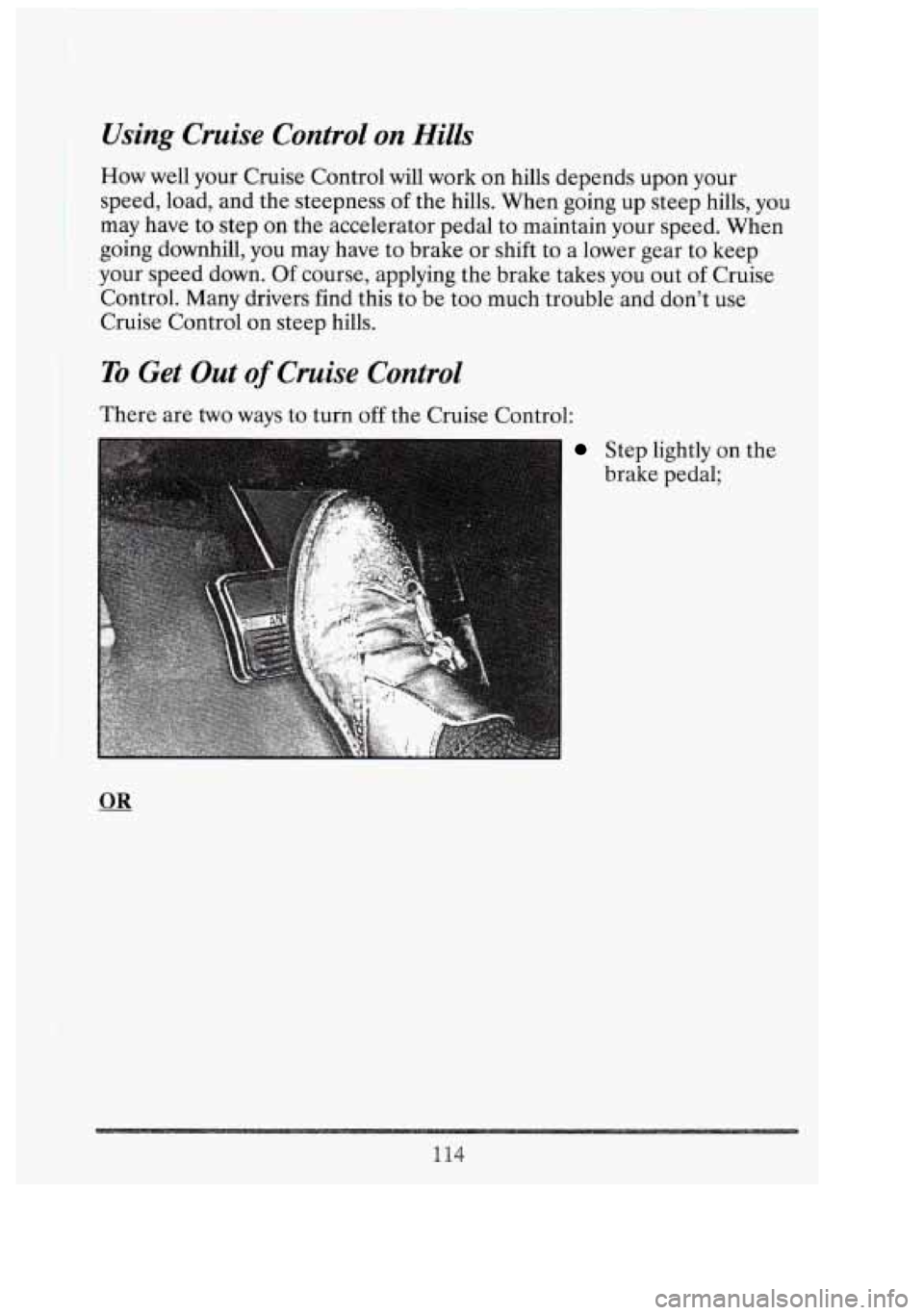
There are two ways to turn off the Cruise Control:
Step lightly on the
brake pedal;
114
Di
Page 145 of 398

I
WMING AND INDICATOR LIGHTS
This section describes the warning lights that are on your vehicle. The
pictures will help you locate them.
Warning lights can signal that something is wrong before it bec0me.s
serious enough to cause an expensive repair or replacement. Paying
attention to your warning lights could also save you or others from injury.
Warning lights go on when there may be or is a problem with one
of your
vehicle’s functions.
As you will see in the details on the next few pages,
some warning lights come on briefly when you turn the ignition key just to
let you know they’re working.
If you are familiar with this section, you
should not be alarmed when this happens.
When one of the warning lights comes on and stays on when you are
driving, check the section that tells you what to do about it. Please follow
the manual’s advice. Waiting to do repairs can be costly
-- and even
dangerous.
So please get to know your warning lights. They’re a big help.
Brake System Warning Light
Your Cadillac’s hydraulic brake system is divided into two parts. If one
part isn’t working, the other part can still work and stop you. For good
braking, though, you need both parts working well.
If the warning light
comes on, there could
be a brake problem.
Have your brake
system inspected right
away.
This light should come on as you start the vehicle.
If it doesn’t come on
then, have it fixed
so it will be ready to warn you if there’s a problem.
132
D‘ I
1
1 i’
Page 147 of 398

If the light stays on, turn the ignition off. Or, if the light comes on when
you’re driving, stop as soon as possible and turn the ignition off. Then
start the engine again to reset the system. If the light still stays on, or
comes on again while you’re driving, your Cadillac needs service.
If the
regular brake system warning light isn’t on, you still have brakes, but you
don’t have anti-lock brakes. If the regular brake system warning light is
also on,
you don’t have anti-lock brakes and there’s a problem with your
regular brakes. See “Brake System Warning Light” earlier
in this part.
The anti-lock brake system warning light may also come on when you are
driving with
a compact spare tire. If this happens, the light means you
won’t have anti-lock until you replace the compact spare with a full-size
tire. If the warning light stays
on after you replace the compact spare with
a full-size tire, or if it comes on again when you’re driving, your Cadillac
needs service.
Traction Control System Lights
Traction Engaged
This light will go on as
a bulb check when you
start your engine. It
will also come on when
the traction control
system is active.
Zl
i-‘
I
d
:il
1,
I
134
n t
-
Page 153 of 398
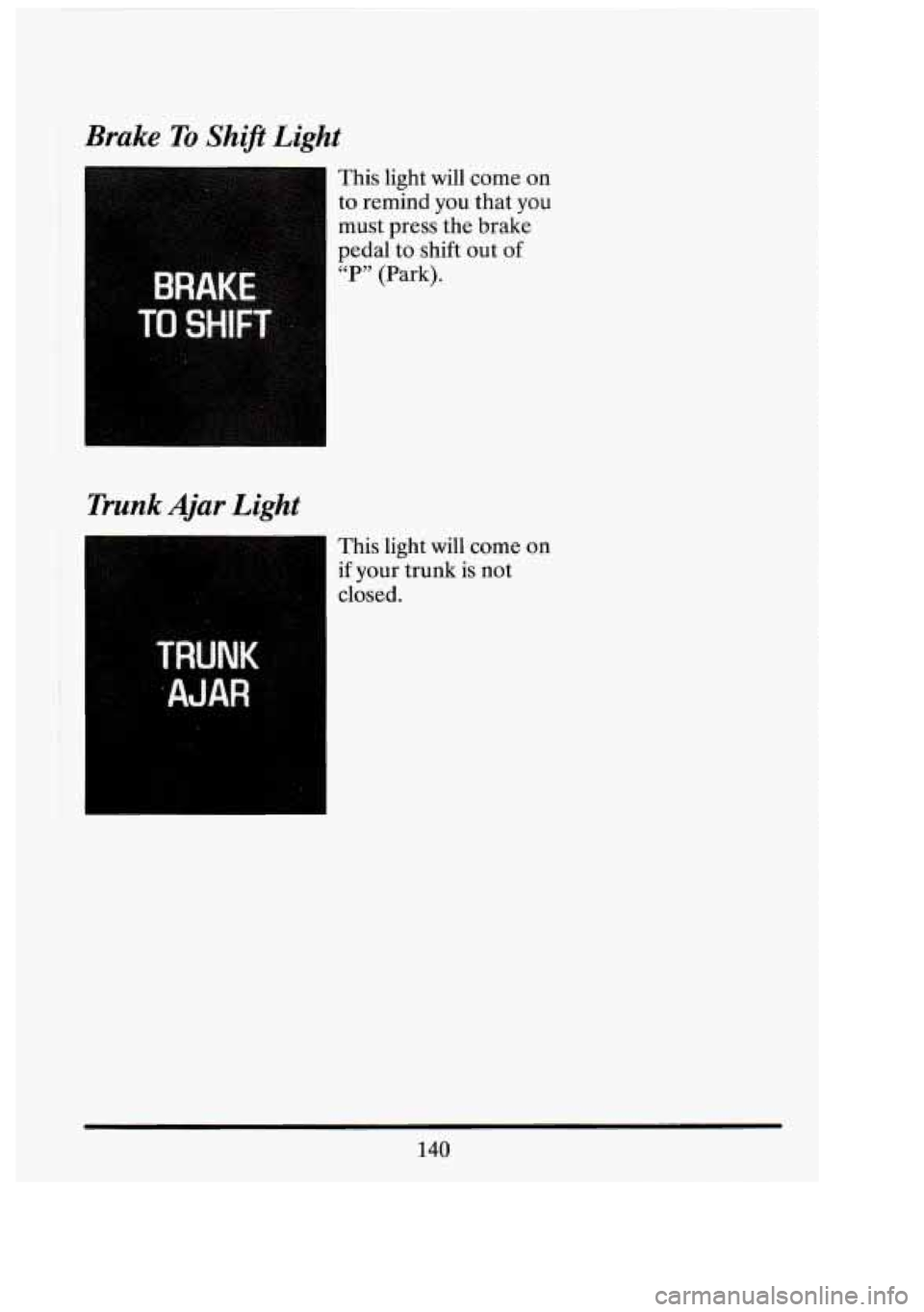
Brake To Shif’t Light
Trunk Ajar Light
This light will corne on
to remind you that you
must press the brake
pedal to shift out of
“P” (Park).
I This light will come on
if your trunk is not
closed.
i7
140
u
Page 186 of 398
Anti-Lock Brakes (ABS)
Your Cadillac has an advanced electronic braking system that will help
prevent skidding.
This light on the
instrument panel will
go on when you start
your vehicle.
When you start your vehicle and begin to drive away, you may hear a
momentary motor or clicking noise. And you may even notice that your
brake pedal moves a little while this
is going on. This is the ABS system
testing itself.
If there’s a problem with the anti-lock brake system, the
anti-lock brake system warning light will stay on.
See “Anti-lock Brake System Warning Light’’ in the Index.
Here’s how anti-lock works. Let’s say the road is wet. You’re driving
safely. Suddenly an animal jumps out in front
of you.
173
Page 188 of 398
Traction Control System
This feature is deleted on Coach Builder limousines and funeral coach
packages.
Your vehicle has a traction control system that limits wheel spin. This is
especially useful in slippery road conditions.
The system operates only if
it senses that the rear wheels are spinning or beginning to lose traction.
When this happens, the system works the rear brakes and reduces engine
power (by closing the throttle) to limit wheel spin.
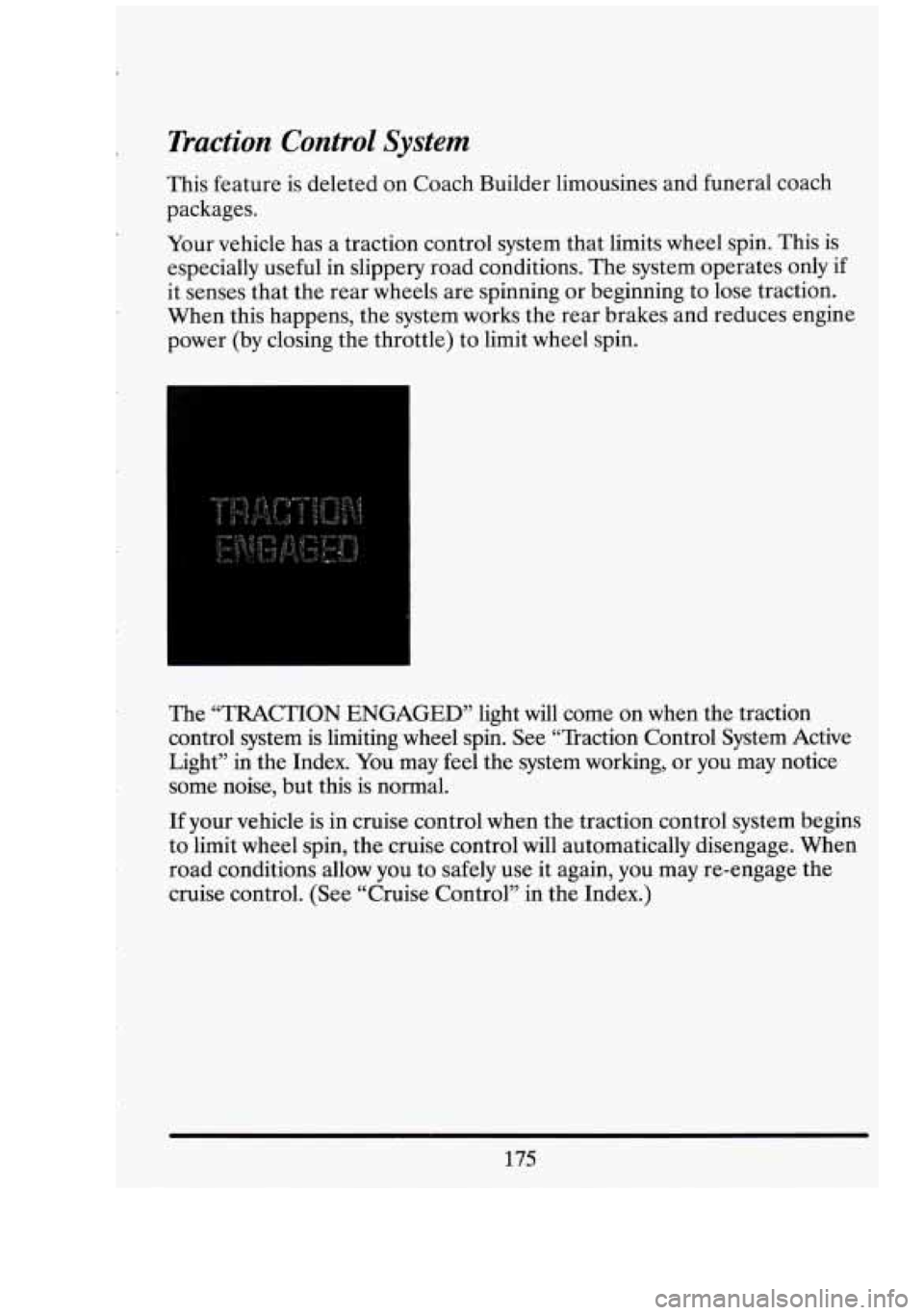
The ‘TRACTION ENGAGED’’ light will come on when the traction
control system is limiting wheel spin. See “Traction Control System Active
Light” in the Index. You may feel the system working, or you may notice
some noise, but this is normal.
If your vehicle is in cruise control when the traction control system begins
to limit wheel spin, the cruise control will automatically disengage. When
road conditions allow you to safely use it again, you may re-engage the
cruise control,. (See “Cruise Control” in the Index.)
175