Page 71 of 399
Downloaded from www.Manualslib.com manuals search engine 6. Pull the rest of
lap belt all the
way out
of the
retractor to set
the
lock.
the
7. To tighten the
belt, feed the lap
belt back into the
retractor while
you push down
on
the child restraint.
LC
-.
LJ
Page 72 of 399
Downloaded from www.Manualslib.com manuals search engine 8. Push and pull the
child restraint
.in
different
directions to be
sure it
is secure.
To remove the child restraint, just unbuckle the vehicle’s safety belt and
let it go back all the way.
The safety belt
will move freely again and be ready to work for an adult
or larger child passenger.
Page 73 of 399
Downloaded from www.Manualslib.com manuals search engine Larger Children
Children who have outgrown child restraints should wear the vehicle's
safety belts.
If
you have the choice, a child should sit next to a window so the child can
wear
a lap-shoulder belt and get the additional restraint a shoulder belt
can provide.
Accident statistics show that children are safer
if they are restrained in
the rear seat. But they need to use the safety belts properly.
60
Page 75 of 399
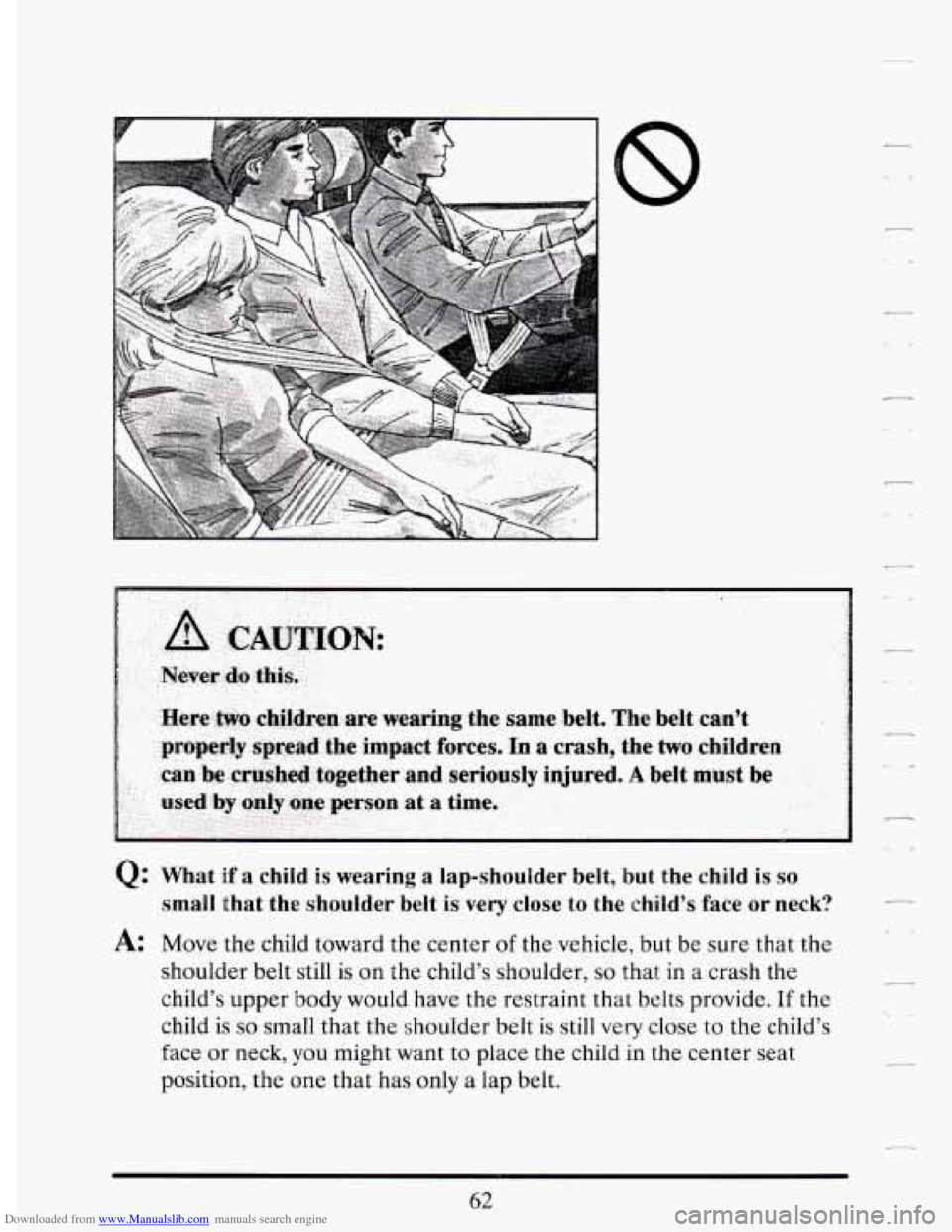
Downloaded from www.Manualslib.com manuals search engine Q: What if a child is wearing a lap-shoulder belt, but the child is so
small that the shoulder belt is very close to the child’s face or neck?
A: Move the child toward the center of the vehicle, but be sure that the
shoulder belt still is
on the child’s shoulder, so that in a crash the
child’s upper body would. have the restraint that belts provide.
If the
child
is so small that the shoulder belt is still very close to the child’s
face or neck, you might want to place the child in the center seat
position, the one that has
only a lap belt.
62
Page 76 of 399
Downloaded from www.Manualslib.com manuals search engine n
7 Wherever the child sits, the lap portion of the belt should be worn low
and snug on the hips, just touching the child’s thighs. This applies belt
force to the child’s pelvic bones in a crash.
r
63
Page 77 of 399

Downloaded from www.Manualslib.com manuals search engine SAFETYBELT EXTENDER
If the vehicle’s safety belt will fasten around you, you should use it.
But if a safety belt isn’t long enough to fasten, your dealer
will order you
an extender. It’s free. When you go in to order
it, take the heaviest coat
you will wear,
so the extender will be long enough for you. The extender
will be just for you, and just for the seat in your vehicle that you choose.
Don’t let someone else use it, and use
it only for the seat it is made to fit.
To wear it, just attach it to the regular safety belt.
CHECKING YOUR RESTMNT SYSTEMS
Now and then, make sure all your belts, buckles, latch plates, retractors,
anchorages and reminder systems are working properly.
Look for any
loose parts
or damage. If you see anything that might keep a restraint
system from doing its job, have it repaired.
REPLACING SMETYBELTSAFTER A
CRASH
If you’ve had a crash, do you need new belts?
After a very minor collision, nothing may be necessary. But
if the belts
were stretched, as
they would be if worn during a more severe crash, then
you need new belts.
If belts are cut or damaged, replace them. Collision damage also may
mean you will need to have safety belt
or seat parts repaired or replaced.
New parts and repairs may be necessary even
if the belt wasn’t being used
at the time
of the collision.
64
Page 187 of 399

Downloaded from www.Manualslib.com manuals search engine Care of Your Cassette Tape Player
A tape player that is not cleaned regularly can cause reduced sound
quality, ruined cassettes, or a damaged mechanism. Cassette tapes should
be stored in their cases away from contaminants, direct sunlight, and
extreme heat. If they aren't, they may not operate properly or cause
failure
of the tape player.
Your tape player should be cleaned after every
50 hours of use. If you
notice
a reduction in sound quality, try a known good cassette to see if the
tape
or the tape player is at fault. If this other cassette has no
improvement
in sound quality, clean the tape player.
Cleaning may be done with a scrubbing action, non-abrasive cleaning
cassette. This system uses a cleaning cassette with pads which scrub the
tape head as the hubs of the cleaner cassette turn. It is normal for the
cartridge to eject while cleaning. Insert the cassette at least
3 times to
ensure thorough cleaning.
A scrubbing action cleaning cassette is
available through your Cadillac dealership.
You may also choose a non-scrubbing action, wet-type cleaner which uses
a cassette with a fabric belt to clean the tape head. This type
of cleaning
cassette will
not eject. It may not clean as thoroughly as the scrubbing
type cleaner.
Cassettes are subject
to wear and the,sound quality and may degrade over
time. Always make sure that the cassette tape is
in good condition before
you have your tape player serviced.
Care of Your Compact Discs
Handle discs carefully. Store them in their original cases or other
protective cases and away from direct sunlight and dust. If the surface
of
a disc is soiled, dampen a clean, soft cloth in a mild, neutral detergent
solution and clean it, wiping from the center
to the edge.
Be sure never
to touch the signal surface when handling discs. Pick up
discs by grasping the outer edges or the edge of the hole and the
outer edge.
174
r
Page 189 of 399
Downloaded from www.Manualslib.com manuals search engine YOUR DRIVING AND THE ROAD
I- - c-
Here you’ll find information about driving on different kinds of roads and
in varying weather conditions. We’ve also included many other useful tips
on driving.
DEFENSm DmNG
The best advice anyone can give about driving is: Drive defensively.
Please start with a very important safety device
in your Cadillac: Buckle
up. (See “Safety Belts” in the Index.)
Defensive driving really means “be ready for anything.” On city streets,
rural roads, or freeways, it means “always expect the unexpected.”
Assume that pedestrians or other -drivers are going to be careless and
make mistakes. Anticipate what they might do. Be ready for their
mistakes.