Page 197 of 308
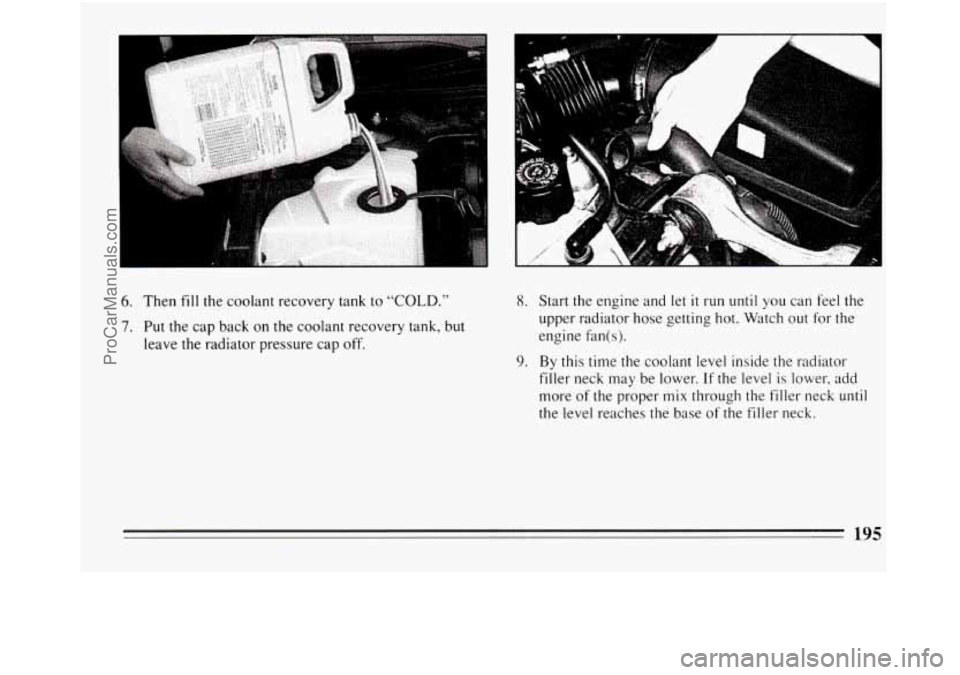
6. Then fill the coolant recovery tank to “COLD.”
7. Put the cap back on the coolant recovery tank, but
leave
the radiator pressure cap off.
A
8. Start the engine and let it run until you can feel the
upper radiator hose getting hot. Watch out for the
engine
fan( s).
9. By this time the coolant level inside the radiator
filler neck may
be lower. If the level is lower, add
more of the proper mix through the filler neck
until
the level reaches the base of the filler neck.
195
ProCarManuals.com
Page 225 of 308
Engine Coolant
The following explains your cooling system and how to
add coolant when it is low. If you have a problem with
engine overheating or if you need to add coolant to your
radiator, see “Engine Overheating” in the Index.
The proper coolant for your Buick will:
0 Give freezing protection down to -34°F (-37°C).
0 Give boiling protection up to 262°F (128°C).
Protect against rust and corrosion.
0 Help keep the proper engine temperature.
Let the warning lights work as they should.
What to Use
Use a mixture of one-half clean water (preferably
distilled) and one-half antifreeze that meets “GM Specification
1825-M,” which won’t damage aluminum
parts. You can also use a recycled coolant conforming to
GM Specification 1825-M with a complete coolant flush
and refill.
If you use this mixture, you don’t need to add
anything else.
NOTICE:
If you use an improper coolant mix, your engine
could overheat and be badly damaged. The repair cost wouldn’t be covered by your
warranty. Too much water in the mix can freeze
‘and crack the engine, radiator, heater core and other parts.
223
ProCarManuals.com
Page 226 of 308
Adding Coolant
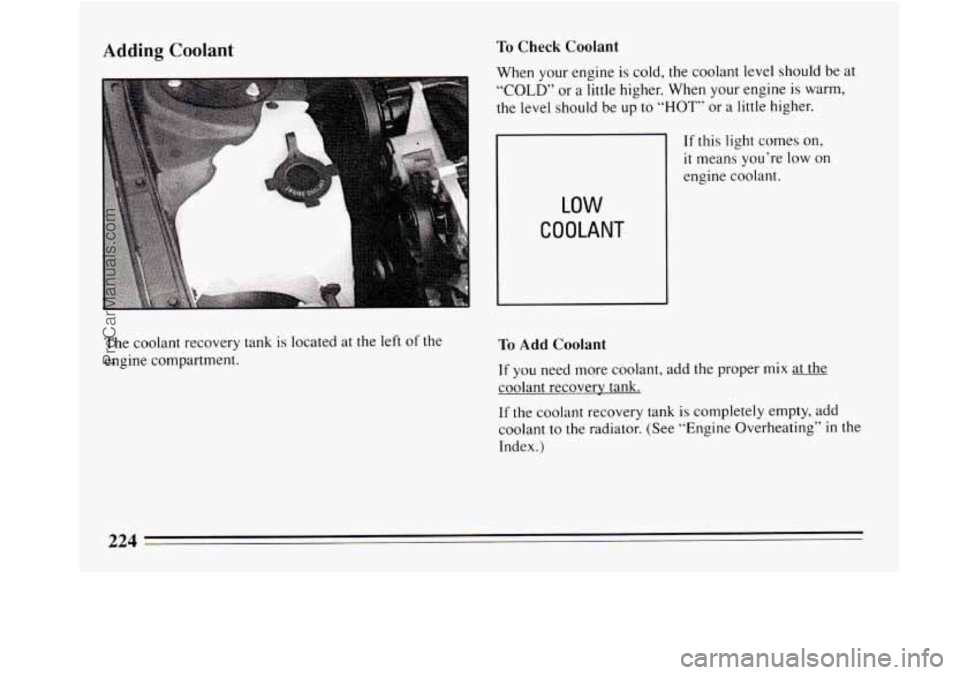
The coolant recovery tank is located at the left of the
engine compartment.
To Check Coolant
When your engine is cold, the coolant level should be at
“COLD” or a little higher. When your engine is warm,
the level should be up to
“HOT” or a little higher.
LOW
COOLANT
If this light comes on,
it means you’re low on
engine coolant.
To Add Coolant
If you need more coolant, add the proper mix at the
coolant recovery tank.
If the coolant recovery tank is completely empty, add
coolant to the radiator. (See “Engine Overheating” in the
Index.)
224
ProCarManuals.com
Page 227 of 308
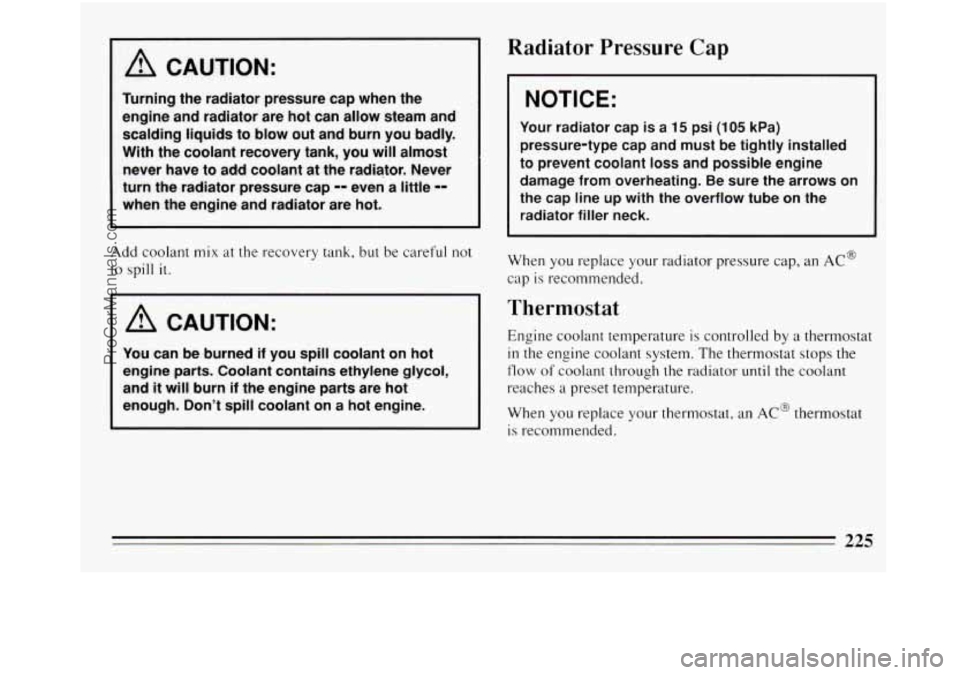
A CAUTION:
Turning the radiator pressure cap when the
engine
and radiator are hot can allow steam and
scalding liquids
to blow out and burn you badly.
With the coolant recovery tank, you will almost
never have
to add coolant at the radiator. Never
turn the radiator pressure cap -- even a little --
when the engine and radiator are hot.
Add coolant mix at the recovery tank, but be careful not
to spill it.
A CAUTION:
You can be burned if you spifl coolant on hot
engine parts. Coolant contains ethylene glycol,
and
it will burn if the engine parts are hot
enough. Don’t spill coolant on a hot engine.
Radiator Pressure Cap
NOTICE:
Your radiator cap is a 15 psi (1 05 kPa)
pressure-type cap and must be tightly installed
to prevent coolant
loss and possible engine
damage from overheating. Be sure the arrows on
the cap line up with the overflow tube on the
radiator filler neck.
When you replace your radiator pressure cap, an AC@
cap
is recommended.
Thermostat
Engine coolant temperature is controlled by a thermostat
in the engine coolant system. The thermostat stops the
flow of coolant through the radiator until the coolant
reaches a preset temperature.
When
you replace your thermostat, an AC@ thermostat
is recommended.
225
ProCarManuals.com
Page 229 of 308
Windshield Washer Fluid
To Add
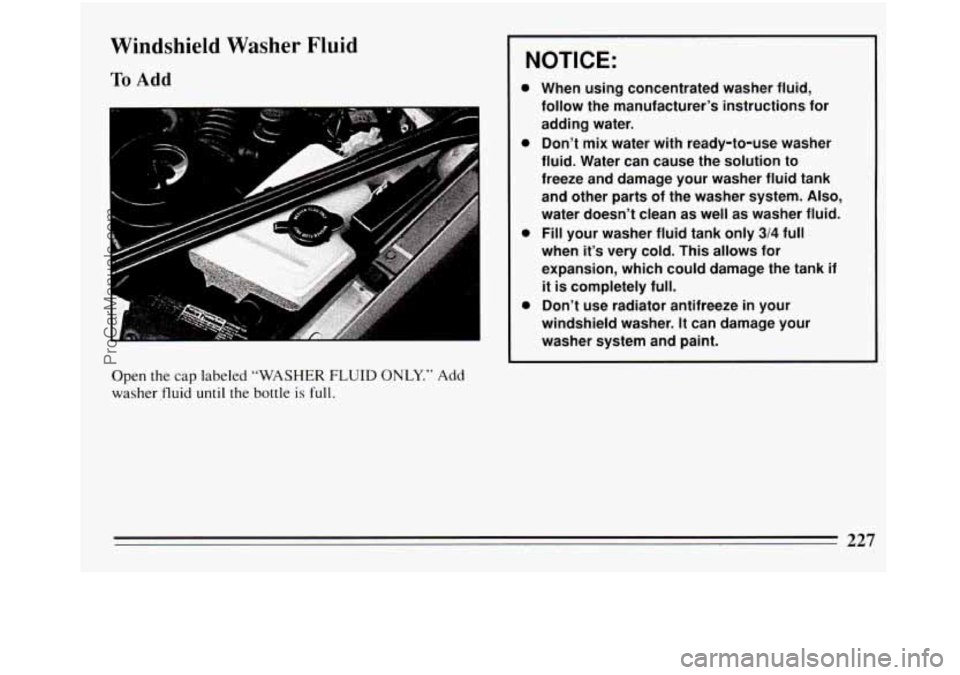
Open the cap labeled “WASHER FLUID ONLY.” Add
washer fluid
until the bottle is full.
NOTICE:
0
0
0
0
When using concentrated washer fluid,
follow the manufacturer’s instructions for
adding water.
Don’t mix water with ready-to-use washer
fluid. Water can cause the solution to
freeze and damage your washer fluid tank
and other parts of the washer system.
Also,
water doesn’t clean as well as washer fluid.
Fill your washer fluid tank only
3/4 full
when
it’s very cold. This allows for
expansion, which could damage the tank
if
it is completely full.
Don’t use radiator antifreeze in your
windshield washer.
It can damage your
washer system and paint.
227
ProCarManuals.com
Page 263 of 308
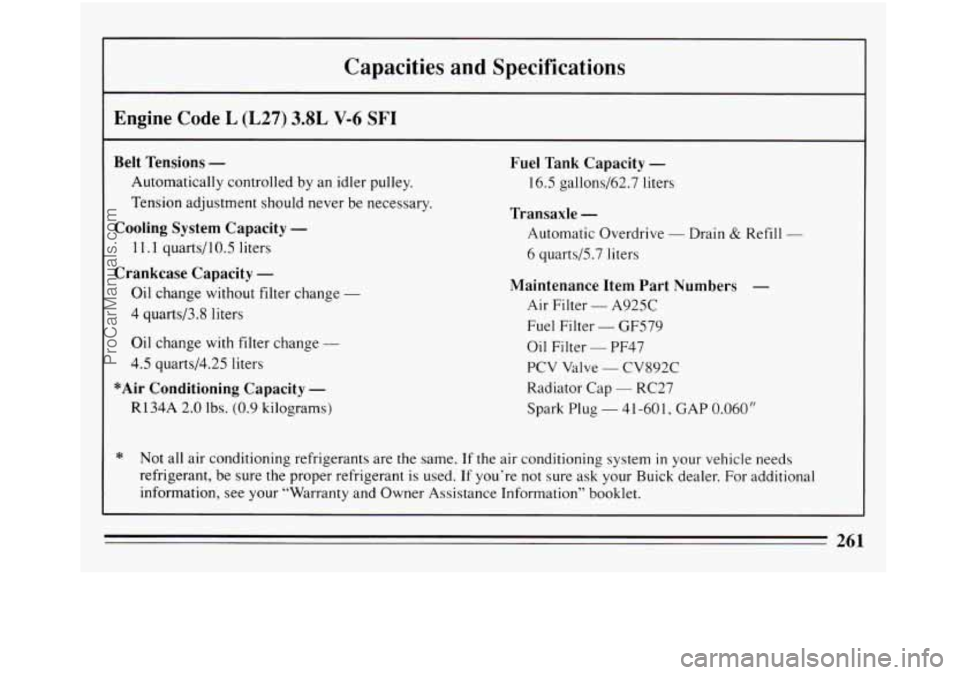
Capacities and Specifications
Engine Code L (L27) 3.8L V-6 SF1
Belt Tensions -
Automatically controlled by an idler pulley.
Tension adjustment should never be necessary.
Cooling System Capacity -
11.1 quartsl10.5 liters
Crankcase Capacity -
Oil change without filter change -
4 quarts/3.8 liters
Oil change with filter change -
4.5 quarts/4.25 liters
*Air Conditioning Capacity -
R134A 2.0 lbs. (0.9 kilograms)
Fuel Tank Capacity -
16.5 gallons/62.7 liters
Transaxle -
Automatic Overdrive - Drain & Refi 11 -
6 quarts/5.7 liters
Maintenance Item Part Numbers -
Air Filter - A925C
Fuel Filter
- GF579
Oil Filter
- PF47
PCV Valve
- CV892C
Radiator Cap
- RC27
Spark Plug
- 4 1-60 1, GAP 0.060”
* Not all air conditioning refrigerants are the same. If the air conditioning system in your vehicle needs
refrigerant, be sure the proper refrigerant is used. If you’re not sure ask your Buick dealer. For additional
information, see your “Warranty and Owner Assistance Information” booklet.
261
ProCarManuals.com
Page 264 of 308
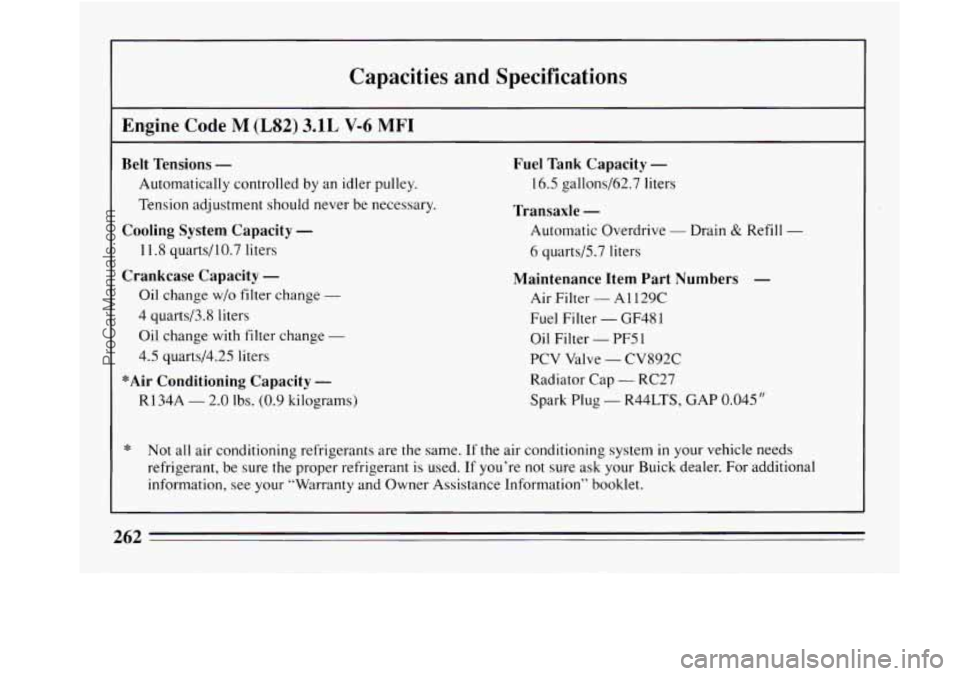
Capacities and Specifications
Engine Code M (LS2) 3.1L V-6 MFI
Belt Tensions -
Automatically controlled by an idler pulley.
Tension adjustment should never be necessary.
Cooling System Capacity -
11.8 quartsll0.7 liters
Crankcase Capacity -
Oil change w/o filter change -
4 quarts/3.8 liters
Oil change with filter change
-
4.5 quarts/4.25 liters
*Air Conditioning Capacity -
R134A - 2.0 lbs. (0.9 kilograms)
Fuel Tank Capacity -
16.5 gallons/62.7 liters
Transaxle -
Automatic Overdrive - Drain & Refill -
6 quarts/5.7 liters
Maintenance Item Part Numbers -
Air Filter - A 1 129C
Fuel Filter - GF48 1
Oil Filter - PF5 1
PCV Valve - CV892C
Radiator Cap
- RC27
Spark Plug
- R44LTS, GAP 0.045”
* Not all air conditioning refrigerants are the same. If the air conditioning system in your vehicle needs
refrigerant, be sure the proper refrigerant is used. If you’re not sure ask your Buick dealer. For additional
information, see your “Warranty and Owner Assistance Information” booklet.
262
ProCarManuals.com
Page 274 of 308
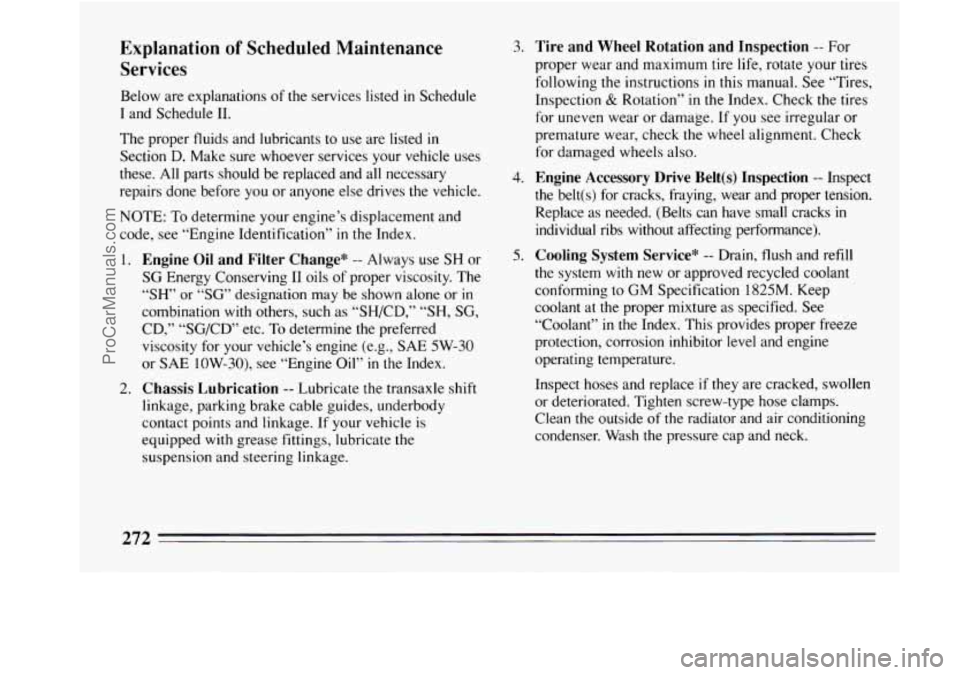
Explanation of Scheduled Maintenance
Services
Below are explanations of the services listed in Schedule
I and Schedule 11.
The proper fluids and lubricants to use are listed
in
Section D. Make sure whoever services your vehicle uses
these. All
parts should be replaced and all necessary
repairs done before you or anyone else drives the vehicle.
NOTE: To determine your engine’s displacement and
code, see “Engine Identification”
in the Index.
1.
Engine Oil and Filter Change* -- Always use SH or
SG Energy Conserving I1 oils of proper viscosity. The
“SH” or “SG” designation may be shown alone or in
combination with others, such as “SH/CD,” “SH, SG,
CD,” “SG/CD” etc.
To determine the preferred
viscosity for your vehicle’s engine (e.g., SAE 5W-30-
or SAE 10W-30), see “Engine Oil” in the Index.
2. Chassis Lubrication -- Lubricate the transaxle shift
linkage, parking brake cable guides, underbody
contact points and linkage. If your vehicle is
equipped with grease fittings, lubricate the
suspension and steering linkage. 3.
4.
5.
Tire
and Wheel Rotation and Inspection -- For
proper wear and maximum tire life, rotate your tires
following the instructions
in this manual. See “Tires,
Inspection
& Rotation” in the Index. Check the tires
for uneven wear or damage. If you see irregular or
premature wear, check the wheel alignment. Check
for damaged wheels also.
Engine Accessory Drive Belt(s) Inspection -- Inspect
the belt(s) for cracks, fraying, wear and proper tension.
Replace as needed. (Belts can have small cracks
in
individual ribs without affecting performance).
Cooling System Service* -- Drain, flush and refill
the system
with new or approved recycled coolant
conforming to GM Specification
1825M. Keep
coolant at the proper mixture as specified. See
“Coolant”
in the Index. This provides proper freeze
protection, corrosion inhibitor level and engine
operating temperature.
Inspect hoses and replace if they are cracked, swollen
or deteriorated. Tighten screw-type hose clamps.
Clean the outside of the radiator and air conditioning
condenser. Wash the pressure cap and neck.
272
ProCarManuals.com