1994 BUICK REGAL brake light
[x] Cancel search: brake lightPage 147 of 308
Anti-Lock Brakes (ABS)
Your Buick has an advanced electronic braking system
that will help prevent skidding.
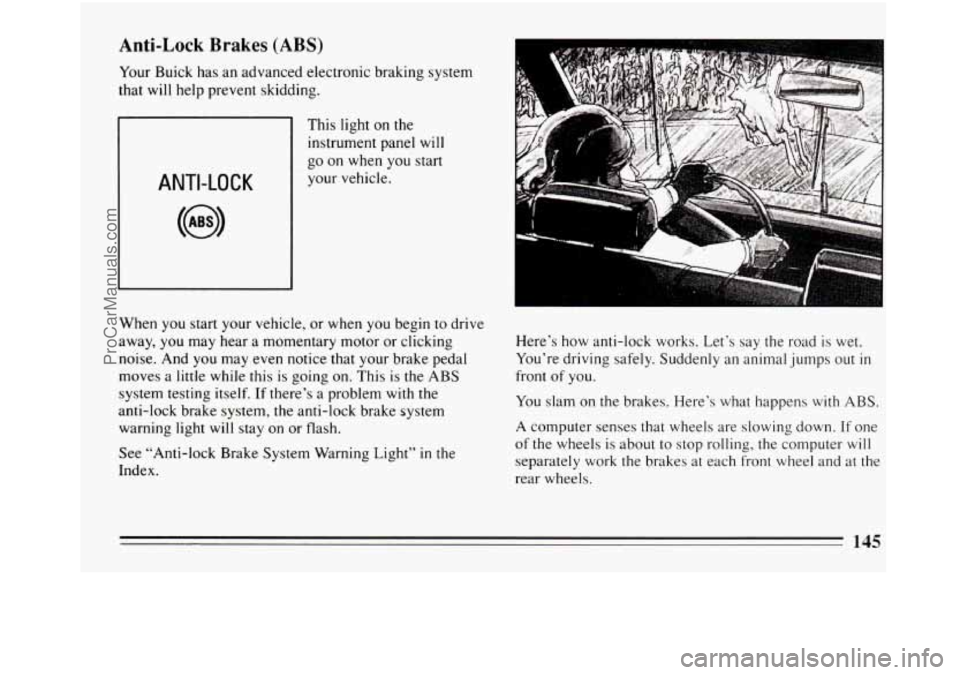
ANTI-LOCK
This light on the
instrument panel will
go on when you start
your vehicle.
When you start your vehicle, or when you begin to drive
away, you may hear a momentary motor or clicking
noise. And
you may even notice that your brake pedal
moves a little while this is going on. This is the
ABS
system testing itself. If there’s a problem with the
anti-lock brake system, the anti-lock brake system
warning light
will stay on or flash.
See “Anti-lock Brake System Warning Light”
in the
Index. Here’s how
anti-lock works. Let’s say the road is wet.
You’re driving safely. Suddenly an animal jumps out
in
front of you.
You slam on the brakes. Here’s what happens
with ABS.
A computer senses that wheels are slowing down. If one
of the wheels
is about to stop rolling, the computer will
separately work the brakes at each front wheel and at the
rear wheels.
145
ProCarManuals.com
Page 152 of 308
Do not get too close to the vehicle you want to pass
while you’re awaiting an opportunity. For one thing,
following too closely reduces your area of vision,
especially if you’re following a larger vehicle. Also,
you won’t have adequate space if the vehicle ahead
suddenly slows or stops. Keep back a reasonable
distance.
0 When it looks like a chance to pass is coming up,
start
to accelerate but stay in the right lane and don’t
get too close. Time.your move
so you will be
increasing speed as the time comes to move into the
other lane. If the way is clear
to pass, you will have a
“running start” that more than makes up for
the
distance you would lose by dropping back. And if
something happens to cause
you to cancel your pass,
you need only slow down and drop back again and
wait for another opportunity.
0 If other cars are lined up to pass a slow vehicle, wait
your turn. But take care that someone isn’t trying to
pass you as
you pull out to pass the slow vehicle.
Remember to glance over your shoulder and check
the blind spot.
Check your mirrors, glance over your shoulder, and
start your left lane change signal before moving out
of the right lane to pass. When you are far enough
ahead of the passed vehicle to see its front in you:
inside mirror, activate your right lane change signal
and move back into the right lane. (Remember that
your right outside mirror is convex. The vehicle you
just passed may seem to be farther away from
you
than it really is.)
Try not to pass more than one vehicle at a time on
two-lane roads. Reconsider before passing the next
vehicle.
0 Don’t overtake a slowly moving vehicle too rapidly.
Even though the brake lights are not flashing,
it may
be slowing down or starting to turn.
If you’re being passed, make it easy for the
following driver to get ahead of you. Perhaps you
can ease a little
to the right.
ProCarManuals.com
Page 169 of 308
monoxide (CO) from your exhaust can get into your
vehicle (see “Carbon Monoxide”
in the Index). Dirt
and water can,
too.
The bumpers on your vehicle are not intended for
hitches. Do not attach rental hitches or other
bumper-type hitches to them. Use only a
frame-mounted hitch that does not attach to the
bumper.
Safety Chains
You should always attach chains between your vehicle
and your trailer. Cross the safety chains under the
tongue of the trailer
so that the tongue will not drop to
the road
if it becomes separated from the hitch.
Instructions about safety chains may be provided by the
hitch manufacturer or by the trailer manufacturer.
Follow the manufacturer’s recommendation for
attaching safety chains. Always leave just enough slack
so you can turn with your rig. And, never allow safety
chains to drag
on the ground.
Trailer Brakes
If your trailer weighs more than 1,000 pounds (450 kg)
loaded, then
it needs its own brakes -- and they must be
adequate. Be sure to read and follow the instructions for
the trailer brakes
so you’ll be able to install, adjust and maintain
them properly. Because you have anti-lock
brakes, do not try to tap into your vehicle’s brake
system. If you do, both brake systems won’t work well,
or at all.
Driving with a Trailer
Towing a trailer requires a certain amount of experience.
Before setting out for the open road, you’ll want to get
to know your rig. Acquaint yourself with the feel of
handling and braking with the added weight
of the
trailer. And always keep
in mind that the vehicle you are
driving
is now a good deal longer and not nearly so
responsive as your vehicle is by itself.
Before you start, check the trailer hitch and platform,
,
safety chains, electrical connector, lights, tires and
mirror adjustment. If
the trailer has electric brakes, start
your vehicle and trailer moving and then apply the
trailer brake controller by hand to be sure the brakes are
working. This lets you check your electrical connection
at the same time.
During your trip, check occasionally to be sure that the
load is secure, and that the lights and any trailer brakes
are still working.
167
ProCarManuals.com
Page 170 of 308

Following Distance
Stay at least twice as far behind the vehicle ahead as you
would when driving your vehicle without a trailer. This
can help you avoid situations that require heavy braking
and sudden turns.
Passing
You’ll need more passing distance up ahead when
you’re towing a trailer. And, because you’re a good deal
longer, you’ll need
to go much farther beyond the
passed vehicle before
you can return to your lane.
Backing Up
Hold the bottom of the steering wheel with one hand.
Then,
to move the trailer to the left, just move that hand
to the left.
To move the trailer to the right, move your
hand
to the right. Always back up slowly and, if
possible, have someone guide you.
Making Turns
When you’re turning with a trailer, make wider turns
than normal.
Do this so your trailer won’t strike soft
shoulders, curbs, road signs, trees, or other objects.
Avoid jerky or sudden maneuvers. Signal well
in
advance.
Turn Signals When Towing a Trailer
When you tow a trailer, your vehicle has to have a
different turn signal flasher and extra wiring. The green
arrows
on your instrument panel will flash whenever
you signal a turn or lane change. Properly hooked up,
the trailer lights will also flash, telling other drivers
you’re about to turn, change lanes or stop.
When towing a trailer,
the green arrows on your
instrument panel will flash for turns even
if the bulbs on
the trailer are burned out. Thus, you may think drivers
behind you are seeing your signal when they are
not. It’s
important to check occasionally to be sure the trailer
bulbs are still working.
Driving On Grades
Reduce speed and shift to a lower gear before you start
down a long or steep downgrade. If you don’t shift
down,
you might have to use your brakes so much that
they would get hot and no longer work
well.
On a long uphill grade, shift down and reduce your
speed to around
45 mph (70 km/h) to reduce the
possibility
of engine and transaxle overheating.
If you are towing a trailer that weighs more than
1,000
pounds (450 kg), you may prefer to drive in “D” instead
of Overdrive (or, as you need to, a lower gear).
168
ProCarManuals.com
Page 176 of 308
I NOTICE:
Ignoring these steps could result in costly
damage
to your vehicle that wouldn’t be covered
by your warranty. Trying to start your Buick by
pushing or pulling it won’t work, and it could
damage your vehicle.
To Jump Start Your Buick:
1. Check the other vehicle. It must have a 12-volt
battery
with a negative ground system.
NOTICE:
If the other system isn’t a 12-volt system with a
negative ground, both vehicles can be damaged.
2. Get the vehicles close enough so the jumper cables
can reach, but be sure the vehicles aren’t touching
each other.
If they are, it could cause a ground
connection you don’t want.
You wouldn’t be able to
start your Buick, and the bad grounding could
damage the electrical systems. You
could be injured
if the vehicles roll. Set the
parking brake firmly on each vehicle. Put an
automatic transaxle
in “P” (Park) or a manual
transaxle
in “N” (Neutral).
3. Turn off the ignition on both vehicles. Turn off all
lights that aren’t needed, and radios. This will avoid
sparks and help save both batteries. And
it could
save your radio!
1 NOTICE:
If you leave your radio on, it could be badly
damaged. The repairs wouldn’t be covered by
your warranty.
ProCarManuals.com
Page 230 of 308
Brakes
Brake Master Cylinder
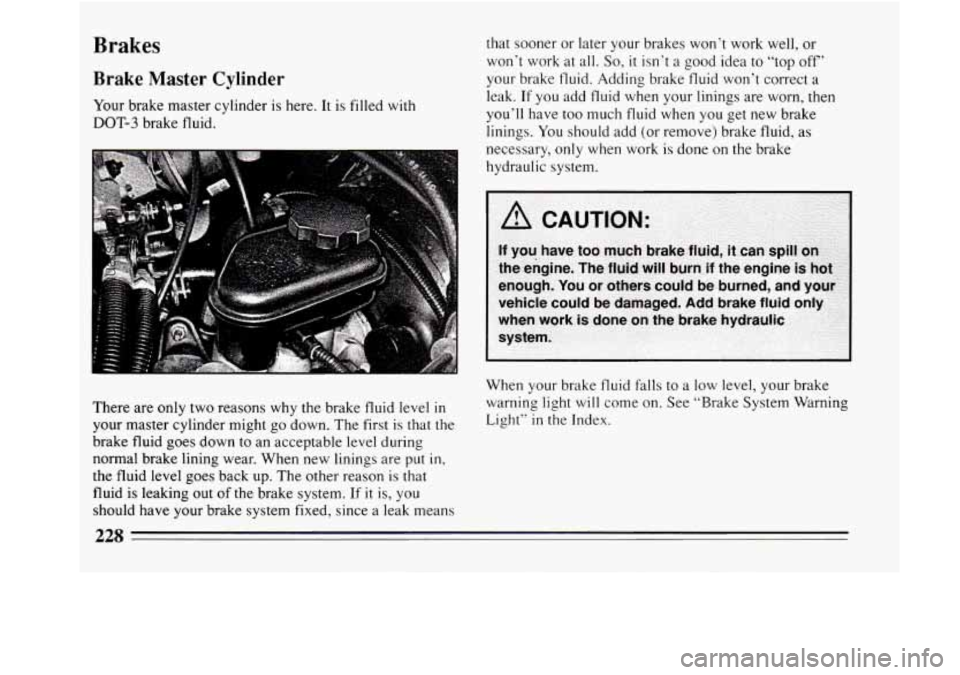
Your brake master cylinder is here. It is filled with
DOT-3 brake fluid. that
sooner or later your brakes won’t work well, or
won’t work at all.
So, it isn’t a good idea to “top off’
your brake fluid. Adding brake fluid won’t correct a
leak. If you add fluid when your linings are worn, then
you’ll have too much fluid when you get new brake
linings. You should add (or remove) brake fluid, as
necessary, only when work is done on the brake
hydraulic system.
When your brake fluid falls to a low level, your brake
There are only two reasons why
the brake fluid level in warning light will come on. See “Brake System Warning
your master cylinder might
go down. The first is that the Light” in the Index.
brake fluid goes down to an acceptable level during
normal brake lining wear. When new linings are
put in,
the fluid level goes back up. The other reason is that
fluid is leaking out
of the brake system. If it is, you
should have your brake system fixed, since a leak means
228
ProCarManuals.com
Page 232 of 308
Some driving conditions or climates may cause a brake
squeal when the brakes are first applied or
lightly
applied. This does not mean something is wrong with
your brakes.
Brake linings should always be replaced as complete
axle sets.
Brake Pedal Travel
See your dealer if the brake pedal does not return to
normal height, or if there is a rapid increase in pedal
travel. This could
be a sign of brake trouble.
Brake Adjustment
Every time you make a moderate brake stop, your disc
brakes adjust for wear. If you rarely make a moderate .or
heavier siop, then your brakes might not adjust
correctly. If you drive
in that way, then -- very carefully
-- make a few moderate brake stops about every 1000
miles (1600 km), so your brakes will adjust properly.
Keplacing Brake System Parts
The braking system on a modern vehicle is complex. Its
many parts have to be
of top quality and work well
together
if the vehicle is to have really good braking. Vehicles we
design and test have top-quality
GM brake
parts
in them, as your Buick does when it is new. When
you replace parts of your braking system
-- for example,
when your brake linings wear down and you have
to
have new ones put in -- be sure you get new genuine
GM replacement parts. If you don’t, your brakes may no
longer work properly. For example,
if someone puts in
brake linings that are wrong for your vehicle, the
balance between your front and rear brakes can change,
for the worse. The braking performance you’ve come
to
expect can change in many other ways if someone puts
in the wrong replacement brake parts.
Battery
Every new Buick has a Delco Freedom@ battery. You
never have to add water to one of these. When it’s time
for a new battery, we recommend a Delco Freedom@
battery. Get one that has the catalog number shown on
the original battery’s label.
Vehicle Storage
If you’re not going to drive your vehicle for 25 days or
more, take off the black, negative
(-) cable from the
battery. This
will help keep your battery from running
down.
230
ProCarManuals.com
Page 244 of 308
Wheel Replacement
Replace any wheel that is bent, cracked or badly rusted.
If wheel nuts keep coming loose, the wheel, wheel bolts,
and wheel nuts should be replaced. If the wheel leaks
air, replace
it (except some aluminum wheels, which can
sometimes be repaired). See your Buick dealer
if any of
these conditions exist.
Your dealer will know the kind of wheel you need.
Each new wheel should have the same load carrying
capacity, diameter, width, offset, and be mounted the
same way as the one it replaces.
If you need to replace any of your wheels, wheel bolts,
or wheel nuts, replace them only with new
GM original
equipment parts. This way, you will be sure
to have the
right wheel, wheel bolts, and wheel nuts for your Buick
model. NOTICE:
The wrong wheel can also cause problems with
bearing life, brake cooling,
speedometer/odometer calibration, headlight
aim, bumper height, vehicle ground clearance,
and tire or tire chain clearance to the body and
chassis.
242
ProCarManuals.com