Page 199 of 324
e I
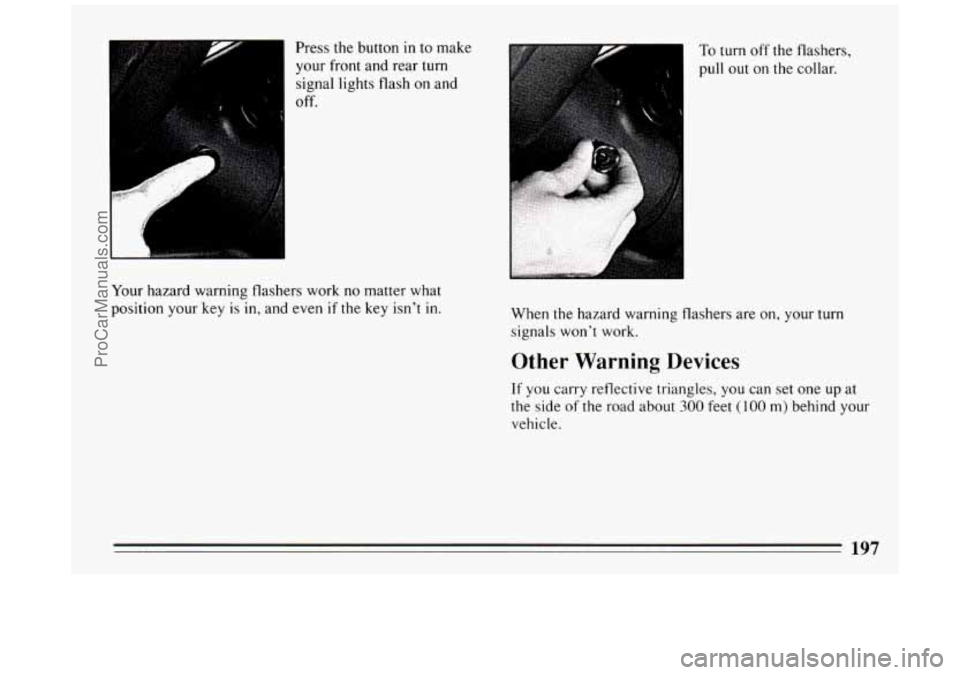
Press the button in to make
your front and rear turn
signal lights flash
on and
off.
I
Your hazard warning flashers work no matter what
position your key is in, and even
if the key isn’t in.
To turn off the flashers,
pull
out on the collar.
When
the hazard warning flashers are on, your turn
signals won’t work.
Other Warning Devices
If you carry reflective triangles, you can set one up at
the side of the road about
300 feet (100 m) behind your
vehicle.
197
ProCarManuals.com
Page 201 of 324
You could be injured if the vehicles roll. Set the
parking brake firmly
on each vehicle. Put an
automatic transaxle
in “P” (Park) or a manual
transaxle in “N” (Neutral).
3. Turn off the ignition on both vehicles. Turn off the
radios and all lights that aren’t needed. This
will
avoid sparks and help save both batteries. It could
save your radio!
NOTICE:
If you leave your radio on, it could be badly
damaged. The repairs wouldn’t be covered by
your warranty.
4. Open the hoods and locate the batteries. Find the positive
(+) and negative (-) terminals
on
each battery.
199
ProCarManuals.com
Page 209 of 324
Engine Overheating
You will find a warning light about a hot engine on your
Buick instrument panel and if you have the optional
gage cluster, a coolant temperature gage. You will also
find a low coolant warning light.
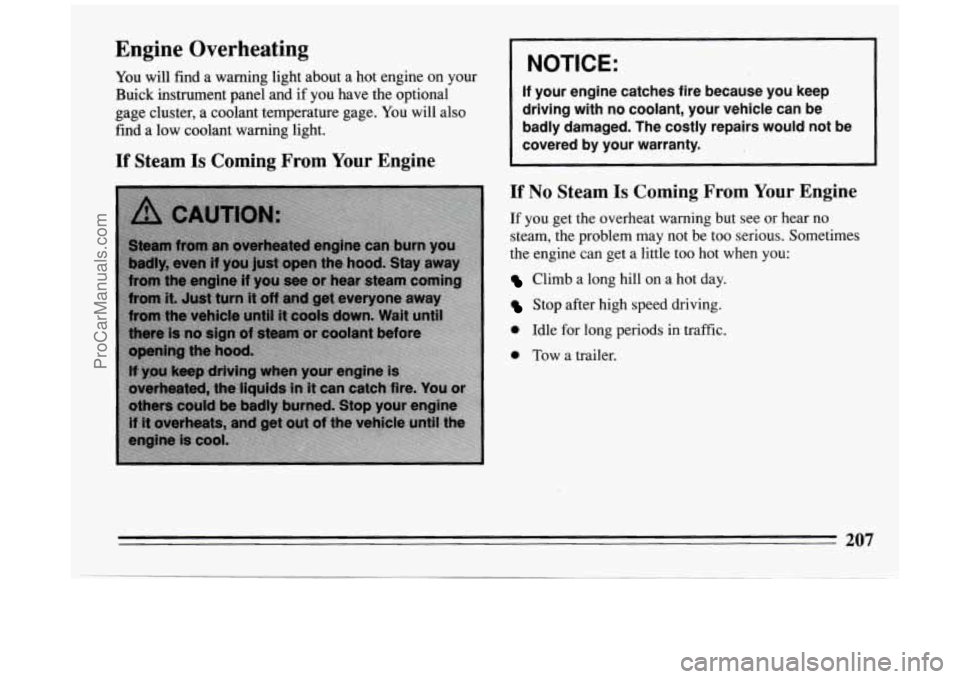
If Steam Is Coming From Your Engine
NOTICE:
If your engine catches fire because you keep
driving with no coolant, your vehicle can be
badly damaged. The costly repairs would not be
covered by your warranty.
If NO Steam Is Coming From Your Engine
If you get the overheat warning but see or hear no
steam, the problem may not be too serious. Sometimes
the engine can get a little too hot when you:
Climb a long hill on a hot day.
Stop after high speed driving.
0 Idle for long periods in traffic.
0 Tow a trailer.
207
ProCarManuals.com
Page 228 of 324
NOTICE:
Spinning your wheels can destroy parts of your
vehicle as well as the tires.
If you spin the wheels
too fast while shifting your transaxle back and
forth, you can destroy your transaxle.
Rocking your vehicle to get it out:
First, turn your steering wheel left and right. That will
clear the area around your front wheels. You should turn
your traction control system off. (See “Traction Control
System” in
the Index.) Then shift back and forth
between
“R” (Reverse) and a forward gear, spinning the
wheels as little as possible. Release the accelerator pedal
while you shift, and press lightly on the accelerator
pedal when the transaxle is in gear. If that doesn’t get
you out after a few tries,
you may need to be towed out.
If
you do need to be towed out, see “Towing Your Car”
in the Index.
226
ProCarManuals.com
Page 239 of 324

3800 Supercharged (L67) Engine
(Option)
Your Park Avenue Ultra has a 3800 Supercharged
engine. Buick chose supercharging rather than
turbocharging because Buick emphasizes smooth,
refined power.
The Supercharger is a device which is designed to pump
more air into the engine than it would normally use.
This air mixed with fuel, creates increased engine
power. Since
the Supercharger is a pump and is driven
from an engine accessory drive belt, increased pressure
is available at all driving conditions.
The powertrain control module (PCM), works with a
vacuum control to regulate the increased pressure
required during specific driving conditions. When this
increased pressure or boost is not desired, such as during
idling and light throttle cruising, the excess air that the
Supercharger is pumping
is routed through a bypass. All
of these controls, working together provide high
performance character and
fuel efficiency in the 3800
V6 Supercharged Buick engine.
The power steering pump uses a remote reservoir
mounted on the throttle and cruise control cable bracket.
See “Maintenance Schedule’’ in
the Index for when you
should check the fluid.
Engine Accessory Belt
The Supercharged 3800 engine uses two accessory drive
belts. One belt drives the generator and the power
steering pump. The second belt drives the supercharger,
coolant pump and air conditioning compressor. Each
belt has its own tensioner and idler pulley.
1. Front Belt
C. Crank
2. Back belt D. Supercharger
A. Generator
E. Coolant Pump
B. Power Steering Pump E Air Conditioning
237
ProCarManuals.com
Page 240 of 324
Supercharger Oil
Unless you are technically qualified and have the proper
tools, you should
let your dealer or a qualified service
center perform this maintenance.
When to Check: Check oil level every 30,000 miles
(50,000 km) or every 36 months.
What Kind of Oil to Use: See “Recommended Fluids and
Lubricants”
in the Index. Use only the recommended oil.
How to Check and Add Oil: Check oil only when the
engine is cold. Allow the engine to cool
2 to 3 hours after
running.
1. Remove the wiring harness shield.
2. Clean the area around the oil fill plug before
removing
it.
3. Remove the oil fill plug using a 3/16 allen wrench.
4. The oil level is correct when it just reaches the
bottom
of the threads of the inspection hole.
5. Replace the oil plug with the O-ring in place. Torque
to 10 Nom (88 lb. in.).
6. Replace the wiring harness shield.
Engine Oil
CHECK
OIL LEVEL
If the “CHECK OIL
LEVEL” light on the
instrument panel
comes on,
it means
you need to check
your engine oil level
right away.
For more information, see “CHECK
OIL LEVEL” light
in the Index. You should check your engine oil level
regularly; this is an added reminder.
238
ProCarManuals.com
Page 244 of 324
Engine Oil Additives
Don’t add anything to your oil. Your Buick dealer is
ready to advise if you think something should be added.
When to Change Engine Oil
See if any one of these is true for you:
Most trips are less than 4 miles (6 km).
It’s below freezing outside and most trips are less
than
10 miles (16 km).
The engine is at low speed most of the time (as in
door-to-door delivery, or in stop-and-go traffic).
0 You tow a trailer often.
Most trips are through dusty places.
If any one of these is true for your vehicle, then you
need to change your oil and filter every
3,000 miles
(5 000 km) or 3 months -- whichever comes first. (See
“Change Oil Soon” in the Index.) If
none of
them is true, change the oil every 7,500 miles
(12 500 km) or 12 months -- whichever comes first.
Change the filter at the first oil change and at every
other oil change after that.
If the optional “Change Oil Soon” light comes on you
will need to change your oil sooner than either mileage
specified. Depending upon driving habits, the “Change
Oil Soon’’ light may come on
as early as 2,000 miles or
less from the last time the oil life monitor was reset (See
“Oil Life Monitor” in the Index.)
Always reset the oil
life monitor after every oil change.
Engine Coolant Heater (Engine Block
Heater)
An engine coolant heater can be a big help if you have
to park outside in very cold weather,
0°F (- 18 “C) or
colder. If your vehicle has this option, see “Engine
Coolant Heater” in the Index.
242
ProCarManuals.com
Page 249 of 324
Engine Coolant
The following explains your cooling system and how to
add coolant when
it is low. If you have a problem with
engine overheating, see “Engine Overheating” in the
Index.
The proper coolant for your Buick will:
0 Give freezing protection down to -34°F (-37 “C).
0 Give boiling protection up to 262°F (128 “C).
0 Protect against rust and corrosion.
0 Help keep the proper engine temperature,
Let the warning lights work as they should.
What to Use
Use a mixture of one-half clean water (preferably
distilled) and one-half antifreeze that meets “GM
Specification 1825-M,” which won’t damage aluminum
parts.
You can also use a recycled coolant conforming to
GM Specification 1825-M with a complete coolant flush
and refill. If you use this mixture,
you don’t need to add
anything else.
I NOTICE:
If you use an improper coolant mix, your engine
could overheat and be badly damaged. The
repair cost wouldn’t be covered by your
warranty. Too much water in the mix can freeze
and crack the engine, radiator, heater core and
other parts.
247
ProCarManuals.com