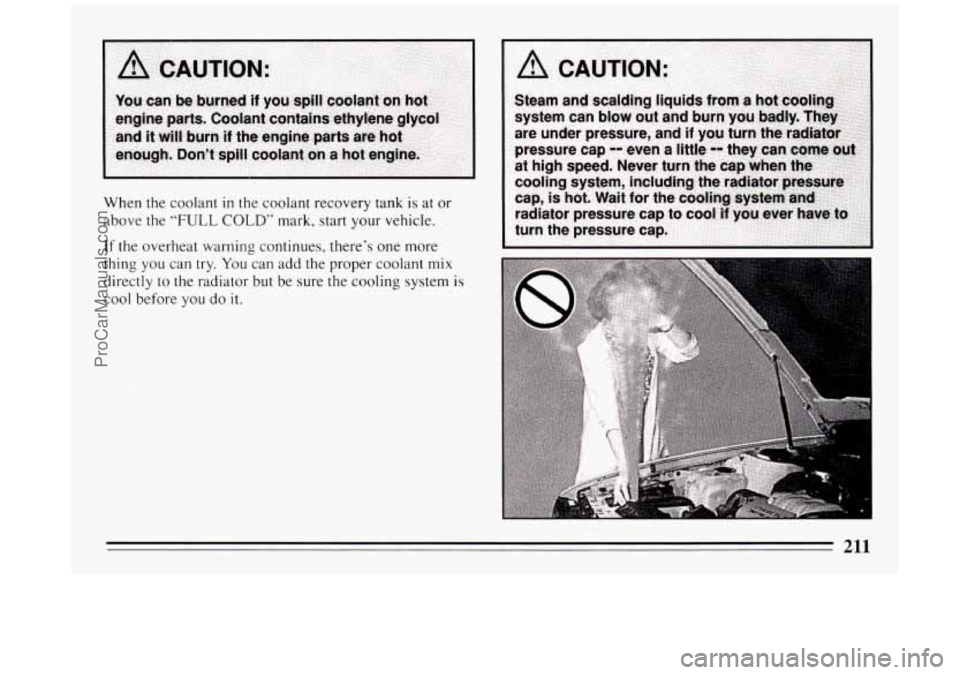
Page 210 of 324
If you get the overheat warning with no sign of steam,
try this for a minute or
so:
1. Turn off your air conditioner.
2. Turn on your heater to full hot at the highest fan
speed and open the window as necessary.
3. If you’re in a traffic jam, shift to “N” (Neutral).
If you no longer have the overheat warning, you can
drive. Just to be safe, drive slower for about ten minutes.
If the warning doesn’t come back on, you can drive
normally.
If the warning continues, pull over, stop, and park your
vehicle right away.
If there’s still no sign of steam, you can idle the engine
for two or three minutes while you’re parked, to see
if
the warning stops. But then, if you still have the
warning, TURN OFF THE ENGINE AND GET
EVERYONE OUT OF THE VEHICLE until it cools
down.
You may decide not to lift the hood but to get service
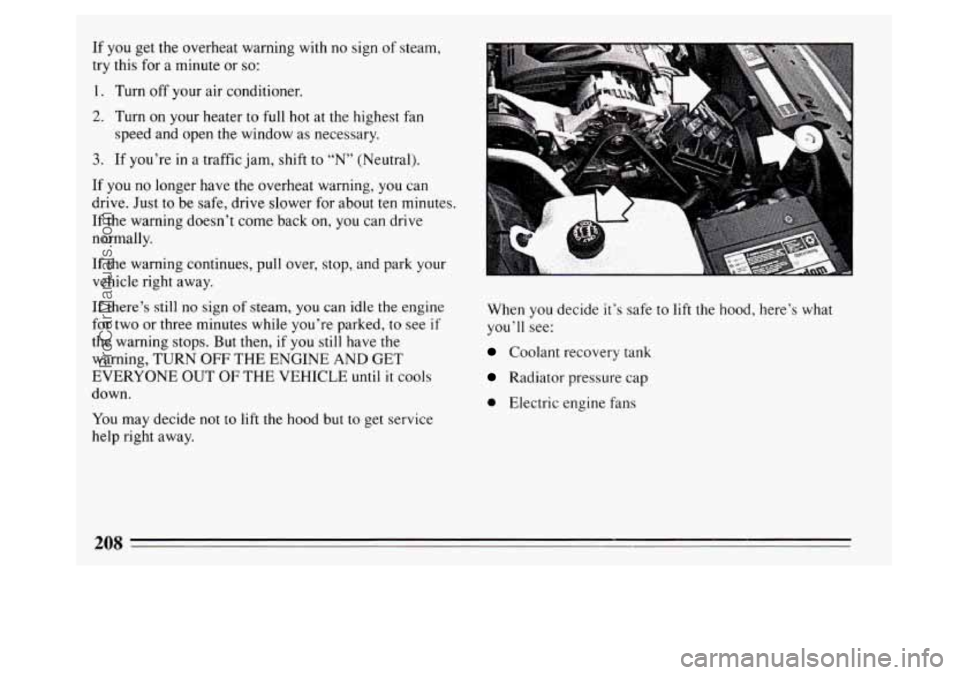
help right away. When you
decide it’s safe to lift the hood, here’s what
you’ll see:
Coolant recovery tank
Radiator pressure cap
0 Electric engine fans
208
ProCarManuals.com
Page 213 of 324
When the coolant in the coolant recovery tank is at or
above the
“FULL COLD” mark, start your vehicle.
If the overheat warning continues, there’s one more
thing you can try.
You can add the proper coolant mix
directly to the radiator but be sure the cooling system
is
cool before you do it.
ProCarManuals.com
Page 217 of 324
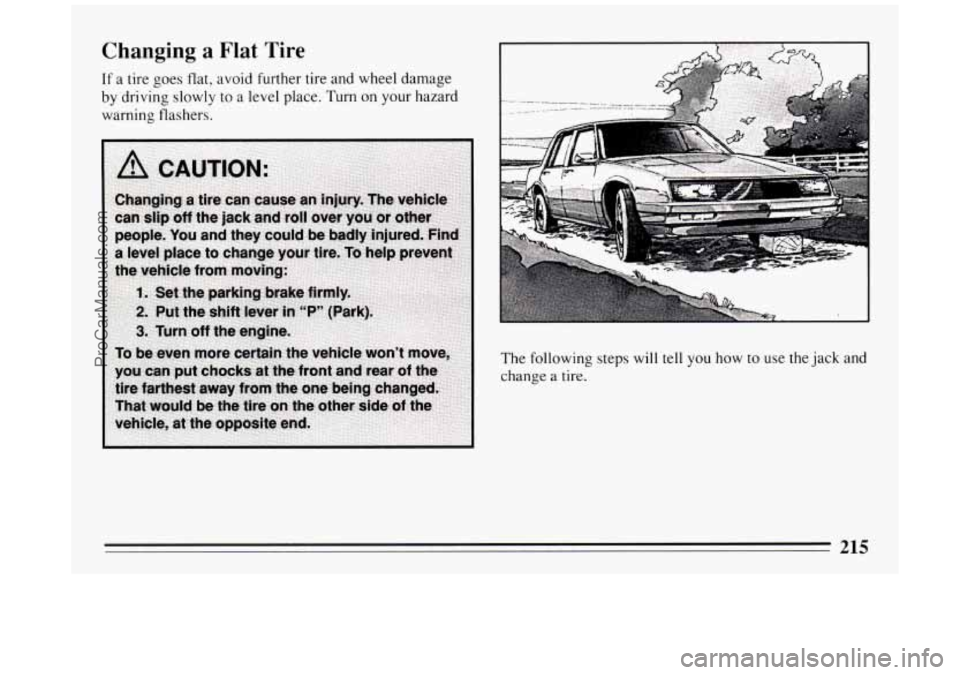
Changing a Flat Tire
If a tire goes flat, avoid further tire and wheel damage
by driving slowly to a
level place. Turn on your hazard
warning flashers.
i
The following steps will tell you how to use the jack and
change
a tire.
215
ProCarManuals.com
Page 245 of 324
What to Do with Used Oil
Did you know that used engine oil contains certain
elements
that may be unhealthy for your skin and could
even cause cancer? Don’t let used oil stay on your skin
for very long. Clean your skin and nails with soap and
water, or a good hand cleaner. Wash or properly throw
away clothing or rags containing used engine oil. (See
the manufacturer’s warnings about the use and disposal
of oil products.)
Used oil can be a real threat to the environment. If you
change your own
oil, be sure to drain all free-flowing
oil from the filter before disposal. Don’t ever dispose of
oil by putting it in the trash, pouring
it on the ground,
into sewers, or into streams or bodies of water. Instead,
recycle it by taking
it to a place that collects used oil. If
you have a problem properly disposing of your used oil,
ask your dealer, a service station or a local recycling
center for help.
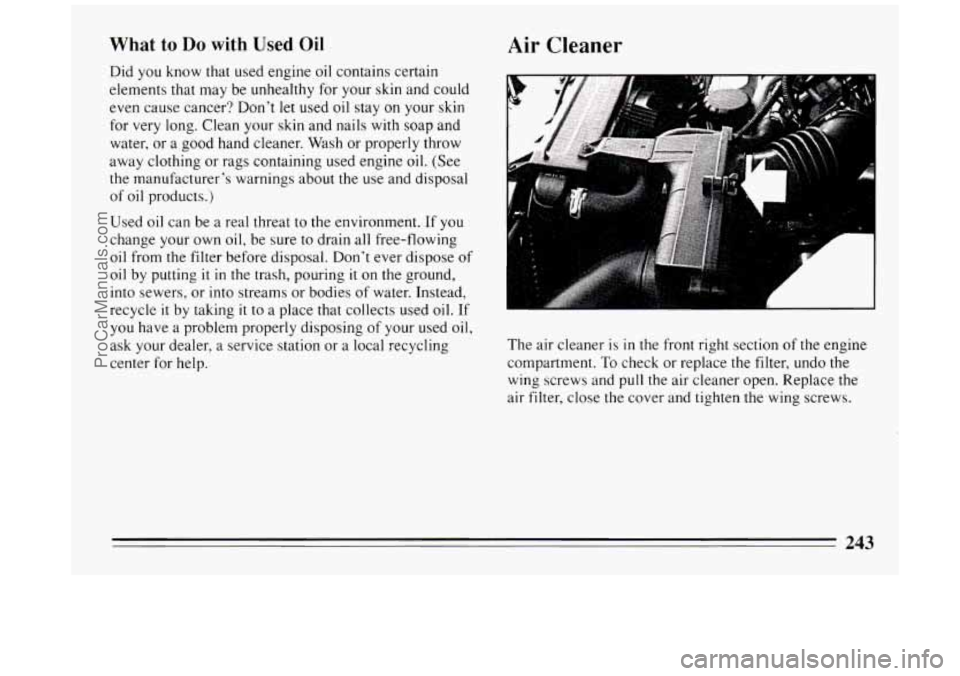
Air Cleaner
1
The air cleaner is in the front right section of the engine
compartment.
To check or replace the filter, undo the
wing screws and pull the air cleaner open. Replace the
air filter, close
the cover and tighten the wing screws.
243
ProCarManuals.com
Page 249 of 324
Engine Coolant
The following explains your cooling system and how to
add coolant when
it is low. If you have a problem with
engine overheating, see “Engine Overheating” in the
Index.
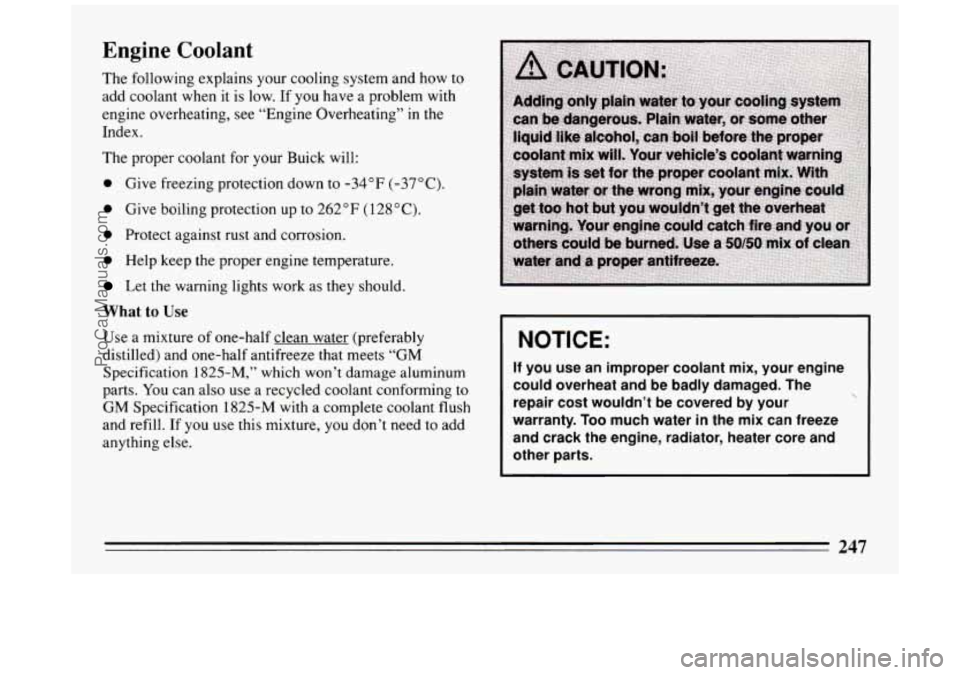
The proper coolant for your Buick will:
0 Give freezing protection down to -34°F (-37 “C).
0 Give boiling protection up to 262°F (128 “C).
0 Protect against rust and corrosion.
0 Help keep the proper engine temperature,
Let the warning lights work as they should.
What to Use
Use a mixture of one-half clean water (preferably
distilled) and one-half antifreeze that meets “GM
Specification 1825-M,” which won’t damage aluminum
parts.
You can also use a recycled coolant conforming to
GM Specification 1825-M with a complete coolant flush
and refill. If you use this mixture,
you don’t need to add
anything else.
I NOTICE:
If you use an improper coolant mix, your engine
could overheat and be badly damaged. The
repair cost wouldn’t be covered by your
warranty. Too much water in the mix can freeze
and crack the engine, radiator, heater core and
other parts.
247
ProCarManuals.com
Page 254 of 324
Brakes
Brake Master Cylinder
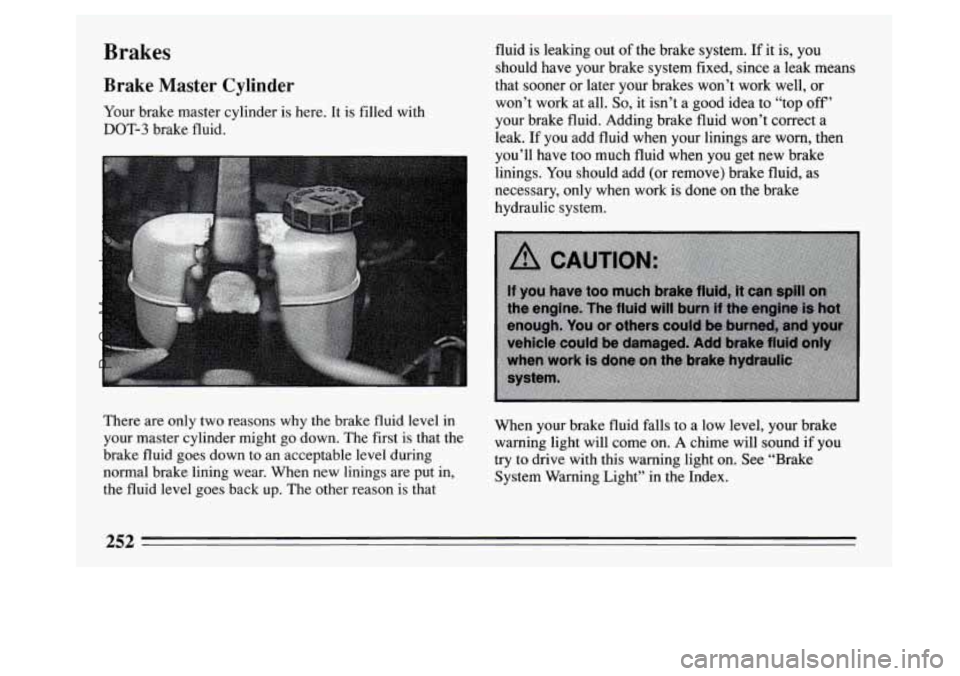
Your brake master cylinder is here. It is filled with
DOT-3 brake fluid. fluid is leaking
out of the brake system. If it is, you
should have your brake system fixed, since a leak means
that sooner or later your brakes won’t work well, or
won’t work at all.
So, it isn’t a good idea to “top off’
your brake fluid. Adding brake fluid won’t correct a
leak. If you add fluid when your linings are worn, then
you’ll have too much fluid when you get new brake
linings.
You should add (or remove) brake fluid, as
necessary, only when work is done on the brake
hydraulic system.
There are only two reasons why the brake fluid level
in
your master cylinder might go down. The first is that the
brake fluid goes down to an acceptable level during
normal brake lining wear. When new linings are put in,
the fluid level goes back up. The other reason is that When
your brake fluid falls to a low level, your brake
warning light will come on. A chime will sound if you
try to drive with this warning light on. See “Brake
System Warning Light” in the Index.
252
ProCarManuals.com
Page 255 of 324
What to Add
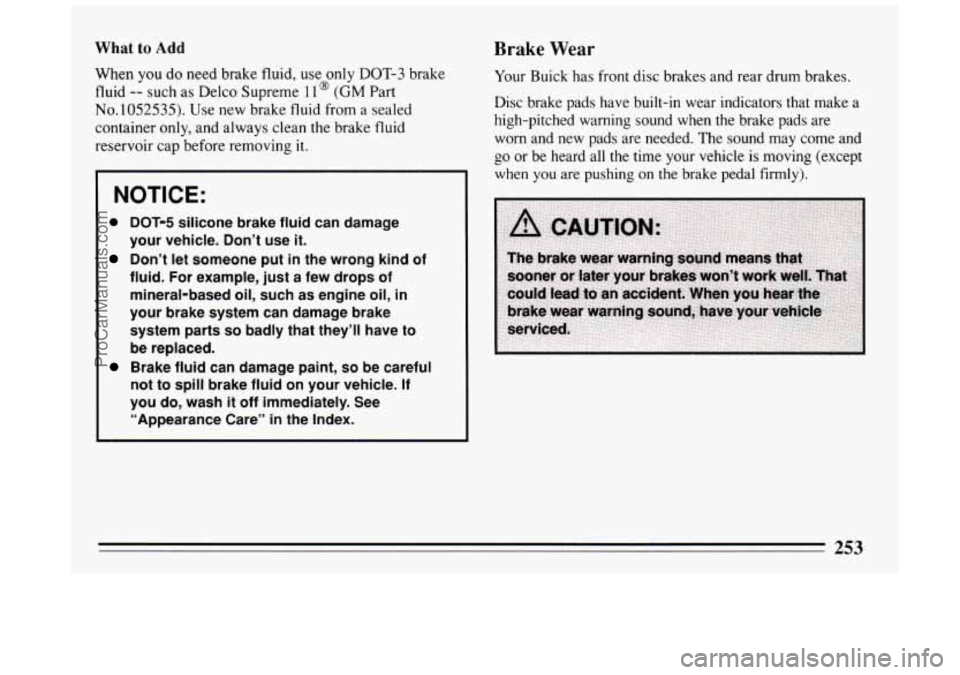
When you do need brake fluid, use only DOT-3 brake
fluid
-- such as Delco Supreme 11 @ (GM Part
No. 1052535). Use new brake fluid from a sealed
container only, and always clean
the brake fluid
reservoir cap before removing
it.
Brake Wear
Your Buick has front disc brakes and rear drum brakes.
NOTICE:
0 DOT-5 silicone brake fluid can damage
your vehicle. Don’t use
it.
Don’t let someone put in the wrong kind of
fluid. For example, just
a few drops of
mineral-based oil, such as engine oil, in
your brake system can damage brake
system parts
so badly that they’ll have to
be replaced.
Brake fluid can damage paint, so be careful
not
to spill brake fluid on your vehicle. If
you do, wash
it off immediately. See
“Appearance Care”
in the Index.
Disc brake pads have built-in wear indicators that make a
high-pitched warning sound when the brake pads are
worn and new pads are needed. The sound may come and
go or be heard all the time your vehicle
is moving (except
when
you are pushing on the brake pedal firmly).
253
ProCarManuals.com
Page 267 of 324
graded 100. The relative performance of tires depends
upon the actual conditions
of their use, however, and
may depart significantly from the norm due to variations
in driving habits, service practices and differences in
road characteristics and climate.
Traction - A, B, C
The traction grades, from highest to lowest are: A, B,
’ and C. They represent the tire’s ability to stop on wet
pavement as measured under controlled conditions on
specified government test surfaces of asphalt and
concrete.
A tire marked C may have poor traction
performance.
Warning: The traction grade assigned
to this tire is based
on braking (straight-ahead) traction tests and does not
include cornering (turning) traction.
Temperature - A, B, C
The temperature grades are A (the highest), B, and C,
representing the tire’s resistance to the generation of
heat and its ability to dissipate heat
when tested under
controlled conditions on a specified indoor laboratory
test wheel. Sustained high temperature can cause the
material
of the tire to degenerate and reduce tire life, and
excessive temperature can lead to sudden tire failure.
The grade
C corresponds to a level of performance which all passenger car tires must meet under
the
Federal Motor Vehicle Safety Standard No.
109. Grades
B and A represent higher levels of performance on the
laboratory test wheel than the minimum required by law.
Warning: The temperature grade for
this tire is
established for a tire that is properly inflated and not
overloaded. Excessive speed, underinflation, or
excessive loading, either separately or in combination,
can cause heat buildup and possible tire failure.
These grades are molded on the sidewalls
of passenger
car tires.
While the tires available as standard or optional
equipment on General Motors vehicles may vary
with
respect to these grades, all such tires meet General
Motors performance standards and have been approved
for use on General Motors vehicles.
All passenger type
(P Metric) tires must conform to Federal safety
requirements
in addition to these grades.
Wheel Alignment and Tire Balance
The wheels on your vehicle were aligned and balanced
carefully at the factory to give you the longest tire life
and best overall performance.
265
ProCarManuals.com