1994 BUICK CENTURY tires
[x] Cancel search: tiresPage 195 of 308

10. Then replace the
pressure cap. At any
time during this
procedure if coolant
begins to flow
out of the
filler neck, reinstall the
pressure cap. Be sure
the arrows on pressure cap line up like this.
11. Check the coolant in the recovery tank. The level in
the coolant recovery tank should be at the
“HOT”
mark when the engine is hot or at the “ADD” mark
when the engine
is cold.
If a Tire Goes Flat
It’s unusual for a tire to “blow out” while you’re driving,
especially
if you maintain your tires properly. If air goes
out
of a tire, it’s much more likely to leak out slowly.
But if you should ever have a “blowout,” here are
a few
tips about what
to expect and what to do:
If a front tire fails, the flat tire will create a drag that
pulls the vehicle toward that side. Take your
foot off the
accelerator pedal and grip the steering wheel firmly.
Steer to maintain lane position, then gently brake to a
stop well out
of the traffic lane.
A rear blowout, particularly on a curve, acts much like a
skid and may require the same correction you’d use in a
skid.
In any rear blowout, remove your foot from the
accelerator pedal. Get the vehicle under control by
steering the way
you want the vehicle to go. It may be
very bumpy and noisy, but
you can still steer. Gently
brake to
a stop, well off the road if possible.
If a tire goes flat, the next section shows how to use
your jacking equipment to change a flat tire safely.
193
ProCarManuals.com
Page 207 of 308

Compact Spare Tire
Although the compact spare was fully inflated when
your vehicle was new, it can lose air after a time. Check
the inflation pressure regularly. It should be 60 psi
(420 kPa). After installing the compact spare on your
vehicle, you should stop as soon as possible and make
sure your spare tire is correctly inflated. The compact
spare is made to perform well at posted speed limits for
distances up to
3,000 miles (5 000 km). The compact
spare is made to go up to
3,000 miles (5 000 km), so you
can finish your trip and have your full-size tire repaired
or replaced where you want. Of course, it’s best to
replace your spare
with a full-size tire as soon as you
can. Your spare will last longer and be in good shape
in
case you need it again.
I NOTICE:
Don’t take your compact spare through an
automatic car wash with guide rails. The
compact spare can get caught on the rails. That
can damage the tire and wheel, and maybe other
parts of your vehicle.
Don’t use your compact spare on some other vehicle.
And don’t
mix your compact spare or wheel with other
wheels or tires. They won’t fit. Keep your spare and its
wheel together.
NOTICE:
Tire chains won’t fit yoUP-Cijimpct spare. Using
them will damage your vehicle and destroy the
chains too. Don’t use tire chains
on your
compact spare.
205
ProCarManuals.com
Page 208 of 308

If You’re Stuck: In Sand, Mud, Ice or
Snow
What you don’t want to do when your vehicle is stuck is
to spin your wheels. The method known as “rocking”
can help you get out when you’re stuck, but you must
use caution.
I NOTICE:
Spinning your wheels can destroy parts of your
vehicle as well as the tires. If you spin the wheels
too fast while shifting your transaxle back and
forth, you can destroy your transaxle.
Rocking your vehicle to get it out:
First, turn your steering wheel left and right. That will
clear the area around your front wheels. Then shift back
and forth between
“R” (Reverse) and a forward gear,
spinning the wheels as little
as possible. Release the
accelerator pedal while you shift, and press lightly on
the accelerator pedal when
the transaxle is in gear. If
that doesn’t get you out after a few tries, you may need
to be towed
out. If you do need to be towed out, see
“Towing Your Buick”
in the Index.
206
ProCarManuals.com
Page 209 of 308

.
@) Part 6 Service and Appearance Care
~ ~~~~~
Here you will find information about the care of your Buick . This part begins with service and fuel information.
and then
it shows how to check important fluid and lubricant levels . There is also technical information about your
vehicle. and a section devoted to its appearance care
.
Part 6 includes:
Service ........................................................................\
..
Fuel ........................................................................\
.....
HoodRelease .....................................................................
EngineOil ....................................................................... \
Aircleaner ....................................................................... \
TransaxleFluid ....................................................................
Enginecoolant ....................................................................
Powersteering ....................................................................
Windshield Washer Fluid ............................................................
Brakes ........................................................................\
...
Battery ........................................................................\
..
BulbReplacement .................................................................
LoadingYourVehicle ...............................................................
Tires ........................................................................\
....
Appearancecare ..................................................................
Vehicle Identification Number (VIN) ..................................................
Fuses and Circuit Breakers ...........................................................
ReplacementBulbs .................................................................
Capacities and Specifications .........................................................
208
209
212
213 218
220
223
226
227
228
231
232
236 238
245
253
254 258
259
207
ProCarManuals.com
Page 232 of 308
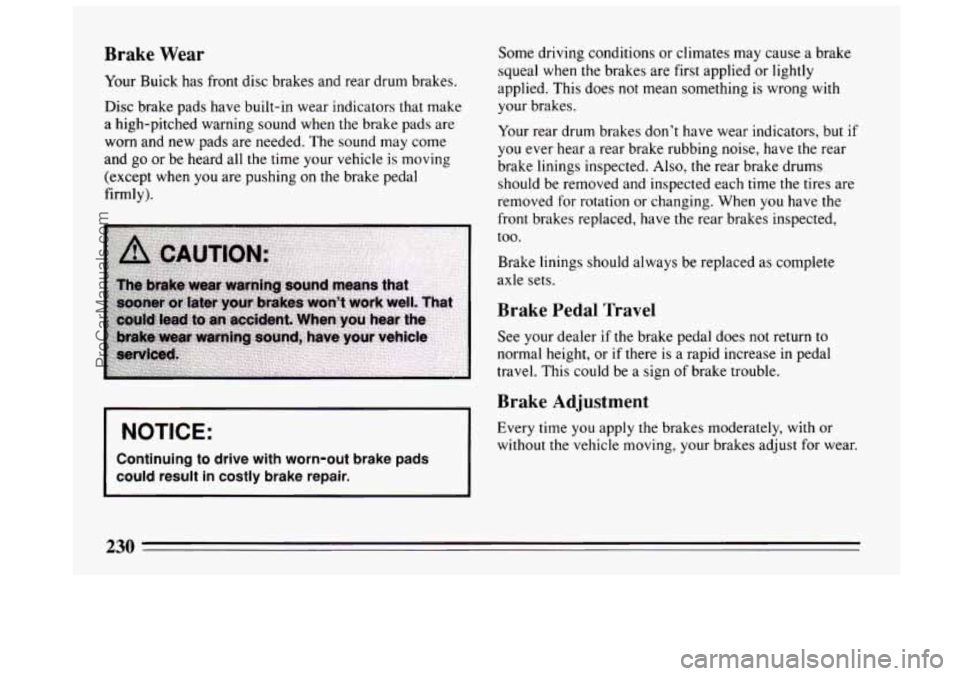
Brake Wear
Your Buick has front disc brakes and rear drum brakes.
Disc brake pads have built-in wear indicators that make
a high-pitched warning sound when the brake pads are
worn and new pads are needed. The sound may come
and
go or be heard all the time your vehicle is moving
(except when
you are pushing on the brake pedal
firmly).
Continuing to drive with worn-out brake pads
could result in costly brake repair.
Some driving conditions or climates may cause a brake
squeal when the brakes are first applied or lightly
applied. This does not mean something
is wrong with
your brakes.
Your rear drum brakes don’t have wear indicators, but if
you ever hear a rear brake rubbing noise, have the rear
brake linings inspected. Also, the rear brake drums
should be removed and inspected each time the tires are
removed for rotation or changing. When you have the
front brakes replaced, have the rear brakes inspected,
too.
Brake linings should always be replaced as complete
axle sets.
Brake Pedal Travel
See your dealer if the brake pedal does not return to
normal height, or
if there is a rapid increase in pedal
travel. This could be a sign of brake trouble.
Brake Adjustment
Every time you apply the brakes moderately, with or
without the vehicle moving, your brakes adjust for wear.
230
ProCarManuals.com
Page 238 of 308

Loading Your Vehicle
TIRE-LOADING INFORMATION
OCCUPANTS VEHICLE CAP. WT.
FRT. CTR. RR. TOTAL LBS. KG
MAX. LOADING & GVWR SAME AS VEHICLE
CAPACITY WEIGHT
XXX COLD TIRE
TIRE SIZE SPEED PRESSURE RTG
PSI/KPa
FRT.
RR.
SPA.
IF TIRES ARE HOT, ADD 4PSD28KPa
SEE OWNER‘S MANUAL FOR ADDITIONAL
INFORMATION IlrmlI :$#
~
Two labels on your vehicle show how much weight it
may properly carry. The Tire-Loading Information label
found on
the rear edge of the driver’s door tells you the
proper size, speed rating and recommended inflation
pressures for the tires
on your vehicle. It also gives you
important information about the number
of people that
can be in your vehicle and the total weight that you can
carry. This weight is called the Vehicle Capacity Weight
and includes the weight
of all occupants, cargo, and all
nonfactory-installed options.
MFD BY GENERAL MOTORS CORP
DATE GVWR GAWR FRT GAWR RR
THIS VEHICLE CONFORMS TO ALL APPLI-
CABLE
U.S. FEDERAL MOTOR VEHICLE
SAFETY, BUMPER, AND THEFT PREVENTION
STANDARDS
IN EFFECT ON THE DATE OF
MANUFACTURE
SHOWN ABOVE.
The other label is the Certification label, found on the
rear edge of the driver’s door. It tells you the gross
weight capacity of your vehicle, called the GVWR
(Gross Vehicle Weight Rating). The GVWR includes the
weight of the vehicle,
all occupants, fuel and cargo.
Never exceed the GVWR for your vehicle, or the Gross
Axle Weight Rating (GAWR) for either the front or rear
axle.
And, if you do have a heavy load, you should spread it
out. Don’t carry more than
160 pounds (72 kg) in the
sedan
trunk or 300 pounds (136 kg) in the six-passenger
wagon rear area.
ProCarManuals.com
Page 240 of 308

Tires
We don't make tires. Your new vehicle comes with high
quality tires made by a leading tire manufacturer. These
tires are'warranted by the tire manufacturers and their
warranties are delivered with every new Buick. If your
spare tire is a different brand than your road tires, you
will have
a tire warranty folder from each of these
manufacturers.
238
ProCarManuals.com
Page 241 of 308

Inflation - Tire Pressure
The Tire-Loading Information label which is on the rear
edge of the driver’s door shows the correct inflation
pressures for your tires, when they’re cold. “Cold”
means your vehicle has been sitting for at least three
hours or driven no more than a mile.
I NOTICE:
Don’t let anyone tell you that underinflation 911
overinflation is all right. It’s not. If your tires don’t
have enough air (underinflation) you can get:
Too much flexing
Too much heat
0 Tire overloading
Bad wear
Bad handling
0 Bad fuel economy.
If your tires have too much air (overinflation),
you can get:
Unusual wear
Bad handling
Rough ride
Needless damage from road hazards.
When to Check
Check your tires once a month or more.
Don’t forget your compact spare tire. It should be at
60
psi (420 kPa).
How to Check
Use a good quality pocket-type gage to check tire
pressure. Simply looking at the tires will not tell you the
pressure, especially if you have radial tires
-- which
may look properly inflated even if they’re underinflated.
If your tires have valve caps, be sure to put them back
on. They help prevent leaks by keeping out dirt and
moisture.
239
ProCarManuals.com