Page 84 of 308

c
0 1 (First Gear)
This position gives you even more power (but lower
fuel economy) than
“2.” You can use it on very steep
hills, or in deep snow or mud. If the selector lever is
put in
“1,” the transaxle won’t shift into first gear
until the vehicle
is going slowly enough.
NOTICE:
If your front wheels can’t rotate, don’t try to
drive. This might happen if you were stuck
in
very deep sand or mud or were up against a solid
object. You could damage your transaxle.
Also, if you stop when going uphill, don’t hold
your vehicle there with only the accelerator
pedal. This could overheat and damage the
transaxle. Use your brakes to hold your vehicle
in position on a hill.
Parking Brake
To set the parking brake:
Hold the regular brake
pedal down with your right
foot. Push down the
parking brake pedal with
your left foot.
If the
ignition is on, the brake
system warning light will
come on.
To release the parking
brake:
Hold the regular
brake pedal down. Pull the
brake release lever.
ProCarManuals.com
Page 86 of 308
0 Move the lever up as far as it will go.
3. Move the ignition key to “Lock.”
4. Remove the key and take it with you. If you can
walk away from your vehicle with the ignition key in
your hand, your vehicle is in
“P’, (Park).
Leaving Your Vehicle With the Engine
Running
If you have to leave your vehicle with the engine
running, be sure your vehicle
is in “P’, (Park) and your
‘parking brake is firmly set before you leave it. After
you’ve moved the shift lever into the
“P,’ (Park)
position, hold the regular brake pedal down. Then, see if
you can move the shift lever away
from “P” (Park)
without first pulling it toward you. If you can, it means
that the shift lever wasn’t fully locked into “P” (Park).
ProCarManuals.com
Page 89 of 308
Follow the proper steps to be sure your vehicle won’t
move. See “Shifting Into
‘P’ (Park)” in the Index.
If you are parking on a hill and if you’re pulling a
trailer,
also see “Towing a Trailer” in the Index.
Windows
On a vehicle with manual windows, use the window
crank to open and close
each window.
Power Windows (Option)
With power windows, switches on the driver’s armrest
control each
of the windows when the ignition is on. In
addition, each passenger door has
a control switch for its
own window.
87
ProCarManuals.com
Page 100 of 308
To Get Out of Cruise Control
There are two ways to turn
off the Cruise Control:
-
1. Step lightly on the brake
pedal,
OR
2. Move the Cruise switch
to
“OFF.”
To Erase Speed Memory
When you turn off the Cruise Control or the ignition,
your Cruise Control set speed memory is erased.
Lights
I These switches control the
following light systems:
Headlights
Parking Lights
Side Marker Lights
Taillights
License Plate Lights
Instrument Panel Lights
To turn on the headlights, press the switch with the light
symbol.
Press the switch marked
“P’ to turn on the parking
lights.
Press
“OFF” to turn off all lights.
98
ProCarManuals.com
Page 101 of 308

Interior/Instrument Panel Lights
You can brighten or dim the
instrument panel lights by
rotating the control up or
down. To turn on the
interior courtesy lights,
rotate the control all the
way up to
“HI.”
Headlight ccOn99 Warning
If you open the door while leaving the lights on, you
will hear
a warning chime.
Daytime Running Lights (Canada Only)
The Canadian Federal Government has decided that
“Daytime Running Lights” (DRL) are a useful feature,
in that DRL can make your vehicle more visible to
pedestrians and other drivers during daylight hours.
DRL are required on new vehicles sold in Canada.
Your DRL work with a light sensor on top of the
instrument panel. Don’t cover it up.
The low beam headlights will come on at reduced
brightness in daylight when:
0 the ignition is on,
0 the headlight switch is off, and
0 the parking brake is released.
At dusk, the exterior lights will come on automatically
and the low beams will change to full brightness. At
dawn, the exterior lights will go out and the low beams
will change to the reduced brightness
of DRL (if the
headlight switch is off).
99
ProCarManuals.com
Page 102 of 308
Of course, you may still turn on the headlights any time
you need to.
To idle your vehicle with the DRL off, set the parking
brake while the ignition
is in the “Off’ or “Lock”
position. Then start the vehicle. The
DRL will stay off
until you release the parking brake.
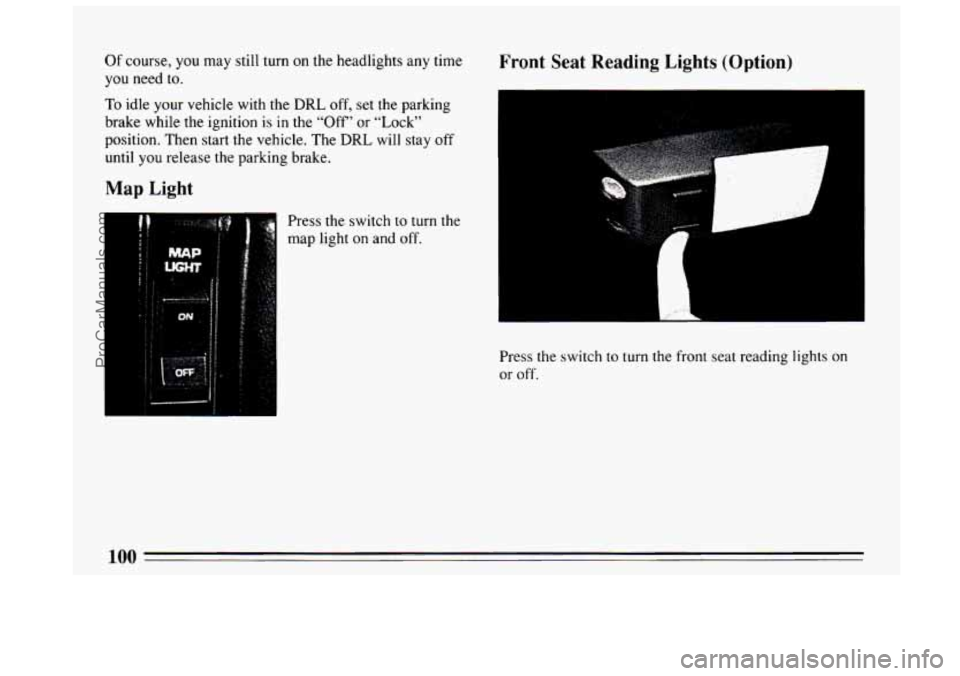
Press the switch to turn the
map light on and off.
Front Seat Reading Lights (Option)
.. . , ..
L
Press the switch to turn the front seat reading lights on
or off.
100
ProCarManuals.com
Page 104 of 308
Interior Lights Delay
When you pull on the driver’s outside door handle, the
dome and courtesy lights will go on and stay on for
about
40 seconds, or until you turn the ignition on.
If you pull on the driver’s inside door handle within 30
seconds of switching off the ignition, the interior lights
will go
on and stay on for about 5 seconds, to allow you
to unlock your door(s).
Courtesy Lights
When any door is opened, several lights go on. These
lights are under
the instrument panel. Optional lights are
on the rear doors. They make it easy for you to enter and
leave
the vehicle. You also can turn these lights on by
rotating the interior lights switch to
“HI.”
Mirrors
Inside Mirror
When you are sitting in a comfortable driving position,
adjust the mirror
so you can see clearly behind you car.
The day-night adjustment allows
you to reduce glare
from lights behind you, pull the lever toward
you to the
night position.
1 A3
ProCarManuals.com
Page 113 of 308

Trip Odometer
The trip odometer can tell
you how many miles you
have driven since you last
set
it to zero. To reset it,
push the button.
L
Warning Lights, Gages and
Indicators
This section describes the warning lights and gages that
may be on your vehicle. The pictures will help you
locate them.
Warning lights and gages can signal that something
is
wrong before it becomes serious enough to cause an expensive
repair or replacement. Paying attention to
your warning lights and gages could also save you or
others from injury.
Warning lights go on when there may be or is a problem
with one of
your vehicle’s functions. As you will see in
the details on the next few pages, some warning lights
come
on briefly when you turn the ignition key just to
let you know they’re working. If you are familiar with
this section,
you should not be alarmed when this
happens.
Gages can indicate when there may be
or is a problem
with one
of your vehicle’s functions. Often gages and
warning lights work together to let you know when
there’s a problem with your vehicle.
When one of the warning lights comes on and stays
on
when you are driving, or when one of the gages shows
there may be a problem, check
the section that tells you
what to do about it. Please follow the manual’s advice.
Waiting to
do repairs can be costly -- and even
111
ProCarManuals.com