1994 BMW 325i 610
[x] Cancel search: 610Page 3 of 759
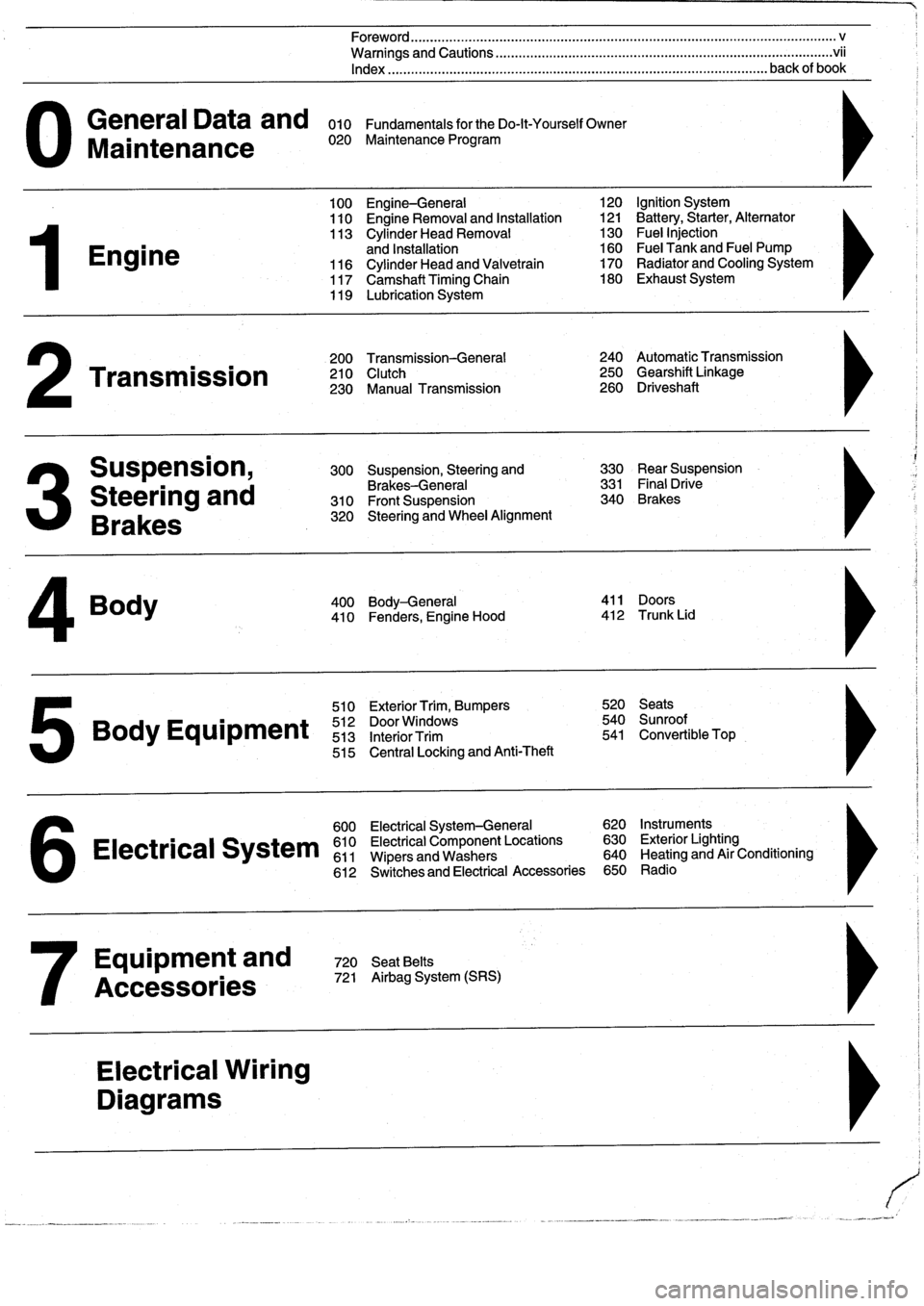
General
Data
and
010
FundamentalsfortheDo-lt-YourselfOwner
Maintenance
020
Maintenance
Program
Engine
Transmission
Suspension,
Steering
and
Brakes
4
Body
100
Engine-General
110
Engine
Removal
and
Installation
113
Cylinder
Head
Removal
and
Installation
116
Cylinder
Head
and
Valvetrain
117
Camshaft
Timing
Chain
119
Lubrication
System
200
Transmission-General
210
Clutch
230
Manual
Transmission
510
Exterior
Trim,
Bumpers
520
Seats
Bo
y
Equipment
512
DoorWTdws
540
nr
t
513
InteriorTrim
541
Convertible
Top
515
Central
Locking
and
Anti-Theft
600
Electrical
System-General
620
Instruments
Electrical
S
stem
610
Electrical
Component
Locations
630
Exterior
Lighting
611
Wipers
and
Washers
640
Heating
and
Air
Conditioning
6
612
Switches
and
Electrical
Accessories
650
Radio
Equipment
and
720
SeatBelts
Accessories
721
Airbag
System
(SRS)
Electrical
Wiring
Diagrams
Foreword
.
...
.
.
.
..................
.
.
.
.....
.
............
.
...
.
.
.
.
.
................
.
.
.
.....
.
......
.
................
.
.
.
.....
v
Warnings
and
Cautions
.....
.
...
.
.
.
.
.
..........
.
...
.
.
.
.
.
......
.
.........
.
.
.
...
.
.
.
......
.
.
.
.
.
............
.
.
.
.
.
.
.vii
Index
..............
.
.
.
.....
.
............
.
...
.
.
.
.
.
........
.
...
.
.
.
.
.
.......
.
......
.
...
.
.
.
.
.
.
.
........
.
.
.
..
back
of
book
300
Suspension,
Steering
and
330
RearSuspension
Brakes-General
331
Final
Drive
310
Front
Suspension
340
Brakes
320
Steering
and
Wheel
Alignment
400
Body-General
411
Doors
410
Fenders,
Engine
Hood
412
Trunk
Lid
120
Ignition
System
121
Battery,Starter,
Alternator
130
Fue¡
Injection
160
Fuel
Tank
and
Fuel
Pump
170
Radiator
and
Cooling
System180
Exhaust
System
240
Automatic
Transmission
250
Gearshift
Linkage
260
Driveshaft
Page 63 of 759

11
.
Draín
engine
coolant
and
Rmove
coolant
hoses
at-
tached
to
cylinder
head
.
"
Drain
engine
block
byremoving
block
drain
.
"
Disconnect
hoses
from
thermostat
housing
in
front
of
cylinder
head
.
"
Disconnect
heater
hoses
at
rear
of
engine
.
See
Fig
.
9
.
"
Drain
radiator
by
removingthreaded
plastic
plug
from
lower
left
comer
.
NOTE-
"
The
block
drain
plug
is
located
oh
the
exhaust
side
to-
wards
rear
ofengine
.
"
Remove
small
plastic
lock
clipto
pulíradiator
draín
plug
out
completely
.
NOTE-
CAUTION-
Radiatorfan
has
left
hand
threads
.
ENGINE
REMOVAL
AND
INSTALLATION
110-
5
Fig
.
9
.
Coolant
hoses
at
heater
valve
and
heater
core
to
be
discon-
nected
(arrows)
.
12
.
Remove
radiator
cooling
fan
and
radiator
as
described
in
170
Radiator
and
Cooling
System
.
13
.
Label
and
disconnectcoolant
hoses,
cables,
and
har-
ness
connectors
from
throttle
housing
.
See
Fig
.
10
.
14
.
Working
atrearof
intake
manifold,
label
and
then
re-
move
fuel
supply
and
fuel
retum
lines
.
Disconnect
fuel
lines
from
support
bracket
on
manifold
.
See
Fig
.
11
.
uu12ivu
Fig
.
10
.
Throttle
housing
assemblyon
M52
engine
.
Disconnect
hos-
es,
cables
and
harness
connectors
at
and
around
housing
.
0012699
Fig
.
11
.
Special
fuelline
fitting
at
fuel
rail
on
M52/S52US
engine
.
Use
BMW
special
tool
16
1
050
to
releaselocking
fittings
at
ends
offuel
lines
.
WARNING
-
"
Fuel
may
be
expelled
under
pressure
.
Do
not
smoke
or
work
near
heaters
or
other
fire
haz-ards
.
Keep
a
fire
extinguísher
handy
.
Before
dis-
connecting
fuel
hoses,
wrapa
cloth
around
fuel
hoses
to
absorb
any
leaking
fuel
.
Plug
all
oyen
fuel
fines
.
"
Always
unscrew
the
fuel
tank
cap
to
release
pres-
sure
ín
the
tank
before
working
on
the
tank
or
lines
.
OnM52
and
S52US
engines,
special
fittings
are
used
to
retain
the
fuel
lines
to
the
fuel
rail
.
Use
BMW
special
16
.
Remove
intake
manifold
from
engine
byremoving
sev-
tool
no
.
161050
to
compress
the
locking
clip
insidethe
en
mounting
nuts
from
above
andtwo
mounting
bracket
end
of
the
fuel
line
fittings
to
release
the
fine
.
boits
from
below
.
See
Fig
.
12
.
15
.
Unbolt
power
steering
fluid
reservoir
from
its
mounting
CAllTION-
bracket
.
Use
stiff
wire
to
hang
reservoir
to
one
side
.
Do
Stuff
clean
rags
into
the
open
intake
ports
to
pre-
not
disconnect
fluid
fines
.
vent
any
parts
from
falling
into
the
engine
intake
.
ENGINE
REMOVAL
AND
INSTALLATION
Page 155 of 759

Oxygen
Sensor
FUEL
DELIVERY
TESTS
FUEL
INJECTION
130-
9
"
Voltage
at
¡dle
..
.
..
..
....
0
.2
to
0
.8
VDC,
fluctuating
Checking
fuel
delivery
is
afundamental
part
of
trouble-
shooting
and
diagnosing
the
engine
management
system
.
Fuel
pressure
directly
influences
fuel
delivery
.
An
accurate
NOTE-
fuel
pressure
gauge
will
be
needed
to
make
the
tests
.
To
check
sensorresponse
to
lean
and
rich
mixtures,
createenairleak,
orpull
vacuumhoseofffue¡
pressure
There
are
three
significant
fuel
delivery
values
to
be
mea-
regulator
to
increase
fuel
pressure
.
sured
:
3
.
Separate
sensorharness
connector
from
sensor
.
Check
for
battery
voltage
between
terminals
3
and
4
(green
wire
and
brown
wire)
in
main
wiring
harness
side
of
con-
nector
with
engine
running
.
If
voltage
is
not
present,
check
oxygen
sensor
heater
relay
.
See610
Electrical
Component
Locations
.
4
.
Check
heater
element
resistance
between
terminals
3
and
4
in
sensor
side
of
connector
.
If
element
is
electri-
cally
open
(no
continuity),
replace
sensor
.
NOTE-
The
oxygen
sensor
heater
relay
is
mounted
in
the
main
power
distributfon
box
in
the
left
rear
of
the
engine
com-
partment
.
Refer
to
Fig
.
6
.
The
heater
relay
is
energized
wíth
positive
(+)
battery
voltage
from
the
main
relayanda
switched
ground
from
the
ECM
.
See
Electrical
Wir-
ing
Diagrams
.
"
Oxygen
sensor
to
exhaust
pipe
...
..
55
Nm
(41
ft-Ib)
"
System
pressure-created
by
the
fuel
pump
and
main-
tained
by
the
pressure
regulator
.
"
Fuel
delivery
volume-created
by
the
fuel
pump
and
af-
fected
by
restrictions,
suchasclogged
fuel
filter
.
"
Residual
pressure-the
pressure
maintained
in
the
closed
system
after
the
engine
and
fuel
pump
are
shut
off
.
Procedures
for
measuring
the
first
two
quantities
arede-
scribed
in
160
Fuel
Tank
and
Fuel
Pump
.
Residual
fuel
pres-
sure
is
checked
using
the
procedure
detailed
later
in
this
group
.
Operating
fuel
pump
fortests
To
operate
the
fuel
pump
for
testing
purposes
without
hav-
íng
to
runthe
engine,
the
fuel
pump
relay
can
be
bypassed
to
power
the
pump
directly
.
Fuel
pump
relay
location
is
shown
in
Fig
.
6
.
5
.
¡f
oxygen
sensor
doesn't
produce
a
fluctuating
voltage
To
runthe
fuel
pump,
remove
the
fuel
pump
relay
and
con-
and
preheater
circuit
is
OK,
replace
sensor
.
nect
the
socket
for
relayterminal
30
to
the
socket
for
relay
ter-
mina¡
87
with
a
fused
jumper
wire
.
After
completing
the
tests,
NOTE-
remove
the
jumper
wire
.
If
not
already
applied,
coat
the
oxygen
sensor
threads
with
an
anti-seize
compound
before
installation
.
Do
not
CAUTION-
getthe
compound
on
the
sensor
tip
.
"
Relay
locations
may
vary
.
Use
care
when
identi-
fying
relays
and
making
electrical
checks
at
the
fuselrelay
panel
.
See
610
Electrical
Compo
Tightening
Torque
nent
Locations
for
additional
relay
information
.
"
The
fuel
pump
relay
has
a
1
.5
mm2
red
wire
at
ter-
minal
30
in
the
relay
socket
.
Terminal
87
has
a
1
.5
mm
2
greenlviolet
wire
.
See
Electrical
Wiring
Di-
agrams
for
additional
wiring
information
.
NOTE-
Thejumper
wire
should
be
1.5
mm2
(14
ga
.)
and
in-
clude
an
in-line
tuse
holder
with
a15
amp
tuse
.
To
avoid
fuselrelay
panel
damage
from
repeated
connect-
ing
and
disconnecting,
also
include
a
toggle
switch
.
A
heavy-duty
jumper,
BMW
tool
no
.
61
3
050,
is
also
available
from
an
authorized
BMW
dealer
.
FUEL
DELIVERYTESTS
Page 199 of 759

NOTE-
Some
cars
covered
by
this
manual
may
have
an
alter-
nate
cooling
fan
switchwith
switching
temperatures
of
176%190W
(80%88°C)
.
When
replacing
the
switch
check
theswitching
specifications,
whichshouldbe
stamped
on
the
switch
body
.
1
.
If
coolant
is
circulating
at
normal
operating
tempera-
ture,
but
auxiliary
cooling
fan
does
not
run,
disconnect
connector
from
radiator
temperature
switch
and
make
tests
listed
in
Table
c
.
Table
c
.
Auxiliary
Cooling
Fan
Temperature
Switch
Tests
Wires
jumpered
Test
Test
resuits
conditions
Black/green
(terminal2)
and
Ignition
ON
Fan
runs
on
brown
(terminal
1)
low
speed
Black/gray
(terminal
3)
and
Ignition
ON
Fan
runson
brown
(terminal
I
1)
high
speed
2
.
If
fan
runs
only
when
powered
directly
by
jumpered
connector
and
hot
coolant
is
circulating
through
radia-
tor,
radiator
temperature
switch
is
most
likelyfaulty
.
Use
a
new
sealing
ring
when
replacing
switch
Tightening
Torque
"
Temperature
switch
to
radiator
......
15
Nm
(11
ft-Ib)
3
.
If
auxiliary
fan
does
notrun
when
powered
directly,
check
for
battery
voltage
at
temperature
switch
connec-
tor
(black/green
wire)
with
ignition
on
.
If
battery
voltage
is
not
present,
check
fuses
.
See
610
Electrical
Com-
ponent
Locations
.
RADIATOR
AND
COOLING
SYSTEM
170-
5
~r~nmm
a
00
0
Fig
.
4
.
Auxiliary
radiator
cooling
fan
low
speed
relay
(1)
and
high
speed
relay
(2)
in
power
distribution
box
.
(Relay
locations
may
vary
.)
Auxiliary
Cooling
Fan
Circuit
Fuses
Fig
.
5
.
Auxiliary
radiator
fan
resistor
(arrow)
.
"
Fuse16
.
...................
..
..
...
...
.5
amp
"
Fuse
41
(ex
.
M44
w/man
.
trans)
.
..
.
..
.....
30
amp
"
Fuse
48
(M44
w/man
.
trans
.
only)
..
.
..
.....
40
amp
COOLING
SYSTEM
SERVICE
0013034
4
.
If
no
faults
are
found,
remove
low
speed
relay
and
turn
Coolant,draining
and
filling
ignition
ON
.
See
Fig
.
4
.
1
.
Remove
expansion
tank
cap
.
Set
temperature
controls
"
Check
for
power
at
terminal
30
and
terminal
86
of
relay
to
full
warm
.
socket
.
"
Reinstall
low
speed
relay
and
repeat
testat
high
speed
WARNING
-
relay
socket
.
Fix
any
wiring
faults
found
.
Allow
the
cooling
system
to
cool
before
openlng
or
On
early
productioncars
(up
to
9/92)
:
If
fan
operates
only
on
draining
the
cooling
system
.
high
speed
and
no
electrical
faults
have
been
foundup
to
this
point,
usean
ohmmeter
to
check
that
fan
resistor
is
not
electri-
2
.
Place
3
ra
allo
ug
.
beneath
radiator
drain
plug
and
re-
cally
open
.
Resistor
is
mounted
on
auxiliary
cooling
fan
housing
move
drain
plg
.
See
Fig
.
6
.
behind
front
grille
.
See
Fig
.
5
.
Wiring
diagrams
for
the
radiator
cooling
fan
canbefoundunder
Electrical
Wiring
Diagrams
.
3
.
Place
3-g
pail
beneath
rear
of
engine
blo
.
Loos-
en
and
re
mlon
ove
engine
blockcoolant
drain
plug
k
.
COOLING
SYSTEM
SERVICE
Page 239 of 759

Fig
.
10
.
Align
contact
slide
(1)
with
slot
in
switch
housing
(2)
before
in-
stalling
gear
position/neutral
safety
switch
.
Fig
.
11
.
Engage
release
button
pin
to
hole
in
pull
rod
before
installing
The
automatic
shiftlock
uses
an
electríc
solenoid
to
lock
the
selector
lever
in
P
or
N
.
Depressing
the
foot
brake
withthe
ig-
nition
on
energizes
the
solenoid,
allowingthe
lever
to
be
moved
into
a
drive
gear
.
The
solenoid
is
energized
only
when
the
engine
speed
is
below
2,500
rpmand
thevehicle
speed
is
below
3
mph
.
The
solenoid
ís
mounted
in
the
right-hand
side
of
theselector
lever
housing
.
See
Fig
.
12
.
1
.
With
engine
running
and
car
stopped,
place
selector
le-
ver
in
P
or
N
.
2
.
Without
depressing
brake
pedal,
check
that
selector
le-
ver
is
locked
in
position
P
or
N
.
3
.
Depress
brakepedal
firmly
.
Solenoid
should
be
heard
to
energize
.
GEARSHIFT
LINKAGE
250-
5
Fig
.
12
.
Automatic
shiftlock
prevents
drive
gear
selection
until
the
brakepedal
is
depressed
.
4
.
Check
thatselector
lever
can
now
be
moved
out
of
P
or
N
.
NOTE
-
The
next
test
should
be
performed
in
anopen
area
with
the
parking
brake
on
and
with
extreme
caution
.
5
.
With
selector
lever
in
P
or
N
and
brake
pedal
de-
pressed,
raise
engine
above
2,500
rpm
.
Check
that
se-
lector
lever
cannotbe
moved
outof
P
or
N
.
shift
lever
handle
.
If
any
faults
are
found
check
the
electrical
operation
of
the
shiftlock
solenoid
and
check
for
wiring
faultsto
or
from
the
Automatic
shiftiock,
checking
function
transmission
control
module(TCM)
.
See610
Electrical
(automatic
transmission)
Component
Locations
and
Electrical
Wiring
Diagrams
.
NOTE
-
The
solenoid
is
controlled
viathe
TCM,
using
brakepedal
position,
engine
speed,
and
road
speed
as
con-
trolling
inputs
.
AUTOMATIC
TRANSMISSION
GEARSHIFT
Page 307 of 759

Ambient
temperaturelclock
MÍM
Aa
.Mi}rm
-Mil"
IMua~naa~u~itacar
"
za
.~
Central
Body
Electronics
0013028
Fig
.
4
.
Different
versionsof
Multi-information
Display(MID)
installed
in
E36
cars
.
The
E36
cars
are
equipped
with
a
sophisticated
centralized
body
electric/electronics
plan
.
The
system
is
self-diagnostic
and
incorporates
many
functions
into
a
single
control
module
.
The
consolidation
of
several
systems
into
a
single
control
module
minimizes
power
requirements
and
the
incorporation
of
the
diagnostic
link
results
in
more
efficient
and
accurate
troubleshooting
.
Self-diagnostic
codes
are
accessible
electronically
through
the
data-link
connector
in
the
engine
compartment
.
See610
Electrical
Component
Locations
.
BODY-GENERAL
400-
5
Two
versions
of
central
body
electronics
are
used
depend-
ing
on
model
year
.
1992
and
1993
models
are
equipped
with
a
central
locking
module
(ZVM)
which
incorporates
control
of
the
following
sys-
tems
:
"Interiorlighting
"
Central
locking
with
double
lock
feature
"
Output
relays
for
powerwindows
and
sunroof
"
Electronic
power
protection
E36
cars
since
the
1994
model
year
are
equipped
with
ZKE
IV
.
This
is
an
electronic
comfort
and
convenience
system
that
includes
the
following
additional
features
:
"
One
touch
up/down
power
window
operation
"
Power
window
and
sunroof
closure
from
driver
or
pas-
sengerdoor
lock
"
Vehicle
locking
or
unlocking
from
the
trunk
lock
.
Other
features
of
the
system
are
discussed
in
515
Central
Locking
and
Anti-Theft
.
Electronic
Immobilization
System
Beginning
in
model
year
1994,
all
E36
vehicles
incorporate
adriveaway
protection
system
regardless
of
whether
the
vehi-
cle
is
equipped
with
a
BMW
Alarm
System
or
an
On-Board
computer
.
Two
types
of
factory
systems
were
installed,
de-
pending
on
vehicle
production
date
.
On
the
early
system
(model
year
1994
up
to
January
1995),
the
ignition
and
fuel
injection
functions
are
disabled
whenever
the
vehicle
is
locked
in
the
double
lock
mode
.
This
is
referred
lo
as
EWS
or
EWS
I
.
Beginning
in
January
1995,
the
driveaway
protection
sys-
tem
was
upgraded
to
a
more
sophisticated
system,
called
EWS
II
.
This
system
uses
a
wireless
communication
link
be-
tween
a
transponder
chip
in
the
ignition
keyand
the
ring
an-
tenna
surrounding
the
ignition
switch
.
The
EWS
II
control
module
blocksthe
starting
of
the
vehicle
unlessthe
correct
coded
ignition
key
is
used
.
For
further
information
about
drive
away
protection
sys-
tems,
see
515
Central
Locking
and
Anti-Theft
.
INTERIOR
EQUIPMENT
Page 311 of 759

ENGINE
HOOD
Hood,
raising
to
service
position
CA
UTION-
Do
not
switch
on
the
windshield
wipers
wlth
the
engine
hood
raised
.
As
a
precaution,
remove
the
wiper
motor
fuse
.
See
610
Electrical
Compo-
nent
Locations
.
1
.
4-door
models
:
Open
hood
fully
.
Remove
bolt
from
hood
hinge
behind
hood
supports
(left
and
right)
.
Raise
hood
to
service
position
.
See
Fig
.
5
.
2
.
2-door
models
:
Open
hood
fully
.
Fig
.
5
.
Hood
support
bracket
boltto
be
removed
(A)
on
4-door
cars
.
Remove
bolts
at
left
and
right
hinges
.
Swing
bracket
in
direc-
tion
of
arrow
to
raise
hood
into
service
position
.
"
Remove
ground
cable
atright
hood
hinge
.
"
Whilean
assistant
supports
hood,
detach
both
hood
supportsfrom
hood
.
"
Remove
detent
screws
at
back
of
hood
hinges
.
See
Fig
.
6
.
"
Lift
hood
while
pulling
hinge
forward
.
Support
hood
at
higher
position
.
3
.
When
service
work
is
complete,
return
hood
to
lower
position
and
instaf
screws
or
bolts
.
FENDERS,
ENGINE
HOOD
410-
3
Fig
.
6
.
Torx
screw
at
base
of
hood
hinge
(arrow)
.
Hood,
removing
and
installing
0013147
1
.
Raise
hood
.
Where
applicable,
partially
remove
hood
acoustic
insulation
to
access
rear
of
hood
.
See
Fig
.
7
.
Fig
.
7
.
Hood
insulation
retainer
being
pried
out
3
.
Detachgas-charged
hood
supportsfrom
hood
.
CAUTION
-
The
hood
is
heavy
.
Before
removing
the
hood
sup-
ports
or
hood
retainingbolts,
be
sure
to
have
an
assistant
help
support
the
hood
.
0013148
2
.
Disconnect
washer
fluid
hoses
from
washer
nozzles
.
Where
applicable,
disconnect
electrical
harness
con-
nectors
fromheated
nozzles
.
ENGINE
HOOD
Page 349 of 759

515
Central
Locking
and
Anti-Theft
GENERAL
.....
.
.
.
.
.
.
.
..:
.
.
.
......
.
.
.
.
515-1
Luggage
compartment
locking
actuator,
removing
and
installing
.
.
.
.
.
...........
.
515-6
DOOR
HANDLES
AND
LOCKS
.........
515-1
LOCKING
SYSTEM
AND
Front
door
lock,
removing
and
installing
....
.515-1
ELECTRONIC
IMMOBILIZATION
......
.515-7
Front
door
handle,
removing
and
installing
...
515-3
Rear
door
lock,
removing
and
installing
.....
515-4
Central
Locking
System(ZVM)
.
.
.
.
.......
.
515-7
Rear
door
handle,
removing
and
installing
...
515-5
Central
Body
Electronics
(ZKE
IV)
.
.
.......
.515-8
Electronic
Immobilization
System
(EWS)
.
.
.
.
.515-8
Door
striker,
rep
lacing
.
.
.
.
.
.
.
.
.
..........
515-6
EWS
II
control
module,
re
lacin
515-10
LOCKING
ACTUATORS
.
.
.
.
.
.
..........
515-6
Ring
antenna,
replacing
.
.
.
.
.
.
.
.
.
.
...
.
.
.
.
515-10
Door
Locking
Actuator
.
.
.
.
.
.
.
.
..........
515-6
EWS
II
transmitter/receiver
module,
replacing
...........
.
.
.
.
.
.
.
.
.
.
.
.
.
.
.
.
515-11
GENERAL
This
section
covers
repair
information
for
the
central
locking
and
the
anti-theft
systems
.
Keep
in
mind
that
E36
cars
are
CA
UTION-
equipped
with
sophisticated
and
self-diagnostic
electrical
sys-
Prior
to
disconnecting
the
battery,
read
the
battery
tems
.
When
experiencing
malfunctions
relatinglo
the
central
disconnection
cautions
given
at
the
front
of
this
locking
or
the
anti-theft
system,
it
is
recommended
that
the
manual
onpage
vi¡¡
.
systembe
diagnosed
using
the
BMW
service
tester
(DIS)
.
This
advanced
diagnostic
tool
can
usually
pinpoint
electrical
NOTE-
faults
quickly
and
safely
.
Consult
an
authorized
BMW
dealer
.
In
some
models
covered
inthis
manual,
it
is
not
essen-
tial
to
remove
the
side-impact
airbag
to
access
intemal
NOTE-
door
components
.
However,
the
procedure
is
recom-
Additional
general
electrical
information
can
be
found
mended
for
safely
reasons
.
i
n
610
Electrical
Component
Locations
and
Electri-
cal
Wiring
Diagrams
.
4
.
Disconnect
harnessconnector
from
window
motor
to
DOOR
HANDLES
AND
LOCKS
Front
door
lock,
removing
and
installing
1
.
Remove
front
door
panel
and
vapor
barrier
asde-
scribed
in
411
Doors
.
WARNING
-
Some
1997
and
all
1998
cars
are
fitted
with
side-im-
pact
airbags
in
the
front
doors
.
When
servicing
the
door
locks
on
cars
with
front
side-impact
airbags,
al-
ways
disconnect
the
negative
(-)
battery
terminal
.
See721
Airbag
System
(SRS)
forcautions
andpro-
cedures
relating
to
the
airbag
system
.
2
.
Raise
door
window
completely
CENTRAL
LOCKING
AND
ANTI-THEFT
515-1
3
.
On
cars
with
side-impact
airbags,
disconnect
negative
(-)
cable
from
battery,
then
remove
airbag
module
.
prevent
accidental
operation
.
5
.
On
4-door
cars
:
Peel
back
rubber
window
guide
from
reas
guide
rail
:
Remove
guide
rail
mounting
boltat
bot-
tom
.
Unclip
any
wiring
from
guide
rail
and
pull
guide
rail
downward
and
remove
from
door
.
See
Fig
.
1
.
NOTE
-
The
top
of
the
guide
rail
is
"hooked"
to
the
doorsheet
metal
.
6
.
Remove
inside
door
handle
retaining
screw
.
Discon-
nect
inside
handle
from
linkage
and
remove
.
See
Fig
.
2
.
7
.
Cut
wire
ties
and
remove
door
lock
electrical
harness
con-
nector
.
Remove
door
lock
mounting
screws
.
See
Fig
.
3
.
8
.
Working
inside
door,
disconnect
outside
door
handle
and
lockcylinder
linkage
from
door
lock
.
Remove
lock
from
inside
door
.
See
Fig
.
4
.
DOOR
HANDLES
AND
LOCKS