1994 BMW 325i 250
[x] Cancel search: 250Page 235 of 759

GENERAL
.
.
.
.
.
.
.
.
.
................
.
.
.
250-1
AUTOMATIC
TRANSMISSION
GEARSHIFT
...
.
.........
.
.
.
.
.
.
.
.
.
.
.
.
.
.
250-3
MANUAL
TRANSMISSION
Gearshift
mechanism,
adjusting
GEARSHIFT
.
.
.
.
.
.
.
.....
.
..........
.
.
.
250-1
(automatictransmission)
..
.
.
.
.
.
.
.
.
.
...
.
.
250-3
Gearshift
lever,
removing
Gear
position/neutral
safety
switch,
replacing
(manual
transmission)
.
.
.
.
...
.
.
.
.......
250-1
(automatic
transmission)
..
.
.
.
.........
.
.
250-4
Gearshift
lever,
installing
Automatic
shiftlock,
checking
function
(manual
transmission)
.
.
.
.
.
.
.
.
.
.
.......
250-2
(automatic
transmission)
..
..
...
.
.
.
....
..
250-5
Shiftinterlock,
checking
function
(automatic
transmission)
.......
.
.
.
.....
.250-6
GENERAL
This
repair
group
covers
transmission
gearshift
and
linkage
service
.
Special
service
tools
are
required
for
some
of
the
proce-
dures
given
here
.
To
gain
access
to
the
complete
gearshift
mechanism
ít
is
necessary
to
remove
the
exhaust
system
and
the
driveshaft
as
described
in
180
Exhaust
System
and260
Driveshaft
.
MANUAL
TRANSMISSION
GEARSHIFT
Gearshift
lever,
removing
(manual
transmission)
The
manual
transmission
gearshift
linkage
is
shown
in
Fig
.1
.
Use
thisillustration
asaguide
when
removing
and
installing
the
linkage
.
1
.
Pull
straight
upon
shift
knob
lo
remove
it
from
shift
lever
.
NOTE
-
Removal
of
the
shift
knob
will
require
about
90
lbs
.
of
force
.
2
.
Pry
upon
rear
of
shift
boot
tounclip,
then
remove
boot
from
front
retainers
.
3
.
Raise
vehicle
togain
access
to
underside
of
vehicle
.
WARNING
-
Make
sure
thecar
is
stable
and
well
supported
at
afl
times
.
Use
a
professional
automotive
lift
orjackstands
designed
for
the
purpose
.
A
floor
jack
is
not
adequate
support
.
250
Gearshift
Linkage
GEARSHIFT
LINKAGE
250-1
Fig
.1
.
Manual
transmission
gearshift
linkage
.
4
.
Disconnect
oxygen
sensorharness
connectors
.
Re-
move
completeexhaust
system
.
See
180
Exhaust
System
.
MANUAL
TRANSMISSION
GEARSHIFT
Page 236 of 759

250-2
GEARSHIFT
LINKAGE
5
.
Remove
driveshaft
.
See260
Driveshaft
.
9
.
Release
gearshift
lever
retaining
ring
from
below
by
turningspecial
tool
90°(
1
/4
turn)
counterclockwise
.
See
6
.
Support
transmission
with
transmission
jack
.
Remove
Fig
.
4
.
crossmember
from
rear
of
transmission
.
See
Fig
.
2
.
Fig
.
2
.
Rear
transmission
crossmember
(arrow)
.
7
.
Lower
rear
of
transmission
to
access
gearshift
linkage
.
CAUTION-
Tilting
the
engine
to
lower
thetransmission
can
lead
to
damage
to
various
componente
due
to
lackof
clearance
.
-On
cars
with
AST
remove
throttle
body
.
-Remove
brake
fluid
reservoir
if
necessary
.
0013135
8
.
Working
below
transmission,
disconnect
shift
rod
from
gearshift
lever
.
Note
washers
on
either
side
of
shift
rod
end
.
See
Fig
.
3
.
v
clip
Shift
rod
Fig
.
3
.
Pull
off
shift
rod
retaining
clip
in
direction
of
arrow
(t)
;
disen-
gage
shift
rod
from
gearshift
lever
(2)
.
MANUAL
TRANSMISSION
GEARSHIFT
BMW
Tool
No
.
25
1
110
orequivalent
Fig
.
4
.
Shift
lever
retaining
ring
being
removed
using
BMW
special
tool
25
1
110
.
10
.
Raise
transmission
and
temporarily
instan
transmission
crossmember
.
11
.
Lower
vehicle
.
Working
from
inside
passengercom-
partment,
pull
upon
gearshift
lever
to
remove
it
togeth-
erwith
retaining
ring
and
rubber
grommet
.
Gearshift
lever,
installing
(manual
transmission)
6532
1
.
Instan
shift
lever,
aligninglocking
tabs
with
openings
in
shift
console
.
Press
down
on
retaining
ring
until
it
clicks
into
place
.
See
Fig
.
5
.
\
Retaining
Fig
.
5
.
Shift
lever
retaining
ring
.
Fit
plastic
tabs
into
slots
of
shift
con-
sole(arrows)
.
Page 237 of 759

2
.
Install
rubber
grommet
with
arrow
pointing
forward
.
In-
AUTOMATic
TRANSMISSION
stall
shift
rod
and
shift
boot
.
GEARSHIFT
NOTE-
Install
rubbergrommet
correctly
so
that
is
seals
outwa-
ter
.
4
.
Install
driveshaft
and
heat
shield
.
See
260
Driveshaft
.
Manual
valveleven
(at
transmission)
Fig
.
6
.
Automatic
transmission
gearshift
assembfy
.
Shift
cable
GEARSHIFT
LINKAGE
250-
3
The
automatic
transmission
shift
mechanism
is
shown
in
Fig
.
6
.
Use
the
illustration
as
a
guide
when
servícing
the
gear-
shift
mechanism,
including
shift
cable
replacement
.
3
.
Connect
shift
rod
to
shift
lever
.
Install
transmission
crossmember
.
Lift
transmission
and
tighten
crossmem-
Gearshift
mechanism,
adjusting
ber
bolts
.
(automatictransmission)
NOTE-
1
.
Position
selector
lever
in
Park
.
Beforeconnecting
the
shift
rod
to
the
lever,
be
sure
the
2
.
Raise
vehicle
to
gain
access
to
shift
linkage
.
gearshift
leven
is
facing
the
correct
way
as
illustrated
in
Fig
.
1
.
WARNING
-
Make
sure
thecan
is
stable
and
well
supported
at
all
times
.
Use
a
professional
automotive
lift
or
jack
stands
designed
for
the
purpose
.
5
.
Reinstall
exhaust
system
.
See
180
Exhaust
System
.
Connect
oxygen
sensor
harness
connectors
.
3
.
Loosen
selector
cable
clamping
nut
.
See
Fig
.
7
.
6
.
Lower
vehicle
.
Insta¡¡
shift
boot
cover
.
Push
shift
knob
4
.
Push
shift
lever
forwardtoward
engine(Park
position)
onto
lever
.
while
applying
light
pressure
on
cable
end
.
Tighten
ca-
ble
clamping
nut
.
Tightening
Torques
NOTE-
"
Driveshaft
to
final
drive
Do
not
overtighten
the
nut
so
that
it
twists
the
cable
.
flange
(with
U-joint)
.
..
.
.....
.
.
See
250
Driveshaft
"
Flex-disc
to
driveshaft
or
transmission
flange
...
.
.......
See
250
Driveshaft
Tightening
Torque
"
Transmission
crossmember
"
Shift
cable
clamping
nut
.......
10-12
Nm
(75-9
ft-Ib)
to
body
(M8)
.
.
.
...
..............
21
Nm
(16
ft-Ib)
/S
r\
1
1
Gear
position/
neutral
safetyswitch
Automatic
shilo
solenoid
id
AUTOMATIC
TRANSMISSION
GEARSHIFT
Page 238 of 759
250-
4
GEARSHIFT
LINKAGE
r%
;
5
(((((C
"
~
;
Fig
.
7
.
Selector
lever
cable
clamping
nut
(A)
.
Counterhold
clamping
bolt
when
loosening
nut
.
Gear
position/neutral
safety
switch,
replacing
(automatic
transmission)
NOTE-
The
gear-positionlneutral
safetyswitch
is
also
some-
times
referred
to
as
the
automatic
transmission
range
switch
.
Failure
of
the
gear
positionlneutral
safetyswitch
can
cause
a
no-start
condition
.
In
acidition,
since
it
signals
gearshift
posi-
tion
tothe
transmission
control
unit,
a
faulty
switch
can
cause
erratic
transmission
operation
.
1
.
Remove
hex-head
screw
(3mm
allen
key)
from
shift
le-
ver
handle
and
remove
handle
.
Carefully
pry
up
cover
from
gearshift
lever
console
.
2
.
Disconnect
harness
connector
from
gear
positionlneu-
tral
safety
switch
andremove
mounting
screws
.
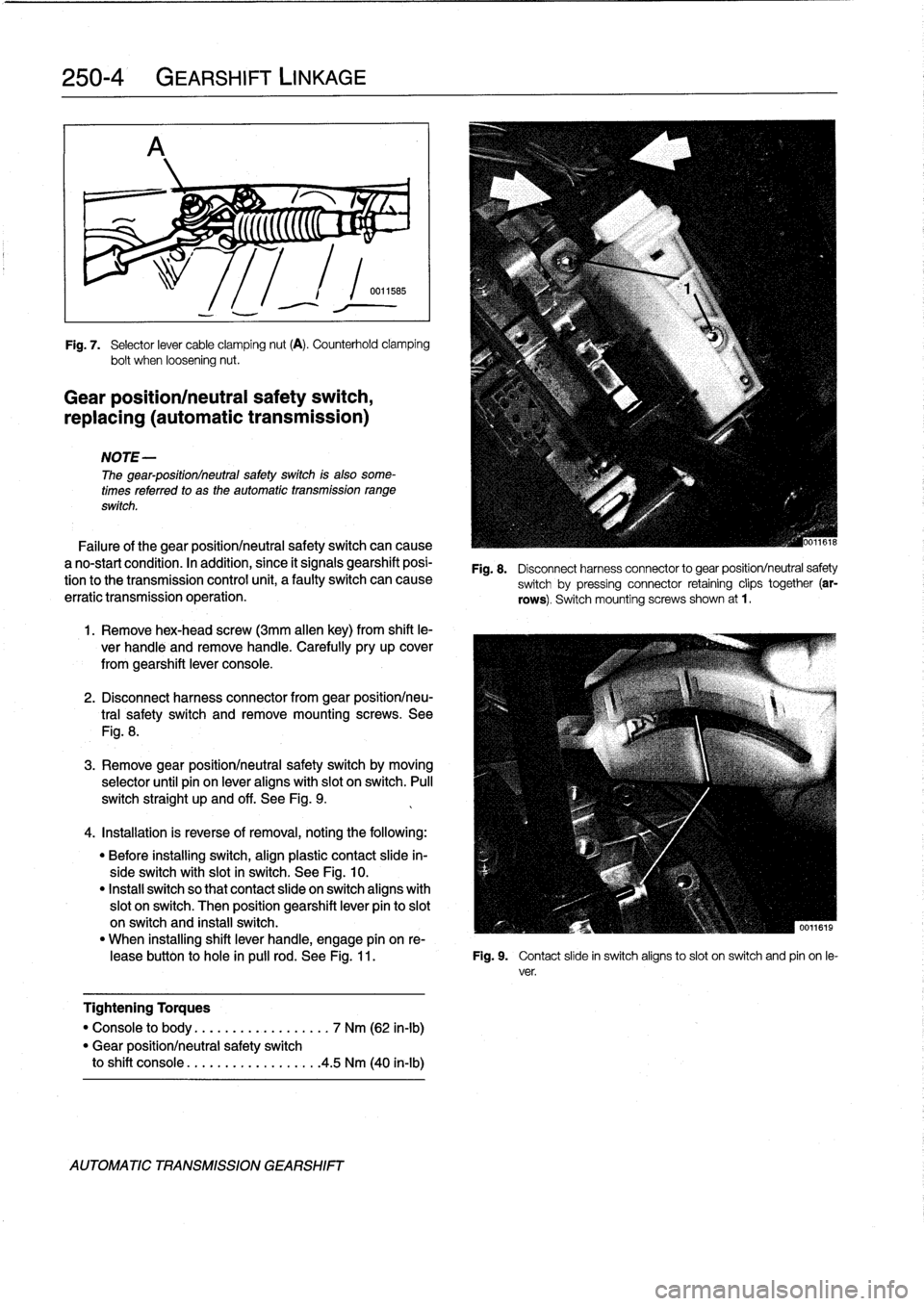
See
Fig
.
8
.
3
.
Remove
gear
positionlneutral
safety
switch
by
moving
selector
until
pin
on
lever
aligns
with
slot
on
switch
.
Pull
switch
straight
up
and
off
.
See
Fig
.
9
.
4
.
Installation
is
reverse
of
removal,
noting
the
following
:
"
Before
installing
switch,
align
plastic
contact
slide
in-
sideswitch
with
slot
in
switch
.
See
Fig
.
10
.
"
Instan
switch
so
that
contact
slide
on
switch
aligns
with
slot
on
switch
.
Then
position
gearshift
lever
pin
to
slot
on
switch
and
install
switch
.
"
When
installing
shift
lever
handle,
engage
pín
on
re
leasebutton
to
hole
in
pulí
rod
.
See
Fig
.
11
.
Fig
.
9
.
Contact
slide
in
switch
aligns
toslot
on
switch
and
pin
on
le-
ver
.
Tightening
Torques
"
Console
to
body
..............
...
.
7
Nm
(62
in-lb)
"
Gear
positionlneutral
safety
switch
to
shift
console
.................
.
4
.5
Nm
(40
in-lb)
AUTOMATIC
TRANSMISSION
GEARSHIFT
Fig
.
8
.
Disconnect
harness
connector
to
gear
position/neutral
safety
switch
by
pressing
connector
retaining
clips
together
(ar-
rows)
.
Switch
mountingscrews
shown
at
1
.
Page 239 of 759

Fig
.
10
.
Align
contact
slide
(1)
with
slot
in
switch
housing
(2)
before
in-
stalling
gear
position/neutral
safety
switch
.
Fig
.
11
.
Engage
release
button
pin
to
hole
in
pull
rod
before
installing
The
automatic
shiftlock
uses
an
electríc
solenoid
to
lock
the
selector
lever
in
P
or
N
.
Depressing
the
foot
brake
withthe
ig-
nition
on
energizes
the
solenoid,
allowingthe
lever
to
be
moved
into
a
drive
gear
.
The
solenoid
is
energized
only
when
the
engine
speed
is
below
2,500
rpmand
thevehicle
speed
is
below
3
mph
.
The
solenoid
ís
mounted
in
the
right-hand
side
of
theselector
lever
housing
.
See
Fig
.
12
.
1
.
With
engine
running
and
car
stopped,
place
selector
le-
ver
in
P
or
N
.
2
.
Without
depressing
brake
pedal,
check
that
selector
le-
ver
is
locked
in
position
P
or
N
.
3
.
Depress
brakepedal
firmly
.
Solenoid
should
be
heard
to
energize
.
GEARSHIFT
LINKAGE
250-
5
Fig
.
12
.
Automatic
shiftlock
prevents
drive
gear
selection
until
the
brakepedal
is
depressed
.
4
.
Check
thatselector
lever
can
now
be
moved
out
of
P
or
N
.
NOTE
-
The
next
test
should
be
performed
in
anopen
area
with
the
parking
brake
on
and
with
extreme
caution
.
5
.
With
selector
lever
in
P
or
N
and
brake
pedal
de-
pressed,
raise
engine
above
2,500
rpm
.
Check
that
se-
lector
lever
cannotbe
moved
outof
P
or
N
.
shift
lever
handle
.
If
any
faults
are
found
check
the
electrical
operation
of
the
shiftlock
solenoid
and
check
for
wiring
faultsto
or
from
the
Automatic
shiftiock,
checking
function
transmission
control
module(TCM)
.
See610
Electrical
(automatic
transmission)
Component
Locations
and
Electrical
Wiring
Diagrams
.
NOTE
-
The
solenoid
is
controlled
viathe
TCM,
using
brakepedal
position,
engine
speed,
and
road
speed
as
con-
trolling
inputs
.
AUTOMATIC
TRANSMISSION
GEARSHIFT
Page 240 of 759

250-
6
GEARSHIFT
LINKAGE
Shift
interlock,
checking
function
1
.
Shift
selectorlever
to
park
(P)
position
and
turn
ignition
(automatic
transmission)
The
shift
interlock
usesa
cable
between
the
ignition
switch
and
the
shift
lever
to
lock
the
shift
lever
in
the
park
position
when
the
key
is
in
the
off
position
or
removed
.
This
feature
also
prevents
the
key
from
being
removed
from
the
ignition
lock
until
the
selectorlever
is
in
P
.
Fig
.
13
.
Fig
.
13
.
Shift
interlock
serves
two
safety
functions
:
1)
it
locks
shift
le-
ver
in
park
(P)
when
thekey
is
removed,
and
2)
it
prevents
re-
moval
of
key
untilshift
lever
is
moved
into
P
.
AUTOMATIC
TRANSMISSION
GEARSHIFT
Latchirig
Gate
0012714
key
to
the
"zero"
(off)
position
.
2
.
Remove
ignition
key
.
Check
that
selectorlever
cannot
be
shifted
out
of
P
position
.
NOTE-
"
lt
must
only
be
possible
to
remove
ignition
key
with
selector
lever
in
P
position
.
"
Shiftinterlock
cable
must
not
be
kinked
.
3
.
Turn
ignition
keyon
and
depressbrakepedal
.
Check
that
selectorlever
moves
freely
from
gear
to
gear
.
4
.
With
the
selectorlever
in
a
gear
position
other
than
P,
attempt
to
move
thekey
to
the
zero
position
.
The
key
shouldnot
go
into
the
zero
position
.
If
any
faults
arefound
check
the
cable
for
kinks
and
theca-
ble
attachment
points
for
damage
or
faults
.
Page 278 of 759

330-
6
REAR
SUSPENSION
12
.
Install
brake
caliper
assembly
and
rotor
as
described
in
340Brakes
.
13
.
Install
drive
axie
as
described
below
.
Tightening
Torques
"
Brake
rotor
to
drive
flange
.........
16
Nm
(12
ft-ib)
"
Brake
caliper
to
trailing
arm
........
67
Nm
(50
ft-Ib)
"
Drive
axie
collar
nut
to
drive
flange
..
.
..
..............
250
Nm
(184
ft-Ib)
M3
.....
...
..
.
.............
.
300
Nm
(221
ft-Ib)
"
Road
wheel
to
hub
.........
100±10
Nm
(74±7
ft-Ib)
DRIVE
AXLES
The
drive
axles
use
constant-velocity
(CV)
joints
on
both
ends
.
To
replace
a
CV
joint
or
dust
boot,
the
drive
axie
must
be
removed
fromthe
car
.
The
components
of
the
drive
axie
are
illustrated
in
Fig
.
10
.
Drive
axie,
removing
and
installing
1
.
Raise
rear
of
car
.
Remove
rear
wheel
.
Dust
cover
Fig
.
10
.
Driveaxie
assembly
.
DRIVE
AXLES
Inner
CV
boot
kit
-Reinforcement
WARNING
-
Make
sure
that
the
car
is
firmly
supportedon
jack
stands
designed
for
the
purpose
.
Place
the
jack
stands
beneatha
structural
chassis
point
.
Do
not
place
jack
stands
undersuspension
parts
.
2
.
Pry
off
dust
cap
from
center
of
wheel
hub
.
3
.
Remount
wheel
and
lug
boits
.
4
.
Lower
car
to
ground
.
With
an
assistant
applying
brakes,
loosen
collar
nut
.
Do
not
remove
completely
.
See
Fig
.
11
.
The
drive
flange
collar
nut
is
tightened
to
a
torque
of
250
Nm
(184
ft-Ib)
.
Make
sure
the
car
is
firmly
on
the
ground
.
5
.
Raisecar
andremove
wheel
.
6
.
Remove
brake
caliper
assembly
and
rotor
as
described
in
340
Brakes
.
Leave
brake
hose
connected
to
caliper
.
Suspend
caliper
assembly
from
chassis
using
stiff
wire
.
7
.
Remove
drive
axie
from
drive
flange
.
See
Fig
.
12
.
Sus-
pend
drive
axie
from
chassis
using
stiff
wire
.
Outer
CV
boot
kit
Drive
axle
Outer
CV
joint
Page 279 of 759

Fig
.
11
.
Drive
flange
collar
nut
(arrow)
.
0012111
8
.
Support
trailing
arm
from
below,
using
a
transmission
jackorequivalent
.
Remove
shock
absorber
to
trailing
arm
bolt
.
WARNING
-
It
is
recommended
that
a
restraining
chain
be
in-
stalled
between
the
bottom
coil
of
the
coil
spring
and
the
upper
control
arm
to
retain
thespring
in
case
of
accidental
release
.
Personal
injury
can
re-
sult
if
the
compressed
coil
spring
is
not
released
slowly
and
carefully
.
REAR
SUSPENSION
330-
7
9
.
Lower
trailing
arm
sufficiently
to
gain
clearance
for
re-
moving
drive
axle
.
If
necessary
use
an
appropriate
puller
to
Rmove
drive
axle
from
wheel
bearing
housing
.
See
Fig
.
13
.
10
.
Installation
is
reverse
of
removal
.
Fig
.
13
.
Press
drive
axle
from
wheel
bearing
housing
using
puller
.
"
Apply
a
light
coating
of
oil
to
contact
face
of
collar
nut,
and
install
it
loosely
.
"
Install
road
wheel
and
lower
car
to
ground
.
"
With
an
assistant
applying
brakes,
tighten
drive
axle
collar
nut
to
its
final
torque
.
"
Install
a
new
collar
nut
retaining
plate
.
Tightening
Torques
"
Brake
caliper
to
trailing
arm
........
67
Nm
(50
ft-Ib)
"
Brake
rotor
to
drive
flange
.........
16
Nm
(12
ft-Ib)
"
Drive
axle
collar
nut
to
drive
flange
.
.
....
..
.
..........
250
Nm
(184
ft-Ib)
M3
......
.
.
.....
.
.
..........
300
Nm
(221
ft-Ib)
"
Drive
axie
to
final
drive
unit
mounting
flange
.
.
.
.....
M8
Torx
bolt
.
...
...
.
............
64
Nm
(47
ft-Ib)
M10
Torx
bolt
...
...............
100
Nm
(74
ft-Ib)
Road
wheel
to
hub100±10
Nm
(74t7
ft-Ib)
0012103
"
Shock
absorber
to
Fig
.
12
.
Drive
axle
to
final
drive
mounting
bolts
(arrows)
.
trailing
arm
.
.
...
...
.
............
77
Nm
(57
ft-Ib)
DRIVE
AXLES