1994 BMW 325i 250
[x] Cancel search: 250Page 92 of 759

116-
8
CYLINDER
HEAD
AND
VALVETRAIN
0012502
Fig
.
10
.
Location
of
camshaft
oil
sprayer
tube
sea¡
in
M44
cylinder
head
(arrow)
.
Hydraulic
valve
adjusters,
checking
and
replacing
(M44
engine)
The
M44
engine
uses
hydraulic
valveadjusters
(HVA)
to
keep
valve
clearances
within
a
limited
working
range
.
See
Fig
.
11
.
HVAs
are
sealed
units
and
require
no
maintenance
.
1
.
Camshafts
2
.
Rocker
arms
3
.
Hydraulic
valve
adjusters
(HVA)
4
.
Valve
and
conical
valve
spring
Fig
.
11
.
Cutaway
view
of
M44
cylinder
head
.
Under
some
circumstances,
such
as
a
cold
start,
thehy-
draulic
units
may
become
noisy
.
Hydraulic
valve
adjusternoise
is
usually
ahigh-pitched
tapping
or
chattering
noise
.
In
most
instances,
this
is
consídered
normal
aslong
as
the
noise
goes
away
in
a
few
minutes
(maximum20
minutes)
.
If
thenoise
does
not
go
away,
either
the
hydraulic
unit
is
faulty
orthe
oil
pressure
tothe
adjuster(s)
is
low
.
CYLINDER
HEAD
AND
VALVETRAIN,
RECONDITIONING
NOTE-
8efore
checking
valveadjusters,
make
sure
engine
oil
is
fresh
and
at
proper
level
.
1
.
Run
engine
until
it
reaches
normal
operating
tempera-
ture
.
2
.
Turn
engine
off
and
remove
top
engine
cover,
spark
plugs,
and
cylinder
head
cover
.
See
113
Cylinder
Head
Removal
and
Installation
.
3
.
Use
a
plastic
or
wooden
stick
to
press
down
on
top
of
rocker
armend
(side
away
from
camshaft)
.
If
any
play
can
be
detected,the
HVA
is
faulty
and
should
be
re-
placed
.
NOTE-
When
checking
the
HVA,
make
sure
the
camshaft
lobe
is
facing
upso
that
there
is
no
valve
spring
pressure
on
the
adjuster
.
4
.
To
remove
an
HVA,
turn
engine
over
until
camshaft
lobe
points
straight
up
.
Using
BMW
special
tool
no
.
11
5
130,
depress
valvespring
and
remove
rocker
arm
from
under
camshaft
.
See
Fig
.
12
.
Fig
.
12
.
BMW
special
tool
no
.
115
130
(arrow)
being
used
to
depress
valve
stem
to
remove
rocker
arm
.
WARNING
-
Removed
rocker
armsmustbe
reinstalled
in
the
same
locations
.
Page 100 of 759

117-
4
CAMSHAFT
TIMING
CHAIN
15
.
Remove
mounting
bolts
from
left
and
right
camshaft
4
.
Insta¡¡
and
hand-tighten
sprocket
mounting
bolts
.
sprockets
.
16
.
On
M42
engines,
remove
upper
bolt
on
right
side
chainguide
and
unbolt
lower
timing
chainguide
below
crank-
shaft
.
17
.
Remove
camshaft
sprockets
from
camshafts
together
with
chain
and
crankshaft
sprocket
.
NoteWoodruffkey
when
removing
crankshaftsprocket
.
CA
UTION-
The
crankshaft
must
not
be
allowed
to
rotate
when
the
timing
chaín
is
removed
.
The
pistons
can
contact
the
valves
.
Camshaft
timing
chain,
installing
(4-cylinder
engines)
Inspectal¡
sprockets
for
wear
or
damage
.
Inspect
the
chain
guide
and
tensioner
rails
for
grooves
caused
by
chain
contact
.
Replace
any
partthat
is
worn
.
If
any
of
the
sprockets
are
worn,
the
chain
and
sprocketsare
replaced
asan
assembly
.
The
procedure
outlined
below
assumes
that
the
camshafts
and
the
crankshaft
arelocked
in
the
TDC
installation
positionwithspecial
tools
(shown
earlier
in
Fig
.
5
and
Fig
.
6)
.
1
.
Install
timing
chain
to
crankshaft
sprocket,
then
slide
sprocket
on
crankshaft
whílealigníng
woodruff
key
.
2
.
Place
camshaft
sprockets
on
chain,
then
place
sprock-
ets
oncamshafts
so
that
arrows
on
sprockets
point
up
and
elongatedholes
in
sprockets
are
centered
lo
tapped
holes
in
camshafts
.
See
Fig
.
9
.
.
I
Pa
-
s
~_
a
Ge
..
.
0012509
5
.
On
M42
engine
:
Install
lowerchainguide
.
6
.
On
M44
engine
:
Remove
allen-head
retaining
screw
at
left
chain-guide
.
Turn
slotted-head
of
adjusting
sleeve
so
that
sleeve
contacts
cylinder
head
.
Then
install
and
tighten'allen-head
screw
fully
.
See
Fig
.
10
.
Fig
.
10
.
Left
upper
chain
guide
adjusting
sleeve
(arrow)
.
Note
cam-
shaft
position
CAUTION-
Different
hydraulic
chaintensioners
were
used
duringmanufacture,
depending
onengíne
type
.
See
Fig
.
11
.
Note
that
the
late
style
tensioner
canbe
retrofitted
to
the
earlier
engíne,
so
be
sure
to
identify
the
versíon
of
tensioner
ínstalled
as
ínstal-
lation
instructions
vary
between
the
two
.
7
.
On
M42
engine
:
Disassemble
chain
tensioner
by
strik-
ing
outer
sleeve
against
a
solid
object
.
This
will
release
snap
ring
and
tensioner
will
separate
.
See
Fig
.
12
.
8
.
On
M42
engine
:
Clamp
chain
tensioner
piston
in
vice
(soft
jaws)
.
Slowly
compress
piston,
making
sure
de-
tent
ring
fits
into
taper
of
outer
sleeve
.
If
necessary,
press
ends
of
detent
ring
together
.
Slowly
continueFig
.
9
.
Camshaft
sprockets
correctly
installed
with
arrows
pointing
pressing
tensioner
together
until
snap
ring
audibly
upand
bores
centered
to
tapped
holes
(M44
engine)
.
clicks
into
outer
sleeve
.
Measure
overall
length
of
ten-
sionerto
confirm
correct
assembly
:
68
.5
mm
(2
.7
in
.)
.
3
.
On
M44
engine
:
Place
cylinder
position
sensor
plate
on
intake
camshaft
sprocket
so
that
arrowonsensor
plate
NOTE-
points
up
.
The
¡ate-style
tensioner
on
the
M44
engine
can
be
ret-rofittedto
the
M42
engíne
.
CAMSHAFT
TIMING
CHAIN,
4-CYLINDER
Page 101 of 759

M42
Engine
CL
(EM
Fig
.
11
.
Two
versionsof
hydraulic
chaintensioners
.
Original
chain
ten-
sioner
on
M42
engine
(top)
canbe
disassembled
.
Chain
ten-
sioner
on
M44
engine
(bottom)
cannot
be
disassembled
.
Note
differences
in
outer
sleeve
.
Also,
the
M42
tensioner
de-
tent
ring
groove
is
visible
when
tensioner
is
extended
(arrow)
.
Outer
sleeve
Spring
0013024a
Detent
ring
9
.
On
M44
engines
:
Clamp
tensioner
piston
in
vice
(soft
jaws)
and
squeeze
oil
from
it
.
Slowly
compress
piston
only
up
to
end
círclip
.
Repeat
procedure
twice
to
ensure
al¡oil
is
expelled
.
See
Fig
.
13
.
10
.
Insta¡¡
hydraulic
chain
tensioner
lo
cylinder
head
.
Usea
new
sealing
washer
on
tensionerplug
when
installing
.
Tightening
Torque
"
Chain
tensioner
to
cylinder
head
....
40
Nm
(30
ft-Ib)
11
.
On
M42
engines
:
Release
early-style
chain
tensioner
by
pressing
chain
guide
against
tensioner
until
it
un-
locks
and
expands
out
.
CAMSHAFT
TIMING
CHAIN
117-
5
0012507
Fig
.
13
.
When
reinstalling
chain
tensiones,
oil
in
tensioner
piston
must
first
be
expelled
by
compressing
piston
in
vise
.
When
com-
pressing
piston,
only
compress
up
to
and
circlip
(arrow)
.
Tightening
Torque
"
Chain
sprocket
lo
camshaft
flange
(M6)
..
.
..
.............
.
..
10
Nm
(89
in-lb)
13
.
Remove
crankshaft
locking
tool
from
bellhousing
and
camshaft
locking
tool
from
rear
of
cylinder
head
.
14
.
Install
lower
timingchain
cover
:
"
Insta¡¡
new
crankshaft
oil
seal
in
cover
.
"
Use
new
gaskets
when
installing
cover
.
"
Thoroughly
clean
profile
gasketgroove
and
all
gasket
sealing
surfaces
on
lowerchaincover
.
"
Apply
a
small
bead
of
silicon
sealer
(3-Bond
1209
or
Snap
equivalent)
lo
joint
corners
where
chaincover
meets
ring
0013024
head
and
block
.
See
Fig
.
14
.
"
Tap
cover
into
position
to
engage
locating
dowels
.
Fig
.
12
.
Disassembled
early-style
chain
tensioner
usadon
M42
en-
"
Tighten
cover
mounting
bolts
alternately
and
in
stages
.
gine
.
12
.
Check
that
chain
is
now
free
of
siack
.
Tighten
down
sprocket
mounting
bolts
.
where
chain
cover
meets
head
and
block
(arrows)
.
Fig
.
14
.
Apply
sealer
(3-Bond
1209
0
or
equivalent)
to
joint
corners
CAMSHAFT
TIMING
CHAIN,
4-CYLINDER
Page 156 of 759

130-
1
0
FUEL
INJECTION
Relleving
fuel
pressure
and
connecting
fuel
pressure
gauge
WARNING
-
"
Gasoline
is
highly
flammable
and
its
vaporsare
explosive
.
Do
not
smoke
orwork
on
acarnear
heaters
or
other
fire
hazards
when
diagnosing
and
repairing
fuel
system
problems
.
Have
a
fire
extinguisher
available
in
case
of
an
emergency
.
"
When
working
onanopen
fuel
system,
wear
suit-
able
hand
protection
.
Prolonged
contact
with
fuel
can
cause
illnesses
and
skin
disorders
.
To
prevent
fuel
from
spraying
on
a
hot
engine,
system
fuel
pressure
should
be
relieved
before
disconnecting
fuel
lines
.
One
method
is
to
tightly
wrap
a
shop
towel
around
a
fuelline
fit-
ting
and
loosenor
disconnect
the
fitting
.
Cleanliness
is
essential
when
working
with
fuelcircuit
com-
ponents
.
Thoroughly
clean
theunionsbefore
disconnecting
fuellines
.
NOTE-
"
OnM44
engines,
a
Schrmder
valve
is
integrated
in
the
fuel
rail
.
Compressed
air
pressure
canbe
applied
at
the
valve
to
force
the
fuel
in
the
system
back
into
the
tank
.
See
Fig
.
11
.
0012503
Fig
.
11
.
Fuel
rail
showing
location
of
Schraeder
valve
fitting
on
M44
engine
(arrow)
.
NOTE-
B~
specifies
a
special
gauge
and
special
connecting
adapters
to
measure
fuel
pressure
.
If
the
special
tools
arenot
available,
a
length
of
fuel
fine
and
a
T-fitting
canbe
installed
to
the
inlet
fuel
fine
and
connected
to
a
fuel
gauge
.
On
some
vehicles,
thisis
not
possible
without
cutting
finto
a
fuel
lino
.
In
these
lnstances,
it
Is
recom-
mended
that
fuel
pressure
be
checked
at
theoutput
sidoof
the
fuel
pump
.
See
160
Fuel
Tankand
Fuel
Pump
.
FUELDELIVERY
TESTS
On
OBD
II
6-cylinder
engines,
the
fuel
lines
use
a
special
locking
fitting
.
Use
BMW
special
tool
16
1
050
to
release
the
fittings
and
connect
the
fuel
gauge
.
See
Fig
.
12
.
0012699
Fig
.
12
.
Fuel
linos
at
rear
of
intake
manifold
on
M52
engine
.
Use
BMW
special
tool
16
1
050
torelease
fittings
.
WARNING
-
"
Gasoline
is
highly
flammable
and
its
vapors
are
explosive
.
"
The
fuel
pressure
gauge
must
be
securely
con-nected
to
prevent
it
from
coming
loose
under
pressure
.
NOTE-
"
The
fuel
pressure
gauge
should
have
arangoof
0
to
5
bar
(0
to
75
psi)
.
"
On
6-cylinder
engine,
thetop
left-sido
engine
cover
will
have
to
be
removed
to
access
the
fuel
rail
.
Residual
fuel
pressure,
testing
For
quick
restarts
and
to
avoid
vapor
lock
when
the
engine
is
hot,
the
fuel
injection
system
is
designed
to
retain
fuel
pres-
sure
after
the
engine
has
been
turned
off
.
Thís
residualpres-
sure
is
primarily
maíntained
by
a
check
valve
at
the
fuel
pump
outiet
and
the
fuel
pressure
regulator
.
The
fuel
pump
check
valve
is
not
serviceable
asan
individual
part
.
1.
Relieve
fuel
pressure
and
connect
a
pressure
gauge
as
described
earlier
.
WARNING
-
Fuel
will
be
discharged
.
Wrap
a
shop
towel
around
the
fuellino
fitting
when
disconnecting
the
fuel
fine
.
Do
not
smoke
or
worknear
heaters
or
other
fire
hazards
.
Keep
an
approved
fire
extinguisher
handy
.
2
.
Operate
fuel
pump
for
approximately
one
minuto
by
by-
passing
fuel
pump
relay
as
described
earlier
.
Observe
fuel
pressure
.
Page 159 of 759

6
.
Remove
fuel
rail
mounting
bolts
.
See
Fig
.
17
.
0012504
Fig
.
17
.
Location
of
fuel
rail
mounting
bolts
(A)
and
fuel
inlet
and
return
lines
(B)
on
M44
engine
.
Upper
manifold
has
been
removed
.
7
.
Pull
upon
fuel
rail
and
remove
injector
rail
with
injec-tors
.
Remove
individualinjectors
by
removing
injector
retaining
clip
and
pullinginjector
from
rail
.
See
Fig
.
18
.
Fig
.
18
.
Pry
retaining
clip
from
injector
(1),
then
pull
injector
from
rail
(2)
.
8
.
Installation
is
reverse
of
removal
.
Tightening
Torque
"
Fuel
rail
to
cylinder
head
..
.
..
..
...
10
Nm
(89
in-lb)
FUEL
INJECTION
130-
1
3
Fuel
Pressure
Regulator
The
fuel
pressure
regulator
location
on
E36
models
is
mounted
in
one
of
two
locations
:
Fuel
Pressure
Regulator
Location
"
4-cylinder
engines
1992-
January
1997
............
...
..
on
fuel
rail
January
1997-
on
...............
..
...
under
car
"
6-cylinderengines
1992-1995
.
.
...
...
.
...........
...
..
on
fuel
rail
1996-on
..
.
..
................
...
...
undercar
Fuel
pressure
regulator,
replacing
(fuel
rail
mount)
WARNING
-
Fuel
will
be
discharged
.
Do
not
disconnect
any
wires
that
could
cause
electrícal
sparks
.
Do
not
smoke
or
work
near
heaters
or
other
fire
hazards
.
Keepan
approved
fire
extinguisher
handy
.
9
.
On
6-cylinder
engines,
remove
top
engine
covers
.
Re-
move
fuel
rail
mounting
bolts
and
lift
up
fuel
rail
.
1
.
Disconnect
vacuum
hose
from
fuel
pressure
regulator
.
See
Fig
.
19
.
"
Fit
new
O-rings
when
installing
injectors
.
For
ease
of
installation,
lightly
lubricate
O-rings
with
SAE
90
or
0012732
equivalent
lubricant
.
Fig
.
19
.
Fuel
pressure
regulator
(arrow)
on
M42
engine
.
Vacuum
hose
"
Check
that
injector
electrical
connections
are
correctly
shown
at
A
.
fitted
and
that
injectors
are
fully
seated
prior
to
install-
ing
fuel
rail
mounting
bolts
.
2
.
Remove
bolt
from
regulator
clamp
.
Remove
clamp
.
Note
"
Replace
wire
ties
.
installed
direction
of
regulator
to
fuel
rail
.
3
.
Wrap
a
shop
rag
around
regulator,
then
remove
regula-
tor
from
fuel
rail
by
pulling
straight
out
.
FUELDELIVERYTESTS
Page 166 of 759
130-20
FUEL
INJECTION
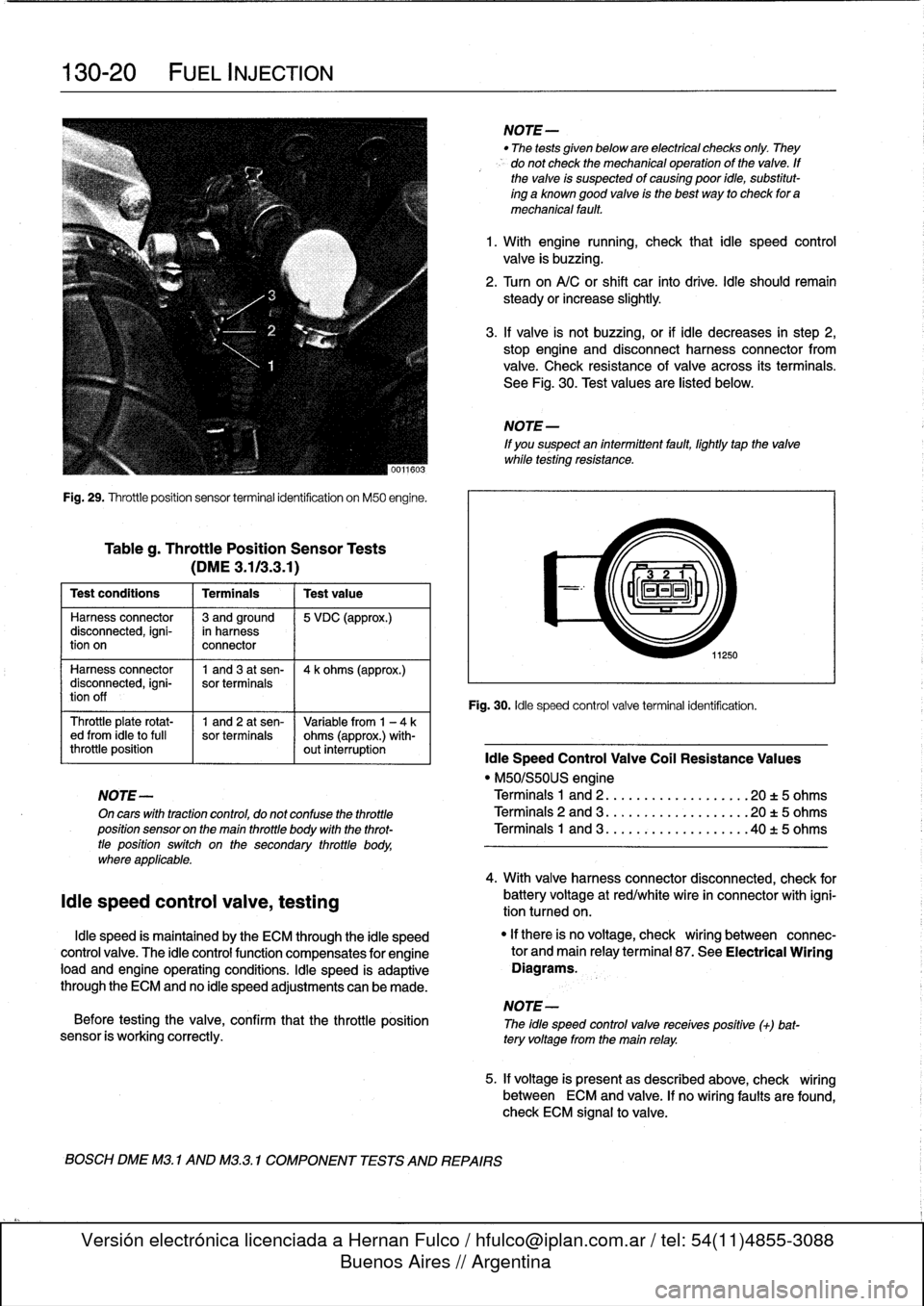
Fig
.
29
.
Throttleposition
sensor
terminal
identification
on
M50
engine
.
Tableg
.
Throttle
Position
Sensor
Tests
(DME3
.113
.3
.1)
Test
conditions
I
Terminals
I
Testvalue
Harness
connector
13
andground
15
VDC
(approx
.)
disconnected,
igni-
in
harness
tion
on
connector
Harness
connector
1
and3
at
sen-
14
k
ohms
(approx
.)
disconnected,
igni-
sor
terminals
tion
off
Throttle
plate
rotat-
1
and
2
at
sen-
Variable
from
1
-
4ked
from
¡dieto
full
sor
terminals
ohms
(approx
.)
with-
throttle
position
out
interruption
¡die
Speed
Control
Valve
Coil
Resistance
Values
"
M50/S50US
engine
NOTE-
Terminals
1
and
2
..
.
................
20
t
5
ohms
On
cars
with
tractioncontrol,
do
not
confuse
the
throttle
Terminals
2
and
3
...................
20
t5
ohms
position
sensor
on
the
main
throttle
body
with
the
throt-
Terminals
1
and
3
..
.
..
:
............
.40
t
5
ohms
tle
positionswitch
on
the
secondary
throttle
body,
where
applicable
.
¡die
speed
control
valve,
testing
¡die
speed
is
maintained
by
the
ECM
through
the
¡die
speed
control
valve
.
The
¡die
controlfunction
compensates
for
engine
load
and
engine
operating
conditions
.
¡die
speed
is
adaptive
through
the
ECM
and
no
¡die
speed
adjustments
can
be
made
.
NOTE-
Before
testing
the
valve,
confirm
that
the
throttle
position
The
idle
speed
controlvalve
receives
positive
(+)
bat-
sensor
is
working
correctly
.
tery
voltage
from
the
main
relay
.
BOSCH
DME
M3
.
1
AND
M3
.3
.1
COMPONENT
TESTS
AND
REPAIRS
NOTE-
"
The
tests
given
below
are
electrical
checks
only
.
They
do
not
check
the
mechanical
operation
of
the
valve
.
If
the
valve
is
suspected
of
causing
poor
idie,
substitut-
ing
a
known
good
valve
is
the
best
way
to
check
for
a
mechanical
fault
.
1
.
With
engine
running,
check
that
¡die
speed
control
valve
is
buzzing
.
2
.
Turn
on
A/C
or
shift
car
finto
drive
.
¡die
should
remain
steady
orincrease
slightly
.
3
.
If
valve
is
not
buzzing,or
if
¡die
decreases
in
step
2,
stop
engine
and
disconnect
harness
connector
from
valve
.
Check
resistance
of
valve
across
its
terminals
.
See
Fig
.
30
.
Test
values
are
listed
below
.
NOTE
-
If
you
suspect
an
intermittent
fault,
lightly
tapthe
valve
while
testing
resistance
.
11250
Fig
.
30
.
¡die
speed
control
valve
terminal
identification
.
4
.
With
valve
harnessconnector
disconnected,
check
for
battery
voltage
at
red/white
wire
in
connector
with
igni-
tion
tumed
on
.
"
If
there
is
no
voltage,
check
wiring
between
connec-
tor
and
main
relayterminal
87
.
See
Electrical
Wiring
Diagrams
.
5
.
If
voltage
is
presentas
described
above,
check
wiring
between
ECM
and
valve
.
If
no
wiring
faults
are
found,
check
ECM
signal
to
valve
.
Page 189 of 759

Fuel
leve¡
senders,
testing
Fuel
leve¡
sender
(right
side)
The
left
and
right
fuelleve¡
sending
units
are
wired
in
series
.
and
fuel
pump,
removing
and
installing
The
fuel
gauge
receives
a
signal
that
is
the
average
of
the
two
1
.
Disconnect
negative
(-)
cable
from
battery
.
input
values
.
1
.
Remove
rear
seat
cushion,
lift
up
insulation
mats,
andremove
both
fuel
tank
access
covers
.
2
.
Disconnect
white
plug
on
each
sending
unit
.
See
Fig
.
6
.
3
.
Check
resistance
value
of
eachsending
unit
.
Values
should
be
the
same
.
5
.
If
valuesare
different,
remove
sending
units
as
described
below,
and
check
resistance
valuésacross
terminals
.
Table
a
lists
resistance
values
for
senders
at
various
float
positions
.
Table
a
.
Fuel
Leve¡
Sender
Resistances
Float
position
Test
result
(ohms)
Right
side
empty
10
ohm
t2
Right
side
full
250
ohm
±
5
Left
side
empty
10
ohm
t
2
Left
side
fui¡
250
ohm
±
5
FUEL
TANK
AND
FUEL
PUMP
160-
5
CAUTION
-
Prior
to
disconnecting
the
battery,
read
the
battery
disconnection
cautionsglven
at
the
front
of
this
manual
onpage
viii
.
2
.
Drain
fuel
from
tank
as
described
earlier
.
WARNING
-
Always
unscrew
the
fuel
tank
cap
to
release
pres-
sure
in
the
tank
before
working
on
the
tank
or
fines
.
3
.
Remove
rear
seat
cushion
and
pull
back
insulation
pad
under
right
side
.
4
.
Remove
screws
holding
rightfuel
tank
accesscover
.
Remove
cover
.
5
.
Label
fuel
hoses
.
Disconnect
hoses
and
harness
con-
nectors
from
fuel
sending
unit
and
fuel
pump
.
6
.
Unscrew
threaded
collar
from
fuel
pumplfuel
leve¡
sender
.
Slowly
withdraw
assembly
from
tank,allowing
fuelto
drain
off
.
See
Fig
.
7
.
0013187
&
0013194
Fig
.
6
.
Fuel
pump/leve¡
sender
terminal
identification
.
Check
resis-
tance
at
terminals
of
white
connectors
(arrows)
.
"
If
necessary,
push
leve¡
sender
arm
toward
fuel
pump
assembly
to
facilitate
removal
.
NOTE
-
BMW
special
tool
no
.
16
1
020
should
beused
to
re-
move
and
install
the
threaded
collar
.
Damage
to
the
collar
may
result
if
the
special
tool
is
not
used
WARNING
-
NOTE-
Fuel
may
be
spilled
.
Do
not
smoke
or
work
near
The
compensating
siphon
pump
(Fig
.
1)
maintains
the
heaters
or
other
fire
hazards
.
fuel
leve¡
between
the
right
and
left
tank
lobes
.
If
the
re-
sistances
are
different
between
the
left
and
right
send-
ers,
remove
the
senders
and
visually
inspect
the
leve)
in
7
.
Using
a
new
sealing
ring,
install
pump
and
sending
each
lobe
.
If
the
leve¡
is
different,
check
the
siphon
com-
unit,
being
sure
that
fuel
line
connections
point
in
same
pensating
pump
.
direction
as
they
carne
out
.
8
.
Reconnect
harnessconnector
and
hoses
.
Fill
tank
and
check
for
leaks
by
running
engine
.
Insta¡¡
access
cover
and
its
mountingscrews
.
Reconnect
negative
(-)
cable
to
battery
.
CAUTION
-
Before
starting
the
engine,
fill
the
fuel
tank
with
at
least
1
.5
gallons
(5liters)
of
fuel
.
The
pump
will
be
damaged
if
you
run
it
without
fuel
.
FUEL
LEVEL
SENDERS
Page 193 of 759

NOTE-
NOTE
-
On
1996
and
later
4-cylinder
cars,
use
BMW
special
"
Use
BMW
pressure
gauge
Part
No
.
133
060,or
an
tool
13
6051
(hose
with
quick
release
coupling)
toat-
equivalent
.
The
fuel
pressure
gauge
should
have
a
tach
pressure
gauge
to
Shraeder
valve
fitting
on
top
of
rangeof
0
to
5bar
(0
to
75
psi)
and
mustbe
securely
the
M44
fuel
rail
.
See
Fig
.
13
.
connected
to
prevent
it
from
coming
loose
under
pres-
sure
.
u012503a
Fig
.
13
.
Fuel
rail
showing
location
of
Shrader
valve
fitting
on
M44
en-
gine
(arrow)
.
Later
model
6-cylinder
fuel
systems
require
BMW
specíal
tool
16
1
050
to
release
fittings
and
connect
the
fuel
gauge
.
See
Fig
.
14
.
0012699
Fig
.
14
.
Fuel
lines
at
rear
of
íntake
manifold
on
M52
engine
.
Use
BMW
special
tool
16
1
050
to
release
fittings
.
If
the
special
tools
arenot
available,
a
length
offuel
line
and
a
T-fitting
can
be
installed
tothe
inlet
fuel
line
and
connected
to
a
fuel
gauge
.
FUEL
TANK
AND
FUEL
PUMP
160-
9
"
On
cars
with
6-cylinder
engine,
thetop
left-side
en-
Bine
cover
will
have
to
be
removed
to
access
the
fuel
rail
.
System
pressure,
testing
System
pressure
is
the
pressure
created
by
the
fuel
pump
and
maintained
by
the
pressure
regulator
.
See
Fig
.
15
.
Sys-
tem
pressure
is
not
adjustable
.
1
.
Remove
fuel
tank
filler
cap
.
Fig
.
15
.
Fuel
pressure
regulator
.
Fuel
pressure
deflects
diaphragm
to
retum
fuel
to
tank
when
pressure
reaches
desired
limit
.
CA
UTION-
The
fuel
pump
is
capable
of
developing
a
higher
pressure
than
that
regulated
by
the
pressure
reg-
ulator
.
In
the
event
the
fuel
pump
check
valve
is
faulty
(stuck
closed),
make
sure
the
fuel
pressure
does
not
rise
aboye
6
.0
bar(87
psi)
.
Damage
to
the
fuel
fines
or
fuel
system
components
could
re-
sult
.
2
.
Connect
in-fine
a
Tfitting
and
fuel
pressure
gauge
to
outlet
hose
atfuel
pump
.
FUEL
PUMP