1993 VOLKSWAGEN GOLF heating
[x] Cancel search: heatingPage 61 of 156
Downloaded from www.Manualslib.com manuals search engine CONTROLS AND EQUIPMENT
Air conditioner*
-'le air conditioner is available as a normal :r fu lly automatic system (Climatronic*)
'le air conditioner in both cases is a com
u ne d cooling and heating system which
c " ers maximum comfort at all seasons of "18 year.
h e air conditioner
works only when the en
gine is running, the ambient temperature is
,:move about + 5°C and the blower speed is
cetween 1 and 4.
. 'hen air conditione r is switched on it re
d uc es not only the temperature inside the
. e hicle but also the air humidity When the .ambient air humidity is high this not only
a kes the vehicle occupants feel more
_ o m fortable but also prevents the
windows
c ~rom steaming up.
Ni th
the Climatronic* the selected veIcle interior temperature is maintained fully
a u tomatically. This is done by automatically
. I a rying the temperature of the air from the "e nts, the blower speed (air volume) and meair distribution.
Notes
• The operation of the normal air conditioner* is described on pages 59 -61. • The differences for the Climatronic* are given on pages 62 and 63.
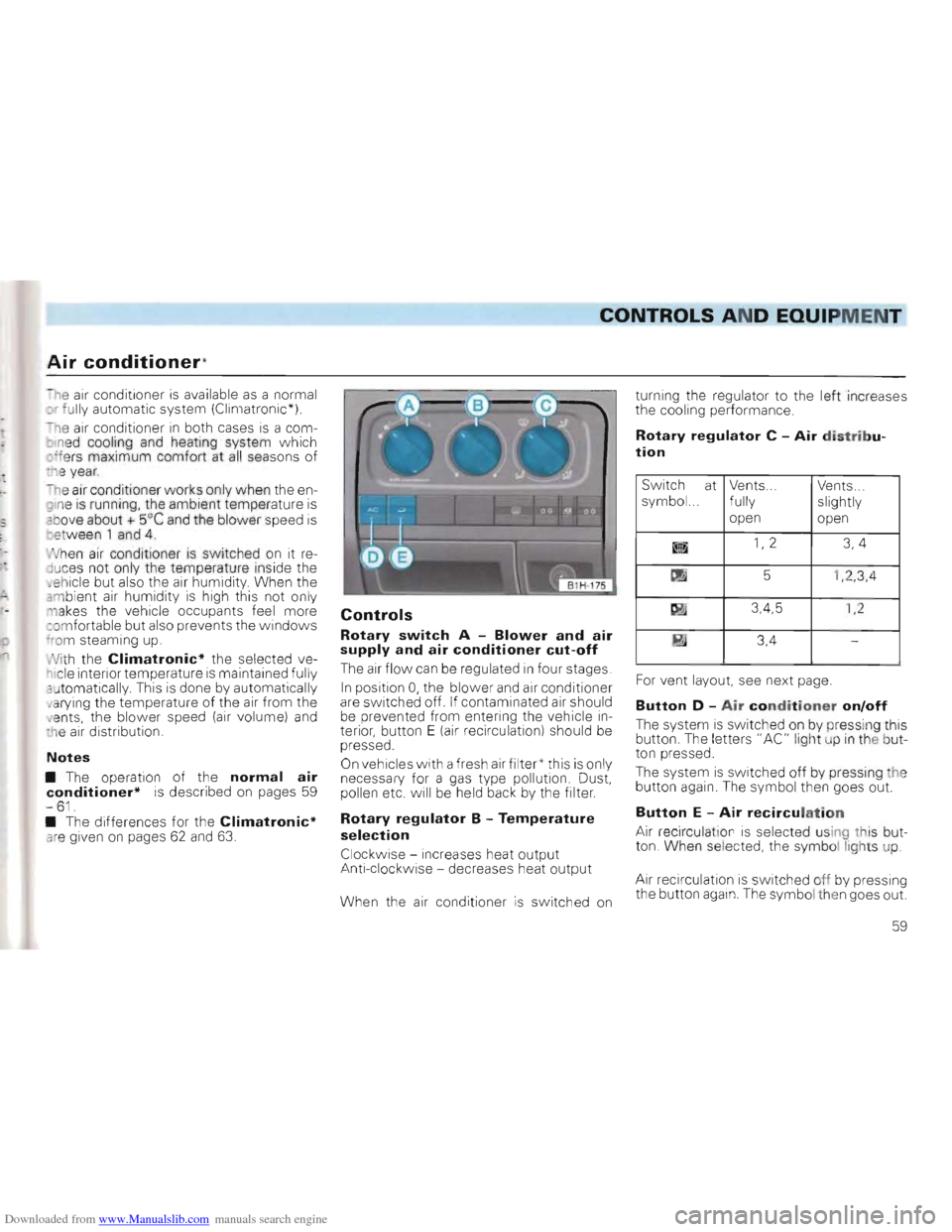
Controls
Rotary switch A -Blower and air supply and air conditioner cut-off
The air flow can be regulated in four stages.
In position 0, the blower and air conditioner
are switched off. If contaminated air should
be prevented from entering the vehicle in
terior, button E (air recirculation) should be
pressed.
On vehicles
with a fresh airfilter' this is only
necessary for a gas type pollution. Dust,
pollen etc. will be held back by the filter.
Rotary regulator B -Temperature
selection
Clockwise -increases heat output Anti-clockwise -decreases heat output
When the air conditioner is switched on turning
the regulator to the l
eft increases the cooling performance.
Rotary regulator C -Air distribu
tion
Switch
at
symbol. Vents..
fully
open V
ents ..
slig htly
open
~ 1,2 3,4
m 5 1 ,2,3,4
~ 3,4, 5
1,2
81 3,4 -
For vent layout, see next page.
Button D -Air conditioner on/off
The syste m is switched on by pressing this
button. The letters" AC" ligh t up i n t he but
ton pressed.
The system
is switched off by pre ss ing th e
button again. The symbol then goes out.
Button E -Air recirculation
Air rec ircula tion is selected usin g this button. When se le cted, the symbol lights up .
Air recir cu lation
is switched off b y pressing
the button ag ain , T he symbo l th e n goes out.
59
Page 62 of 156
Downloaded from www.Manualslib.com manuals search engine • •
CONTROLS AND EQUIPMEN.-=T-""------__________________
Air recirculation should only be selected for short periods of time as no fresh air is taken in in this mode and the windows can steam up if the air conditioner is switched off.
Note
Buttons D and E can be pressed In conjunc
tion w ith one another .
Air vents
Depending on the position of rotary regula
tor B heated or unhea ted fresh air or coo led
air flows from all vents.
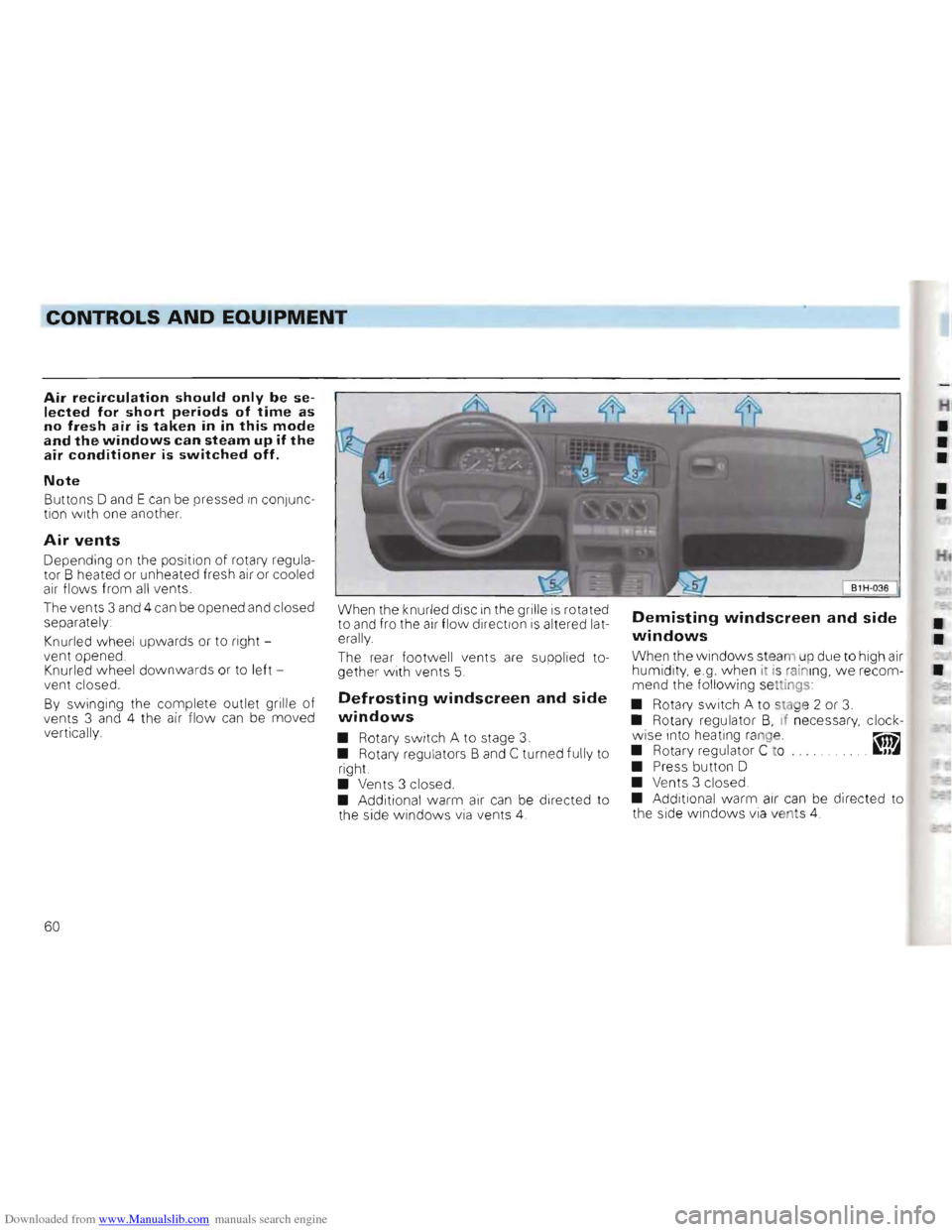
The vents 3 and 4 can be opened and closed
separately :
Knurled wheel upwards
or to right
vent opened .
Knurled
wheel downwards or to left
ven t closed.
By swinging the complete outlet grille of
vents 3 and 4 the air flow ca n be moved
vertically.
W hen the knurled disc in the grille is rota ted
to and fro the air flow direction is altered lat
erally
The
rear footwell vents are supplied to
gether with vents 5.
Defrosting windscreen and side
windows
• Rotary switch A to stage 3.
• Rotary regu lators Band C turn ed fully to
right.
• Vents 3 closed .
• Additional warm a
ir can be directed to
the side windows via vents 4.
Demisting windscreen and side
windows ••When the windows steam up due to high air
humidity, e.g. when it is rain ing, we recom•mend the following settings
• Rotary switch A to stag e 2 or
3. • Rotary regulator B, if necessary, clock
wise into heating range. ~
• Rotary regu lator C to . JJ~
• Press button D
• Ve nts 3 closed.
• Additiona l warm air can be directed to
th e sid e windows via vents 4.
60
Page 63 of 156
Downloaded from www.Manualslib.com manuals search engine __C_ONTROLS AND EQUIPMENT
Heating interior quickly
• Rotary switch A to stage 3.
• Rotary regulator B fully to right. PWll
• Rotary regulator C
to .. ~
• Vents 3 closed .
• Vents 4 fully or partially opened w ith
1 u rled discs
as required
Heating interior comfortably
hen the w indows are clear and the de
s red tempera ture has been reached we rec ommend the following settings
Rotary
switch A at stage 1 or 2.
• Rotary regulator B at the desired heat
Jt put.
Depending on air distribution
esir ed , turn rotary regulator C
re ween .. .. ~
'ld ~
, the windscreen mists over again,
e regulator can also be turned
etw een
•
Vents 3 closed.
•
With vents 4 the desired amount of
warm air and the air flow direction can be
set.
Ventilation (fresh air operation)
With the following settings, unheated fresh
air flows from vents 3 and 4:
• Switch air conditioner off with button D
• Rotary switch A to desired stage.
• Rotary regulator B anti-clockwise to the
stop D.1
• Rotary regulator C to . .. ~
• Vents 3 and 4 open.
If required, regulator C can be turned to
another position.
Maximum cooling
• All windows and sliding/tilting roof*
closed.
• Rotary s
witch A to stage 4.
• Rotary regulator B to left.
• Rotary regulator C to
• Right-hand button 0 (max) pressed.
• Select air recirculation by pressing but
ton E
• Vents 3 and 4 open.
In this mod e, air is drawn from inside the ve
hicle and cooled (air recircu lation) The air
recirculation mode should not be selected for long periods of time as no fresh air is then supplied.
Note
Smoking should be avoided w hen air recir
culation is selected , as the smoke drawn in from the vehicle interior deposits on the
evaporator of the air conditioner. This leads
to permanent odours when the air condi
tioner is i n operation. These can only be
eliminated by exchanging the evaporator,
which is time-consuming and expensive.
Normal cooling
• Switch air condit ioner on by pressing
button 0
• Rotary
switch A to stage 1 -4 as re
quired.
• Rotary regula
tor B to the desired air temperature (so that heating is also possible)
• Rotary regulator C to desired position
• Vents 3 and 4 set
as required.
I n this operating mode air is drawn in from
outside and cooled (fresh air operation)
To operate the Climatronic*, see pages 62 and 63.
61
Page 66 of 156
Downloaded from www.Manualslib.com manuals search engine CONTROLS AND EQUIPMENT
Operating instructions
• Ensure that the sensor betvveen the
windscreen defrost outlets in the centre of
the instrument panel and the air grille next
to the radio is not covered.
• If, after switching on the ignition,
all sym
bols in the display area flash for about 15
seconds, there is a fault in the system -con
tact a Volkswagen dealer.
Notes for both air conditioning
systems
• To ensure that the heating, ventilation
and air conditioner can work properly, the air
inlet in front of the windscreen should be
kept free of ice, snow and leaves.
• The heat output depends
on the coolant
temperature -the full heat output is there
fore available when the engine IS warm.
• The stale air escapes through openings
in the luggage compartment side panels.
Therefore when loading the luggage com
partment ensure that the openings are not
covered .
• When the ambient temperature
is high
and the air very humid, condensed water can drip off the evaporator and form a
puddle under the vehicle. This is quite nor
mal and does not indicate a leak.
Notes for the normal air condi
tioner
• All controls except the rotar y switch A and buttons 0 and E can be set to any inter
mediate position.
•
To prevent the windows from misting up
the blower should be running slowly when driving at low speeds.
Using air conditioners economi
cally
In cooling operation the air conditioner com
pressor places demands on the engine and
therefo re influences the fuel consumption.
To keep the period switched on as short as possible, the following points should be
noted:
• If the
in side temperature is very high
after the car has been parked in the sun, it is recommended to open doors or windows briefly to enable the hot air to escape
• The air conditioner should not be
switched on during a Journey if the
windows or sliding/tilting roof* are open.
• If the desired interior temperature
can be attained w ithout switching on the air
cond itioner the fresh air operation should
be selected (does not apply to Climatronicl.
Operating faults
• Should the air cond i:ioner not work at
any time, either .
- the ambient temperatu re IS below about +5 °C,
-or the fuse has blown.
Check fuse and if necessary r
enew it - see
page 119. If the troub le is n ot due to a defec
tive fuse, SWitch the system off and have It
checked.
- the air conditioner
has svvitched off due
to coolant temperature being too high -see
page 45.
• If the cooling output drops off, switch
the AlC
off and have the system checked.
64
Page 70 of 156
Downloaded from www.Manualslib.com manuals search engine CONTROLS AND EQUIPMENT
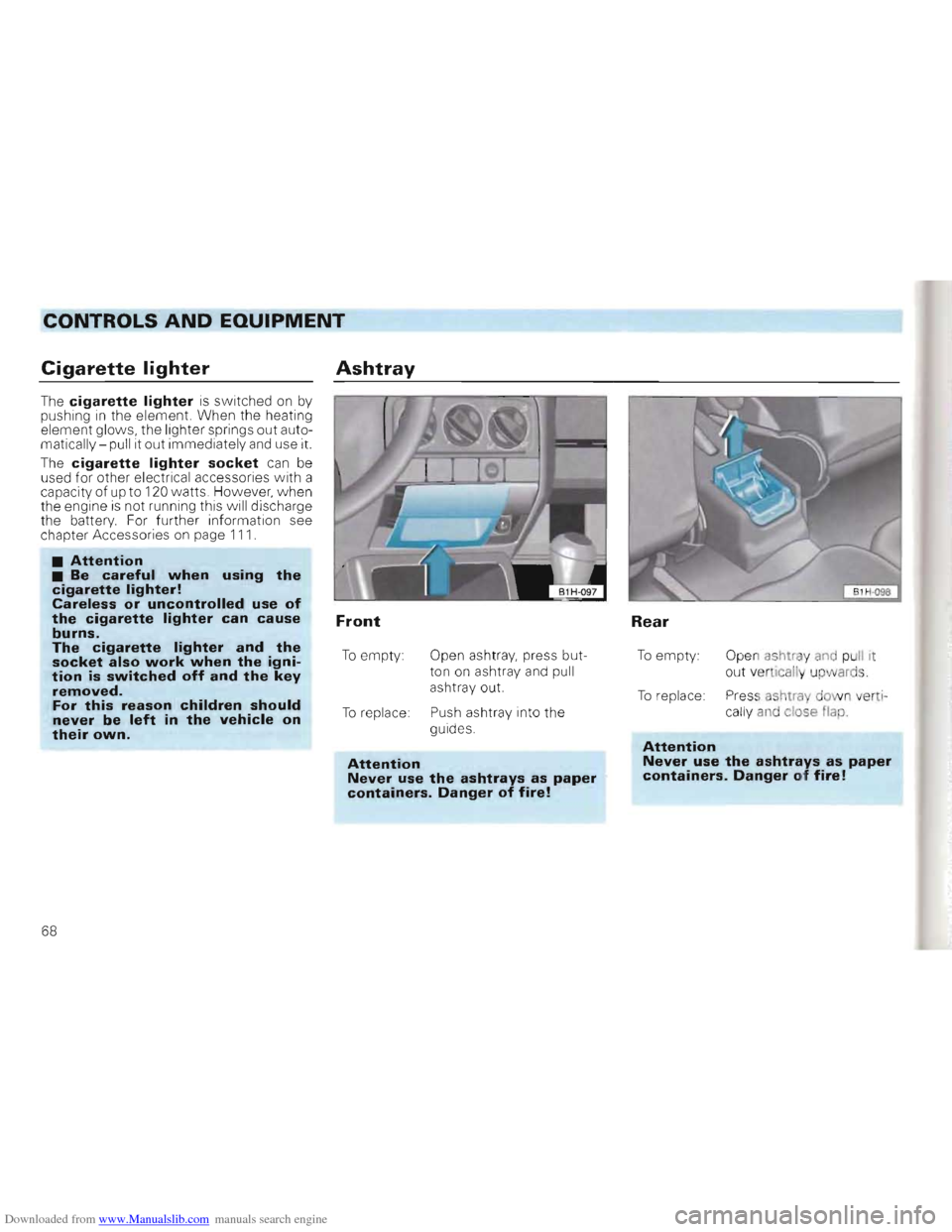
Cigarette lighter
The cigarette lighter is switched on by
pushing in the element. When the heating
element glows, the lighter springs out auto
matically -pull it out immediately and use it.
The
cigarette lighter socket can be
used for other electrical accessories with a
capacity of up to 120 watts. However, when the engine is not running this will discharge
the battery. For further information see
chapter Accessories on page
111 .
•
Attention • Be careful when using the cigarette lighter! Careless or uncontrolled use of the cigarette lighter can cause burns. The cigarette lighter and the socket also work when the ignition is switched off and the key removed. For this reason children should never be left in the vehicle on their own.
Ashtray
Front
To empty: Open ashtray, press but
ton
on ashtray and pull
ashtray out.
To replace Push ashtray into the
guides.
Attention Never use the ashtrays as paper containers. Danger of fire!
Rear
To empty
To replace: O
pen ashtra y and pull it
out ver ticall y u
pwards
P re ss ashtray
down ve rti cally and close flap.
Attention Never use the ashtrays as pape r containers. Danger of fire!
68
Page 76 of 156
Downloaded from www.Manualslib.com manuals search engine DRIVING TIPS
Trouble-free functioning of the exhaust emission control system is de
c isi ve for the enviro nment-friendly oper
ation of the vehicle .
The follow ing points should therefore
be noted:
• Vehicles fitted with a catal ytic con verter
may onl y be driven on unleaded petrol (see
page 82).
• Never drive until the fuel tank
is com
pletely empty on vehicles with a catal yst.
The irregular fuel supply ca n cause misfir
ing This allows un burnt fuel into the ex
haust system. This can cause overheating
and damage to the catalyst.
• If whilst driving, the engine misfires,
loses power and runs unevenly, this could
be due to a fault in the ignition system . In a
case like this, unburnt fuel can enter the ex
haust system and then escape to atmos
phere. Furthermore, the catalytic converter
could become damaged due to overheat
ing The vehicle speed
must be reduced im
mediately and the defect should be elImIn
ated at the nearest Volkswagen dealer.
• Do not sw itch
off ignition whilst driving
- see page 38 . •
Do not
overfill engine oil-see page 95.
•
Do not tow start vehicle for more than 50 m -see page 130.
Attention Due to high temperatures which can occur in the catalytic converter on petrol engine vehicles in very unfavourable conditions, the vehicle should not be parked so that the catalytic converter can come into contact with inflammable materials_
Note
Even in the case of a perfectl y working ex
haust emission control sy stem there can,
under certain engine operating conditions,
be a sulphur-type exhaust smell.
This depends upon the sulphur content
in
the fuel being used.
Quite often this
can be remedied by select
ing another brand of fuel or, filling up with
unleaded premium petrol.
74
Page 83 of 156
Downloaded from www.Manualslib.com manuals search engine Filling the tank
B1H-040
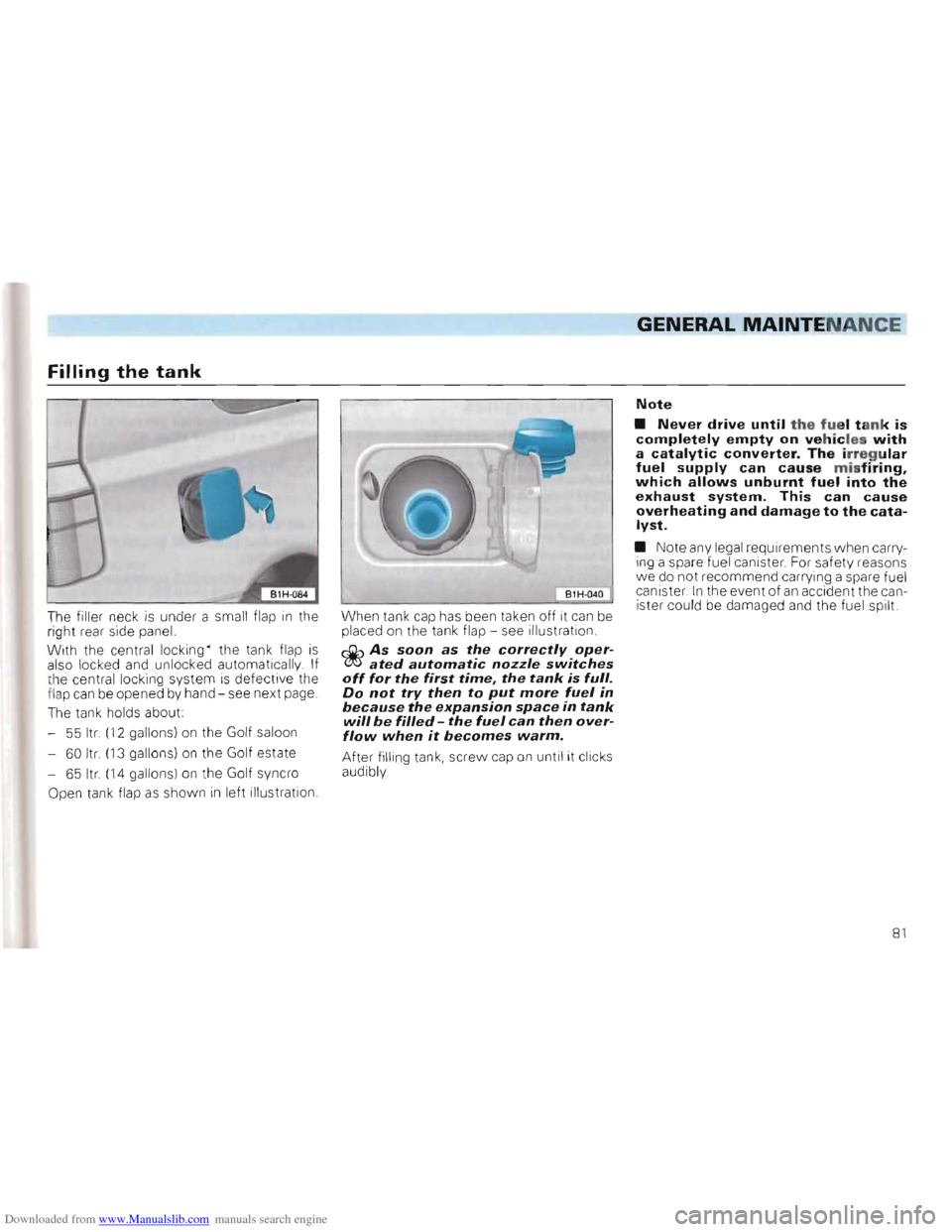
When tank cap has been taken off it can be
placed on the tank flap -see illustration.
r::ljb As soon as the correctly oper~ated automatic nozzle switches off for the first time, the tank is full. Do not try then to put more fuel in because the expansion space in tank will be filled -the fuel can then overflow when it becomes warm.
After filling tank, screw cap on until it clicks
audibly .
The
filler neck
is under a small flap in the
right rear side panel.
With the central locking ' the tank flap is also locked and unlocked automatically. If the central locking system is defective the fiapcanbeopenedbyhand-seene~page.
The tank holds about
-55 Itr (12 gallons) on the Golf saloon
- 60 Itr.
(13 gal lons) on the Golf estate
- 651tr .
(14 gallons) on the Golf syncro
Open
tank flap as shown in left illustr ation.
Note
• Never drive until 1he fuel tank is completely empty on vehicles with a catalytic converter. The irregular fuel supply can cause misfiring, which allows unburnt fuel into the exhaust system. This can cause overheating and damage to the catalyst.
• Note any lega l requirements when carry
ing a spa re fuel canis ter. For safety reasons we do not recommend carrying a spare fuel
canister. In the event of an accident the can
ister could be damaged and the fuel spilt.
81
Page 86 of 156
Downloaded from www.Manualslib.com manuals search engine GENERAL MAINTENANCE ~~~~~~=--------------------
Diesel engines
Diesel fuel
to DIN 51 601. eN1) not lower than 45.
Driving in winter
When using summer Diesel trouble may be experienced at temperatures below Ooe because the fuel thickens due to wax separ
ation.
For this reason, w inter Diesel which
is more
resistant to cold is sold during the winter in Germany, and this works satisfactorily
down to between -15 and -22°e, depend
ing on the type of fuel used.
In countries with different climatic condi
tions the Diesel fuels offered have a differ
ent temperature characteristic. Check with
Volkswagen dealers or filling stations
in the
country concerned regarding the character
istic s of Diesel fuels.
Filter preheating
The vehicle is fitted with a filter preheater.
This will ensure , that the fuel system remains operational down to about -25°e provided that winter Diesel which is cold resistant down to -15°e is used. Diluting with
petrol is then no longer necessary under
these conditions.
If, at temperatures below -25°e the fuel is waxed to such an extent that the engine w ill
not sta rt it is sufficient to place the vehicle in a warm room for a while .
Fuel additives (anti-waxing agents) and
similar fluids must not be mixed with the
Diesel fuel.
11 Cetane N u bee ind icates the ig nltabillty of
D iesel.
84