1993 VOLKSWAGEN CORRADO length
[x] Cancel search: lengthPage 303 of 920
2.8L IN-LINE V6 (VR6)
Article Text (p. 12)
1993 Volkswagen Corrado
For Volkswagen Technical Site: http://vw.belcom.ru
Copyright © 1998 Mitchell Repair Information Company, LLC
Wednesday, March 22, 2000 08:47PM
Application In. (mm)
Intake Valve ................................. 1.33 (33.9)
Exhaust Valve ................................ 1.34 (34.1)ÄÄÄÄÄÄÄÄÄÄÄÄÄÄÄÄÄÄÄÄÄÄÄÄÄÄÄÄÄÄÄÄÄÄÄÄÄÄÄÄÄÄÄÄÄÄÄÄÄÄÄÄÄÄÄÄÄÄÄÄ 3) The difference is maximum refacing allowable for valve and
seat. If valve installed height is too low or too high, lifters will
not work correctly. Replace cylinder head assembly.
Valves
Measure valve length, stem diameter and valve margin. If not
within specification, replace valves. Lap valves by hand or replace as
necessary. See VALVES SPECIFICATIONS table under ENGINE SPECIFICATIONS
at end of article.
CYLINDER BLOCK ASSEMBLY
Piston & Rod Assembly
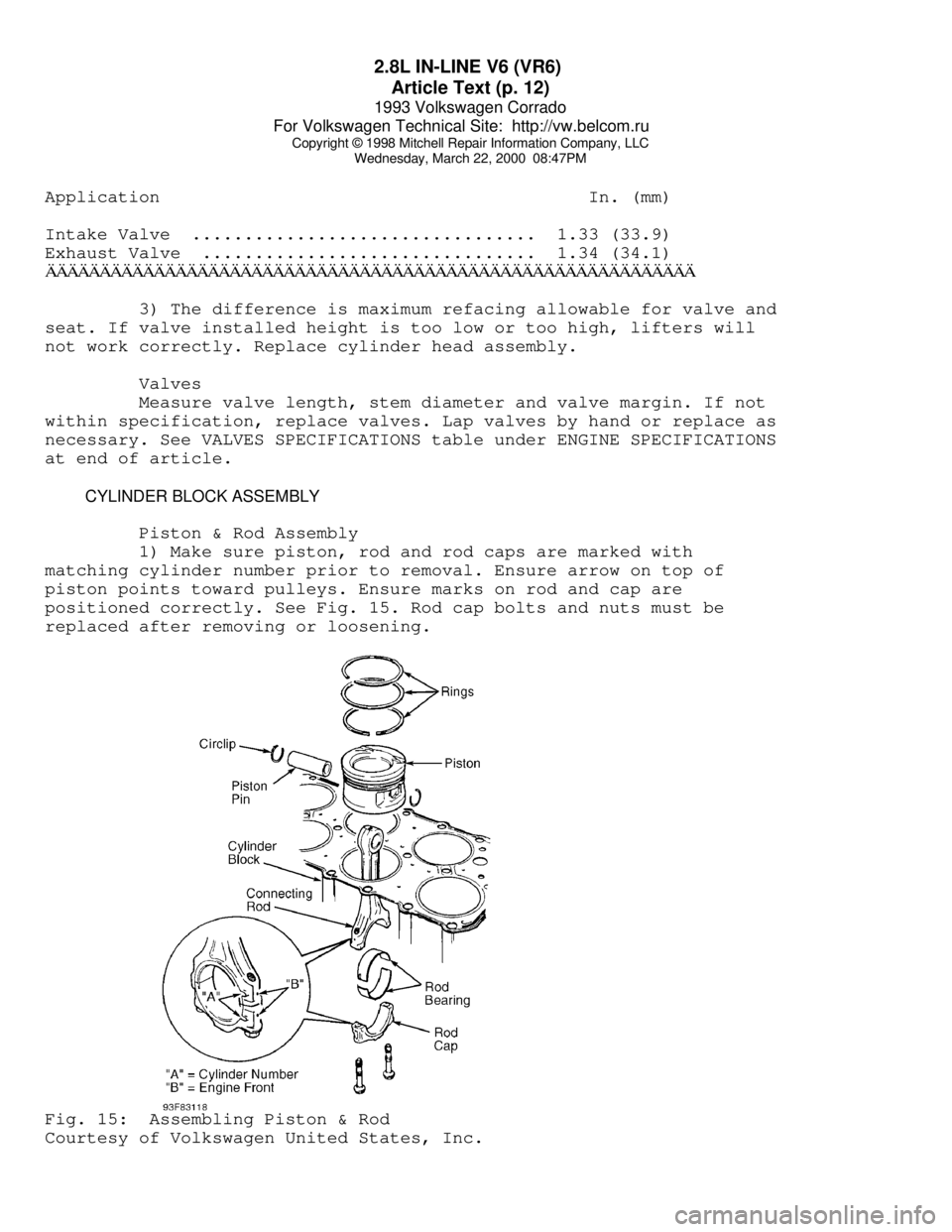
1) Make sure piston, rod and rod caps are marked with
matching cylinder number prior to removal. Ensure arrow on top of
piston points toward pulleys. Ensure marks on rod and cap are
positioned correctly. See Fig. 15. Rod cap bolts and nuts must be
replaced after removing or loosening.Fig. 15: Assembling Piston & Rod
Courtesy of Volkswagen United States, Inc.
Page 310 of 920

2.8L IN-LINE V6 (VR6)
Article Text (p. 19)
1993 Volkswagen Corrado
For Volkswagen Technical Site: http://vw.belcom.ru
Copyright © 1998 Mitchell Repair Information Company, LLC
Wednesday, March 22, 2000 08:47PM
VALVES SPECIFICATIONS
VALVES SPECIFICATIONS TABLEÄÄÄÄÄÄÄÄÄÄÄÄÄÄÄÄÄÄÄÄÄÄÄÄÄÄÄÄÄÄÄÄÄÄÄÄÄÄÄÄÄÄÄÄÄÄÄÄÄÄÄÄÄÄÄÄÄÄÄÄApplication Specification
Intake Valves
Face Angle .......................................... 45
ø Head Diameter ......................... 1.535" (39.00 mm)
Length ............................... 4.210" (106.95 mm)
Minimum Margin (1) .................................. (2)
Stem Diameter ........................... .274" (6.97 mm)
Exhaust Valves
Face Angle .......................................... 45
ø Head Diameter ......................... 1.346" (34.20 mm)
Length ............................... 4.210" (106.95 mm)
Minimum Margin (1) .................................. (2)
Stem Diameter ........................... .243" (6.95 mm)
(1) - DO NOT machine valves; hand lap only.
(2) - Information not available from manufacturer.
ÄÄÄÄÄÄÄÄÄÄÄÄÄÄÄÄÄÄÄÄÄÄÄÄÄÄÄÄÄÄÄÄÄÄÄÄÄÄÄÄÄÄÄÄÄÄÄÄÄÄÄÄÄÄÄÄÄÄÄÄ CYLINDER HEAD SPECIFICATIONS
CYLINDER HEAD SPECIFICATIONS TABLE
ÄÄÄÄÄÄÄÄÄÄÄÄÄÄÄÄÄÄÄÄÄÄÄÄÄÄÄÄÄÄÄÄÄÄÄÄÄÄÄÄÄÄÄÄÄÄÄÄÄÄÄÄÄÄÄÄÄÄÄÄApplication Specification
Cylinder Head Height ........................ 5.492-5.515"
Maximum Warpage .......................... .039" (1.00 mm)
Valve Seats
Intake Valve
Seat Angle ......................................... 45
ø Seat Width ......................................... (1)
Exhaust Valve
Seat Angle ......................................... 45
ø Seat Width ......................................... (1)
Valve Guides
Intake Valve
Valve Guide Installed Height ....................... (2)
Oil Clearance ...................... (3) .039" (1.0 mm)
Exhaust Valve
Valve Guide Installed Height ...................... (2)
Valve Stem-to-Guide
Oil Clearance ...................... (3) .051" (1.30 mm)
(1) - Information not available from manufacturer.
(2) - Valve guide shoulder flush with cylinder head.
(3) - New valve installed in cylinder head. Dial indicator
used to measure valve rock in guide.
Page 373 of 920

A/C SYSTEM GENERAL SERVICING
Article Text (p. 5)
1993 Volkswagen Corrado
For Volkswagen Technical Site: http://vw.belcom.ru
Copyright © 1998 Mitchell Repair Information Company, LLC
Wednesday, March 22, 2000 08:48PM
Because R-134a is not interchangeable with R-12, separate
sets of hoses, manifold gauge set and recovery/recycling equipment are
required to service vehicles. This is necessary to avoid cross-
contaminating and damaging system.
All equipment used to service systems using R-134a must meet
SAE standard J1991. The service hoses on the manifold gauge set must
have manual (turn wheel) or automatic back-flow valves at the service
port connector ends. This will prevent refrigerant from being released
into the atmosphere.
For identification purposes, R-134a service hoses must have a
Black stripe along its length and be clearly labeled SAE J2196/R-134a.
The low pressure test hose is Blue with a Black stripe. The high
pressure test hose is Red with a Black stripe, and the center test
hose is Yellow with a Black stripe.
NOTE: Refrigerant R-12 service hoses will ONLY be labeled SAE
J2196.
R-134a manifold gauge sets can be identified by one or all of
the following:
* Labeled FOR USE WITH R-134a on set
* Labeled HFC-134 or R-134a on gauge face
* Light Blue color on gauge face
In addition, pressure/temperature scales on R-134a gauge sets
are different from R-12 manifold gauge sets.
SYSTEM SERVICE VALVES
SCHRADER-TYPE VALVES
NOTE: Although similar in construction and operation to a tire
valve, NEVER replace a Schrader-type valve with a tire valve.
Schrader valve is similar in construction and operation to a
tire valve. When a test gauge hose with built-in valve core depressor
is attached, Schrader stem is pushed inward to the open position and
allows system pressure to reach gauge.
If test hose does not have a built-in core depressor, an
adapter must be used. Never attach hose or adapter to Schrader valve
unless it is first connected to manifold gauge set.
Refrigerant R-12 Schrader-type valve cores have TV5 thread
size. Refrigerant R-134a Schrader-type valve cores use M6 (Metric)
threads. R-134a valve cores can be easily identified by use of "O"
rings and external spring. See Fig. 1.
SERVICE VALVE LOCATIONS
SERVICE VALVE LOCATIONS TABLEÄÄÄÄÄÄÄÄÄÄÄÄÄÄÄÄÄÄÄÄÄÄÄÄÄÄÄÄÄÄÄÄÄÄÄÄÄÄÄÄÄÄÄÄÄÄÄÄÄÄÄÄÄÄÄÄÄÄÄÄÄÄVehicle High Low
Page 380 of 920

A/C-HEATER SYSTEM - MANUAL
Article Text (p. 5)
1993 Volkswagen Corrado
For Volkswagen Technical Site: http://vw.belcom.ru
Copyright © 1998 Mitchell Repair Information Company, LLC
Wednesday, March 22, 2000 08:49PM
both gauges read too low, locate leak and recharge system. If both
gauges read too high, replace expansion valve. If low side is too high
and high side is too low, replace compressor.
INSUFFICIENT COOLING
1) Ensure blower fan motor operates at all 4 speeds. Ensure
air duct closes off outside air intake and heater water valve is
closed. Clean condenser.
2) Adjust engine speed to 2500 RPM. Set controls for maximum
cooling and high fan. Insert thermometer in left air duct and close
all other ducts. With vehicle in shade, close windows and doors and
connect pressure gauges. Operate system for 10 minutes.
3) If both gauges read too high, replace expansion valve. If
both gauges read low, locate leak and recharge system. If both gauge
readings are normal, go to next step. If high side is too high and
suction side is normal, go to step 5). If high side is too low and
suction side is too high, go to step 6). If high side is normal and
suction side is too low, go to step 7).
4) Turn compressor off and observe gauges. If readings
equalize in 30 seconds, replace compressor. If readings take longer to
equalize, ensure capillary tube installed length is 13" (330 mm).
5) If capillary tube installation is correct, run system at
maximum cooling for 15 minutes. If thermometer indicates temperature
is less than 36øF (2øC) when compressor is turned off, or temperature
is greater than 48
øF (9øC) with compressor on, replace thermostatic
switch.
6) Check condenser fins and clean or straighten. If operation
is still not correct, discharge system until bubbles appear in sight
glass. Recharge system until bubbles disappear, and recheck pressures.
If operation is still incorrect, locate leaks and tighten fittings.
Discharge A/C system using approved refrigerant recovery/recycling
equipment. Evacuate system to remove all air and recharge system.
7) Check for bubbles at sight glass. If bubbles are present,
repair leaks and recharge system. If no bubbles are present, check
condenser-to-expansion valve line for kinks and repair if necessary.
Check line (from condenser to expansion valve) for restrictions by
feeling line for cold spots. If there are no cold spots, replace
expansion valve.
8) If cold spot is felt, remove and flush out lines and
condenser. Check for bubbles at sight glass. If there are no bubbles
present, replace compressor. If bubbles are present, check for leaks.
Repair and recharge system.
INTERMITTENT COOLING
1) Ensure blower fan motor operates in all 4 speeds. Ensure
air duct closes off outside air and heater water valve is closed.
Clean condenser.
2) Adjust engine speed to 2500 RPM. Set controls for maximum
cooling and high fan. Insert thermometer in left air duct and close
all other ducts. With vehicle in shade, close windows and doors and
Page 381 of 920

A/C-HEATER SYSTEM - MANUAL
Article Text (p. 6)
1993 Volkswagen Corrado
For Volkswagen Technical Site: http://vw.belcom.ru
Copyright © 1998 Mitchell Repair Information Company, LLC
Wednesday, March 22, 2000 08:49PM
connect pressure gauges. Operate system for 10 minutes.
3) Check for cool air from left duct. Low pressure gauge
should read more than 16 psi (1.1 kg/cmý). If low pressure gauge
reading is incorrect, place hands around expansion valve to warm
valve. If pressure rises, moisture is present in system. Discharge A/C
system using approved refrigerant recovery/recycling equipment.
Evacuate and recharge system. If pressure does not rise, go to next
step.
4) Check temperature on thermometer when thermostatic switch
turns compressor off. If temperature is 39
øF (4øC), system is okay. If
temperature is lower than 39
øF (4øC), ensure capillary tube installed
length is 13" (330 mm). If capillary tube installation is correct,
replace thermostatic switch.
TESTING
A/C SYSTEM PERFORMANCE
1) Park vehicle out of direct sunlight. Start engine and
operate engine at 2500 RPM. Set A/C controls to outside air, panel
(vent) mode, full cold, and A/C button on.
2) Set blower/fan on high speed and open windows. Operate
system for 6-7 minutes to allow system to stabilize. Insert
thermometer in center vent, and measure temperature. Temperature at
center vent must be 19-40
øF (-7 to 4øC) at center vent, with high side
and low side pressures within specification. See SPECIFICATIONS table
at beginning of article.
AMBIENT TEMPERATURE SWITCH
1) Remove air intake grille from right side cowl. Remove
switch from panel on right side of tray area. Place switch in freezer.
2) Using a DVOM, check switch resistance. Switch resistance
must be infinite (no continuity) below 30
øF (-1øC). Allow switch to
warm above 45
øF (7øC). Switch resistance must be zero ohms
(continuity). Replace switch if necessary.
COMPRESSOR CLUTCH COIL
Disconnect compressor clutch harness connector. Check
resistance between clutch connector terminals. Resistance reading
should be 3.6 ohms. If resistance reading is not as specified, replace
clutch coil.
DUAL-PRESSURE SWITCH
High-Pressure Cut-Out Switch
Locate dual-pressure switch on refrigerant line (right strut
tower). Switch is identified by its 4 wires. Ensure switch opens at
464 psi (32 kg/cm
ý). Ensure switch closes at 348 psi (24 kg/cmý).
NOTE: Dual-pressure switch may be removed without discharging
Page 427 of 920

AXLE SHAFTS
Article Text
1993 Volkswagen Corrado
For Volkswagen Technical Site: http://vw.belcom.ru
Copyright © 1998 Mitchell Repair Information Company, LLC
Wednesday, March 22, 2000 08:57PM
ARTICLE BEGINNING
1993-94 DRIVE AXLES
Volkswagen Axle Shafts - FWD
Corrado SLC, Passat
TROUBLE SHOOTING
Refer to TROUBLE SHOOTING - BASIC PROCEDURES article in the
GENERAL TROUBLE SHOOTING section.
REMOVAL, DISASSEMBLY, REASSEMBLY & INSTALLATION
NOTE: Clean bolts and nuts to ensure tightening torque is correct.
AXLE SHAFT
Removal
1) Remove axle shaft nut. Remove wheel. Remove brake caliper,
and secure aside. Remove tie rod end bolts.
2) Remove 2 bolts attaching spindle assembly to strut
assembly. Remove lower ball joint bolt or nut if necessary. Remove
spindle assembly. Loosen inner CV joint from transaxle flange. On
models with V6 engine, use Axle Press (3283) to press axle from wheel
housing. Clean old locking compound from splines. Remove axle shaft
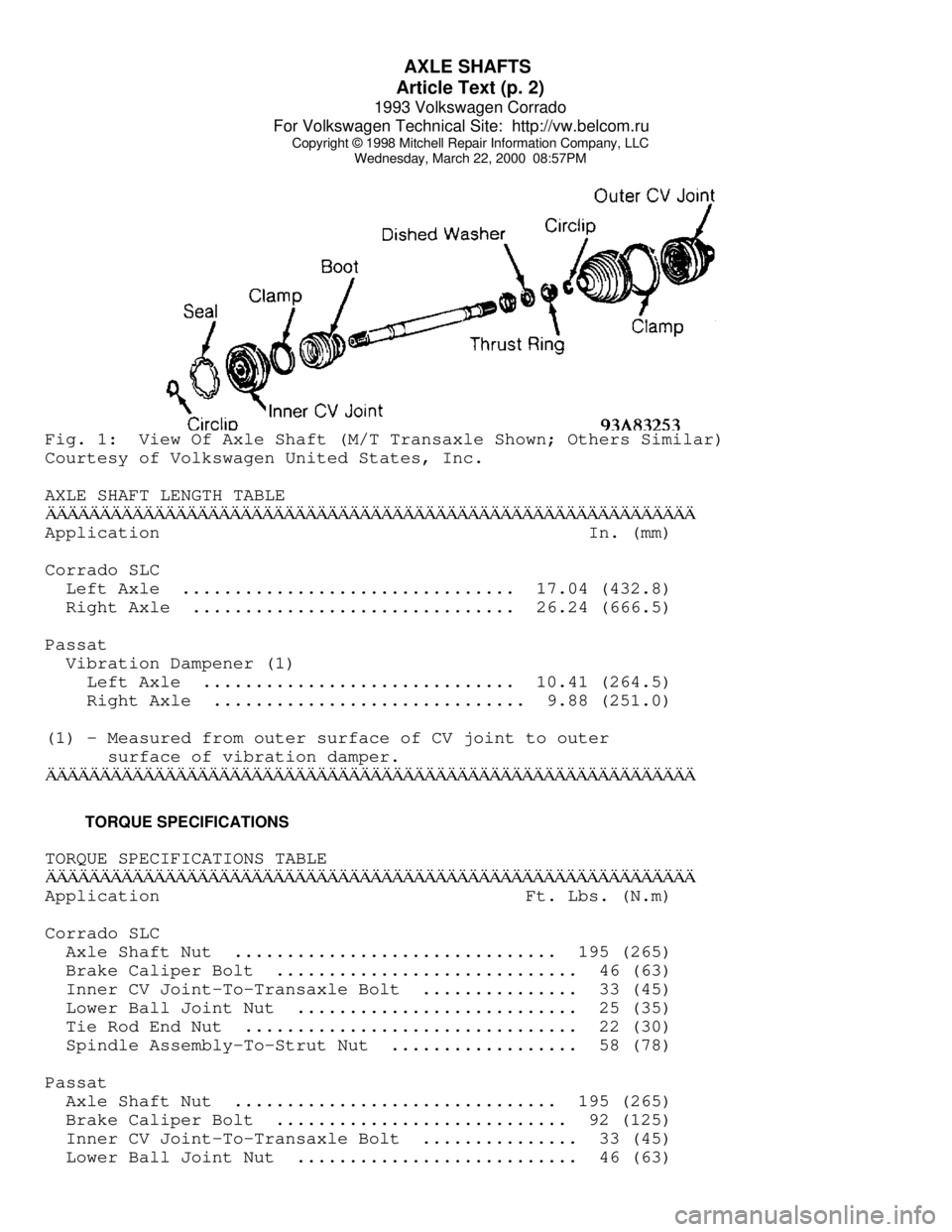
assembly. See Fig. 1.
Disassembly & Reassembly
1) Remove axle shaft boot(s). Using a drift, remove
protective cap from CV joint. Remove circlip from inner CV joint.
Support CV joint with axle assembly on Support Stand (VW 402).
2) Using Driver (VW 408A), press inner CV joint off axle
shaft. DO NOT disassemble inner CV joint, replace complete unit. To
remove outer CV joint, use a driver and hammer to drive CV joint off
axle shaft.
3) Rotate inner race and remove balls. Inspect for galling or
wear. Cover balls with grease and reinstall in race.
4) To reassemble, reverse disassembly procedure. Refer to the
AXLE SHAFT LENGTH table. Use new circlips and boot clamps during
assembly.
Installation
To install, reverse removal procedure. Install new axle shaft
nut. On models with V6 engine, apply locking compound to splines. See
the TORQUE SPECIFICATIONS table.
Page 428 of 920
AXLE SHAFTS
Article Text (p. 2)
1993 Volkswagen Corrado
For Volkswagen Technical Site: http://vw.belcom.ru
Copyright © 1998 Mitchell Repair Information Company, LLC
Wednesday, March 22, 2000 08:57PMFig. 1: View Of Axle Shaft (M/T Transaxle Shown; Others Similar)
Courtesy of Volkswagen United States, Inc.
AXLE SHAFT LENGTH TABLEÄÄÄÄÄÄÄÄÄÄÄÄÄÄÄÄÄÄÄÄÄÄÄÄÄÄÄÄÄÄÄÄÄÄÄÄÄÄÄÄÄÄÄÄÄÄÄÄÄÄÄÄÄÄÄÄÄÄÄÄApplication In. (mm)
Corrado SLC
Left Axle ................................ 17.04 (432.8)
Right Axle ............................... 26.24 (666.5)
Passat
Vibration Dampener (1)
Left Axle .............................. 10.41 (264.5)
Right Axle .............................. 9.88 (251.0)
(1) - Measured from outer surface of CV joint to outer
surface of vibration damper.
ÄÄÄÄÄÄÄÄÄÄÄÄÄÄÄÄÄÄÄÄÄÄÄÄÄÄÄÄÄÄÄÄÄÄÄÄÄÄÄÄÄÄÄÄÄÄÄÄÄÄÄÄÄÄÄÄÄÄÄÄ TORQUE SPECIFICATIONS
TORQUE SPECIFICATIONS TABLE
ÄÄÄÄÄÄÄÄÄÄÄÄÄÄÄÄÄÄÄÄÄÄÄÄÄÄÄÄÄÄÄÄÄÄÄÄÄÄÄÄÄÄÄÄÄÄÄÄÄÄÄÄÄÄÄÄÄÄÄÄApplication Ft. Lbs. (N.m)
Corrado SLC
Axle Shaft Nut ............................... 195 (265)
Brake Caliper Bolt ............................. 46 (63)
Inner CV Joint-To-Transaxle Bolt ............... 33 (45)
Lower Ball Joint Nut ........................... 25 (35)
Tie Rod End Nut ................................ 22 (30)
Spindle Assembly-To-Strut Nut .................. 58 (78)
Passat
Axle Shaft Nut ............................... 195 (265)
Brake Caliper Bolt ............................ 92 (125)
Inner CV Joint-To-Transaxle Bolt ............... 33 (45)
Lower Ball Joint Nut ........................... 46 (63)
Page 438 of 920

BRAKE SYSTEM
Article Text (p. 7)
1993 Volkswagen Corrado
For Volkswagen Technical Site: http://vw.belcom.ru
Copyright © 1998 Mitchell Repair Information Company, LLC
Wednesday, March 22, 2000 08:57PM
caliper mounting bolts. Depress brake pedal several times to allow
pads to move into operating position. Ensure master cylinder reservoir
fluid level is full.
MASTER CYLINDER
Removal
1) Drain master cylinder reservoir. Remove cover plate (if
equipped). Disconnect brakelines and wiring at master cylinder.
2) On models without power assist servo, disconnect brake
push rod at brake pedal. On models equipped with power assist servo,
remove master cylinder from servo. Be careful to keep any spacers used
on attaching bolts for proper installation.
Installation
To install, reverse removal procedure. Always use NEW "O"
ring between master cylinder and power assist servo. Bleed hydraulic
system.
VACUUM POWER ASSIST SERVO
Removal
Remove master cylinder from power assist servo. Disconnect
brake push rod from brake pedal. Disconnect vacuum hose from servo.
Remove servo from vehicle.
NOTE: Not all vehicles have all components.
Installation
To install, reverse removal procedure. Before attaching brake
push rod to brake pedal, check and adjust push rod length. Always use
NEW damping ring, washer, filter and "O" ring (as equipped). Slots in
damping washer and filter must be offset 180 degrees (if equipped).
Complete installation, and bleed hydraulic system.
OVERHAUL
NOTE: Black staining from piston seal wear may show on caliper
bore walls and piston. This staining is normal. DO NOT
disassemble power assist servo as parts are not available.
Refer to appropriate illustration for caliper and master
cylinder overhaul. See Figs. 6 and 7.