1993 PONTIAC GRAND-PRIX radiator
[x] Cancel search: radiatorPage 220 of 338
d
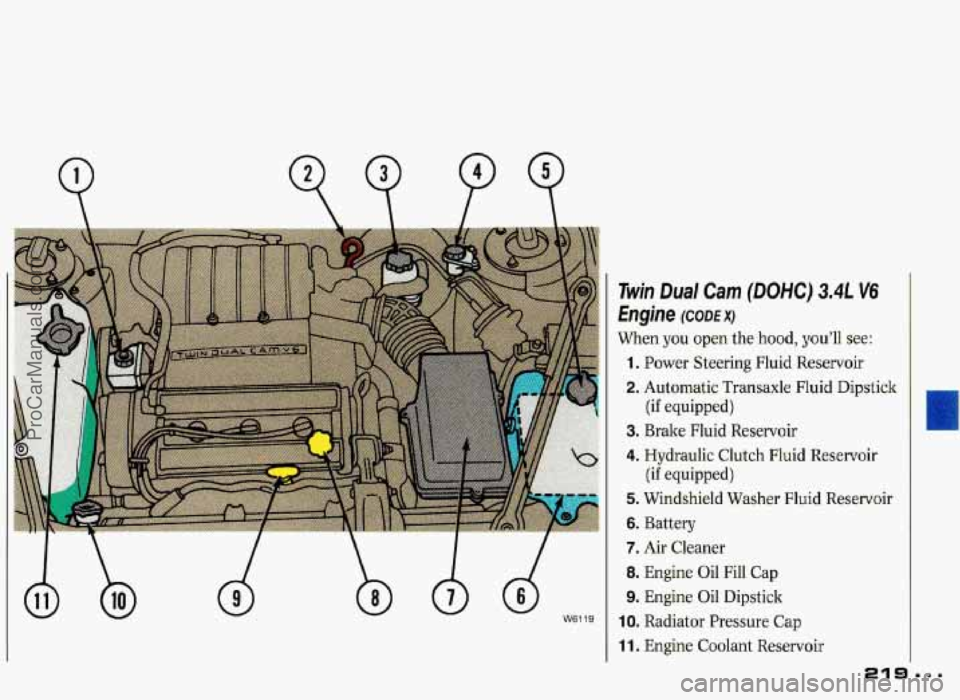
Twin Dual Cam (DOHC) 3.4L V6
hgne (CODE x)
When you open the hood, you’ll see:
1. Power Steering Fluid Reservoir
2. Automatic Transaxle Fluid Dipstick
3. Brake Fluid Reservoir
4. Hydraulic Clutch Fluid Reservoir
5. Windshield Washer Fluid Reservoir
6. Battery
7. Air Cleaner
8. Engine Oil Fill Cap
9. Engine Oil Dipstick
IO. Radiator Pressure Cap
11. Engine Coolant Reservoir
(if equipped)
(if equipped)
ProCarManuals.com
Page 231 of 338

Service & Appearance Cam
Hydraulic Clutch Fluid (CONTJ
How to Check
The proper fluid should be added if the
level does not reach the bottom
of the
diaphragm when it’s in place in the
reservoir. See the instructions on the
reservoir cap.
230
Engine Coolant
The following explains your cooling
system and
how to add coolant when it
is low. If you have a problem with
engine overheating or
if you need to add
coolant to your radiator, see the Index
under Engine Overheuling.
The proper coolant for your Pontia’c
will:
Give freezing protection do;wn to
Give boiling protection up to 262°F
Protect against rust and corrosion.
Help keep the proper engine
Let the warning lights work as they
What to Use:
Use a mixture of one-half dean water
(preferably distilled) and one-half
antifreeze that meets
“GM Specification
1825-M,” which won’t darnage
-34°F (-3 7 “C) .
(12S°C).
temperature.
should.
aluminum parts. You can also use a
recycled coolant conforming to
GM
Specification 1825-M with a complete
coolant flush and refill. If you use this
mixture, you don’t need to add
anything else.
Adding only plain water
to
your cooling system can be
dangerous. Plain water, or some
other liquid like alcohol, can boil
before the proper coolant mix will.
Your vehicle’s coolant warning
system is set for the proper coolant
mix. With plain water or the wrong
mix, your engine could get
too hot
but you wouldn’t get the overheat
warning. Your engine could catch
fire and you or others could be
burned. Use a
50/50 mix of clean
water and
a Droner antifreeze.
ProCarManuals.com
Page 232 of 338
I
NOTICE
If you use an improper coolant
mix, your engine could overheat
and be badly damaged. The repair
cost wouldn’t be covered by your
warranty. Too much water in the
mix can freeze and crack the
engine, radiator, heater core and
other parts.
i,,~~~,~,,”;l,,I;i,.,t”. ~~,,,~,~,~~~~,~,~~.~~~,~
Adding Coolant
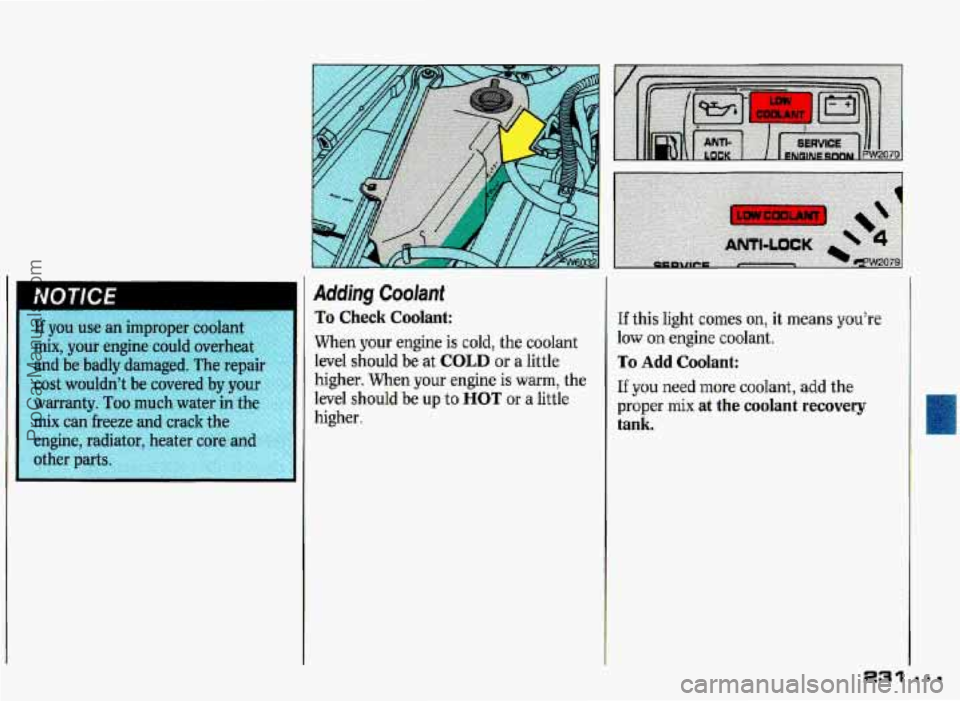
To Check Coolant:
When your engine is cold, the coolant
level should be at
COLD or a little
higher. When your engine is warm, the
level should be up to
HOT or a little
higher.
If this light comes on, it means you’re
low on engine coolant.
To Add Coolant:
I€ you need more coolant, add the
proper mix at the coolant recovery
tank. n
ProCarManuals.com
Page 233 of 338

Service & Appearance Care
Turning the radisiitor pressure
1 b cap when the en& and
radiator am hat can daw steam
and scalding liquids to blow out
and burn you badly. With the
almost never have to add coolant at
the radiator. Never turn the
radiator pressure mp-evtm a
I.lttle-whm the engine and
coolant recoverg tadq lyou will
Add coolant mix at the recovery tank,
but be careful not to spill it.
Radiator Pressure Cap
Dm
Your radiator cap is a 15 psi
(105 kPa) pressure-type cap and
must be tightly installed to prevent
coolant loss and possible engine
damage
from overheating. Be sure
the arrows on the cap line up
with
the overflow tube on the radiator
filler neck.
I I'
11 CAUTION
You can be burned if you
I spill coolant on hot engine I
,~rts. Coolant contains ethylene
glycol, and it will burn if the engine
parts are hot enough.
Don't spill
coolant on a hot engine.
I I When you replace your radiator pressure
I
cap, an AC@ cap is recommended.
Thermostat
Engine coolant temperature is
controlled by a thermostat in the engine
coolant system. The thermostat stops
the
flow of coolant through the radiator
until the coolant reaches a preset
temperature.
When you replace your thermostat, an
AC@ thermostat is recommended.
ProCarManuals.com
Page 235 of 338

Service & Appearance Care
Windshield Washer Fluid (CONT.)
NOTICE
When using concentrated washer
fluid, follow the manufacturer’s
instructions for adding water.
Don’t mix water with ready-to-
use washer fluid. Water can cause the solution to freeze and
damage your washer fluid tank
and other parts
of the washer
system. Also, water doesn’t clean
as well as washer fluic
allows for expansiok, which
could damage the tank if it i
completely full.
Don’t use radiator antifreeze in
~ ~~~-
Brake Master Cylinder
Your brake master cylinder is here. It is
filled with DOT-3 brake fluid.
Your vehicle is equipped with either
Standard Power Brakes or the Anti-
Lock Brake System.
There are only two reasons why the
brake fluid level in your master cylinder
might go down. The first is that the
brake fluid goes down to an acceptable
level during normal brake lining wear.
When new linings are put in, the fluid
level goes back up. The
other reason is that fluid is leaking
out of the brake system.
If it is, you
should have your brake system fixed, since a leak means that sooner or later
your brakes won’t work well, or won’t
work at all.
So, it isn’t a good idea to “top
off” your
brake fluid. Adding brake fluid won’t correct a leak. If you add fluid when
your linings are worn, then you’ll have
too much fluid when you get new bralce
linings. You should add (or remove)
brake fluid, as necessary, only when
work is done on the brake hydraulic
system.
ProCarManuals.com
Page 298 of 338

ITEM
NO. SERVICE
ITEM NO. SERVICE
5
6
Engine
Accessory Drive Belt Inspection
(California
3.1L Code T, engine*)-Inspect the
belt for cracks, fraying, wear and proper tension.
Replace as needed,
Camshaft Timing Belt Inspection
(3.4L Code X
engine only)*-Inspect for cracks, wear or oiliness.
Check tensioner for proper operation. See the
service manual. (To purchase a service manual,
see the
Index under Publications.) Replace parts
as needed.
7 Cooling System Service*-Drain, flush and refill
the system with new or approved recycled coolant
conforming to
GM Specification 1825111. Keep
coolant at the proper mixture as specified. See the
Index under Coolant. This provides proper freeze
protection, corrosion inhibitor level, and engine
operating temperature.
Inspect hoses and replace if they are cracked,
swollen or deteriorated. Tighten screw-type hose
. clamps. Clean the outside of the radiator and air
conditioning condenser. Wash the pressure cap
and neck.
To help ensure proper operation, we recommend a
pressure test of both the cooling system and the
pressure cap.
8 Transaxle Service-For manual transaxles, fluid
doesn’t require changing.
For automatic transaxles, change both the fluid
and filter every
15,000 miles (25 000 lun) if the
vehicle is mainly driven under one or more of
these conditions:
In heavy city traffic where the outside
temperature regularly reaches
90°F (32°C) or
higher.
In hilly or mountainous terrain.
9
10
When doing frequent trailer towing. (With some
models,
you shouldn’t ever tow a trailer. See the
Index under Towing a Trailer.)
Uses such as found in taxi, police car or delivery
service.
If you do not use your vehicle under any
of these
conditions, change both the fluid and filter every
100,000 miles (160 000 km).
Spark Plug Replacement *-Replace spark plugs
with the proper type. See the
Index under
Replacement Parts.
Spark Plug Wire Inspection*+Inspect for
burns, cracks
or other damage. Check the boot fit
at the coils and at the spark plugs. Replace wires
as needed.
ProCarManuals.com
Page 332 of 338

..
Net. Convenience ............................. 50
New Vehicle Break-In ................ 51. 175
Night Driving
................................... 157
Octane Requirements
Odometer
........................................... 96
Off-Road Recovery
........................... 154
Oil Change Indicator
........................ 107
Oil. Engine
........................................ 220
Capacity
.......................................... 276
Change. Distance to
....................... 107
Quality
........................................... 22 1
Thickness ...................................... 222
Used Oil
.......................................... 223
When to Change
.................... 107. 223
Oil Warning Light
............................. 100
Operation
of Lights ............................. 78
Outside Rearview Mirrors ................. 83
Overdrive. Automatic ................... 57. 60
Overheated Engine Coolant Warning Light
................................. 98
Owner Checks
& Services ............... 299
(see
Fuel
Requirements)
Overheated Engine .......................... 193 Paint
Chemical Spotting
......................... 268
Finish Care
..................................... 266
Finish Damage
............................... 267
Column Shift
................................... 65
Console Shift
................................... 66
On Hills ......................................... 169
Over Things That Burn
................... 68
With the Engine Running
................ 68
Parking Brake ..................................... 64
Passenger Assist Straps
...................... 89
Passenger Belts (see Safety Belts)
Passing ............................................. 154
Polishing and Waxing
Power Antenna
................................ 135
Power Door Locks
.............................. 46
Power Mirrors
.................................... 84
Power Seat Controls
.......................... 11
Power Steering ................................ 151
Power Steering Fluid
........ 233.277. 279
Power Windows
......................... 70. 275
Park.
Shifting Into
Parking
(see
Appearance Care)
Pregnancy. Use of Safety Belts
During
............................................. 23
Problems
on the Road ..................... 183
Publications (see Service Publications)
Pulse Windshield Wipers .................... 76
Radiator Overheating
(see
Overheated Engine)
Radiator Pressure Cap .............. 197. 232
Radio (see
Audio Systems)
Rain. Driving in the .......................... 159
Reading Lights
.................................... 81
Rear Window Defogger ................... 118
Rearview Mirror .......................... 83, 84
Reclining Seatbacks
............................ 12
Reminder Light
................................... 19
Remote Control Mirrors .................... 84
Remote Lock Control
......................... 46
Remote Positive Battery Terminal
.... 186
Remote Trunk Release
...................... 50
Replacement Bulbs .......................... 280
Replacement Fuses
........................... 271
Replacement Parts
........................... 284
Replacing Brakes
.............................. 235
Replacing Safety Belts
........................ 40
.
ProCarManuals.com