1993 PONTIAC BONNEVILLE tire type
[x] Cancel search: tire typePage 165 of 322

Your Driving and the Road
Passing (CONX:)
right lane to pass. When you are far
enough ahead of the passed vehicle to
see its front in your inside mirror,
activate your right lane change signal
and move back into the right lane.
(Remember that your right outside
mirror is convex. The vehicle you just
passed may seem to be farther away
from you than it really is.)
Try not to pass more than one vehicle
at a time on two-lane roads.
Reconsider before passing the next
vehicle.
vehicle too rapidly. Even though the
brake lights are not flashing,
it may be
slowing down or starting to
turn.
If you’re being passed, make it easy
for the following driver to get ahead
of
you. Perhaps you can ease a little to
the right.
Don’t overtake a slowly moving
Loss of Control
Let’s review what driving experts say
about what happens when the three
control systems (brakes, steering and
acceleration) don’t have enough friction
where the tires meet the road to do what
the driver has asked.
In any emergency, don’t give up. Keep
trying to steer and constantly seek
an
escape route or area of less danger.
Skidding
In a skid, a driver can lose control of
the vehicle. Defensive drivers avoid
most skids by taking reasonable care
suited to existing conditions, and by not
“overdriving” those conditions. But
skids are always possible.
The three types of skids correspond to
your Pontiac’s three control systems. In
the braking skid your wheels aren’t rolling. In the steering or cornering
skid, too much speed or steering in a
curve causes tires to slip and lose
cornering force. And in the acceleration
skid too much throttle causes the driving
wheels
to spin.
A cornering skid and an acceleration
skid are best handled by easing your
foot
off the accelerator pedal. If your
vehicle starts to slide (as when
you turn
ProCarManuals.com
Page 187 of 322

Your Driving and the Road
I4
If bu Do Decide to Pull a Trailer
(CONT.)
Total Weight on Your Vehicle’s Tires
Be sure your vehicle’s tires are inflated
to the limit for cold tires. You will find
these numbers on the Certification
label at the rear edge of the driver’s
door (or, see the
Index under 7ire
Loading).
Then be sure you don’t go
over the
GVW limit for your vehicle.
186
Hitches
It’s important to have the correct hitch
equipment. Crosswinds, large trucks
going by, and rough roads are a
few
reasons why you’ll need the right hitch.
Here are some rules to follow:
If you’ll be pulling a trailer that, when
loaded, will weigh more than 2,000
pounds (900 kg), be sure to use a
properly mounted, weight-distributing
hitch and sway control
of the proper
size. This equipment is very important
for proper vehicle loading
and good
handling when you’re driving.
Will you have to make any holes in the
body of your vehicle, when you install
a trailer hitch?
If you do, then be sure
to seal the holes later when you remove
the hitch.
If you don’t seal them, deadly
carbon monoxide
(CO) from your
exhaust can get into your vehicle. (See
the
Index under Carbon Monoxide in
Exhaust.) Dirt and water can, too.
The bumpers on your vehicle are not
intended for hitches. Do not attach
rental hitches or other bumper-type
hitches to them. Use only a frame-
mounted hitch that does not attach to
the bumper.
ProCarManuals.com
Page 198 of 322

1 2. Remove the cables in reverse order
to prevent electrical shorting. Take
care that they don't touch each other
or any other metal.
Towing Your Pontiac
Try to have a GM dealer or a
professional towing service tow your
Pontiac. The usual towing equipment is:
(A) Sling-type tow truck
(B) Wheel-lift tow truck
(C) Car carrier
If your vehicle has been changed or
modified since it was factory-new by
adding aftermarket items like fog lamps,
aero skirting, or special tires and
wheels, these instructions and
illustrations may not be correct.
Before you
do anything, turn on the
hazard warning flashers. When
you call,
tell the towing service:
That your vehicle can only be towed
with certain equipment, as described
later in this section.
drive. vehicle.
lever. damaged.
That your vehicle has fi-ont-wheel
The make, model, and year of your
Whether you can still move the shift
If there was an accident, what was
When the towing service arrives, let the
tow operator know that this manual
contains detailed towing instructions
and
illustrations. The operator may want to
see them.
197
ProCarManuals.com
Page 247 of 322
Service & Appearance Care
Halogen Bulbs
L Halogen bulbs have
l pressurized gas inside and can
if you drop or scratch the
bulb. You or others could be
' jured. Take special care when
llmdling and disposing
of halogen
bulbs.
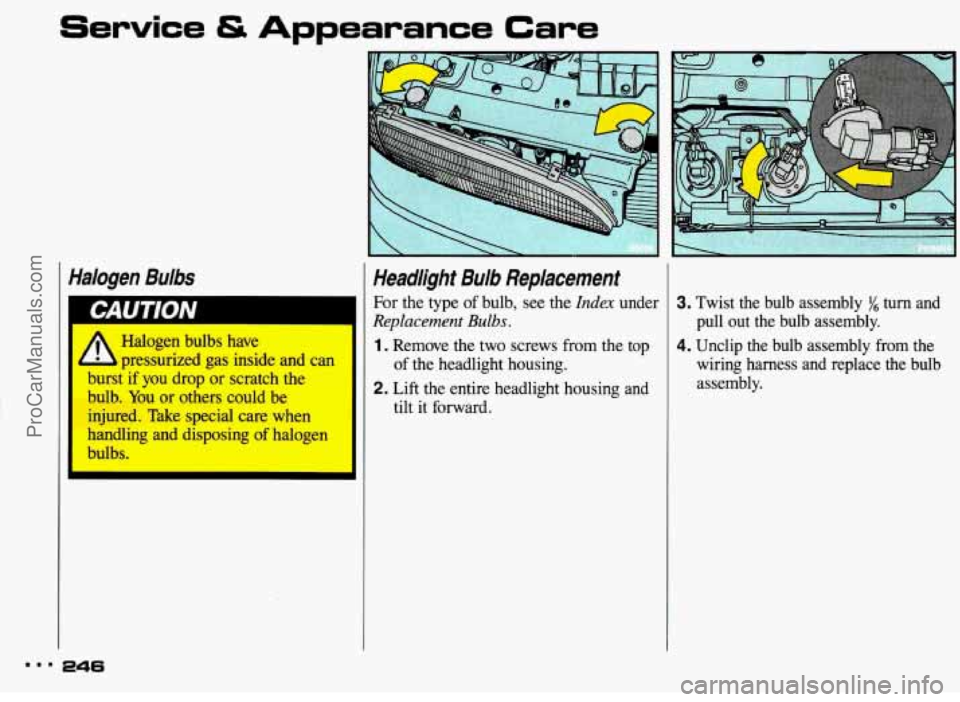
Headlight Bulb Replacement
For the type of bulb, see the Index under
Replacement Bulbs.
1. Remove the two screws from the top
2. Lift the entire headlight housing and
of
the headlight housing.
tilt it forward.
3. Twist the bulb assembly $/6 turn and
4. Unclip the bulb assembly from the pull out the bulb assembly.
wiring harness and replace the bulb
assembly.
ProCarManuals.com
Page 249 of 322

Service & Appearance Care
Windshield Wiper Blade
Replacement
Replacement blades come in different
types and are removed
in different ways.
Here’s how to remove the type with a
release clip:
1. Pull the windshield wiper arm away
2. Lift the release clip with a
from
the windshield.
screwdriver and pull the blade
assembly off the wiper arm.
the wiper arm.
3. Push the new wiper blade securely on
Loading bur Vehicle
Two labels on your vehicle show how
much weight it may properly carry. The
Tire-Loading Information label found on
the rear edge of the driver’s door tells
you the proper size, speed rating and
recommended inflation pressures for the
tires on your vehicle. It also gives you
important information about the number
of people that can be in your vehicle and
the total weight that you can carry. This
weight is called the Vehicle Capacity
Weight and includes the weight of all
occupants, cargo, and all nonfactory-
installed options.
The other label is the Certification
label,
also on the rear edge of the
driver’s door. It tells you the gross
weight capacity of your vehicle, called the
GVWR (Gross Vehicle Weight
Rating). The GVWR includes the
weight of the vehicle, all occupants, fuel
and cargo. Never exceed the GVWR for
your vehicle, or
the Gross Axle Weight
Rating (GAWR) for either the front or
rear axle.
And, if you do have a heavy load,
you
should spread it out. Don’t carry more
than
176 lbs. (80 kg) in your trunk.
On vehicles equipped with electronic
level control, the rear of the vehicle
is
automatically kept level as you load or
unload your vehicle.
... 248
ProCarManuals.com
Page 252 of 322

Don't let anyone tell you that , 1 ,~ ,%$:
underinflation or overinflation
all right. It's not.
If your tires don't ;1
When to Check:
Check your tires once a month or more.
Don't forget your compact spare tire. It
should be at
60 psi (420 kpa).
How to Check:
Use a good quality pocket-type gage to
check tire pressure. Simply looking at
the tires will not tell you the pressure,
especially if
you have radial tires-
which may look properly inflated even if
they're underinflated.
If your tires have valve caps, be sure to
put them back on. They help prevent
leaks by keeping out dirt and moisture.
Tire lnspection and Rotation
To make your tires last longer, have
them inspected and rotated at the
mileages recommended in your Mainte-
nance Schedule. See the
Index under
Scheduled Maintenance Services.
Use this rotation pattern.
After the tires have been rotated, adjust
the front and rear inflation pressure as
shown on the Tire-Loading Information
label. Make certain that all wheel nuts
are properly tightened. See the
Index
under Wheel Nut Torque.
ProCarManuals.com
Page 253 of 322

Service & Appearance Care
Tire Inspection and Rotation
(CONT)
r st or dirt on a wheel, or on
tne parts to which it is
stened, can
make the wheel nuts
“dome loose
after a time. The
wheel could come
off and cause an
.. - cident . When you change a
wheel, remove any
rust or dirt
from places where
the wheel
attaches to the vehicle.
In an
emergency, you can use
a cloth or
a paper towel to do this; but be
sure to use a scraper or wire brush ’ -kr, if you need to, to get all the
,,Adder
changing a Flat Ere.
st or dirt off. See the Index
I
... 252
When It’s Time for New Tires
One way to tell when it’s time for new
tires is
to check the treadwear
indicators, which will appear when your
tires have only
2/32 inch (1.6 mm) or
less of tread remaining.
You need a new tire if
You can see the indicators at three
You can see cord or fabric showing
The tread or sidewall is cracked, cut
places around the
tire.
through the tire’s rubber.
or snagged deep enough
to show cord
or fabric.
The tire has a bump, bulge or split.
The tire has a puncture, cut, or other
damage that can’t be repaired well
because
of the size or location of the
damage.
Buying New Tires
To find out what kind and size of tires
you need, look at the Tire-Loading
Information label. The tires installed
on
your vehicle when it was new had a Tire
Performance Criteria Specification
(TPC Spec) number
on each tire’s
sidewall. When you get new tires, get
ones with that same TPC Spec number.
That way, your vehicle will continue to
have tires that are designed to give
proper endurance, handling, speed rating, traction, ride and other things
during normal service
on your vehicle.
If your tires have an all-season tread
design, the TPC number will be followed
by a
“MS” (for mud and snow).
If you ever replace your tires with those
not having a TPC Spec number, make sure they are the same size, load range,
speed rating and construction type (bias,
bias-belted or radial) as your original
tires.
ProCarManuals.com
Page 254 of 322

I CAUTION
A
Mixing tires could cause you
to lose control while driving.
If you
mix tires of different sizes
or types (radial and bias-belted
tires), the vehicle may not handle
properly, and you could have a
crash. Be sure to use the same size
and type tires on all wheels. It’s all
right to drive with your compact
spare, though. It was developed for
limited use on your vehicle.
rn Uniform Tire Quality
Grading
The following information relates to the
system developed by the United States
National Highway Traffic Safety
Administration which grades tires by
treadwear, traction and temperature
performance. (This applies only to
vehicles sold in the United States.)
Treadwear
The treadwear grade is a comparative
rating based on the wear rate
of the tire
when tested under controlled conditions
on a specified government test course.
For example, a tire graded
150 would
wear one and a half
(1%) times as well
on the government course as a tire
graded
100. The relative performance of
tires depends upon the actual conditions
of their use, however, and may depart
significantly from the norm due to
variations in driving habits, service
practices and differences
in road
characteristics and climate.
253
ProCarManuals.com