1993 OLDSMOBILE SILHOUETTE warning lights
[x] Cancel search: warning lightsPage 106 of 323

Features & Controls
Trip Odometer
The trip odometer can tell you how far
your vehicle has been driven since you
last set it to zero. To set it to zero, push
the reset button located above the fuel
gage.
and Indicators
This section decribes the warning lights
and gages that may be on your vehicle.
The pictures will help you locate them.
Warning lights and gages can signal that something is wrong before it becomes
serious enough to cause an expensive
repair or replacement. Paying attention
to your warning lights and gages could also save you or others from injury.
Warning lights go on when there may be
or is a problem with one
of your
vehicle’s functions.
As you will see in
the details on the next few pages, some warning lights come on briefly when
you turn the ignition key just to let you
know they’re working.
If you are
familiar with
this section, you should
not be alarmed when this happens. bages
can indicate when there may be
or is a problem with one of your
vehicle’s functions. Often gages and
warning lights work together to
let you
know when there’s a problem with your
vehicle.
When one of the warning lights comes
on and stays on when you are driving,
or when one
of the gages shows there
may be a problem, check the section
that tells you what to do about it. Please
follow the manual’s advice. Waiting to
do repairs can be costly-and even
dangerous.
So please get to know your
warning lights and gages. They’re a big
help.
ProCarManuals.com
Page 145 of 323

m%p&:*g%
REVERSIBLE LANE ON MULTILANE ROADWAY
Many city roads and expressways, and
even bridges, use reversible-lane traffic
control during rush hours.
A red X light
above a lane means no driving in that
lane at that time. A green arrow means
you may drive in that lane.
Look for the
signs posted to warn drivers what hours
and days these systems are in effect.
~ ~~~
NO PASSING ZONE
Pavement Markings
Pavement markings add to traffic signs
and signals. They give information to
drivers without taking attention from the
roadway.
A solid yellow line on your
side of the road or lane means
Don’t
Cross.
Your Own Signals
Drivers signal to others, too. It’s not
only more polite, it’s safer
to let other
drivers know what
you are doing. And
in some places the law requires driver
signals.
Turn and Lane Change Signals:
Always signal when you plan to turn or
change lanes.
If necessary, you can use hand signals
out the window: Left arm straight out
for a left turn, down for slow or about-
to-stop, and up for a right turn.
Slowing Down: If time allows, tap the
brake pedal once or twice in advance of
slowing or stopping. This warns the
driver behind you.
Disabled: Your four-way flashers signal
that your vehicle is disabled or
is a
hazard. See the
Index under Hazard
Warning Flashers.
Traffic Officer
The traffic police officer is also a source
of important information. The officer’s
signals govern, no matter what the
traffic lights
or other signs say.
The next section discusses some
of the
road conditions you may encounter.
143
ProCarManuals.com
Page 161 of 323

a lower gear). Any sudden changes
could cause the tires to slide. You may
not realize the surface is slippery until
your vehicle is skidding. Learn
to
recognize warning clues-such as
enough water, ice or packed snow on
the road to make a “mirrored
surface”-and slow down when
you
have any doubt.
Remember: Any anti-lock braking
system
(ABS) helps avoid only the
braking skid. Steer the way you want to
go.
Driving at Night
Night driving is more dangerous than
day driving. One reason
is that some
drivers are likely to be impaired-by
alcohol or drugs, with night vision
problems, or by fatigue.
Here are some tips on night driving.
Drive defensively. Remember, this is
the most dangerous time.
Don’t drink and drive. (See the Index
under Drunken Driving for more on
this problem.)
Adjust your inside rearview mirror to
reduce the glare from headlights
behind you.
Since you can’t see as well, you may
need to slow down and keep more
space between
you and other vehicles.
It’s hard to tell how fast the vehicle
ahead is going just by looking at its
taillights.
speed roads. Your headlights can light
up only
so much road ahead.
Slow down, especially on higher
In remote areas, watch for animals.
If you’re tired, pull off the road in a
safe place and rest.
159
ProCarManuals.com
Page 167 of 323
something between you and moving
vehicles-space, trees, telephone poles,
a private driveway, anything that
removes you from other traffic.
If visibility is near zero and you must
stop but are unsure whether you are
away from the road, turn your lights on,
start your hazard warning flashers, and
sound your horn at intervals or when
you hear approaching traffic.
Pass other vehicles in fog only if you
can
see far enough ahead to pass safely.
Even then, be prepared to delay your
pass if you suspect the fog is worse up
ahead. If other vehicles
try to pass you,
make it easy for them.
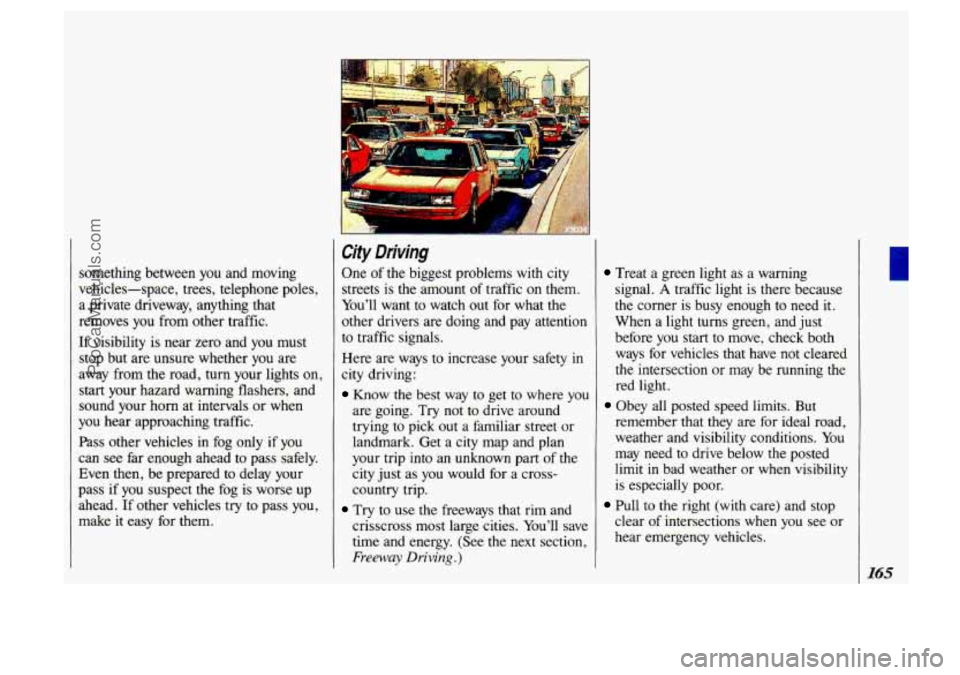
City Driving
One of the biggest problems with city
streets is the amount of traffic on them.
You’ll want to watch out for what the
other drivers are doing and pay attention
to traffic signals.
Here are ways to increase your safety
in
city driving:
Know the best way to get to where you
are going. Try not to drive around
trying
to pick out a familiar street or
landmark. Get a city map and plan
your trip into an unknown part of
the
city just as you would for a cross-
country trip.
Try to use the freeways that rim and
crisscross most large cities. You’ll save
time and energy. (See the next section,
Freeway Driving.)
Treat a green light as a warning
signal.
A traffic light is there because
the corner is busy enough to need it.
When a light turns green, and just
before you
start to move, check both
ways for vehicles that have not cleared
the intersection or may be running the
red light.
remember that
they are for ideal road,
weather and visibility conditions. You
may need
to drive below the posted
limit in bad weather or when visibility
is especially poor.
clear of intersections when you see
or
hear emergency vehicles.
Obey all posted speed limits. But
Pull to the right (with care) and stop
165
ProCarManuals.com
Page 169 of 323

If you are moving from an outside to a
center lane on a freeway having more
than two lanes, make sure another
vehicle isn’t about to move into the same spot. Look at the vehicles two lanes
over and watch for telltale signs:
turn
signals flashing, an increase in speed, or
moving toward the edge of the lane. Be
prepared
to delay your move.
Once you are moving on the freeway,
make certain you allow a reasonable
following distance. Expect
to move
slightly slower at night.
Leaving the Fkeeway
When you want to leave the freeway,
move to the proper lane well
in advance.
Dashing across lanes at the last minute
is dangerous.
If you miss your exit do
not, under any circumstances, stop and
back up. Drive on
to the next exit.
At each exit point is a deceleration lane.
Ideally it should be long enough for
you
to enter it at freeway speed (after
signaling, of course) and then do your
braking before moving onto the exit
ramp. Unfortunately, not
all deceleration
lanes are long enough-some are too
short for all the braking. Decide when
to start braking.
If you must brake on
the through lane, and if there is traffic
close behind you, you can allow a little extra time and flash your brake lights (in
addition to your
turn signal) as extra
warning that you are about
to slow
down and exit.
The exit ramp can be curved, sometimes
quite sharply. The exit speed is usually
posted. Reduce your speed according to your speedometer, not
to your sense of
motion. After driving for any distance at
higher speeds, you may tend to
think
you are going slower than you actually
are. For example,
40 mph (65 km/h)
might seem like only 20 mph (30 km/h).
Obviously, this could lead to serious
trouble on a ramp designed for
20 mph
(30 Mh)!
I67
ProCarManuals.com
Page 188 of 323

Problems on the Road
I
Hazard Warning Flashers
Your hazard warning flashers let you
warn others. They
also let police know
you have a problem. Your front and rear
turn signal lights will flash on and off.
But they won’t flash if you’re braking. Your
hazard warning flashers switch is
on the steering column below the
ignition switch. Press the button in to
make your front and rear turn signal
lights flash on and off.
Your hazard warning flashers work no
matter what position your key is in, and
even if the key isn’t in.
L
To turn off the flashers, pull out on the
collar.
When the hazard warning flashers are
on, your turn signals won’t work.
Other Warning Devices
If you carry reflective triangles, you can
set one up at the side of the road about
300 feet (100 m) behind your vehicle.
ProCarManuals.com
Page 237 of 323

3
F
3
1
;.1L V6: Adding Automatic Transaxle
Wid
_I
1800 V6: Adding Automatic
Pansaxle Fluid
Engine Coolant
The following explains your cooling
system and how to add coolant when it
is low.
If you have a problem with
engine overheating, see the
Index under
Engine Overheating.
The proper coolant for your Oldsmobile
will:
Give freezing protection down to
Give boiling protection up to 262°F
Protect against rust and corrosion.
Help keep the proper engine
Let the warning lights work as they
-34°F (-37°C).
(128” C).
temperature.
should.
What to Use:
Use a mixture of one-half clean water
(preferably distilled) and one-half
antifreeze that meets “GM Specification
1825M,” which won’t damage aluminum
parts. You can also use a recycled
coolant conforming to GM Specification 1825M with a complete coolant flush
and refdl. Use
GM Engine Coolant
Supplement (sealer) with any complete
coolant change. If you use these, you
don’t need to add anything else.
235
ProCarManuals.com
Page 315 of 323

Dome Lights ................... 89
Door Locks
............. .47.48. 54
Door. Power Sliding
......... .54. 111
Door. Sliding
................... 53
Driver Position .................. 25
Driving
....................... 139
AtNight
.................... 159
City
........................ 165
Controlling a Skid
............. 158
Defensively
.................. 144
Drunken
.................... 145
Freeway
.................... 166
Hill and Mountain
............ 170
In a Foreign Country
........... 218
In Fog. Mist and Haze
......... 164
In Rain
..................... 161
Long Distance
................ 168
Loss
of Control ............... 158
On Curves
................... 154
Passing
..................... 156
Through Deep Standing Water
.............. 63
Winter Driving
............... 173
With a Trailer
................ 181
Drunken Driving
............... 145
- .
Electric Outside Mirror Control ... 92
Electrical Equipment.
Adding
............. .63. 121. 263
Electronic Level Control
..... .99. 245
Emergencies. Braking in ......... 153
Emergencies on the Road
......... 185
Emergencies. Steering in
......... 155
Emergency Starting
............. 187
Emergency Towing
.............. 191
Engine Block Heater
........ .63. 229
Engine Coolant
....... .235. 269. 272
Engine Coolant Temperature Gage
............. 108
Engine Exhaust
.... .60. 71. 72. 111. 175. 181
Engine Identification
............ 263
Engine Oil
.................... 225
Additives
................... 229
Checking
& Adding ...... .225. 226
Disposing
of Used Oil ......... 230
Energy Conserving
............ 228
Pressure Gage
................ 106
Pressure Indicator
............ -106
Warning
.................... 230
When to Change
.............. 229
Engine Overheating
............. 195 Engine Specifications
............ 271
Engine. Starting
................. 61
Ethanol in Gasoline
............. 217
Exhaust
Dangerous Gas
Parking with the in
......... .60.71.72.111.175. 181
Engine Running
......... .70. 72
Expectant Mothers.
Use of
Safety Belts .................. 29
Expressway Driving
............. 166
Extender. Safety Belt
............. 42
Exterior Appearance (see
Appearance Care)
n
&bric Cleaning (see Appearance Care)
Fan Warnings ...... .188. 189. 197. 222
Filling
the Fuel Tank ............ 219
Filter Air Cleaner
............. .230. 271
Oil
.................... .229. 271
Finish Care
................... 259
Flashers. Hazard Warning
........ 186
Flat Tire
...................... 203
Flooded Engine
................. 62
313
ProCarManuals.com